Lithuanian
Lithuanian (lietuvių kalba, pronounced [lʲiəˈtʊvʲuː kɐɫˈbɐ]) is an East Baltic language belonging to the Baltic branch of the Indo-European language family. It is the language of Lithuanians and the official language of Lithuania as well as one of the official languages of the European Union. There are approximately 2.8 million native Lithuanian speakers in Lithuania and about 1.5 million speakers elsewhere. Around half a million inhabitants of Lithuania of non-Lithuanian background speak Lithuanian daily as a second language. Lithuanian is closely related to neighbouring Latvian, though the two languages are not mutually intelligible. It is written in a Latin script. Some linguists, in some aspects, consider it to be the most conservative of the existing Indo-European languages, retaining features of the Proto-Indo-European language that have otherwise been lost to more recent linguistic developments in the remainder of its descendant languages.
Translate in Lithuanian ↗Lithuanian is spoken mainly in Lithuania. It is also spoken by ethnic Lithuanians living in today's Belarus, Latvia, Poland, and the Kaliningrad Oblast of Russia, as well as by sizable emigrant communities in Argentina, Australia, Brazil, Canada, Denmark, Estonia, France, Germany, Iceland, Ireland, Norway, Russia, Sweden, the United Kingdom, the United States, Uruguay, and Spain. 2,955,200 people in Lithuania (including 3,460 Tatars), or about 86% of the 2015 population, are native Lithuanian speakers; most Lithuanian inhabitants of other nationalities also speak Lithuanian to some extent. The total worldwide Lithuanian-speaking population is about 3,200,000. Lithuanian is the state language of Lithuania and an official language of the European Union.
Europe
Present-day use
Lithuanian is the state language of Lithuania and an official language of the European Union.
Origins
The captured article does not contain a separate origins section. See the historical account and linked source.
Development
The captured article does not contain a distinct historical account. No chronology has been invented.
Writing
Lithuanian uses the Latin script supplemented with diacritics. It has 32 letters. In the collation order, y follows immediately after į (called i nosinė), because both y and į represent the same long vowel [iː]: In addition, the following digraphs are used, but are treated as sequences of two letters for collation purposes. The digraph ch represents a single sound, the velar fricative [x], while dz and dž are pronounced like straightforward combinations of their component letters (sounds): Dz dz [dz] (dzė), Dž dž [dʒ] (džė), Ch ch [x] (cha). The distinctive Lithuanian letter ė was used for the first time in the Daniel Klein's Grammatica Litvanica and firmly established itself in Lithuanian since then. However, linguist August Schleicher used ë (with two points above it) instead of ė for expressing the same. In the Grammatica Litvanica Klein also established the letter w for marking the sound [v], the use of which was later abolished in Lithuanian (it was replaced with v, notably by authors of the Varpas newspaper). The usage of v instead of w especially increased since the early 20th century, likely considerably influenced by Lithuanian press and schools. The Lithuanian writing system is largely phonemic, i.e., one letter usually corresponds to a single phoneme (sound). There are a few exceptions: for example, the letter i represents either the vowel [ɪ], as in English sit, or is silent and merely indicates that the preceding consonant is palatalized.
Beyond the typeface.
Signs, manuscripts, published pages and contextual photographs, with their place, period, source and reuse terms. Captions identify historical spellings, regional examples, community references and character imagery.
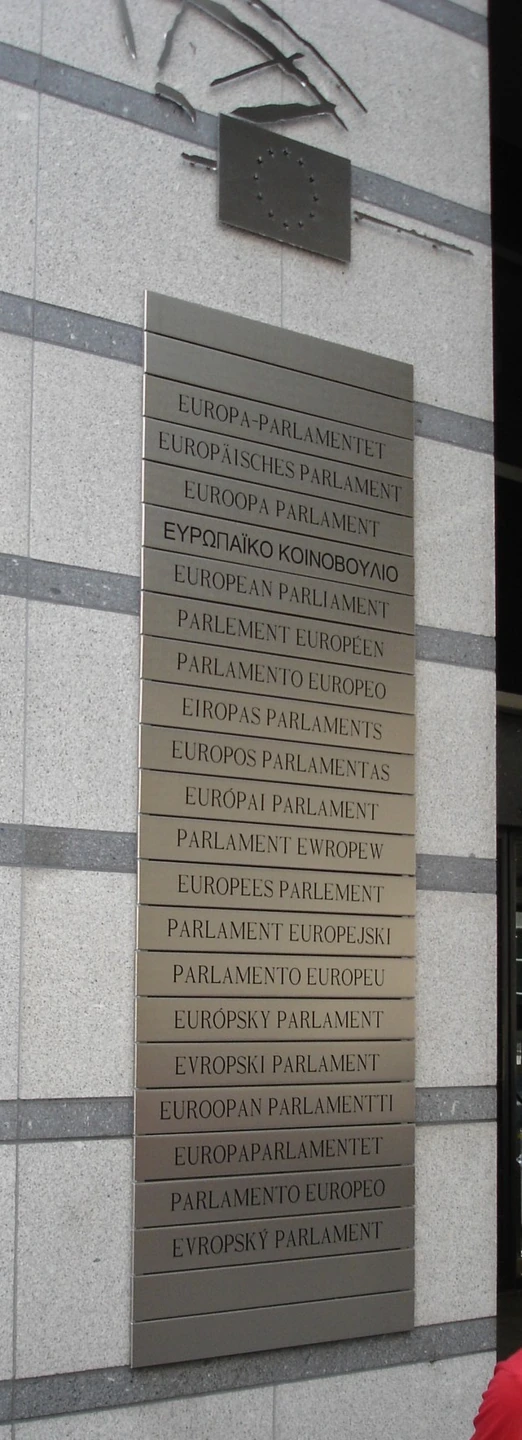
Lithuanian on a multilingual European Parliament sign, photographed in 2006. Language identification follows the source description; not independently transcribed.
Saved in Babelbook · resized display copy. Select the image to open it independently of its source.
Nuno Nogueira · Source ↗Public domain (author dedication) ↗View the local visual field note
Representative reference points from Glottolog. Historical entries show reference locations, not current speakers. 1 point.
Reference & context ↗Babelbook · original editorial illustration · CC BY 4.0 · Glottolog locations; public-domain Natural Earth land
Source excerpts, selected, shortened and where noted editorially corrected from Lithuanian language by Wikipedia contributors. Retrieved 2026-10-05. CC BY-SA 4.0. These excerpts are not an independently verified scholarly history; missing accounts are identified above.
Read further in the source
Geographic distribution
Lithuanian is spoken mainly in Lithuania. It is also spoken by ethnic Lithuanians living in today's Belarus, Latvia, Poland, and the Kaliningrad Oblast of Russia, as well as by sizable emigrant communities in Argentina, Australia, Brazil, Canada, Denmark, Estonia, France, Germany, Iceland, Ireland, Norway, Russia, Sweden, the United Kingdom, the United States, Uruguay, and Spain. 2,955,200 people in Lithuania (including 3,460 Tatars), or about 86% of the 2015 population, are native Lithuanian speakers; most Lithuanian inhabitants of other nationalities also speak Lithuanian to some extent. The total worldwide Lithuanian-speaking population is about 3,200,000.
Official status
Lithuanian is the state language of Lithuania and an official language of the European Union.
Dialects
In the Compendium Grammaticae Lithvanicae, published in 1673, three dialects of Lithuanian are distinguished: Samogitian dialect (Latin: Samogitiae) of Samogitia, Royal Lithuania (Latin: Lithvaniae Regalis) and Ducal Lithuania (Latin: Lithvaniae Ducalis). Ducal Lithuanian is described as pure (Latin: Pura), half-Samogitian (Latin: SemiSamogitizans) and having elements of Curonian (Latin: Curonizans). Authors of the Compendium Grammaticae Lithvanicae singled out that the Lithuanians of the Vilnius Region (Latin: in tractu Vilnensi) tend to speak harshly, almost like Austrians, Bavarians and others speak German in Germany. Due to the historical circumstances of Lithuania, Lithuanian-speaking territory was divided into Lithuania proper and Lithuania Minor, therefore, in the 16th–17th centuries, three regional variants of the common language emerged. Lithuanians in Lithuania Minor spoke Western Aukštaitian dialect with specifics of Įsrutis and Ragainė environs (e.g. works of Martynas Mažvydas, Jonas Bretkūnas, Jonas Rėza, and Daniel Klein's Grammatica Litvanica). The other two regional variants of the common language were formed in Lithuania proper: middle, which was based on the specifics of the Duchy of Samogitia (e.g. works of Mikalojus Daukša, Merkelis Petkevičius, Steponas Jaugelis‑Telega, Samuelis Boguslavas Chylinskis, and Mikołaj Rej's Lithuanian postil), and eastern, based on the specifics of Eastern Aukštaitians, living in Vilnius and its region (e.g. works of Konstantinas Sirvydas, Jonas Jaknavičius, and Robert Bellarmine's catechism). In Vilnius University, there are preserved texts written in the Lithuanian language of the Vilnius area, a dialect of Eastern Aukštaitian, which was spoken in a territory located south-eastwards from Vilnius: the sources are preserved in works of graduates from Stanislovas Rapolionis-based Lithuanian language schools, graduate Martynas Mažvydas and Rapalionis relative Abraomas Kulvietis. The development of Lithuanian in Lithuania Minor, especially in the 18th century, was successful due to many publications and research. In contrast, the development of Lithuanian in Lithuania proper was obstructed due to the Polonization of the Lithuanian nobility, especially in the 18th century, and it was being influenced by the Samogitian dialect. The Lithuanian-speaking population was also dramatically decreased by the Great Northern War plague outbreak in 1700–1721 which killed 49% of residents in the Grand Duchy of Lithuania (1/3 of residents in Lithuania proper and up to 1/2 of residents in Samogitia) and 53% of residents in Lithuania Minor (more than 90% of the deceased were Prussian Lithuanians). Since the 19th century to 1925 the amount of Lithuanian speakers in Lithuania Minor (excluding Klaipėda Region) decreased from 139,000 to 8,000 due to Germanisation and colonization.
As a result of a decrease in the usage of spoken Lithuanian in the eastern part of Lithuania proper, in the 19th century, it was suggested to create a standardized Lithuanian based on the Samogitian dialect. Nevertheless, it was not accomplished because everyone offered their Samogitian subdialects and the Eastern and Western Aukštaitians offered their Aukštaitian subdialects.
In the second half of the 19th century, when the Lithuanian National Revival intensified, and the preparations to publish a Lithuanian periodical press were taking place, the mostly south-western Aukštaitian revival writers did not use the 19th-century Lithuanian of Lithuania Minor as it was largely Germanized. Instead, they used a more pure Lithuanian language which has been described by August Schleicher and Friedrich Kurschat and this way the written language of Lithuania Minor was transferred to resurgent Lithuania. The most famous standardizer of the Lithuanian, Jonas Jablonskis, established the south-western Aukštaitian dialect, including the Eastern dialect of Lithuania Minor, as the basis of standardized Lithuanian in the 20th century, which led to him being nicknamed the father of standardized Lithuanian. According to Polish professor Jan Otrębski's article published in 1931, the Polish dialect in the Vilnius Region and in the northeastern areas in general are very interesting variant of the Polish language as this dialect developed in a foreign territory which was mostly inhabited by the Lithuanians who were Belarusized (mostly) or Polonized, and to prove this Otrębski provided examples of Lithuanianisms in the Tutejszy language. In 2015, Polish linguist Mirosław Jankowiak attested that many of the Vilnius Region's inhabitants who declare Polish nationality speak a Belarusian dialect which they call mowa prosta ('simple speech'). Currently, Lithuanian is divided into two dialects: Aukštaitian (Highland Lithuanian), and Samogitian (Lowland Lithuanian). There are significant differences between standard Lithuanian and Samogitian and these are often described as separate languages. The modern Samogitian dialect formed in the 13th–16th centuries under the influence of Curonian. Lithuanian dialects are closely connected with ethnographical regions of Lithuania. Even nowadays Aukštaitians and Samogitians can have considerable difficulties understanding each other if they speak with their dialects and not standard Lithuanian, which is mandatory to learn in the Lithuanian education system. Dialects are divided into subdialects. Both dialects have three subdialects. Samogitian is divided into West, North and South; Aukštaitian into West (Suvalkiečiai), South (Dzūkian) and East.
Orthography
Lithuanian uses the Latin script supplemented with diacritics. It has 32 letters. In the collation order, y follows immediately after į (called i nosinė), because both y and į represent the same long vowel [iː]:
In addition, the following digraphs are used, but are treated as sequences of two letters for collation purposes. The digraph ch represents a single sound, the velar fricative [x], while dz and dž are pronounced like straightforward combinations of their component letters (sounds): Dz dz [dz] (dzė), Dž dž [dʒ] (džė), Ch ch [x] (cha). The distinctive Lithuanian letter ė was used for the first time in the Daniel Klein's Grammatica Litvanica and firmly established itself in Lithuanian since then. However, linguist August Schleicher used ë (with two points above it) instead of ė for expressing the same. In the Grammatica Litvanica Klein also established the letter w for marking the sound [v], the use of which was later abolished in Lithuanian (it was replaced with v, notably by authors of the Varpas newspaper). The usage of v instead of w especially increased since the early 20th century, likely considerably influenced by Lithuanian press and schools.
The Lithuanian writing system is largely phonemic, i.e., one letter usually corresponds to a single phoneme (sound). There are a few exceptions: for example, the letter i represents either the vowel [ɪ], as in English sit, or is silent and merely indicates that the preceding consonant is palatalized. The latter is largely the case when i occurs after a consonant and is followed by a back or a central vowel, except in some borrowed words (e.g., the first consonant in lūpa [ˈɫûːpɐ], "lip", is a velarized dental lateral approximant; on the other hand, the first consonant in liūtas [ˈlʲuːt̪ɐs̪], "lion", is a palatalized alveolar lateral approximant; both consonants are followed by the same vowel, the long [uː], and no [ɪ] can be pronounced in liūtas).
Due to Polish influence, the Lithuanian alphabet included sz, cz and the Polish Ł for the first sound and regular L (without a following i) for the second: łupa, lutas. During the Lithuanian National Revival in the 19th century the Polish Ł was abolished, while digraphs sz, cz (that are also common in the Polish orthography) were replaced with š and č from the Czech orthography, formally because they were shorter. Nevertheless, another argument to abolish sz and cz was to distinguish Lithuanian from Polish. The new letters š and č were cautiously used in publications intended for more educated readers (e.g. Varpas, Tėvynės sargas, Ūkininkas), however sz and cz continued to be in use in publications intended for less educated readers as they caused tension in society and prevailed only after 1906. The Lithuanians also adopted the letter ž from the Czechs. The nasal vowels ą and ę were taken from the Polish spelling and began to be used by Lithuanian writers in Renaissance, later the Lithuanians introduced the nasal vowels į and ų as analogues. The letter ū is the latest addition by linguist Jonas Jablonskis. A macron (on ū), an ogonek (on ą, ę, į, and ų), a dot (on ė), and y (in place of i) are used for grammatical and historical reasons and always denote vowel length in Modern Standard Lithuanian. Acute, grave, and tilde diacritics are used to indicate pitch accents. However, these pitch accents are generally not written, except in dictionaries, grammars, and where needed for clarity, such as to differentiate homonyms and dialectal use.