Latvian
Latvian (latviešu valoda, IPA: [ˈlatviɛʃu ˈvaluɔda]), also known as Lettish, is an East Baltic language belonging to the Indo-European language family. It is spoken in the Baltic region, and is the language of the Latvians. It is the official language of Latvia as well as one of the official languages of the European Union. There are about 1.5 million native Latvian speakers in Latvia and 100,000 abroad. Of those, around 1.16 million or 62% of Latvia's population used it as their primary language at home, though excluding the Latgale and Riga regions it is spoken as a native language in villages and towns by over 90% of the population. As a Baltic language, Latvian is most closely related to neighbouring Lithuanian (as well as Old Prussian, an extinct Baltic language); however, Latvian has developed in different directions. In addition, there is some disagreement whether Standard Latgalian and Kursenieki, which are mutually intelligible with Latvian, should be considered varieties or separate languages. Latvian first appeared in print in the mid-16th century with the reproduction of the Lord's Prayer in Latvian in Sebastian Münster's Cosmographia universalis (1544), in the Latin script.
Translate in Latvian ↗The history of the Latvian language (see below) has placed it in a peculiar position for a language of its size, whereby many non-native speakers speak it compared to native speakers. The immigrant and minority population in Latvia is 700,000 people: Russians, Belarusians, Ukrainians, Poles, and others. The majority of immigrants settled in Latvia between 1940 and 1991; supplementing pre-existing ethnic minority communities (Latvian Germans, Latvian Jews, Latvian Russians). The trends show that the proficiency of Latvian among its non-native speakers is gradually increasing. In a 2009 survey by the Latvian Language Agency 56% percent of respondents with Russian as their native language described having a good knowledge of Latvian, whereas for the younger generation (from 17 to 25 years) the number was 64%. The increased adoption of Latvian by minorities was brought about by its status as the country's only official language and other changes in the society after the fall of the Soviet Union that mostly shifted linguistic focus away from Russian. As an example, in 2007, universities and colleges for the first time received applications from prospective students who had a bilingual secondary education in schools for minorities. Fluency in Latvian is expected in a variety of professions and careers.
Europe
Present-day use
The captured source does not contain a separate current-use account.
Origins
According to some glottochronological speculations, the East Baltic languages split from West Baltic (or, perhaps, from the hypothetical proto-Baltic language) between 400 and 600 CE. The differentiation between Lithuanian and Latvian started after 800 CE. At a minimum, transitional dialects existed until the 14th century or 15th century, and perhaps as late as the 17th century. Latvian as a distinct language emerged over several centuries from the language spoken by the ancient Latgalians assimilating the languages of other neighbouring Baltic tribes—Curonian, Semigallian, and Selonian—which resulted in these languages gradually losing their most distinct characteristics. This process of consolidation started in the 13th century after the Livonian Crusade and forced Christianisation, which formed a unified political, economic, and religious space in Medieval Livonia.
Development
The first Latvian dictionary Lettus compiled by Georg Mancelius was published in 1638. The first grammar of the Latvian language is a short “Manual on the Latvian language” (Latin: Manuductio ad linguam lettonicam) by Johans Georgs Rehehūzens, published in 1644 in Riga.
Writing
Latvian in Latin script was first based upon the German orthography, while the alphabet of the Standard Latgalian variety was based on the Polish orthography. At the beginning of the 20th century, it was replaced by a more phonologically consistent orthography. Today, the Latvian standard orthography employs 33 characters: The modern standard Latvian alphabet uses 22 unmodified letters of the Latin alphabet (all except ⟨q, w, x, y⟩, which are usually replaced by ⟨k(v)⟩, ⟨v⟩, ⟨ks⟩, and ⟨i/j⟩ respectively in loanwords and even in foreign names, though they may appear in certain specialized terms such as status quo; "W" can be found in older texts, "Y" can be found in the Latgalian language/dialect). It adds a further eleven characters by modification. The vowel letters ⟨a⟩, ⟨e⟩, ⟨i⟩ and ⟨u⟩ can take a macron to show length, unmodified letters being short; these letters are not differentiated while sorting (e.g. in dictionaries). The letters ⟨c⟩, ⟨s⟩ and ⟨z⟩ are pronounced [ts], [s] and [z] respectively, while when marked with a caron, ⟨č, š, ž⟩, they are pronounced [tʃ], [ʃ] and [ʒ] respectively. The letters ⟨ģ, ķ, ļ, ņ⟩, written with a comma placed underneath (or above them for lowercase g), which indicate palatalized versions of ⟨g, k, l, n⟩ representing the sounds [ɟ], [c], [ʎ] and [ɲ]. Latvian orthography also contains nine digraphs, which are written ⟨ai, au, ei, ie, iu, ui, oi, dz, dž⟩. Non-standard varieties of Latvian add extra letters to this standard set. Latvian spelling has almost one-to-one correspondence between graphemes and phonemes. Every phoneme corresponds to a letter so that the reader can almost always pronounce words by putting the letters together. There are only two exceptions to this consistency in the orthography: the letters ⟨e⟩ and ⟨ē⟩ represent two sounds each, the first showing /ɛ/ and /æ/, the second showing /ɛː/ and /æː/.
Beyond the typeface.
Signs, manuscripts, published pages and contextual photographs, with their place, period, source and reuse terms. Captions identify historical spellings, regional examples, community references and character imagery.
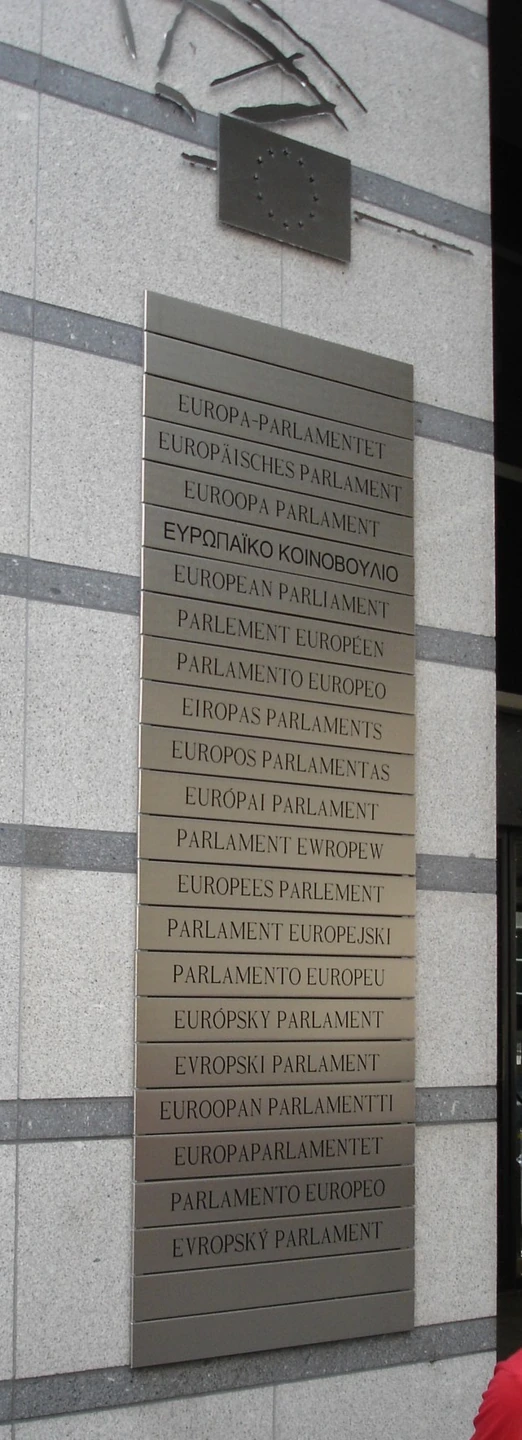
Latvian on a multilingual European Parliament sign, photographed in 2006. Language identification follows the source description; not independently transcribed.
Saved in Babelbook · resized display copy. Select the image to open it independently of its source.
Nuno Nogueira · Source ↗Public domain (author dedication) ↗View the local visual field note
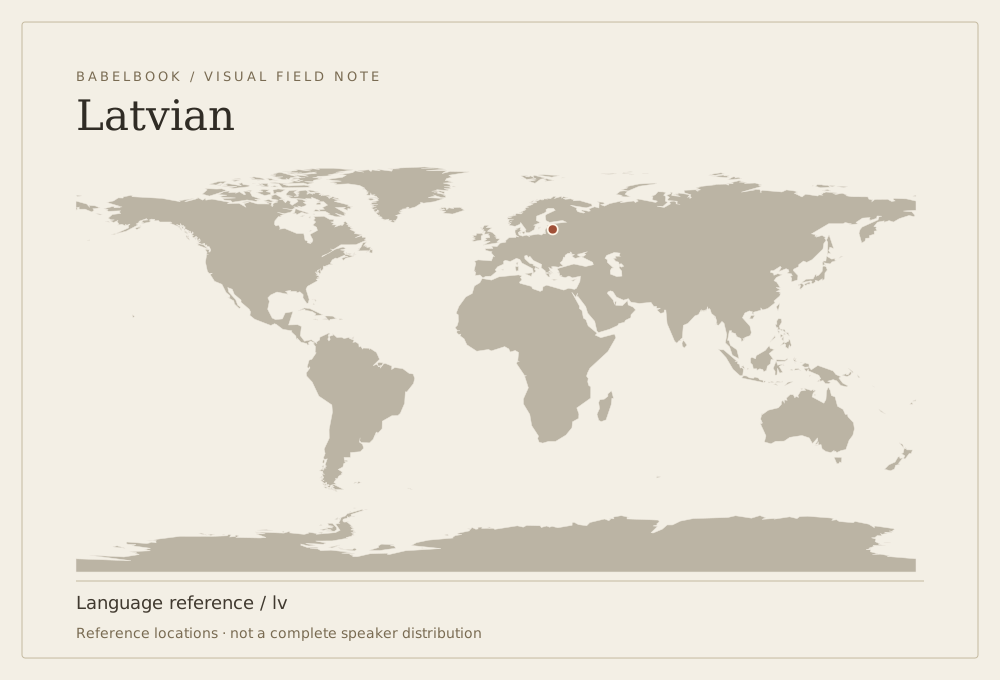
Representative reference points from Glottolog. Historical entries show reference locations, not current speakers. 1 point.
Reference & context ↗Babelbook · original editorial illustration · CC BY 4.0 · Glottolog locations; public-domain Natural Earth land
Source excerpts, selected, shortened and where noted editorially corrected from Latvian language by Wikipedia contributors. Retrieved 2026-10-05. CC BY-SA 4.0. These excerpts are not an independently verified scholarly history; missing accounts are identified above.
Read further in the source
Origins
According to some glottochronological speculations, the East Baltic languages split from West Baltic (or, perhaps, from the hypothetical proto-Baltic language) between 400 and 600 CE. The differentiation between Lithuanian and Latvian started after 800 CE. At a minimum, transitional dialects existed until the 14th century or 15th century, and perhaps as late as the 17th century. Latvian as a distinct language emerged over several centuries from the language spoken by the ancient Latgalians assimilating the languages of other neighbouring Baltic tribes—Curonian, Semigallian, and Selonian—which resulted in these languages gradually losing their most distinct characteristics. This process of consolidation started in the 13th century after the Livonian Crusade and forced Christianisation, which formed a unified political, economic, and religious space in Medieval Livonia.
Dialects
There are three dialects in Latvian: the Livonic dialect, High Latvian and the Central dialect. Latvian dialects and their varieties should not be confused with the Livonian, Curonian, Semigallian and Selonian languages.
Livonic dialect
The Livonic dialect (also called Tamian or tāmnieku) of Latvian was more affected by the Livonian language substratum than Latvian in other parts of Latvia. It is divided into the Vidzeme variety and the Courland variety (also called tāmnieku). There are two syllable intonations in the Livonic dialect, extended and broken. In the Livonic dialect, short vowels at the end of words are discarded, while long vowels are shortened. In all numbers, only one form of the verb is used. Due to migration and the introduction of a standardised language, this dialect has declined. It arose from assimilated Livonians, who started to speak in Latvian.
Central dialect
The Central dialect spoken in central and Southwestern Latvia is the basis of standard Latvian. The dialect is divided into the Vidzeme variety, the Curonic variety and the Semigallic variety. The Vidzeme variety and the Semigallic variety are closer to each other than to the Curonic variety, which is more archaic than the other two. There are three syllable intonations in some parts of Vidzeme variety of the Central dialect, extended, broken and falling. The Curonic and Semigallic varieties have two syllable intonations, extended and broken, but some parts of the Vidzeme variety have extended and falling intonations. In the Curonic variety, ŗ is still used. The Kursenieki language, a historic variety of Latvian, which used to be spoken along Curonian Spit, is closely related to the varieties of the Central dialect spoken in Courland.
High Latvian dialect
High Latvian dialect is spoken in Eastern Latvia. It is set apart from the rest of the Latvian by a number of phonological differences. The dialect has two main varieties – Selonic (two syllable intonations, falling and rising) and Non-Selonic (falling and broken syllable intonations). There is a standard language, i.e., the Standard Latgalian, another historic variety of Latvian, which is based on deep non-Selonic varieties spoken in the south of Latgale. The term "Latgalic" is sometimes also applied to all non-Selonic varieties or even the whole dialect. However, it is unclear if using the term for any varieties besides the standard language is accurate. While the term may refer to varieties spoken in Latgale or by Latgalians, not all speakers identify as speaking Latgalic; for example, speakers of deep Non-Selonic varieties in Vidzeme explicitly deny speaking Latgalic. It is spoken by approximately 15% of Latvia's population, but almost all of its speakers are also fluent in the standard Latvian language and they promote the dialect in popular culture in order to preserve their distinct culture. The Latvian Government since 1990 has also taken measures to protect the dialect from extinction.
Non-native speakers
The history of the Latvian language (see below) has placed it in a peculiar position for a language of its size, whereby many non-native speakers speak it compared to native speakers. The immigrant and minority population in Latvia is 700,000 people: Russians, Belarusians, Ukrainians, Poles, and others. The majority of immigrants settled in Latvia between 1940 and 1991; supplementing pre-existing ethnic minority communities (Latvian Germans, Latvian Jews, Latvian Russians). The trends show that the proficiency of Latvian among its non-native speakers is gradually increasing. In a 2009 survey by the Latvian Language Agency 56% percent of respondents with Russian as their native language described having a good knowledge of Latvian, whereas for the younger generation (from 17 to 25 years) the number was 64%. The increased adoption of Latvian by minorities was brought about by its status as the country's only official language and other changes in the society after the fall of the Soviet Union that mostly shifted linguistic focus away from Russian. As an example, in 2007, universities and colleges for the first time received applications from prospective students who had a bilingual secondary education in schools for minorities. Fluency in Latvian is expected in a variety of professions and careers.
Orthography
Latvian in Latin script was first based upon the German orthography, while the alphabet of the Standard Latgalian variety was based on the Polish orthography. At the beginning of the 20th century, it was replaced by a more phonologically consistent orthography.
Standard orthography
Today, the Latvian standard orthography employs 33 characters:
The modern standard Latvian alphabet uses 22 unmodified letters of the Latin alphabet (all except ⟨q, w, x, y⟩, which are usually replaced by ⟨k(v)⟩, ⟨v⟩, ⟨ks⟩, and ⟨i/j⟩ respectively in loanwords and even in foreign names, though they may appear in certain specialized terms such as status quo; "W" can be found in older texts, "Y" can be found in the Latgalian language/dialect). It adds a further eleven characters by modification. The vowel letters ⟨a⟩, ⟨e⟩, ⟨i⟩ and ⟨u⟩ can take a macron to show length, unmodified letters being short; these letters are not differentiated while sorting (e.g. in dictionaries). The letters ⟨c⟩, ⟨s⟩ and ⟨z⟩ are pronounced [ts], [s] and [z] respectively, while when marked with a caron, ⟨č, š, ž⟩, they are pronounced [tʃ], [ʃ] and [ʒ] respectively. The letters ⟨ģ, ķ, ļ, ņ⟩, written with a comma placed underneath (or above them for lowercase g), which indicate palatalized versions of ⟨g, k, l, n⟩ representing the sounds [ɟ], [c], [ʎ] and [ɲ]. Latvian orthography also contains nine digraphs, which are written ⟨ai, au, ei, ie, iu, ui, oi, dz, dž⟩. Non-standard varieties of Latvian add extra letters to this standard set. Latvian spelling has almost one-to-one correspondence between graphemes and phonemes. Every phoneme corresponds to a letter so that the reader can almost always pronounce words by putting the letters together. There are only two exceptions to this consistency in the orthography: the letters ⟨e⟩ and ⟨ē⟩ represent two sounds each, the first showing /ɛ/ and /æ/, the second showing /ɛː/ and /æː/. The second mismatch is that the letter ⟨o⟩ is used for three different sounds: the short [ɔ], the long [ɔ], and the diphthong [uɔ]. In Standard Latgalian these three sounds are written as ⟨o⟩, ⟨ō⟩ and ⟨uo⟩, and some Latvians campaign for the adoption of this system in standard Latvian. However, Latvian grammarians argue that ⟨o⟩ and ⟨ō⟩ are found only in loanwords, making /uɔ/ the only native Latvian phoneme among the three. The digraph ⟨uo⟩ was discarded in 1914, and the letters ⟨ō⟩ and ⟨ŗ⟩ have not been used in the official Latvian language since 1946. Likewise, the digraph ⟨ch⟩ was discarded in 1957. However, ⟨ō⟩, ⟨ŗ⟩, and ⟨ch⟩ are still used in some varieties, and by many Latvians living beyond the borders of Latvia. The letter ⟨y⟩ is used only in Standard Latgalian, where it represents /ɨ/, a sound not present in other dialects.
Old orthography
The old orthography was based on German and did not represent the Latvian language phonemically. Initially, it was used to write religious texts for German priests to help them in their work with Latvians. The first writings in Latvian were chaotic: twelve variations for writing Š existed, for example. In 1631 the German priest Georg Mancelius tried to systematize the writing. He wrote long vowels according to their position in the word – a short vowel followed by h for a radical vowel, a short vowel in the suffix, and vowel with a diacritic mark in the ending indicating two accents. Consonants were written using multiple letters following the example of German. The old orthography was used until the 20th century when modern orthography slowly replaced it.
Comparative orthography
For example, the Lord's Prayer in Latvian written in different styles:
History of the study
The first Latvian dictionary Lettus compiled by Georg Mancelius was published in 1638. The first grammar of the Latvian language is a short “Manual on the Latvian language” (Latin: Manuductio ad linguam lettonicam) by Johans Georgs Rehehūzens, published in 1644 in Riga.