Marshallese
Marshallese (Marshallese: Kajin Ṃajeḷ or Kajin Majōl [kɑzʲinʲ(i)mˠɑːzʲɛlˠ]), also known as Ebon, is a Micronesian language spoken in the Marshall Islands. The language of the Marshallese people, it is spoken by nearly all of the country's population of 59,000, making it the principal language. There are also roughly 27,000 Marshallese citizens residing in the United States, nearly all of whom speak Marshallese, as well as residents in other countries such as Nauru and Kiribati. There are two major dialects, the western Rālik and the eastern Ratak.
Translate in Marshallese ↗Marshallese is the official language of the Marshall Islands and enjoys vigorous use. As of 1979, the language was spoken by 43,900 people in the Marshall Islands. In 2020, the number was closer to 59,000. Additional groups of speakers in other countries including Nauru and the United States increase the total number of Marshallese speakers, with approximately 27,000 Marshallese-Americans living in the United States. Along with Pohnpeian and Chuukese, Marshallese stands out among Micronesian languages in having tens of thousands of speakers; most Micronesian languages have far fewer. A dictionary and at least two Bible translations have been published in Marshallese.
Oceania
Present-day use
Marshallese is the official language of the Marshall Islands and enjoys vigorous use. As of 1979, the language was spoken by 43,900 people in the Marshall Islands. In 2020, the number was closer to 59,000. Additional groups of speakers in other countries including Nauru and the United States increase the total number of Marshallese speakers, with approximately 27,000 Marshallese-Americans living in the United States. Along with Pohnpeian and Chuukese, Marshallese stands out among Micronesian languages in having tens of thousands of speakers; most Micronesian languages have far fewer. A dictionary and at least two Bible translations have been published in Marshallese. Here is the Hail Mary in standard Marshallese orthography: Iọkwe eok Maria, kwo lōñ kōn menin jouj; Irooj ej pād ippaṃ. Kwo jeraṃṃan iaan kōrā raṇ im ejeraṃṃan ineen lọjiōṃ, Jesus. O Maria kwojarjar, jinen Anij, kwōn jar kōn kem rijjerawiwi. Kiiō im ilo iien amwōj mej. Amen.
Origins
The captured article does not contain a separate origins section. See the historical account and linked source.
Development
The captured article does not contain a distinct historical account. No chronology has been invented.
Writing
Marshallese is written in the Latin alphabet. There are two competing orthographies. The "old" orthography was introduced by missionaries. This system is not highly consistent or faithful in representing the sounds of Marshallese, but until recently, it had no competing orthography. It is currently widely used, including in newspapers and signs. The "new" orthography is gaining popularity especially in schools and among young adults and children. The "new" orthography represents the sounds of the Marshallese language more faithfully and is the system used in the Marshallese–English dictionary by Abo et al. The current alphabet, as promoted by the Republic of the Marshall Islands, consists of 24 letters. Marshallese spelling is based on pronunciation rather than a phonemic analysis. Therefore, backness is marked in vowels despite being allophonic (it does not change the meaning), and many instances of the glides /j ɰ w/ proposed on the phonemic level are unwritten, because they do not surface as consonants phonetically. In particular, the glide /ɰ/, which never surfaces as a consonant phonetically, is always unwritten. The letter w is generally used only in three situations: To mark a rounded consonant (one of kw ḷw ṇw ñw rw) or approximant phoneme (w) before a vowel that precedes an unrounded consonant phoneme (a ā e i ō ū).
Beyond the typeface.
Signs, manuscripts, published pages and contextual photographs, with their place, period, source and reuse terms. Captions identify historical spellings, regional examples, community references and character imagery.
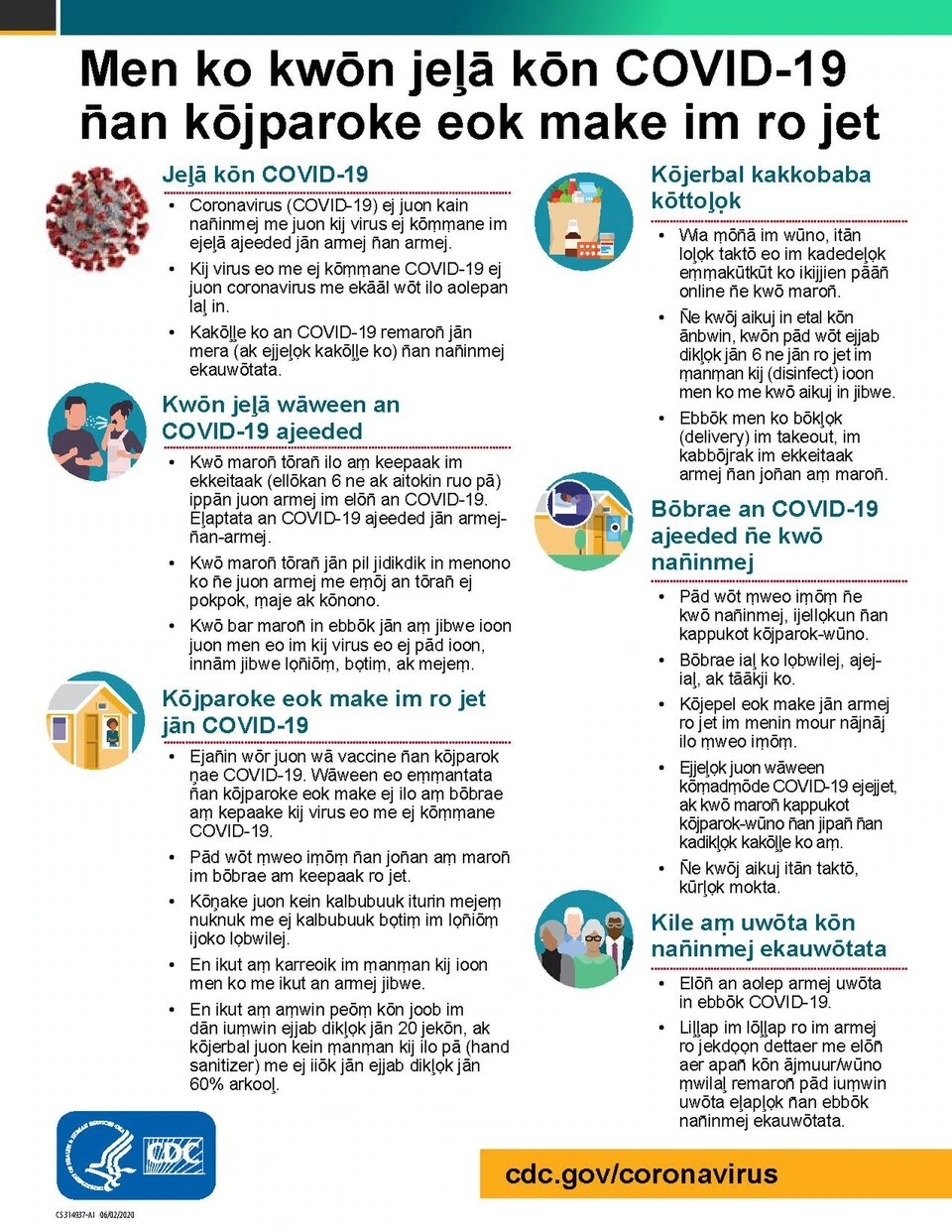
A Marshallese-language CDC public information document from 2020, shown as a historical example of language in public use.
Saved in Babelbook · resized display copy. Select the image to open it independently of its source.
U.S. Centers for Disease Control and Prevention · Source ↗Public domain (U.S. government) ↗View the local visual field note
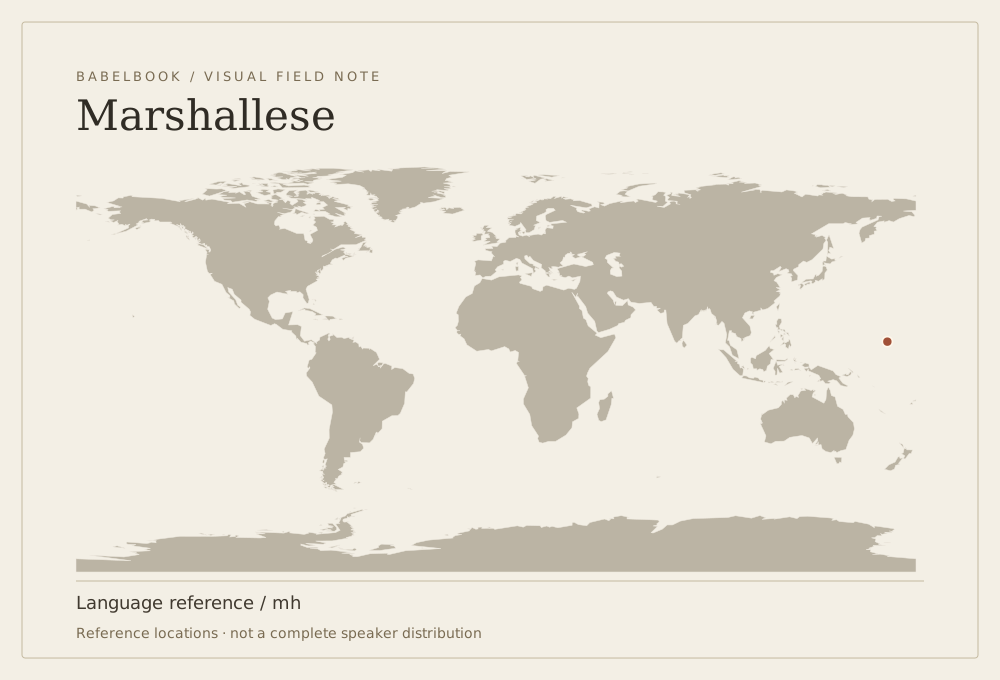
Representative reference points from Glottolog. Historical entries show reference locations, not current speakers. 1 point.
Reference & context ↗Babelbook · original editorial illustration · CC BY 4.0 · Glottolog locations; public-domain Natural Earth land
Source excerpts, selected, shortened and where noted editorially corrected from Marshallese language by Wikipedia contributors. Retrieved 2026-10-05. CC BY-SA 4.0. These excerpts are not an independently verified scholarly history; missing accounts are identified above.
Read further in the source
Status
Marshallese is the official language of the Marshall Islands and enjoys vigorous use. As of 1979, the language was spoken by 43,900 people in the Marshall Islands. In 2020, the number was closer to 59,000. Additional groups of speakers in other countries including Nauru and the United States increase the total number of Marshallese speakers, with approximately 27,000 Marshallese-Americans living in the United States. Along with Pohnpeian and Chuukese, Marshallese stands out among Micronesian languages in having tens of thousands of speakers; most Micronesian languages have far fewer. A dictionary and at least two Bible translations have been published in Marshallese.
Orthography
Marshallese is written in the Latin alphabet. There are two competing orthographies. The "old" orthography was introduced by missionaries. This system is not highly consistent or faithful in representing the sounds of Marshallese, but until recently, it had no competing orthography. It is currently widely used, including in newspapers and signs. The "new" orthography is gaining popularity especially in schools and among young adults and children. The "new" orthography represents the sounds of the Marshallese language more faithfully and is the system used in the Marshallese–English dictionary by Abo et al. The current alphabet, as promoted by the Republic of the Marshall Islands, consists of 24 letters.
Marshallese spelling is based on pronunciation rather than a phonemic analysis. Therefore, backness is marked in vowels despite being allophonic (it does not change the meaning), and many instances of the glides /j ɰ w/ proposed on the phonemic level are unwritten, because they do not surface as consonants phonetically. In particular, the glide /ɰ/, which never surfaces as a consonant phonetically, is always unwritten. The letter w is generally used only in three situations:
To mark a rounded consonant (one of kw ḷw ṇw ñw rw) or approximant phoneme (w) before a vowel that precedes an unrounded consonant phoneme (a ā e i ō ū). Even then, if the consonant phoneme comes after a back rounded vowel ọ o u and before another vowel, it is common to write one of ḷ ṇ r instead of ḷw ṇw rw, but the rounded dorsal consonants kw ñw are still written with w in these circumstances. To mark a velarized bilabial consonant (either bw or ṃw) before a vowel that precedes a palatalized consonant phoneme (ā e i). To indicate a [w] glide phonetically surfacing either word-initially or between two vowels. w is never written out word-finally or before another consonant.
Kuwajleen / Kuajleen [kʷuwɑzʲɛ̆lʲɛːnʲ] "Kwajalein". The palatal glide phoneme /j/ may also be written out but only as e before one of a o ō ọ, or as i before one of either u ū. The approximant is never written before any of ā e i. A stronger raised palatal glide [i̯], phonemically analyzed as the exotic un-syllabic consonant-vowel-consonant sequence /ji̯j/ rather than plain /j/, may occur word-initially before any vowel and is written i. For historical reasons, certain words like iọkwe may be written as yokwe with a y, which does not otherwise exist in the Marshallese alphabet. One source of orthographic variation is in the representation of vowels. Pure monophthongs are written consistently based on vowel quality. However, short diphthongs may often be written with one of the two vowel sounds that they contain. (Alternate phonetic realizations for the same phonemic sequences are provided purely for illustrative purposes.)
wōtōm / otem [wɤdˠɤmʲ ~ o͜ɤdˠɤ͜emʲ ~ odˠemʲ] "all; every". Modern orthography has a bias in certain spelling choices in which both possibilities are equally clear between two non-approximant consonants.
a is preferred over ā. ḷap [lˠɑpʲ ~ lˠɑ͜æpʲ ~ lˠæpʲ] "big", not *ḷāp i is preferred over ū. dik [rʲik ~ rʲi͜ɯk ~ rʲɯk] "small", not *dūk Historically, both ō and e have been common and sometimes interchangeable. It is still true today with some words. In the new orthography, ō is generally preferred over e in most such situations. aelōñ [ɑelʲɤŋ ~ ɑelʲe͜ɤŋ ~ ɑelʲeŋ] "atoll; island; land", not *aeleñ Epatōn [ɛbʲɑdˠʌnʲ ~ ɛbʲæ͜ɑdˠʌ͜ɛnʲ] "Ebadon", not *Epaten Kūrijṃōj [kɯrˠizʲĭmˠɤtʲ ~ kɯrˠɯ͜izʲĭ͜ɯ̆mˠɤ͜etʲ] "Christmas", not *Kūrijṃej Nōḷ [nʲʌlˠ ~ nʲɛ͜ʌlˠ ~ nʲɛlˠ] "Nell", not *Neḷ However, after one of d j m p and before one of unrounded b k ḷ ṃ ṇ ñ r t, the spelling e is preferred over ō. pinjeḷ [pʲinzʲɛlˠ ~ pʲinzʲɛ͜ʌlˠ ~ pʲinzʲʌlˠ] "pencil", not *pinjōḷ For the name of the Marshall Islands, the new orthography prefers e, but the spelling with ō is still found. Ṃajeḷ or Ṃajōḷ [mˠɑːzʲɛlˠ ~ mˠɑːzʲɛ͜ʌlˠ ~ mˠɑːzʲʌlˠ], "Marshall Islands" In a syllable whose first consonant is rounded and whose second consonant is palatalized, it is common to see the vowel between them written as one of a ō ū, usually associated with a neighboring velarized consonant:
Ọkwōj [ɒɡʷʌtʲ ~ ɒɡʷɔ͜ɛtʲ] "August". Wūjlañ [wɯzʲĭlʲɑŋ ~ u͜izʲĭlʲæ͜ɑŋ ~ uzʲĭlʲɑŋ] "Ujelang". The exception is long vowels and long diphthongs made up of two mora units, which are written with the vowel quality closer to the phonetic nucleus of the long syllable:
jouj [tʲoutʲ] "kindness". naaj [nʲɑːtʲ] "will be". tāākji [tˠæːɡĭzʲi] "taxicab". If the syllable is phonetically open, the vowel written is usually the second vowel in the diphthong: the word bwe [pˠɛ] is usually not written any other way, but exceptions exist such as aelōñ (/ɰajɘlʲɘŋ/ [ɑelʲɤŋ] "land; country; island; atoll"), which is preferred over *āelōñ because the a spelling emphasizes that the first (unwritten) glide phoneme is dorsal rather than palatal. The spelling of grammatical affixes, such as ri- (/rˠi-/) and -in (/-inʲ/) is less variable despite the fact that their vowels become diphthongs with second member dependent on the preceding/following consonant: the prefix ri- may be pronounced as any of [rˠɯ͜i, rˠɯ, rˠɯ͜u] depending on the stem. The term Ri-Ṃajeḷ ("Marshallese people") is actually pronounced [rˠɯmˠɑːzʲɛlˠ] as if it were Rūṃajeḷ.
Differences in orthography
The old orthography was still very similar to the new orthography but made fewer phonological distinctions in spelling than the new orthography does. The new orthography attempts phonological consistency while adhering to most of the spelling patterns of the old orthography, especially in regard to vowels and w. It has made the new orthography relatively easy for old orthography users to learn. The phonology of Marshallese was documented by Bender (1969) with written examples using the old orthography. Here are some differences between the new and old orthographies:
The new orthography uses the cedillaed letters ḷ ṃ ṇ ọ. The old orthography did not use cedillas and ambiguously wrote them l m n o. The new orthography uses p for "light" /pʲ/ and b for "heavy" /pˠ/. The old orthography used b for both. Compare old binjel vs. new pinjeḷ [pʲinzʲɛlˠ], 'pencil'. The new orthography consistently uses d for "light" /rʲ/ in all positions. The old orthography often wrote dr before vowels, and r after vowels. Compare old Amerka vs. new Amedka [ɑmʲɛrʲɛ̆ɡɑ], 'United States'. Compare old indreo or indrio vs. new indeeo [inrʲeːɔ], 'forever'. Except in certain affixes like -an whose spelling may be fixed, the new orthography spells the vowel monophthong allophone [æ] as ā in all positions. The old orthography had ā, but it was relatively less common, and [æ] was sometimes written e instead. Compare old Ebeje vs. new Epjā [ɛbʲɛ̆zʲæ], 'Ebeye'. Except in certain affixes like ri- whose the spelling of the vowels may be fixed, the new orthography spells the vowel monophthong allophone [ɯ] as ū in all positions. The old orthography spelled [ɯ] as i between consonants. Compare old Kirijmōj vs. new Kūrijṃōj [kɯrˠizʲĭmˠɤtʲ], 'Christmas'. The new orthography uses only e o ō for allophones of the vowel phoneme /e/. In the old orthography, some words used e o ō, but other words used i u (ū) instead. Compare old ailiñ vs. new aelōñ [ɑelʲɤŋ ~ ɑelʲeŋ], 'land'. The new orthography uses the letter ọ for the vowel monophthong allophone [ɒ] along with many of its related diphthong allophones. The old orthography spelt [ɒ] as a between consonants but o at the ends of words. Compare old iakwe vs. new iọkwe [i̯ɒɡʷɛ], 'hello; good bye; love'. Compare old mo vs. new mọ [mʲɒ], 'taboo'. The new orthography tries to consistently write long vowels and geminated consonants with double letters. The old orthography habitually wrote these as single letters. Compare old ekatak vs. new ekkatak [ɛkːɑdˠɑk], 'study'. Compare old jab vs. new jaab [tʲɑːpˠ], 'no'. The word iọkwe [i̯ɒɡʷɛ] ('hello; goodbye; love') and the phrase iọkwe eok [i̯ɒɡʷɛe̯okʷ] ('hello [to you]') are a special case. The new orthography's rules use iọkwe eok, while the old orthography's rules used iakwe iuk. However, yokwe yuk has been historically more entrenched in both orthographies, but the letter y does not exist in the normal spelling rules of either orthography. That spelling has multilingual significance as well; yokwe (yuk) /ˈjɒkweɪ (ˈjʊk)/ is also the established spelling for the greeting when used in Marshallese-influenced English and by anglophones in the Marshall Islands.
Bender's orthography
In his 1968 publication Marshallese Phonology, linguist Byron W. Bender designed a purely morphophonemic orthography, based on the symbols found on a manual typewriter, with regular reflexes between the dialects and intended for use in dictionaries and language teaching. Besides also appearing in his 1969 tutorial Spoken Marshallese, it appeared in a modified form alongside the "new" orthography in the 1976 Marshallese-English Dictionary (MED) to which he contributed. Bender later collaborated with Stephen Trussel when the MED was adapted to website format as the Marshallese-English Online Dictionary (MOD), with Bender's orthography appearing in an again-modified form.
The MOD's version of Bender's orthography uses under-dot diacritics instead of the cedillas used both by the "new" orthography and by the 1976 MED's version of Bender's orthography, for reasons specific to the MOD's display issues. In addition to plain sequences of phonemes, Bender's orthography recognizes a few special sequences, many of which relate to regular differences between the Rālik and Ratak dialects of Marshallese.
{yiꞌy} is for a "passing over lightly" version of the vowel allophone i that occurs at the beginning of certain words, phonetically pronounced [i̯] and existing on the phonemic level as /ji̯j/. For example, {yiꞌyakʷey} is equivalent to iọkwe [i̯ɒɡʷɛ] /ji̯jækʷɛj/ "hello; goodbye; love". {ꞌyiy} is for a "dwelling upon" version of i that occurs at the beginning of certain words, now generally written ii in the "new" orthography, phonetically pronounced [iː] and existing on the phonemic level as /jijj/, effectively making it identical to {yiyy}. An example is {ꞌyiyayiyȩw}, which is equivalent to iiāio [iːæio] /jijjæjijew/ "reunion". {yiy} at the beginning of a word, without apostrophes, indicates a version of i whose reflex differs between the two dialects. In the Rālik dialect, this assumes the "dwelling upon" pronunciation, equivalent to {ꞌyiy}. In the Ratak dialect, it instead assumes the "passing over lightly" pronunciation, equivalent to {yiꞌy}. An example is {yiyaḷ}, equivalent to iaḷ "road": In the Rālik dialect, {yiyaḷ} becomes [iːɑlˠ] /jijjælˠ/ and is often instead written as iiaḷ in the "new" orthography. In the Ratak dialect, {yiyaḷ} becomes [i̯ɑlˠ] /ji̯jælˠ/. {hhV} at the beginning of a word (where "V" can be any vowel) indicates a back unrounded vowel that whose reflex differs between the dialects. In the Rālik dialect, {hhV} becomes {hVhV}, lengthening the vowel. In the Ratak dialect, the second {h} disappears, becoming {hV}, and the vowel remains short. An example is {hhayȩt}, equivalent to aet "yes": In the Rālik dialect, {hhayȩt} becomes [ɑːetˠ] /ɰæɰæjetˠ/ and is often instead written as aaet in the "new" orthography. In the Ratak dialect, {hhayȩt} becomes [ɑetˠ] /ɰæjetˠ/. {yiwV} at the beginning of a word (where "V" can be any vowel) is usually equivalent to {yiwwV}. {wiwV} at the beginning of a word (where "V" can be any vowel) usually becomes {yiwwV} in the Rālik dialect, but usually becomes {wiwwV} in the Ratak dialect. When a Bender orthography spelling begins with a doubled consonant other than {hh}, such as {ṃṃan} "good", its reflex differs between the dialects. In the Rālik dialect, {ṃṃan} becomes {yeṃṃan}, sprouting both a prothetic {y} and a vowel. The dialect generally spells this eṃṃan [ɛmˠːɑnʲ] /jemˠmˠænʲ/ "good" in the "new" orthography, making it homophonous with the phrase eṃṃan which means "it is good" in both dialects. In the Ratak dialect, {ṃṃan} becomes {ṃeṃan} with only a prothetic vowel, appearing instead between the two consonants. The dialect generally spells this ṃōṃan [mˠʌmˠɑnʲ] /mˠɛmˠænʲ/ "good" in the "new" orthography. In both dialects, the prothetic vowel is equivalent to the first stem vowel unless it is {a}, in which case the stem vowel is always paired with the prothetic vowel {e}. But when spellings like {ṃṃan} take prefixes with a vowel, there are no prothetic vowels: {ri-} "person" + {ṃṃan} "good" becomes {riṃṃan} /rˠi-mˠmˠænʲ/ [rˠɯmˠːɑnʲ], which the "new" orthography spells rūṃṃan "good person".
Modern orthography
Here is the Hail Mary in standard Marshallese orthography:
Iọkwe eok Maria, kwo lōñ kōn menin jouj; Irooj ej pād ippaṃ. Kwo jeraṃṃan iaan kōrā raṇ im ejeraṃṃan ineen lọjiōṃ, Jesus. O Maria kwojarjar, jinen Anij, kwōn jar kōn kem rijjerawiwi. Kiiō im ilo iien amwōj mej. Amen.
Older orthography
Here is the Lord's Prayer from the 1982 Marshallese Bible, which uses the older orthography:
Jememuij iljōn̄: En kwojarjar im utiej etam; En itok am Ailin̄; Kimin kōmōnmōn ankilam ilōl einwōt air kōmmōn ilōn. Letok n̄ōn kim kijim rainin. Jolok amuij bwid ibbam, Einwōt kimij julok bwid ko an ro jet ibbem. Am melejjon̄e kim en jab ellā jen jon̄an, Ak kwon kejbarok kim jen Eo Enana. Bwe am Ailin̄ im kajur im aibuijuij indrio, Amen.