Māori
Māori (Māori: [ˈmaːɔɾi] ; endonym: te reo Māori [tɛ ɾɛɔ ˈmaːɔɾi], 'the Māori language', also shortened to te reo) is an Eastern Polynesian language and the language of the Māori people, the indigenous population of mainland New Zealand. The southernmost member of the Austronesian language family, it is related to Cook Islands Māori, Moriori, Tuamotuan, and Tahitian. The Māori Language Act 1987 gave the language recognition as one of New Zealand's official languages. There are regional dialects of the Māori language. Prior to contact with Europeans, Māori lacked a written language or script. Written Māori now uses the Latin script, which was adopted and the spelling standardised by Northern Māori in collaboration with English Protestant clergy in the 19th century. In the second half of the 19th century, European children in rural areas spoke Māori with Māori children. It was common for prominent parents of these children, such as government officials, to use Māori in the community. Māori declined due to the increase of the European population and government-imposed educational policies; by the early 20th century its use was banned in school playgrounds and classrooms across the country. The number of speakers fell sharply after 1945, but a Māori language revival movement began in the late 20th century and slowed the decline.
Translate in Māori ↗New Zealand has three official languages; New Zealand Sign Language, te reo Māori, and English. Te reo Māori gained its official status with the passing of the Māori Language Act 1987. Most government departments and agencies have bilingual names—for example, the Department of Internal Affairs is alternatively Te Tari Taiwhenua—and places such as local government offices and public libraries display bilingual signs and use bilingual stationery; some government services now even use the Māori version solely as the official name. Personal dealings with government agencies may be conducted in Māori, but in practice, this almost always requires interpreters, restricting its everyday use to the limited geographical areas of high Māori fluency, and to more formal occasions, such as during public consultation. An interpreter is on hand at sessions of the New Zealand Parliament for instances when a member wishes to speak in Māori. Māori may be spoken in judicial proceedings, but any party wishing to do so must notify the court in advance to ensure an interpreter is available. Failure to notify in advance does not preclude the party speaking in Māori, but the court must be adjourned until an interpreter is available and the party may be held liable for the costs of the delay. A 1994 ruling by the Judicial Committee of the Privy Council (then New Zealand's highest court) held the Government responsible under the Treaty of Waitangi (1840) for the preservation of the language. Accordingly, since March 2004, the state has funded Māori Television, broadcast partly in Māori. On 28 March 2008, Māori Television launched its second channel, Te Reo, broadcast entirely in the Māori language, with no advertising or subtitles. The first Māori TV channel, Aotearoa Television Network (ATN) was available to viewers in the Auckland region from 1996 but lasted for only one year. In 2008, Land Information New Zealand published the first list of official place names with macrons.
Oceania
Present-day use
New Zealand has three official languages; New Zealand Sign Language, te reo Māori, and English. Te reo Māori gained its official status with the passing of the Māori Language Act 1987. Most government departments and agencies have bilingual names—for example, the Department of Internal Affairs is alternatively Te Tari Taiwhenua—and places such as local government offices and public libraries display bilingual signs and use bilingual stationery; some government services now even use the Māori version solely as the official name. Personal dealings with government agencies may be conducted in Māori, but in practice, this almost always requires interpreters, restricting its everyday use to the limited geographical areas of high Māori fluency, and to more formal occasions, such as during public consultation. An interpreter is on hand at sessions of the New Zealand Parliament for instances when a member wishes to speak in Māori. Māori may be spoken in judicial proceedings, but any party wishing to do so must notify the court in advance to ensure an interpreter is available. Failure to notify in advance does not preclude the party speaking in Māori, but the court must be adjourned until an interpreter is available and the party may be held liable for the costs of the delay. A 1994 ruling by the Judicial Committee of the Privy Council (then New Zealand's highest court) held the Government responsible under the Treaty of Waitangi (1840) for the preservation of the language. Accordingly, since March 2004, the state has funded Māori Television, broadcast partly in Māori. On 28 March 2008, Māori Television launched its second channel, Te Reo, broadcast entirely in the Māori language, with no advertising or subtitles. The first Māori TV channel, Aotearoa Television Network (ATN) was available to viewers in the Auckland region from 1996 but lasted for only one year. In 2008, Land Information New Zealand published the first list of official place names with macrons.
Origins
According to legend, Māori came to New Zealand from Hawaiki. Current anthropological thinking places their origin in eastern Polynesia, mostly likely from the Southern Cook or Society Islands region (see Māori history § Origins from Polynesia), and says that they arrived by deliberate voyages in seagoing canoes, possibly double-hulled, and probably sail-rigged. These settlers probably arrived by AD 1350 at the latest. Māori evolved in isolation from other sister Polynesian languages adapting to New Zealand's unique geographical features and temperate climate (including presence of snow and loss of tropical floral inventory). Six dialectal variations emerged among iwi due to further internal geographical separation. The language had no written form, but historian Sarah J. K. Gallagher has argued that tā moko, the indigenous art of tattooing, is arguably "a pre-European textual culture in New Zealand... as the Moko can be read, it can be accepted as a form of communication". The idea that tā moko is a written language of sorts has been discussed before. Since its origin, the Māori language has been rich in metaphorical poetry and prose. Forms of this include karakia, whaikōrero, whakapapa and karanga, and in performing arts such as mōteatea, waiata and haka. Karakia are Māori incantations used to invoke spiritual guidance and protection, and are used before eating or gathering, to increase spiritual goodwill and to declare things officially open. Whaikōrero is the term given to traditional oratory given on marae, and whakapapa is the story of one's ancestry. According to historian Atholl Anderson, whakapapa used "mnemonic devices, repetitive patterns [and] rhyme" to leave a lasting impression. "Casting knowledge in formulaic or other standarised story forms... helped to fix the information in the minds of speakers and listeners".
Development
There was originally no native writing system for Māori. It has been suggested that the petroglyphs once used by the Māori developed into a script similar to the Rongorongo of Easter Island. However, there is no evidence that these petroglyphs ever evolved into a true system of writing. Some distinctive markings among the kōwhaiwhai (rafter paintings) of meeting houses were used as mnemonics in reciting whakapapa (genealogy) but again, there was no systematic relation between marks and meanings. Attempts to write Māori words using the Latin script began with Captain James Cook and other early explorers, with varying degrees of success. Consonants seem to have caused the most difficulty, but medial and final vowels are often missing in early sources. Anne Salmond records aghee for aki (in the year 1773, from the North Island East Coast, p. 98), Toogee and E tanga roak for Tuki and Tangaroa (1793, Northland, p. 216), Kokramea, Kakramea for Kakaramea (1801, Hauraki, p. 261), toges for tokis, Wannugu for Uenuku and gumera for kumara (1801, Hauraki, pp. 261, 266 and 269), Weygate for Waikato (1801, Hauraki, p. 277), Bunga Bunga for pungapunga, tubua for tupua and gure for kurī (1801, Hauraki, p. 279), as well as Tabooha for Te Puhi (1823, Northern Northland, p. 385). From 1814, missionaries tried to define the sounds of the language. Thomas Kendall published a book in 1815 entitled A korao no New Zealand, which in modern orthography and usage would be He Kōrero nō Aotearoa. Beginning in 1817, professor Samuel Lee of Cambridge University worked with the Ngāpuhi chief Tītore and his junior relative Tui (also known as Tuhi or Tupaea), and then with chief Hongi Hika and his junior relative Waikato; they established a definitive orthography based on Northern usage, published as the First Grammar and Vocabulary of the New Zealand Language (1820). The missionaries of the Church Missionary Society (CMS) did not have a high regard for this book.
Writing
The modern Māori alphabet has 15 letters, two of which are digraphs (character pairs). The five vowels have both short and long forms, with the long forms denoted by macrons marked above them. The order of the alphabet is as follows: A, E, H, I, K, M, N, O, P, R, T, U, W, Ng, Wh. This standard orthography may be tweaked to represent certain dialects of Māori: An underlined "ḵ" sometimes appears when writing the Southern dialect, to indicate that the /k/ in question corresponds to the ng of the standard language. Both L and G are also encountered in the Southern dialect, though not in standard Māori. Various methods are used to indicate glottal stops when writing the Whanganui dialect.
Beyond the typeface.
Signs, manuscripts, published pages and contextual photographs, with their place, period, source and reuse terms. Captions identify historical spellings, regional examples, community references and character imagery.
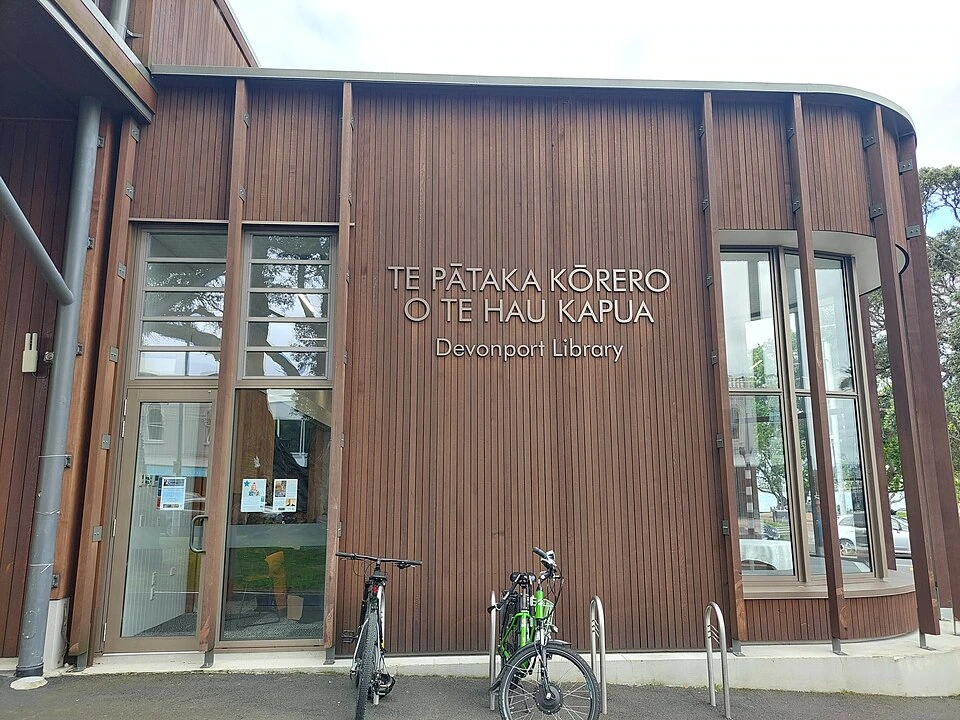
A bilingual Māori–English sign at Devonport Library in Auckland.
Saved in Babelbook · resized display copy. Select the image to open it independently of its source.
Bjankuloski06 · Source ↗CC BY 4.0 ↗View the local visual field note
Representative reference points from Glottolog. Historical entries show reference locations, not current speakers. 1 point.
Reference & context ↗Babelbook · original editorial illustration · CC BY 4.0 · Glottolog locations; public-domain Natural Earth land
Source excerpts, selected, shortened and where noted editorially corrected from Māori language by Wikipedia contributors. Retrieved 2026-10-05. CC BY-SA 4.0. These excerpts are not an independently verified scholarly history; missing accounts are identified above.
Read further in the source
Official status
New Zealand has three official languages; New Zealand Sign Language, te reo Māori, and English. Te reo Māori gained its official status with the passing of the Māori Language Act 1987. Most government departments and agencies have bilingual names—for example, the Department of Internal Affairs is alternatively Te Tari Taiwhenua—and places such as local government offices and public libraries display bilingual signs and use bilingual stationery; some government services now even use the Māori version solely as the official name. Personal dealings with government agencies may be conducted in Māori, but in practice, this almost always requires interpreters, restricting its everyday use to the limited geographical areas of high Māori fluency, and to more formal occasions, such as during public consultation. An interpreter is on hand at sessions of the New Zealand Parliament for instances when a member wishes to speak in Māori. Māori may be spoken in judicial proceedings, but any party wishing to do so must notify the court in advance to ensure an interpreter is available. Failure to notify in advance does not preclude the party speaking in Māori, but the court must be adjourned until an interpreter is available and the party may be held liable for the costs of the delay. A 1994 ruling by the Judicial Committee of the Privy Council (then New Zealand's highest court) held the Government responsible under the Treaty of Waitangi (1840) for the preservation of the language. Accordingly, since March 2004, the state has funded Māori Television, broadcast partly in Māori. On 28 March 2008, Māori Television launched its second channel, Te Reo, broadcast entirely in the Māori language, with no advertising or subtitles. The first Māori TV channel, Aotearoa Television Network (ATN) was available to viewers in the Auckland region from 1996 but lasted for only one year. In 2008, Land Information New Zealand published the first list of official place names with macrons. Previous place name lists were derived from computer systems (usually mapping and geographic information systems) that could not handle macrons.
Origins
According to legend, Māori came to New Zealand from Hawaiki. Current anthropological thinking places their origin in eastern Polynesia, mostly likely from the Southern Cook or Society Islands region (see Māori history § Origins from Polynesia), and says that they arrived by deliberate voyages in seagoing canoes, possibly double-hulled, and probably sail-rigged. These settlers probably arrived by AD 1350 at the latest. Māori evolved in isolation from other sister Polynesian languages adapting to New Zealand's unique geographical features and temperate climate (including presence of snow and loss of tropical floral inventory). Six dialectal variations emerged among iwi due to further internal geographical separation. The language had no written form, but historian Sarah J. K. Gallagher has argued that tā moko, the indigenous art of tattooing, is arguably "a pre-European textual culture in New Zealand... as the Moko can be read, it can be accepted as a form of communication". The idea that tā moko is a written language of sorts has been discussed before. Since its origin, the Māori language has been rich in metaphorical poetry and prose. Forms of this include karakia, whaikōrero, whakapapa and karanga, and in performing arts such as mōteatea, waiata and haka. Karakia are Māori incantations used to invoke spiritual guidance and protection, and are used before eating or gathering, to increase spiritual goodwill and to declare things officially open. Whaikōrero is the term given to traditional oratory given on marae, and whakapapa is the story of one's ancestry. According to historian Atholl Anderson, whakapapa used "mnemonic devices, repetitive patterns [and] rhyme" to leave a lasting impression. "Casting knowledge in formulaic or other standarised story forms... helped to fix the information in the minds of speakers and listeners".
Revitalisation efforts
By the 1950s some Māori leaders had begun to recognise the dangers of the loss of te reo Māori. By the 1970s there were many strategies used to save the language. This included Māori-language revitalisation programs such as the Kōhanga Reo movement, which from 1982 immersed infants in Māori from infancy to school age. There followed in 1985 the founding of the first Kura Kaupapa Māori (Years 1 to 8 Māori-medium education programme) and later the first Wharekura (Years 9 to 13 Māori-medium education programme). In 2011 it was reported that although "there was a true revival of te reo in the 1980s and early to mid-1990s ... spurred on by the realisation of how few speakers were left, and by the relative abundance of older fluent speakers in both urban neighbourhoods and rural communities", the language has continued to decline." The decline is believed "to have several underlying causes". These include:
the ongoing loss of older native speakers who have spearheaded the Māori-language revival movement complacency brought about by the very existence of the institutions which drove the revival concerns about quality, with the supply of good teachers never matching demand (even while that demand has been shrinking) excessive regulation and centralised control, which has alienated some of those involved in the movement an ongoing lack of educational resources needed to teach the full curriculum in te reo Māori natural language attrition caused by the overwhelming increase of spoken English. Based on the principles of partnership, Māori-speaking government, general revitalisation and dialectal protective policy, and adequate resourcing, the Waitangi Tribunal has recommended "four fundamental changes":
Te Taura Whiri (the Māori Language Commission) should become the lead Māori language sector agency. This will address the problems caused by the lack of ownership and leadership identified by the Office of the Auditor-General. Te Taura Whiri should function as a Crown–Māori partnership through the equal appointment of Crown and Māori appointees to its board. This reflects [the Tribunal's] concern that te reo revival will not work if responsibility for setting the direction is not shared with Māori. Te Taura Whiri will also need increased powers. This will ensure that public bodies are compelled to contribute to te reo's revival and that key agencies are held properly accountable for the strategies they adopt. For instance, targets for the training of te reo teachers must be met, education curricula involving te reo must be approved, and public bodies in districts with a sufficient number and/or proportion of te reo speakers and schools with a certain proportion of Māori students must submit Māori language plans for approval. These regional public bodies and schools must also consult iwi (Māori tribes or tribal confederations) in the preparation of their plans. In this way, iwi will come to have a central role in the revitalisation of te reo in their own areas. This should encourage efforts to promote the language at the grassroots. The changes set forth by the Tribunal are merely recommendations; they are not binding upon government.
There is, however, evidence that the revitalisation efforts are taking hold, as can be seen in the teaching of te reo in the school curriculum, the use of Māori as an instructional language, and the supportive ideologies surrounding these efforts. In 2014, a survey of students ranging in age from 18 to 24 was conducted; the students were of mixed ethnic backgrounds, ranging from Pākehā to Māori who lived in New Zealand. This survey showed a 62% response saying that te reo Māori was at risk. Albury argues that these results come from the language either not being used enough in common discourse, or from the fact that the number of speakers was inadequate for future language development. The policies for language revitalisation have been changing in attempts to improve Māori language use and have been working with suggestions from the Waitangi Tribunal on the best ways to implement the revitalisation. The Waitangi Tribunal in 2011 identified a suggestion for language revitalisation that would shift indigenous policies from the central government to the preferences and ideologies of the Māori people. This change recognises the issue of Māori revitalisation as one of indigenous self-determination, instead of the job of the government to identify what would be best for the language and Māori people of New Zealand.
Revival since 2015
Beginning in about 2015, the Māori language underwent a revival as it became increasingly popular, as a common national heritage and shared cultural identity, even among New Zealanders without Māori roots. Surveys from 2018 indicated that "the Māori language currently enjoys a high status in Māori society and also positive acceptance by the majority of non-Māori New Zealanders". As the status and prestige of the language rose, so did the demand for language classes. Businesses, including Google, Microsoft, Vodafone NZ and Fletcher Building, were quick to adopt the trend as it became apparent that using te reo made customers think of a company as "committed to New Zealand". The language became increasingly heard in the media and in politics. Prime Minister Jacinda Ardern—who gave her daughter a Māori middle name, and said she would learn both Māori and English—made headlines when she toasted Commonwealth leaders in 2018 with a Māori proverb, and the success of Māori musical groups such as Alien Weaponry and Maimoa further increased the language's presence in social media. Since 2017, a selected number of Disney movies have received a dubbing in Māori, the first being Moana. In August 2017, Rotorua became the first city in New Zealand to declare itself as bilingual in the Māori and English languages, meaning that both languages would be promoted. In 2019, the New Zealand government launched the Maihi Karauna Māori language revitalisation strategy with a goal of 1 million people speaking te reo Māori by 2040. Also in 2019, Kotahi Rau Pukapuka Trust and Auckland University Press began work on publishing a sizeable library of local and international literature in the language, including the Harry Potter books. Some New Zealanders have pushed against the revival, debating the replacement of English-language place names with original Māori names, criticising a police car having Māori language and graphics, and complaining about te reo Māori being used by broadcasters. In March 2021, the Broadcasting Standards Authority (BSA) said it would no longer entertain complaints regarding the use of the Māori language in broadcasts. This followed a fivefold increase in complaints to the BSA. The use of Māori in itself does not breach any broadcasting standards.
Dialects
Biggs proposed that historically there were two major dialect groups, North Island and South Island, and that South Island Māori is extinct. Biggs has analysed North Island Māori as comprising a western group and an eastern group with the boundary between them running pretty much along the island's north–south axis. Within these broad divisions regional variations occur, and individual regions show tribal variations. The major differences occur in the pronunciation of words, variation of vocabulary, and idiom. A fluent speaker of Māori has no problem understanding other dialects. There is no significant variation in grammar between dialects. "Most of the tribal variation in grammar is a matter of preferences: speakers of one area might prefer one grammatical form to another, but are likely on occasion to use the non-preferred form, and at least to recognise and understand it." Vocabulary and pronunciation vary to a greater extent, but this does not pose barriers to communication.
Northern dialects
In the northern dialects, particularly in Muriwhenua and parts of Ngāpuhi, the digraph wh is not pronounced as ⟨f⟩, as it is in most of the other dialects, but as a voiceless bilabial fricative ⟨ɸ⟩. Some speakers also reduce this sound to ⟨h⟩, particularly in words beginning with the causative prefix whaka- (e.g. whakarongo), leading to the pronunciation being heard as haka- (e.g. hakarongo or 'hakarongo). Speakers of the northern dialect, like other dialects, also have preferences for specific renderings of words (e.g. kāhore instead of kāore, kaurua/kourua instead of kōrua, etc.), or entirely unique words (e.g. kūkupa instead of kererū, whareiti instead of wharepaku, etc.)
Eastern and western dialects
In the southwest of the North Island, in the Whanganui and Taranaki regions, the phoneme ⟨h⟩ is a glottal stop and the phoneme ⟨wh⟩ is [ʔw]. This difference was the subject of considerable debate during the 1990s and 2000s over the then-proposed change of the name of the city Wanganui to Whanganui. In Tūhoe and the Eastern Bay of Plenty (northeastern North Island) ⟨ng⟩ has merged with ⟨n⟩. Speakers in Waikato–Tainui, also have preferences for renderings of words (e.g. ngētehi, ngāna and ngēnā instead of ētahi, āna or ēnā. Pēwhea and Kōwhatu instead of pēhea and pōhatu.)
Southern dialects
In South Island dialects, ng merged into k in many regions. Thus Kāi Tahu and Ngāi Tahu are variations in the name of the same iwi (the latter form is the one used in Acts of Parliament). Since 2000, the government has altered the official names of several southern place names to the southern dialect forms by replacing ng with k. New Zealand's highest mountain, known for centuries as Aoraki in southern Māori dialects that merge ng with k, and as Aorangi by other Māori, was later named "Mount Cook". Now its sole official name is Aoraki / Mount Cook, which favours the local dialect form. Similarly, the Māori name for Stewart Island, Rakiura, is cognate with the name of the Canterbury town of Rangiora. Likewise, Dunedin's main research library, the Hocken Collections, has the name Uare Taoka o Hākena rather than the northern (standard) Te Whare Taonga o Hākena. Maarire Goodall and George Griffiths say there is also a voicing of k to g, which explains why the region of Otago (southern dialect) and the settlement it is named after – Ōtākou (standard Māori) – vary in spelling (the pronunciation of the latter having changed over time to accommodate the northern spelling). The standard Māori r is also found occasionally changed to an l in these southern dialects and the wh to w. These changes are most commonly found in place names, such as Lake Waihola, and the nearby coastal settlement of Wangaloa (which would, in standard Māori, be rendered Whangaroa), and Little Akaloa, on Banks Peninsula. Goodall and Griffiths suggest that final vowels are given a centralised pronunciation as schwa or that they are elided (pronounced indistinctly or not at all), resulting in such seemingly bastardised place names as The Kilmog, which in standard Māori would have been rendered Kirimoko, but which in southern dialect would have been pronounced very much as the current name suggests. This same elision is found in numerous other southern placenames, such as the two small settlements called The Kaik (from the term for a fishing village, kāinga in standard Māori), near Palmerston and Akaroa, and the early spelling of Lake Wakatipu as Wagadib. In standard Māori, Wakatipu would have been rendered Whakatipua, showing further the elision of a final vowel. The name of Tomogalak Stream (a tributary of the Mataura River) also shows a combination of several of these dialect differences; in standard Māori its name would be rendered as Tomokarangi or Tawakarangi. Despite the dialect being officially regarded as extinct, its use in signage and official documentation is encouraged by many government and educational agencies in Otago and Southland.
Geographic distribution
Nearly all speakers are ethnic Māori residents of New Zealand. Estimates of the number of speakers vary: the 1996 census reported 160,000, while a 1995 national survey reported about 10,000 "very fluent" adult speakers. According to the 2023 New Zealand Census, 20.5% of people who identified with the Māori ethnic group could hold a conversation in te reo Māori, compared with 21.3% in 2013 and 20.6% in 2018. Although the proportion has declined slightly over the decade, the number of Māori speakers increased from 125,352 in 2013 to 182,001 in 2023. In 2023, Māori speakers represented 4.3% of New Zealand's total population, up from 3.7% in 2013. The level of competence of self-professed Māori speakers varies from minimal to total. Statistics have not been gathered for the prevalence of different levels of competence. Only a minority of self-professed speakers use Māori as their main language at home. The rest use only a few words or phrases (passive bilingualism). Māori still is a community language in some predominantly Māori settlements in the Northland, Urewera and East Cape areas. Kōhanga reo Māori-immersion kindergartens throughout New Zealand exclusively use Māori. Urbanisation after the Second World War led to widespread language shift from Māori predominance (with Māori the primary language of the rural whānau) to English predominance (English serving as the primary language in the Pākehā cities). Therefore, Māori speakers almost always communicate bilingually, with New Zealand English as either their first or second language. Only around 9,000 people exclusively speak in Māori. In the 2023 school year, around 7.2% of primary and secondary school students in New Zealand were taught fully or partially in Māori. An additional 24.4% were formally taught Māori as an additional language, and 37.1% were taught Māori informally. However, very few students pass through the New Zealand education system without any Māori language education. For example, only 2.1% of students in Year 1 (aged 5) did not receive any Māori language education in 2023. The use of the Māori language in the Māori diaspora is far lower than in New Zealand itself. Census data from Australia show it as the home language of 11,747, just 8.2% of the total Australian Māori population in 2016.
Orthography
The modern Māori alphabet has 15 letters, two of which are digraphs (character pairs). The five vowels have both short and long forms, with the long forms denoted by macrons marked above them.
The order of the alphabet is as follows: A, E, H, I, K, M, N, O, P, R, T, U, W, Ng, Wh. This standard orthography may be tweaked to represent certain dialects of Māori:
An underlined "ḵ" sometimes appears when writing the Southern dialect, to indicate that the /k/ in question corresponds to the ng of the standard language. Both L and G are also encountered in the Southern dialect, though not in standard Māori. Various methods are used to indicate glottal stops when writing the Whanganui dialect.
History
There was originally no native writing system for Māori. It has been suggested that the petroglyphs once used by the Māori developed into a script similar to the Rongorongo of Easter Island. However, there is no evidence that these petroglyphs ever evolved into a true system of writing. Some distinctive markings among the kōwhaiwhai (rafter paintings) of meeting houses were used as mnemonics in reciting whakapapa (genealogy) but again, there was no systematic relation between marks and meanings. Attempts to write Māori words using the Latin script began with Captain James Cook and other early explorers, with varying degrees of success. Consonants seem to have caused the most difficulty, but medial and final vowels are often missing in early sources. Anne Salmond records aghee for aki (in the year 1773, from the North Island East Coast, p. 98), Toogee and E tanga roak for Tuki and Tangaroa (1793, Northland, p. 216), Kokramea, Kakramea for Kakaramea (1801, Hauraki, p. 261), toges for tokis, Wannugu for Uenuku and gumera for kumara (1801, Hauraki, pp. 261, 266 and 269), Weygate for Waikato (1801, Hauraki, p. 277), Bunga Bunga for pungapunga, tubua for tupua and gure for kurī (1801, Hauraki, p. 279), as well as Tabooha for Te Puhi (1823, Northern Northland, p. 385). From 1814, missionaries tried to define the sounds of the language. Thomas Kendall published a book in 1815 entitled A korao no New Zealand, which in modern orthography and usage would be He Kōrero nō Aotearoa. Beginning in 1817, professor Samuel Lee of Cambridge University worked with the Ngāpuhi chief Tītore and his junior relative Tui (also known as Tuhi or Tupaea), and then with chief Hongi Hika and his junior relative Waikato; they established a definitive orthography based on Northern usage, published as the First Grammar and Vocabulary of the New Zealand Language (1820). The missionaries of the Church Missionary Society (CMS) did not have a high regard for this book. By 1830 the CMS missionaries had revised the orthography for writing the Māori language; for example, "Kiddeekiddee" was changed to the modern spelling, "Kerikeri". The Māori embraced literacy enthusiastically, and missionaries reported in the 1820s that Māori all over the country taught each other to read and write, using sometimes quite innovative materials in the absence of paper, such as leaves and charcoal, and flax. Missionary James West Stack recorded the scarcity of slates and writing materials at the native schools and the use sometimes of "pieces of board on which sand was sprinkled, and the letters traced upon the sand with a pointed stick".