Macedonian
Macedonian ( MASS-ih-DOH-nee-ən; македонски јазик, translit. makedonski jazik, pronounced [maˈkɛdɔnski ˈjazik] ) is an Eastern South Slavic language. It is part of the South Slavic languages, and is one of the Slavic languages, which are part of the Balto-Slavic branch and the larger Indo-European language family. Spoken as a first language by around 1.7 million people, it serves as the official language of North Macedonia. Most speakers can be found in the country and its diaspora, with a smaller number of speakers throughout the transnational region of Macedonia. Macedonian is also a recognized minority language in parts of Albania, Bosnia and Herzegovina, Romania, and Serbia and it is spoken by expatriate communities predominantly in Australia, Canada, and the United States. Macedonian developed out of the western dialects of the Eastern South Slavic dialect continuum, whose earliest recorded form is Old Church Slavonic. As it is part of a dialect continuum with other South Slavic languages, Macedonian has a high degree of mutual intelligibility with Bulgarian and varieties of Serbo-Croatian. The international consensus outside of Bulgaria is that Macedonian is an autonomous language within the Eastern South Slavic dialect continuum, although since Macedonian and Bulgarian are mutually intelligible and are socio-historically related, a small minority of linguists are divided in their views of the two as separate languages or as a single pluricentric language. Standard Macedonian was codified in 1945 and has developed modern literature since.
Translate in Macedonian ↗Although the precise number of native and second language speakers of Macedonian is unknown due to the policies of neighboring countries and emigration of the population, estimates ranging between 1.4 million and 3.5 million have been reported. According to the 2002 census, the total population of North Macedonia was 2,022,547, with 1,344,815 citizens declaring Macedonian their native language. Macedonian is also studied and spoken to various degrees as a second language by all ethnic minorities in the country. Outside North Macedonia, there are small ethnic Macedonian minorities that speak Macedonian in neighboring countries including 8,375 in Serbia (2022 census), 4,697 in Albania (1989 census), and 1,609 in Bulgaria (2011 census). The exact number of speakers of Macedonian in Greece is difficult to ascertain due to the country's policies. Estimates of Slavophones ranging anywhere between 50,000 and 300,000 in the last decade of the 20th century have been reported. Approximately 580,000 Macedonians live outside North Macedonia per 1964 estimates with Australia, Canada, and the United States being home to the largest emigrant communities. Consequently, the number of speakers of Macedonian in these countries include 66,020 (2016 census), 15,605 (2016 census) and 22,885 (2010 census), respectively. Macedonian also has more than 50,000 native speakers in countries of Western Europe, predominantly in Germany, Switzerland and Italy. The Macedonian language has the status of an official language only in North Macedonia, and is a recognized minority and official language in parts of Albania (Pustec), Romania, Serbia (Jabuka and Plandište) and Bosnia and Herzegovina. There are provisions to learn Macedonian in Romania as Macedonians are an officially recognized minority group.
Europe
Present-day use
The captured source does not contain a separate current-use account.
Origins
The captured article does not contain a separate origins section. See the historical account and linked source.
Development
The Slavic people who settled in the Balkans during the 6th century CE, spoke their own dialects and used different dialects or languages to communicate with other people. The "canonical" Old Church Slavonic period of the development of Macedonian started during the 9th century and lasted until the first half of the 11th century. It saw translation of Greek religious texts. The Macedonian recension of Old Church Slavonic also appeared around that period in the Bulgarian Empire and was referred to as such due to works of the Ohrid Literary School. Towards the end of the 13th century, the influence of Serbian increased as Serbia expanded its borders southward. During the five centuries of Ottoman rule, from the 15th to the 20th century, the vernacular spoken in the territory of current-day North Macedonia witnessed grammatical and linguistic changes that came to characterize Macedonian as a member of the Balkan sprachbund. This period saw the introduction of many Turkish loanwords into the language. The latter half of the 18th century saw the rise of modern literary Macedonian through the written use of Macedonian dialects referred to as "Bulgarian" by writers. The first half of the 19th century saw the rise of nationalism among the South Slavic people in the Ottoman Empire. This period saw proponents of creating a common church for Bulgarian and Macedonian Slavs which would use a common modern Macedo-Bulgarian literary standard. The period between 1840 and 1870, saw a struggle to define the dialectal base of the common language called simply "Bulgarian", with two opposing views emerging. One ideology was to create a Bulgarian literary language based on Macedonian dialects, but such proposals were rejected by the Bulgarian codifiers. That period saw poetry written in the Struga dialect with elements from Russian. Textbooks also used either spoken dialectal forms of the language or a mixed Macedo-Bulgarian language.
Writing
Similar to the Macedonian alphabet, Macedonian orthography was officially codified on 7 June 1945 at an ASNOM meeting. Rules about the orthography and orthoepy (correct pronunciation of words) were first collected and outlined in the book Правопис на македонскиот литературен јазик (Orthography of the Macedonian standard language) published in 1945. Updated versions have subsequently appeared with the most recent one published in 2016. Macedonian orthography is consistent and phonemic in practice, an approximation of the principle of one grapheme per phoneme. This one-to-one correspondence is often simply described by the principle to "write as you speak and read as it is written". There is only one exception to this rule: the letter ⟨л⟩ is pronounced /l/ before front vowels (e.g. лист 'leaf' pronounced [list]) and /j/ (e.g., полјанка 'meadow' pronounced [poljanka]) but velar /ł/ elsewhere (e.g., бела 'white' pronounced [beła]). Another sound that is not represented in the written form but is pronounced in words is the schwa.
Beyond the typeface.
Signs, manuscripts, published pages and contextual photographs, with their place, period, source and reuse terms. Captions identify historical spellings, regional examples, community references and character imagery.
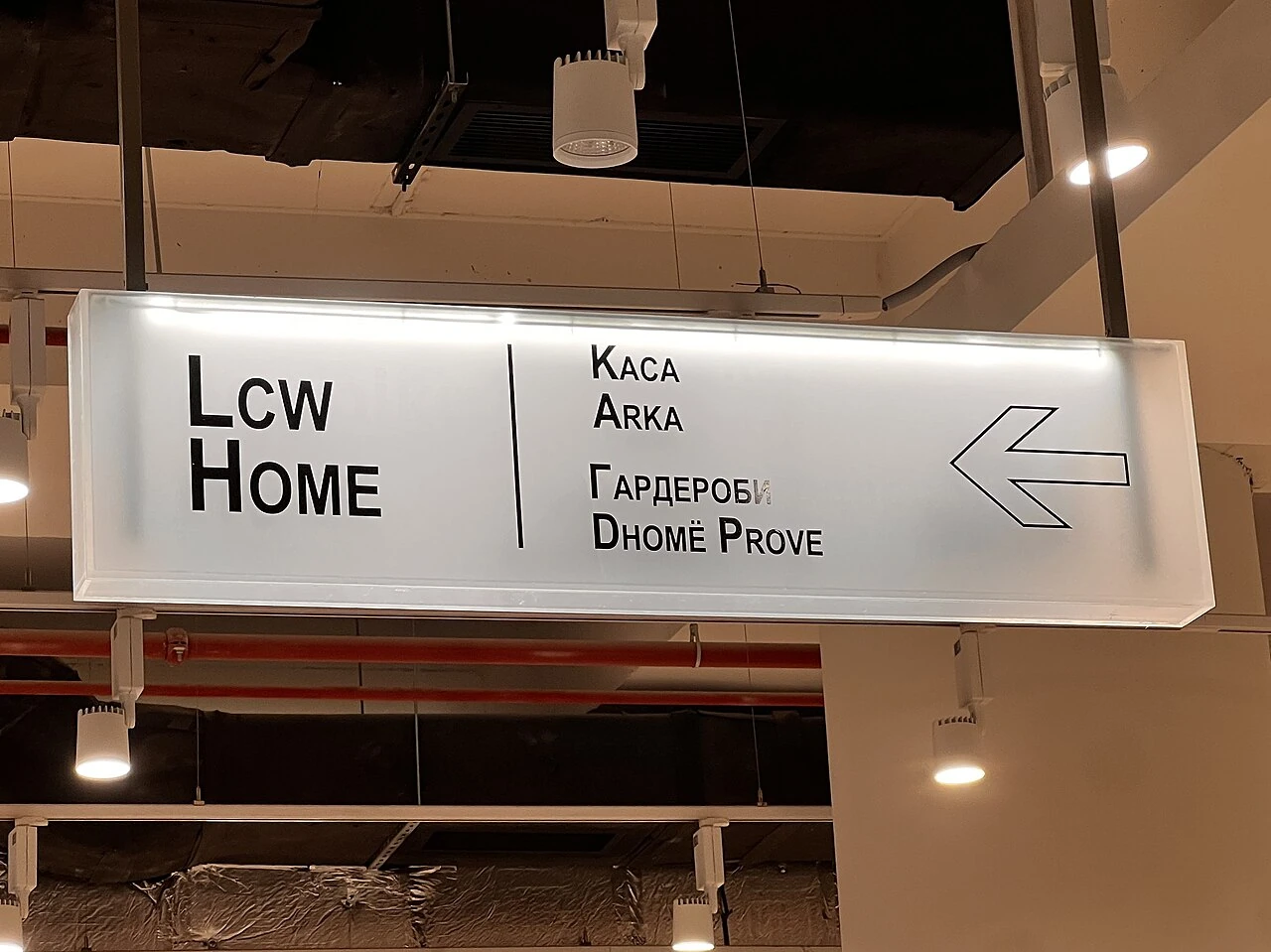
Bilingual Macedonian–Albanian sign in the LC Waikiki clothing shop at Diamond Mall, Skopje, photographed in August 2026. Language identification follows Commons descriptions or categories; not independently transcribed.
Saved in Babelbook · resized display copy. Select the image to open it independently of its source.
Bdx · Source ↗CC0 1.0 ↗View the local visual field note
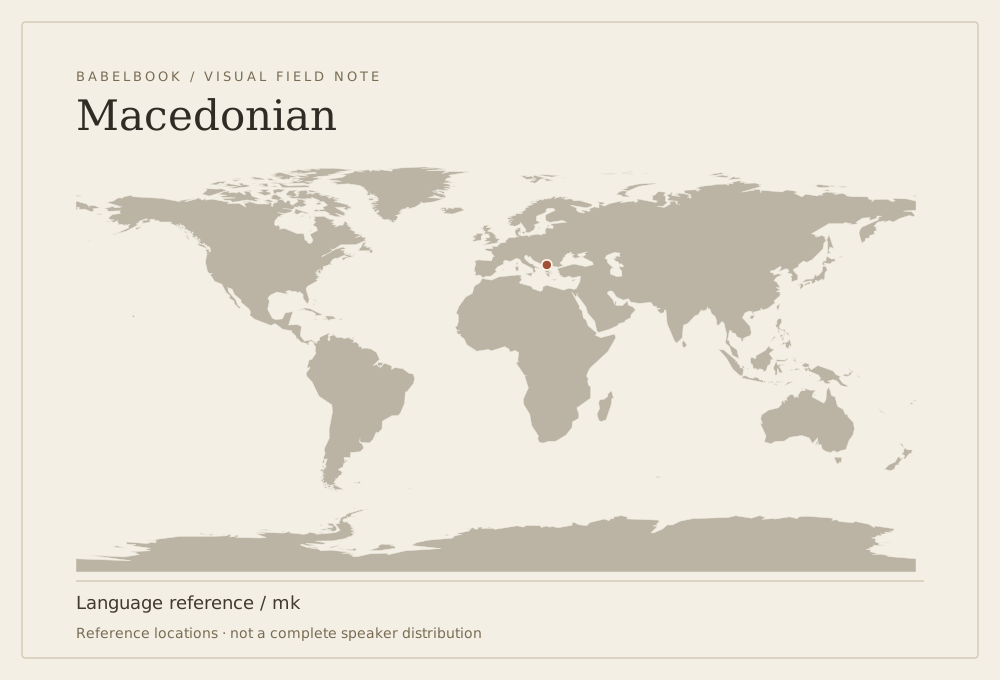
Representative reference points from Glottolog. Historical entries show reference locations, not current speakers. 1 point.
Reference & context ↗Babelbook · original editorial illustration · CC BY 4.0 · Glottolog locations; public-domain Natural Earth land
Source excerpts, selected, shortened and where noted editorially corrected from Macedonian language by Wikipedia contributors. Retrieved 2026-10-05. CC BY-SA 4.0. These excerpts are not an independently verified scholarly history; missing accounts are identified above.
Read further in the source
History
The Slavic people who settled in the Balkans during the 6th century CE, spoke their own dialects and used different dialects or languages to communicate with other people. The "canonical" Old Church Slavonic period of the development of Macedonian started during the 9th century and lasted until the first half of the 11th century. It saw translation of Greek religious texts. The Macedonian recension of Old Church Slavonic also appeared around that period in the Bulgarian Empire and was referred to as such due to works of the Ohrid Literary School. Towards the end of the 13th century, the influence of Serbian increased as Serbia expanded its borders southward. During the five centuries of Ottoman rule, from the 15th to the 20th century, the vernacular spoken in the territory of current-day North Macedonia witnessed grammatical and linguistic changes that came to characterize Macedonian as a member of the Balkan sprachbund. This period saw the introduction of many Turkish loanwords into the language.
The latter half of the 18th century saw the rise of modern literary Macedonian through the written use of Macedonian dialects referred to as "Bulgarian" by writers. The first half of the 19th century saw the rise of nationalism among the South Slavic people in the Ottoman Empire. This period saw proponents of creating a common church for Bulgarian and Macedonian Slavs which would use a common modern Macedo-Bulgarian literary standard.
The period between 1840 and 1870, saw a struggle to define the dialectal base of the common language called simply "Bulgarian", with two opposing views emerging. One ideology was to create a Bulgarian literary language based on Macedonian dialects, but such proposals were rejected by the Bulgarian codifiers. That period saw poetry written in the Struga dialect with elements from Russian. Textbooks also used either spoken dialectal forms of the language or a mixed Macedo-Bulgarian language. Subsequently, proponents of the idea of using a separate Macedonian language emerged. Krste Petkov Misirkov's book Za makedonckite raboti (On Macedonian Matters) published in 1903, was the first attempt to formalize a separate literary language. With the book, the author proposed a Macedonian grammar and expressed the goal of codifying the language and using it in schools. The author postulated the principle that the Prilep-Bitola dialect be used as a dialectal basis for the formation of the Macedonian standard language; his idea however was not adopted until the 1940s. On 2 August 1944 at the first Anti-fascist Assembly for the National Liberation of Macedonia (ASNOM) meeting, Macedonian was declared an official language. With this, it became the last of the major Slavic languages to achieve a standard literary form. As such, Macedonian served as one of the three official languages of Yugoslavia from 1945 to 1991.
Geographical distribution
Although the precise number of native and second language speakers of Macedonian is unknown due to the policies of neighboring countries and emigration of the population, estimates ranging between 1.4 million and 3.5 million have been reported. According to the 2002 census, the total population of North Macedonia was 2,022,547, with 1,344,815 citizens declaring Macedonian their native language. Macedonian is also studied and spoken to various degrees as a second language by all ethnic minorities in the country. Outside North Macedonia, there are small ethnic Macedonian minorities that speak Macedonian in neighboring countries including 8,375 in Serbia (2022 census), 4,697 in Albania (1989 census), and 1,609 in Bulgaria (2011 census). The exact number of speakers of Macedonian in Greece is difficult to ascertain due to the country's policies. Estimates of Slavophones ranging anywhere between 50,000 and 300,000 in the last decade of the 20th century have been reported. Approximately 580,000 Macedonians live outside North Macedonia per 1964 estimates with Australia, Canada, and the United States being home to the largest emigrant communities. Consequently, the number of speakers of Macedonian in these countries include 66,020 (2016 census), 15,605 (2016 census) and 22,885 (2010 census), respectively. Macedonian also has more than 50,000 native speakers in countries of Western Europe, predominantly in Germany, Switzerland and Italy. The Macedonian language has the status of an official language only in North Macedonia, and is a recognized minority and official language in parts of Albania (Pustec), Romania, Serbia (Jabuka and Plandište) and Bosnia and Herzegovina. There are provisions to learn Macedonian in Romania as Macedonians are an officially recognized minority group. Macedonian is studied and taught at various universities across the world and research centers focusing on the language are found at universities across Europe (France, Germany, Austria, Italy, Russia) as well as Australia, Canada and the United States (Chicago and North Carolina).
Dialects
During the standardization process of the Macedonian language, the dialectal base selected was primarily based on the West-Central dialects, which spans the triangle of the communities Makedonski Brod, Kičevo, Demir Hisar, Bitola, Prilep, and Veles. These were considered the most widespread and most likely to be adopted by speakers from other regions. The initial idea to select this region as a base was first proposed in Krste Petkov Misirkov's works as he believed the Macedonian language should abstract on those dialects that are distinct from neighboring Slavic languages, such as Bulgarian and Serbian.
Based on a large group of features, Macedonian dialects can be divided into Eastern, Western and Northern groups. The boundary between them geographically runs approximately from Skopje and Skopska Crna Gora along the rivers Vardar and Crna. There are numerous isoglosses between these dialectal variations, with structural differences in phonetics, prosody (accentuation), morphology and syntax. The Western group of dialects can be subdivided into smaller dialectal territories, the largest group of which includes the central dialects. The linguistic territory where Macedonian dialects were spoken also span outside the country and within the region of Macedonia, including Pirin Macedonia into Bulgaria and Aegean Macedonia into Greece. Variations in consonant pronunciation occur between the two groups, with most Western regions losing the /x/ and the /v/ in intervocalic position (глава (head): /ɡlava/ = /ɡla/: глави (heads): /ɡlavi/ = /ɡlaj/) while Eastern dialects preserve it. Stress in the Western dialects is generally fixed and falls on the antepenultimate syllable while Eastern dialects have non-fixed stress systems that can fall on any syllable of the word, that is also reminiscent of Bulgarian dialects. Additionally, Eastern dialects are distinguishable by their fast tonality, elision of sounds and the suffixes for definiteness. The Northern dialectal group is close to South Serbian and Torlakian dialects and is characterized by 46–47 phonetic and grammatical isoglosses. In addition, a more detailed classification can be based on the modern reflexes of the Proto-Slavic reduced vowels (yers), vocalic sonorants, and the back nasal *ǫ. That classification distinguishes between the following 6 groups:
Orthography
Similar to the Macedonian alphabet, Macedonian orthography was officially codified on 7 June 1945 at an ASNOM meeting. Rules about the orthography and orthoepy (correct pronunciation of words) were first collected and outlined in the book Правопис на македонскиот литературен јазик (Orthography of the Macedonian standard language) published in 1945. Updated versions have subsequently appeared with the most recent one published in 2016. Macedonian orthography is consistent and phonemic in practice, an approximation of the principle of one grapheme per phoneme. This one-to-one correspondence is often simply described by the principle to "write as you speak and read as it is written". There is only one exception to this rule: the letter ⟨л⟩ is pronounced /l/ before front vowels (e.g. лист 'leaf' pronounced [list]) and /j/ (e.g., полјанка 'meadow' pronounced [poljanka]) but velar /ł/ elsewhere (e.g., бела 'white' pronounced [beła]). Another sound that is not represented in the written form but is pronounced in words is the schwa.