Malayalam
Malayalam (മലയാളം, Malayāḷam, [mɐlɐjaːɭɐm] ) is a Dravidian language, primarily spoken by the Malayali people, native to the Indian state of Keralam and the union territories of Lakshadweep and Puducherry (Mahé district). It is one of 22 scheduled languages, as well as one of 11 classical languages, of India. Malayalam has official language status in Kerala, Lakshadweep and Puducherry (Mahé). Malayalam is spoken by significant numbers of people in India and is the majority language in the state of Kerala. Malayalam is also spoken by linguistic minorities in the neighbouring states; with a significant number of speakers in the Kodagu and Dakshina Kannada districts of Karnataka, and Kanyakumari, Coimbatore and Nilgiris district of Tamil Nadu. It is also spoken by the Malayali Diaspora worldwide, especially in the Persian Gulf countries, due to the large populations of Malayali expatriates there. They are a significant population in each city in India including Mumbai, Bengaluru, Chennai, Delhi, Hyderabad etc. The origin of Malayalam remains a matter of dispute among scholars. The mainstream view holds that Malayalam descends from a western coastal dialect of early Middle Tamil and separated from it sometime between the 9th and 13th centuries, though the spoken dialect of this period likely also preserved some archaisms suggesting an earlier divergence of the spoken dialects in the prehistoric period.
Translate in Malayalam ↗Malayalam is a language spoken by the native people of southwestern India and the islands of Lakshadweep in the Arabian Sea. According to the Indian census of 2011, there were 32,413,213 speakers of Malayalam in Kerala, making up 93.2% of the total number of Malayalam speakers in India, and 97.03% of the total population of the state. There were a further 7,74,057 (2.22% of the total number) in Karnataka, 7,26,096 (2.05%) in Tamil Nadu, and 406,358 (1.2%) in Maharashtra. The number of Malayalam speakers in Lakshadweep is 51,100, which is only 0.15% of the total number, but is as much as about 84% of the population of Lakshadweep. Malayalam was the most spoken language in the erstwhile Gudalur taluk (now Gudalur and Panthalur taluks) of Nilgiris district in Tamil Nadu which accounts for 48.8% population and it was the second most spoken language in Mangaluru and Puttur taluks of South Canara accounting for 21.2% and 15.4% respectively according to 1951 census report. 25.57% of the total population in the Kodagu district of Karnataka are Malayalis, and they form the single largest linguistic group accounting for 35.5% in the Virajpet Taluk. Around one-third of the Malayalis in Kodagu district speak the Yerava dialect according to the 2011 census, which is native to Kodagu and Wayanad. In all, Malayalis made up 3.22% of the total Indian population in 2011. Of the total 34,713,130 Malayalam speakers in India in 2011, 33,015,420 spoke the standard dialects, 19,643 spoke the Yerava dialect and 31,329 spoke non-standard regional variations like Eranadan. As per the 1991 census data, 28.85% of all Malayalam speakers in India spoke a second language and 19.64% of the total knew three or more languages. Just before independence, Malaya attracted many Malayalis. Large numbers of Malayalis have settled in Chennai, Bengaluru, Mangaluru, Hyderabad, Mumbai, Navi Mumbai, Pune, Mysuru and Delhi. Many Malayalis have also emigrated to the Middle East, the United States, and Europe.
South Asia
Present-day use
The Middle Malayalam was succeeded by Modern Malayalam (Aadhunika Malayalam) by 15th century CE. The poem Krishnagatha written by Cherusseri Namboothiri, who was the court poet of the king Udaya Varman Kolathiri (1446–1475) of Kolathunadu, is written in modern Malayalam. The language used in Krishnagatha is the modern spoken form of Malayalam. During the 16th century CE, Thunchaththu Ezhuthachan from the Kingdom of Tanur and Poonthanam Nambudiri from the Kingdom of Valluvanad, followed the new trend initiated by Cherussery in their poems. The Adhyathmaramayanam Kilippattu and Mahabharatham Kilippattu, written by Ezhuthachan, and Jnanappana, written by Poonthanam, are also included in the earliest form of Modern Malayalam. Thunchaththu Ezhuthachan is also credited with developing the Malayalam script into the current form through the intermixing and modification of the erstwhile scripts of Vatteluttu, Kolezhuthu, and Grantha script, which were used to write the inscriptions and literary works of Old and Middle Malayalam. He further eliminated excess and unnecessary letters from the modified script. Hence, Ezhuthachan is also known as The Father of modern Malayalam. The development of modern Malayalam script was also heavily influenced by the Tigalari script, which was used to write Sanskrit, due to the influence of Tuluva Brahmins in Kerala. The language used in the Arabi Malayalam works of the 16th–17th century CE is a mixture of Modern Malayalam and Arabic. They follow the syntax of modern Malayalam, though written in a modified form of Arabic script, which is known as Arabi Malayalam script. P. Shangunny Menon ascribes the authorship of the medieval work Keralolpathi, which describes the Parashurama legend and the departure of the final Cheraman Perumal king to Mecca, to Thunchaththu Ramanujan Ezhuthachan. Kunchan Nambiar introduced a new literary form called Thullal, and Unnayi Variyar introduced reforms in Attakkatha literature.
Origins
In a 7th-century poem written by the Tamil poet Sambandar the people of Kerala are referred to as malaiyāḷar (mountain people). The word Malayalam is also said to originate from the words mala, meaning 'mountain', and alam, meaning 'region' or '-ship' (as in "township"); Malayalam thus translates directly as 'the mountain region'. The term Malabar was used as an alternative term for Malayalam in foreign trade circles to denote the southwestern coast of the Indian peninsula, which also means The land of hills. The term originally referred to the western hilly land of the Chera dynasty (later Zamorins and the Kingdom of Cochin), Kingdom of Ezhimala (later Kolathunadu), and Ay kingdom (later Travancore), and only later became the name of its language. The language Malayalam was alternatively called Alealum, Malayalani, Malayali, Malabari, Malean, Maliyad, Mallealle, and Kerala Bhasha until the early 19th century CE. The earliest extant literary works in the regional language of present-day Kerala probably date back to as early as the 12th century. At that time, the language was differentiated by the name Kerala Bhasha. The earliest mention of Malayalam as a language is found outside of Kerala in the 15th century Telugu work Śrībhīmēśvarapurāṇamu by Śrīnātha. The distinctive "Malayalam" named identity of this language appears to have come into existence in Kerala only around this time, when it was known as "Malayayma" or "Malayanma"; the words were also used to refer to the script and the region. According to Duarte Barbosa, a Portuguese visitor who visited Kerala in the early 16th century CE, the people in the southwestern Malabar coast of India from Kumbla in north to Kanyakumari in south had a unique language, which was called "Maliama" by them. Prior to this period, the people of Kerala usually referred to their language as "Tamil", and both terms overlapped into the colonial period.
Development
Due to the geographical isolation of the Malabar Coast from the rest of the Indian peninsula due to the presence of the Western Ghats mountain ranges which lie parallel to the coast, the dialect of Old Tamil spoken in Kerala was different from that spoken in Tamil Nadu. The mainstream view holds that Malayalam began to grow as a distinct literary language from the western coastal dialect of Middle Tamil and the linguistic separation completed sometime between the 9th and 13th centuries. The renowned poets of Classical Tamil such as Paranar (1st century CE), Ilango Adigal (2nd–3rd century CE), and Kulasekhara Alvar (9th century CE) were Keralites. The Sangam works can be considered as the ancient predecessor of Malayalam. However Govindankutty argues that both Tamil and Malayalam was developed during the prehistoric period from a common ancestor, "Proto-Tamil-Malayalam", and that the notion of Malayalam being a "daughter" of Tamil is misplaced. This is based on the fact that Malayalam and several Dravidian languages on the Western Coast have common archaic features which are not found even in the oldest historical forms of literary Tamil. Despite this, Malayalam shares many common innovations with Tamil that emerged during the early Middle Tamil period, thus making independent descent untenable. Indeed, most features of Malayalam morphology are derivable from a form of speech corresponding to early Middle Tamil. Robert Caldwell, in his 1856 book "A Comparative Grammar of the Dravidian or South-Indian Family of Languages", opined that literary Malayalam branched from Classical Tamil and over time gained a large amount of Sanskrit vocabulary and lost the personal terminations of verbs. As the language of scholarship and administration, Old-Tamil, which was written in Tamil-Brahmi and the Vatteluttu alphabet later, greatly influenced the early development of Malayalam as a literary language.
Writing
Aside from the Malayalam script, the Malayalam language has been written in other scripts like Latin, Syriac and Arabic. Suriyani Malayalam was used by Saint Thomas Christians (also known as Nasranis) until the 19th century. Arabic scripts particularly were taught in madrasahs in Kerala and the Lakshadweep Islands. Historically, several scripts were used to write Malayalam. Among these were the Vatteluttu, Kolezhuthu and Malayanma scripts. But it was the Grantha script, another Southern Brahmi variation, which gave rise to the modern Malayalam script. The modern Malayalam script bears high similarity to Tigalari script, which was used for writing Tulu language in Coastal Karnataka (Dakshina Kannada and Udupi districts) and the northernmost Kasaragod district of Kerala. It is syllabic in the sense that the sequence of graphic elements means that syllables have to be read as units, though in this system the elements representing individual vowels and consonants are for the most part readily identifiable. In the 1960s Malayalam dispensed with many special letters representing less frequent conjunct consonants and combinations of the vowel /u, u:/ with different consonants. Malayalam script consists of a total of 578 characters. The script contains 52 letters including 16 vowels and 36 consonants, which forms 576 syllabic characters, and contains two additional diacritic characters named anusvāra and visarga. The earlier style of writing has been superseded by a new style as of 1981. This new script reduces the different letters for typesetting from 900 to fewer than 90. This was mainly done to include Malayalam in the keyboards of typewriters and computers. In 1999 a group named "Rachana Akshara Vedi" produced a set of free fonts containing the entire character repertoire of more than 900 glyphs. This was announced and released along with a text editor in the same year at Thiruvananthapuram, the capital of Kerala.
Beyond the typeface.
Signs, manuscripts, published pages and contextual photographs, with their place, period, source and reuse terms. Captions identify historical spellings, regional examples, community references and character imagery.
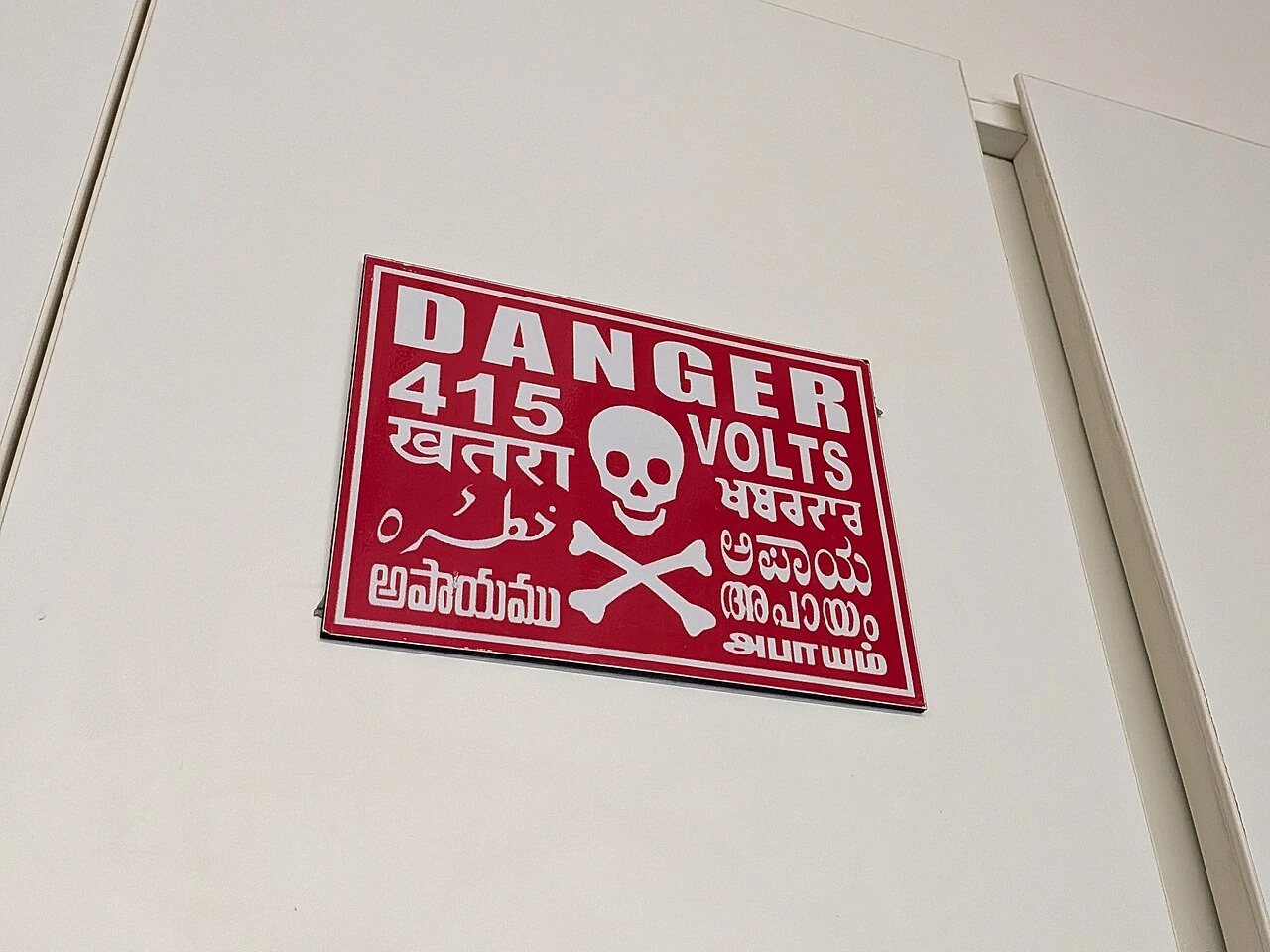
Multilingual high-voltage warning; Commons explicitly identifies Malayalam among the languages. Language identification follows Commons metadata; not independently transcribed.
Saved in Babelbook · resized display copy. Select the image to open it independently of its source.
Syced · Source ↗CC0 1.0 ↗View the local visual field note
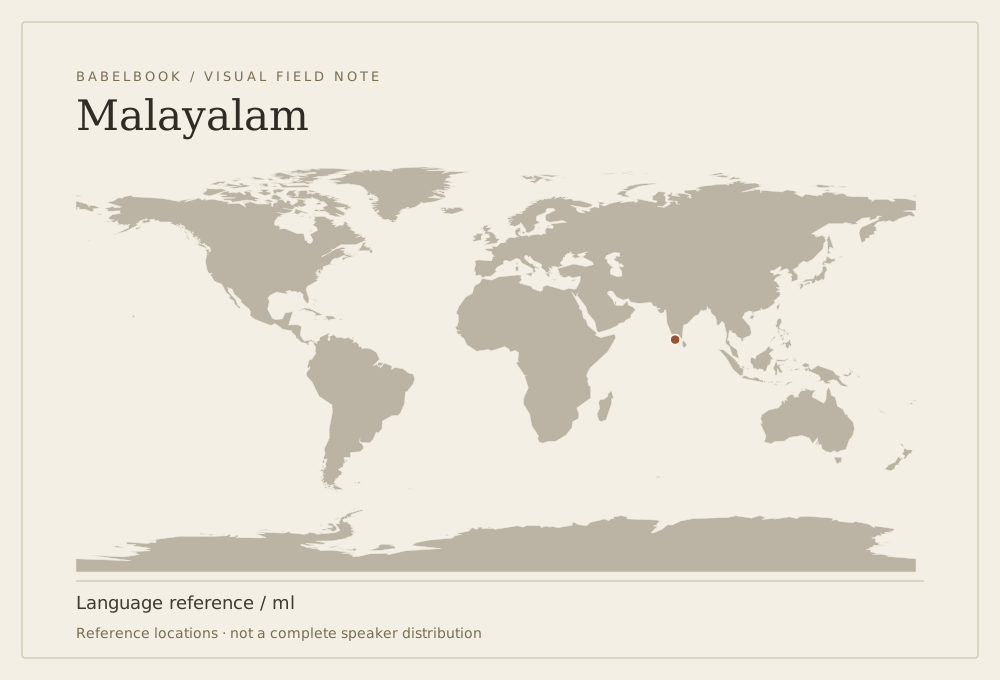
Representative reference points from Glottolog. Historical entries show reference locations, not current speakers. 1 point.
Reference & context ↗Babelbook · original editorial illustration · CC BY 4.0 · Glottolog locations; public-domain Natural Earth land
Source excerpts, selected, shortened and where noted editorially corrected from Malayalam by Wikipedia contributors. Retrieved 2026-10-05. CC BY-SA 4.0. These excerpts are not an independently verified scholarly history; missing accounts are identified above.
Read further in the source
History
Due to the geographical isolation of the Malabar Coast from the rest of the Indian peninsula due to the presence of the Western Ghats mountain ranges which lie parallel to the coast, the dialect of Old Tamil spoken in Kerala was different from that spoken in Tamil Nadu. The mainstream view holds that Malayalam began to grow as a distinct literary language from the western coastal dialect of Middle Tamil and the linguistic separation completed sometime between the 9th and 13th centuries. The renowned poets of Classical Tamil such as Paranar (1st century CE), Ilango Adigal (2nd–3rd century CE), and Kulasekhara Alvar (9th century CE) were Keralites. The Sangam works can be considered as the ancient predecessor of Malayalam. However Govindankutty argues that both Tamil and Malayalam was developed during the prehistoric period from a common ancestor, "Proto-Tamil-Malayalam", and that the notion of Malayalam being a "daughter" of Tamil is misplaced. This is based on the fact that Malayalam and several Dravidian languages on the Western Coast have common archaic features which are not found even in the oldest historical forms of literary Tamil. Despite this, Malayalam shares many common innovations with Tamil that emerged during the early Middle Tamil period, thus making independent descent untenable. Indeed, most features of Malayalam morphology are derivable from a form of speech corresponding to early Middle Tamil. Robert Caldwell, in his 1856 book "A Comparative Grammar of the Dravidian or South-Indian Family of Languages", opined that literary Malayalam branched from Classical Tamil and over time gained a large amount of Sanskrit vocabulary and lost the personal terminations of verbs. As the language of scholarship and administration, Old-Tamil, which was written in Tamil-Brahmi and the Vatteluttu alphabet later, greatly influenced the early development of Malayalam as a literary language. The Malayalam script began to diverge from the Vatteluttu and the Western Grantha scripts in the 8th and 9th centuries of Common Era. By the end of the 13th century, a written form of the language emerged which was unique from the Vatteluttu script that was used to write Tamil on the eastern coast.
Dialects
Variations in intonation patterns, vocabulary, and distribution of grammatical and phonological elements are observable along the parameters of region, religion, community, occupation, social stratum, style and register. According to the Dravidian Encyclopedia, the regional dialects of Malayalam can be divided into fifteen dialect areas. They are as follows:
According to Ethnologue, the dialects are: Malabar, Nagari-Malayalam, North Kerala, Central Kerala, South Kerala, Kayavar, Namboodiri, Nair, Mappila, Beary, Jeseri, Yerava, Pulaya, Nasrani, and Kasargod. The community dialects are: Namboodiri, Nair, Arabi Malayalam, Pulaya, and Nasrani. Whereas both the Namboothiri and Nair dialects have a common nature, the Arabi Malayalam is among the most divergent of dialects, differing considerably from literary Malayalam. Jeseri is a dialect of Malayalam spoken mainly in the Union territory of Lakshadweep and Beary is spoken in Tulu Nadu which are nearer to Kerala. Of the total 33,066,392 Malayalam speakers in India in 2001, 33,015,420 spoke the standard dialects, 19,643 spoke the Yerava dialect and 31,329 spoke non-standard regional variations like Eranadan. The dialects of Malayalam spoken in the districts like Kasaragod, Kannur, Wayanad, Kozhikode, and Malappuram in the former Malabar District have few influences from Kannada. For example, the words those start with the sound "V" in Malayalam become "B" in these districts as in Kannada. Also the Voiced retroflex approximant (/ɻ/) which is seen in both Tamil and the standard form of Malayalam, are not seen in the northern dialects of Malayalam, as in Kannada. For example, the words Vazhi (Path), Vili (Call), Vere (Another), and Vaa (Come/Mouth), become Bayi, Bili, Bere, and Baa in the northern dialects of Malayalam. Similarly the Malayalam spoken in the southern districts of Kerala, i.e., Thiruvananthapuram-Kollam-Pathanamthitta area is influenced by Tamil. Labels such as "Nampoothiri Dialect", "Mappila Dialect", and "Nasrani Dialect" refer to overall patterns constituted by the sub-dialects spoken by the subcastes or sub-groups of each such caste. The most outstanding features of the major communal dialects of Malayalam are summarized below:
Lexical items with phonological features reminiscent of Sanskrit (e.g., viddhi meaning 'fool'), bhosku 'lie', musku 'impudence', dustu 'impurity', and eebhyan and sumbhan (both meaning 'good-for-nothing fellow') abound in Nampoothiri dialect. The Muslim dialect, also known as Arabi Malayalam, shows maximum divergence from the literary Standard Dialect of Malayalam. It is very much influenced by Arabic and Persian rather than by Sanskrit or by English. The retroflex continuant zha of the literary dialect is realised in the Muslim dialect as the palatal ya. In some other dialects of Northern Kerala too, zha of the literary dialect is realised as ya. The Syrian Christian or Nasrani dialect of Malayalam is quite close to the Nair dialect, especially in phonology. The speech of the educated section among Syrian Christians and that of those who are close to the church are peculiar in having a number of assimilated as well as unassimilated loan words from English and Syriac. The few loan words which have found their way into the Christian dialect are assimilated in many cases through the process of de-aspiration. The Ravula is a tribal dialect of Malayalam spoken by the members of Ravula, an indigenous people's tribe who are primarily inhabitants of the Kodagu district of Karnataka. Tamil spoken in the Kanyakumari district has influences from Malayalam language.
Geographic distribution and population
Malayalam is a language spoken by the native people of southwestern India and the islands of Lakshadweep in the Arabian Sea. According to the Indian census of 2011, there were 32,413,213 speakers of Malayalam in Kerala, making up 93.2% of the total number of Malayalam speakers in India, and 97.03% of the total population of the state. There were a further 7,74,057 (2.22% of the total number) in Karnataka, 7,26,096 (2.05%) in Tamil Nadu, and 406,358 (1.2%) in Maharashtra. The number of Malayalam speakers in Lakshadweep is 51,100, which is only 0.15% of the total number, but is as much as about 84% of the population of Lakshadweep. Malayalam was the most spoken language in the erstwhile Gudalur taluk (now Gudalur and Panthalur taluks) of Nilgiris district in Tamil Nadu which accounts for 48.8% population and it was the second most spoken language in Mangaluru and Puttur taluks of South Canara accounting for 21.2% and 15.4% respectively according to 1951 census report. 25.57% of the total population in the Kodagu district of Karnataka are Malayalis, and they form the single largest linguistic group accounting for 35.5% in the Virajpet Taluk. Around one-third of the Malayalis in Kodagu district speak the Yerava dialect according to the 2011 census, which is native to Kodagu and Wayanad. In all, Malayalis made up 3.22% of the total Indian population in 2011. Of the total 34,713,130 Malayalam speakers in India in 2011, 33,015,420 spoke the standard dialects, 19,643 spoke the Yerava dialect and 31,329 spoke non-standard regional variations like Eranadan. As per the 1991 census data, 28.85% of all Malayalam speakers in India spoke a second language and 19.64% of the total knew three or more languages. Just before independence, Malaya attracted many Malayalis. Large numbers of Malayalis have settled in Chennai, Bengaluru, Mangaluru, Hyderabad, Mumbai, Navi Mumbai, Pune, Mysuru and Delhi. Many Malayalis have also emigrated to the Middle East, the United States, and Europe. There were 179,860 speakers of Malayalam in the United States, according to the 2000 census, with the highest concentrations in Bergen County, New Jersey, and Rockland County, New York. There are 144,000 of Malayalam speakers in Malaysia. There were 11,687 Malayalam speakers in Australia in 2016. The 2001 Canadian census reported 7,070 people who listed Malayalam as their mother tongue, mainly in Toronto. The 2006 New Zealand census reported 2,139 speakers. 134 Malayalam speaking households were reported in 1956 in Fiji. There is also a considerable Malayali population in the Persian Gulf regions, especially in Dubai, Kuwait and Doha.
Writing system
Aside from the Malayalam script, the Malayalam language has been written in other scripts like Latin, Syriac and Arabic. Suriyani Malayalam was used by Saint Thomas Christians (also known as Nasranis) until the 19th century. Arabic scripts particularly were taught in madrasahs in Kerala and the Lakshadweep Islands.