Mongolian
Mongolian is the principal language of the Mongolic language family that originated in the Mongolian Plateau. It is spoken by ethnic Mongols and other closely related Mongolic peoples who are native to modern Mongolia and surrounding parts of East, Central and North Asia. Mongolian is the official language of Mongolia and the Chinese autonomous region of Inner Mongolia and is also a recognized language of Xinjiang and Qinghai in China and Buryatia in Russia. The number of speakers across all its dialects may be 5–6 million, including the vast majority of the residents of Mongolia and many of the ethnic Mongol residents of the Inner Mongolia of China. In Mongolia, Khalkha Mongolian is predominant, and is currently written in both Cyrillic and the traditional Mongolian script. In Inner Mongolia, it is dialectally more diverse and written in the traditional Mongolian script.
Translate in Mongolian ↗Mongolian is the official national language of Mongolia, where it is spoken (but not always written) by nearly 3.6 million people (2014 estimate), and the official provincial language (both spoken and written forms) of Inner Mongolia, where there are at least 4.1 million ethnic Mongols. Across the whole of China, the language is spoken by roughly half of the country's 5.8 million ethnic Mongols (2005 estimate). In Inner Mongolia specifically, about 2.1 million people speak Mongolian. The use of Mongolian in Inner Mongolia has witnessed periods of decline and revival over the last few hundred years. The language experienced a decline during the late Qing period, a revival between 1947 and 1965, a second decline between 1966 and 1976, a second revival between 1977 and 1992, and a third decline between 1995 and 2012. However, in spite of the decline of the Mongolian language in some of Inner Mongolia's urban areas and educational spheres, the ethnic identity of the urbanized Chinese-speaking Mongols is most likely going to survive due to the presence of urban ethnic communities. The multilingual situation in Inner Mongolia does not appear to obstruct efforts by ethnic Mongols to preserve their language. Although an unknown number of Mongols in China, such as the Tumets, may have completely or partially lost the ability to speak their language, they are still registered as ethnic Mongols and continue to identify themselves as ethnic Mongols. The children of inter-ethnic Mongol-Chinese marriages also claim to be and are registered as ethnic Mongols so they can benefit from the preferential policies for minorities in education, healthcare, family planning, school admissions, the hiring and promotion, the financing and taxation of businesses, and regional infrastructural support given to ethnic minorities in China.
East Asia
Present-day use
The captured source does not contain a separate current-use account.
Origins
The captured article does not contain a separate origins section. See the historical account and linked source.
Development
The earliest surviving Mongolian text may be the Stele of Yisüngge, a report on sports composed in Mongolian script on stone, which is most often dated at 1224 or 1225. The Mongolian-Armenian wordlist of 55 words compiled by Kirakos of Gandzak (13th century) is the first manuscript evidence of the language. From the 13th to the 15th centuries, Mongolian language texts were written in four scripts (not counting some vocabulary written in Western scripts): Uyghur Mongolian (UM) script (an adaptation of the Uyghur alphabet ), 'Phags-pa script (Ph) (used in decrees), Chinese (SM) (The Secret History of the Mongols), and Arabic (AM) (used in dictionaries). While they are the earliest texts available, these texts have come to be called "Middle Mongol" in scholarly practice. The documents in UM script show some distinct linguistic characteristics and are therefore often distinguished by terming their language "Preclassical Mongolian". The Yuan dynasty referred to the Mongolian language in Chinese as "Guoyu" (Chinese: 國語), which means "National language", a term also used by other non-Han dynasties to refer to their languages such as the Manchu language during the Qing dynasty, the Jurchen language during the Jin dynasty (1115–1234), the Khitan language during the Liao dynasty, and the Xianbei language during the Northern Wei period. The next distinct period is Classical Mongolian, which is dated from the 17th to the 19th century. This is a written language with a high degree of standardization in orthography and syntax that sets it quite apart from the subsequent Modern Mongolian. The most notable documents in this language are the Mongolian Kangyur and Tengyur as well as several chronicles. In 1686, the Soyombo alphabet (Buddhist texts) was created, giving distinctive evidence on early classical Mongolian phonological peculiarities.
Writing
Mongolian has been written in a variety of alphabets, making it a language with one of the largest number of scripts used historically. The earliest stages of Mongolian (Xianbei, Wuhuan languages) may have used an indigenous runic script as indicated by Chinese sources. The Khitan large script adopted in 920 CE is an early Mongol (or according to some, para-Mongolic) script. The traditional Mongolian script was first adopted by Genghis Khan in 1204, who recognized the need to represent his own people's language. It developed from the Uyghur script when several members of the Uyghur elite who were brought into the Mongol confederation early on shared their knowledge of their written language with the Mongol imperial clan. Among the Uyghurs sharing that knowledge were Tata-tonga (Chinese: 塔塔統阿), Bilge Buqa (比俚伽普華), Kara Igach Buyruk (哈剌亦哈赤北魯), and Mengsus (孟速思). From that time, the script underwent some minor disambiguations and supplementation. Between 1930 and 1932, a short-lived attempt was made to introduce the Latin script in the Mongolian state. In 1941, the Latin alphabet was adopted, though it lasted only two months. The Mongolian Cyrillic script was the result of the spreading of Russian influence following the expansion of the Russian Empire. The establishment of the Soviet Union helped the influence continue, and the Cyrillic alphabet was slowly introduced with the effort by Russian/Soviet linguists in collaboration with their Mongolian counterparts. It was made mandatory by government decree in 1941. The introduction of the Cyrillic script, with its smaller discrepancy between written and spoken form, contributed to the success of the large-scale government literacy campaign, which increased the literacy rate from 17.3% to 73.5% between 1941 and 1950. Earlier government campaigns to eradicate illiteracy, employing the traditional script, had only managed to raise literacy from 3.0% to 17.3% between 1921 and 1940.
Beyond the typeface.
Signs, manuscripts, published pages and contextual photographs, with their place, period, source and reuse terms. Captions identify historical spellings, regional examples, community references and character imagery.
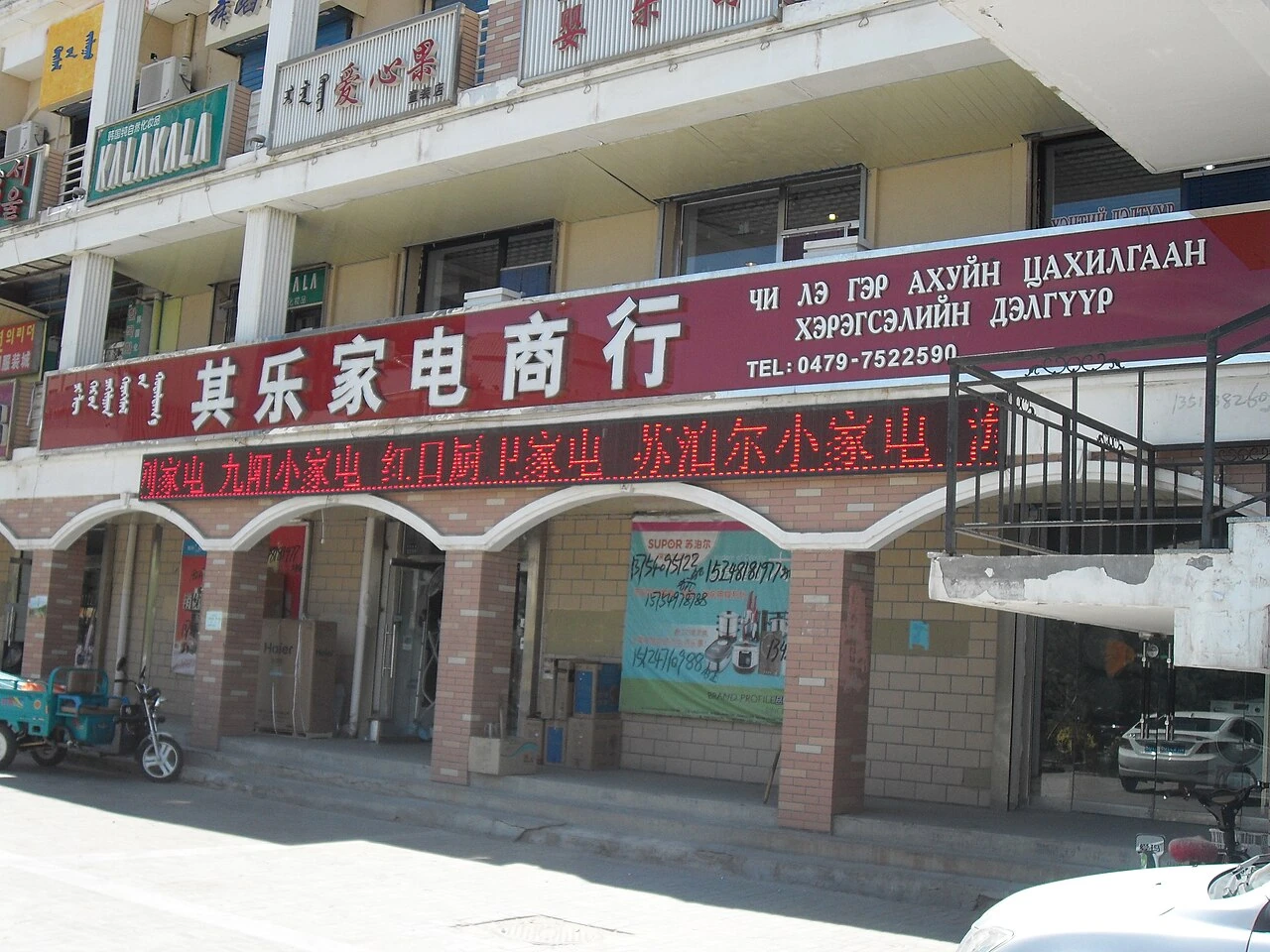
Store sign in Erenhot, 2014, showing Mongolian in both Cyrillic and traditional Mongolian writing alongside Chinese. Source-identified language; displayed without additional cropping.
Saved in Babelbook · resized display copy. Select the image to open it independently of its source.
Terfili · Source ↗CC BY-SA 4.0 ↗View the local visual field note
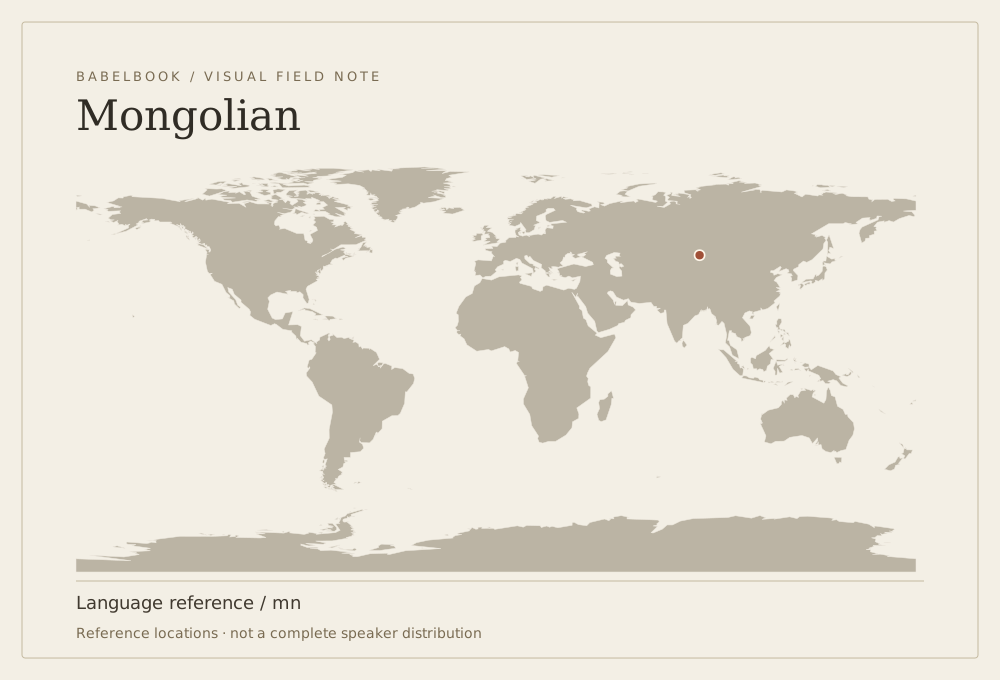
Representative reference points from Glottolog. Historical entries show reference locations, not current speakers. 1 point.
Reference & context ↗Babelbook · original editorial illustration · CC BY 4.0 · Glottolog locations; public-domain Natural Earth land
Source excerpts, selected, shortened and where noted editorially corrected from Mongolian language by Wikipedia contributors. Retrieved 2026-10-05. CC BY-SA 4.0. These excerpts are not an independently verified scholarly history; missing accounts are identified above.
Read further in the source
History
The earliest surviving Mongolian text may be the Stele of Yisüngge, a report on sports composed in Mongolian script on stone, which is most often dated at 1224 or 1225. The Mongolian-Armenian wordlist of 55 words compiled by Kirakos of Gandzak (13th century) is the first manuscript evidence of the language. From the 13th to the 15th centuries, Mongolian language texts were written in four scripts (not counting some vocabulary written in Western scripts): Uyghur Mongolian (UM) script (an adaptation of the Uyghur alphabet ), 'Phags-pa script (Ph) (used in decrees), Chinese (SM) (The Secret History of the Mongols), and Arabic (AM) (used in dictionaries). While they are the earliest texts available, these texts have come to be called "Middle Mongol" in scholarly practice. The documents in UM script show some distinct linguistic characteristics and are therefore often distinguished by terming their language "Preclassical Mongolian". The Yuan dynasty referred to the Mongolian language in Chinese as "Guoyu" (Chinese: 國語), which means "National language", a term also used by other non-Han dynasties to refer to their languages such as the Manchu language during the Qing dynasty, the Jurchen language during the Jin dynasty (1115–1234), the Khitan language during the Liao dynasty, and the Xianbei language during the Northern Wei period. The next distinct period is Classical Mongolian, which is dated from the 17th to the 19th century. This is a written language with a high degree of standardization in orthography and syntax that sets it quite apart from the subsequent Modern Mongolian. The most notable documents in this language are the Mongolian Kangyur and Tengyur as well as several chronicles. In 1686, the Soyombo alphabet (Buddhist texts) was created, giving distinctive evidence on early classical Mongolian phonological peculiarities.
Geographic distribution
Mongolian is the official national language of Mongolia, where it is spoken (but not always written) by nearly 3.6 million people (2014 estimate), and the official provincial language (both spoken and written forms) of Inner Mongolia, where there are at least 4.1 million ethnic Mongols. Across the whole of China, the language is spoken by roughly half of the country's 5.8 million ethnic Mongols (2005 estimate). In Inner Mongolia specifically, about 2.1 million people speak Mongolian. The use of Mongolian in Inner Mongolia has witnessed periods of decline and revival over the last few hundred years. The language experienced a decline during the late Qing period, a revival between 1947 and 1965, a second decline between 1966 and 1976, a second revival between 1977 and 1992, and a third decline between 1995 and 2012. However, in spite of the decline of the Mongolian language in some of Inner Mongolia's urban areas and educational spheres, the ethnic identity of the urbanized Chinese-speaking Mongols is most likely going to survive due to the presence of urban ethnic communities. The multilingual situation in Inner Mongolia does not appear to obstruct efforts by ethnic Mongols to preserve their language. Although an unknown number of Mongols in China, such as the Tumets, may have completely or partially lost the ability to speak their language, they are still registered as ethnic Mongols and continue to identify themselves as ethnic Mongols. The children of inter-ethnic Mongol-Chinese marriages also claim to be and are registered as ethnic Mongols so they can benefit from the preferential policies for minorities in education, healthcare, family planning, school admissions, the hiring and promotion, the financing and taxation of businesses, and regional infrastructural support given to ethnic minorities in China. In 2020, the Chinese government required three subjects—language and literature, politics, and history—to be taught in Mandarin in Mongolian-language primary and secondary schools in the Inner Mongolia since September, which caused widespread protests among ethnic Mongol communities. These protests were quickly suppressed by the Chinese government. Mandarin has been deemed the only language of instruction for all subjects as of September 2023.
List of dialects
Juha Janhunen (2003: 179) lists the following Mongol dialects, most of which are spoken in Inner Mongolia.
Tongliao group Horchin Jasagtu Jarut Jalait Dörbet Gorlos Juu Uda group Aru Horchin Baarin Ongniut Naiman Aohan Josotu group Harachin Tümet Ulan cab group Cahar Urat Darhan Muumingan Dörben Küüket Keshigten Shilingol group Üdzümüchin Huuchit Abaga Abaganar Sönit Outer Mongolian group Halh Hotogoit Darhad Congol Sartul Dariganga
Writing systems
Mongolian has been written in a variety of alphabets, making it a language with one of the largest number of scripts used historically. The earliest stages of Mongolian (Xianbei, Wuhuan languages) may have used an indigenous runic script as indicated by Chinese sources. The Khitan large script adopted in 920 CE is an early Mongol (or according to some, para-Mongolic) script. The traditional Mongolian script was first adopted by Genghis Khan in 1204, who recognized the need to represent his own people's language. It developed from the Uyghur script when several members of the Uyghur elite who were brought into the Mongol confederation early on shared their knowledge of their written language with the Mongol imperial clan. Among the Uyghurs sharing that knowledge were Tata-tonga (Chinese: 塔塔統阿), Bilge Buqa (比俚伽普華), Kara Igach Buyruk (哈剌亦哈赤北魯), and Mengsus (孟速思). From that time, the script underwent some minor disambiguations and supplementation. Between 1930 and 1932, a short-lived attempt was made to introduce the Latin script in the Mongolian state. In 1941, the Latin alphabet was adopted, though it lasted only two months. The Mongolian Cyrillic script was the result of the spreading of Russian influence following the expansion of the Russian Empire. The establishment of the Soviet Union helped the influence continue, and the Cyrillic alphabet was slowly introduced with the effort by Russian/Soviet linguists in collaboration with their Mongolian counterparts. It was made mandatory by government decree in 1941. The introduction of the Cyrillic script, with its smaller discrepancy between written and spoken form, contributed to the success of the large-scale government literacy campaign, which increased the literacy rate from 17.3% to 73.5% between 1941 and 1950. Earlier government campaigns to eradicate illiteracy, employing the traditional script, had only managed to raise literacy from 3.0% to 17.3% between 1921 and 1940. From 1991 to 1994, an attempt at reintroducing the traditional alphabet failed in the face of popular resistance. In informal contexts of electronic text production, the use of the Latin alphabet is common. In the People's Republic of China, Mandarin Chinese is the official language along with Mongolian in some regions, notably the entire Inner Mongolia Autonomous Region. The traditional alphabet has always been used there, although Cyrillic was considered briefly before the Sino-Soviet split. There are two types of written Mongolian used in China: the traditional Mongolian script, which is official among Mongols nationwide, and the Clear Script, used predominantly among Oirats in Xinjiang. In March 2020, the Mongolian government announced plans to use both Cyrillic and the traditional Mongolian script in official documents by 2025.