Marathi
Marathi ( mə-RAH-tee; मराठी, 𑘦𑘨𑘰𑘙𑘲, Marāṭhī, pronounced [məˈɾaːʈʰiː] ) is a classical Indo-Aryan language predominantly spoken by the Marathi people in the Indian state of Maharashtra, and is also spoken in Goa and the territory of Dadra and Nagar Haveli and Daman and Diu. A Marathi-speaking community also exists in Karachi, Pakistan. It is the official language of Maharashtra, and an additional official language in the state of Goa. Derived from Maharashtri Prakrit, it is one of the 22 scheduled languages of India, with 83 million speakers as of 2011. Marathi ranks 15th in the list of languages with the most native speakers in the world. Marathi has the third largest number of native speakers in India, after Hindustani (Hindi / Urdu) and Bengali. Marathi has some of the oldest literature of all modern Indian languages. The major dialects of Marathi are Standard Marathi and the Varhadi Marathi. Marathi was designated as a classical language by the Government of India in October 2024. Marathi distinguishes inclusive and exclusive forms of 'we' and possesses three genders: masculine, feminine, and neuter. Its phonology contrasts apico-alveolar with alveopalatal affricates and alveolar with retroflex laterals ([l] and [ɭ] (Marathi letters ल and ळ respectively).
Translate in Marathi ↗Marathi is primarily spoken in Maharashtra, with 68% of the State's population as their mother tongue, and some parts of neighbouring states of Gujarat (majorly in Vadodara, and among a small number of population in Surat), Madhya Pradesh (in the districts of Burhanpur, Betul, Chhindwara and Balaghat), Goa, Chhattisgarh, Tamil Nadu (in Thanjavur) and Karnataka (in the districts of Belagavi, Karwar, Bagalkote, Vijayapura, Kalaburagi and Bidar), Telangana, union-territories of Daman and Diu and Dadra and Nagar Haveli. The former Maratha ruled cities of Baroda, Indore, Gwalior, Jabalpur, and Tanjore have had sizeable Marathi-speaking populations for centuries. Marathi is also spoken by Maharashtrian migrants to other parts of India and overseas. For instance, the people from western India who emigrated to Mauritius in the early 19th century also speak Marathi. There were 83 million native Marathi speakers in India, according to the 2011 census, making it the third most spoken native language after Hindi and Bengali. Native Marathi speakers form 6.86% of India's population. Native speakers of Marathi formed 68% of the population in Maharashtra, 10.89% in Goa, 7.01% in Dadra and Nagar Haveli, 4.53% in Daman and Diu, 3.38% in Karnataka, 1.7% in Madhya Pradesh, and 1.52% in Gujarat. Marathi is the official language of Maharashtra and additional official language in the state of Goa. In Goa, Konkani is the sole official language; however, Marathi may also be used for any or all official purposes in case any request is received in Marathi. Marathi is included among the languages that are part of the Eighth Schedule of the Constitution of India, thus granting it the status of a "scheduled language".
South Asia
Present-day use
Marathi is the official language of Maharashtra and additional official language in the state of Goa. In Goa, Konkani is the sole official language; however, Marathi may also be used for any or all official purposes in case any request is received in Marathi. Marathi is included among the languages that are part of the Eighth Schedule of the Constitution of India, thus granting it the status of a "scheduled language". The Government of Maharashtra has applied to the Ministry of Culture to grant classical language status to Marathi language, which was approved by the Government of India on 3 October 2024. The contemporary grammatical rules described by Maharashtra Sahitya Parishad and endorsed by the Government of Maharashtra are supposed to take precedence in standard written Marathi. Traditions of Marathi Linguistics and the above-mentioned rules give special status to tatsamas, words adapted from Sanskrit. This special status expects the rules for tatsamas to be followed as in Sanskrit. This practice provides Marathi with a large corpus of Sanskrit words to cope with the demands of new technical words whenever needed. Currently there are many different dialects spoken across India for example, Konkani,Mumbaikar etc. In addition to all universities in Maharashtra, Maharaja Sayajirao University of Baroda in Vadodara, Osmania University in Hyderabad, Karnataka University in Dharwad, Gulbarga University in Kalaburagi, Devi Ahilya University in Indore and Goa University in Goa have special departments for higher studies in Marathi linguistics. Jawaharlal Nehru University (New Delhi) has announced plans to establish a special department for Marathi. Marathi Day is celebrated on 27 February, the birthday of the poet Kusumagraj (Vishnu Vaman Shirwadkar).
Origins
Paumachariyam from around 100 CE, which was written by Acharya Vimalsuri is the earliest known Jain version of the Ramayana and the oldest work of literature written in Maharashtri Prakrit, indicating ancient links of Jainism with Maharashtri Prakrit. Jain authors formed the oldest non-Varkari streams of medieval Marathi literature. Their writings were mainly religious, ethical and didactic, often adapting Jain narrative traditions from Sanskrit, Prakrit and Apabhramsha into regional literary expression. Jain literary activity in Maharashtra was connected with the wider presence of Jain communities in the Deccan and Konkan during the early and later medieval periods. Medieval Jain Marathi works generally emphasised themes such as ahimsa, karma, Jain vegetarianism, soul awareness, renunciation, right conduct and spiritual discipline. Jain poets also contributed to narrative and moral literature, including religious biographies of Tirthankars, stories and instructional compositions. The Sahitya Akademi history of Marathi literature records Jain contributions as part of the development of classical Marathi literature. One later medieval Jain author associated with Marathi writing was Gunakirti, who is credited with the Marathi text Dharmamrita. Such works show that Jain scholars used Marathi not only for literary expression but also for communicating religious and ethical teachings to lay communities. Spoken Marathi contains a high number of Sanskrit-derived (tatsama) words. Such words are for example nantar (from nantara or after), pūrṇa (pūrṇa or complete, full, or full measure of something), ola (ola or damp), kāraṇ (kāraṇa or cause), puṣkaḷ (puṣkala or much, many), satat (satata or always), vichitra (vichitra or strange), svatah (svatah or himself/herself), prayatna (prayatna or effort, attempt), bhītī (from bhīti, or fear) and bhāṇḍe (bhāṇḍa or vessel for cooking or storing food).
Development
Modern Indo-Aryan languages, including Marathi, that belong to the Indo-Aryan language family are derived from Prakrits via Apabhraṃśa. Marathi is one of several languages that further descend from Maharashtri Prakrit. Further changes led to the formation of Apabhraṃśa, followed by Old Marathi. However, this is challenged by Bloch (1970), who states that Apabhraṃśa was formed after Marathi had already separated from the Middle Indo-Aryan dialect. Marathi, a derivative of Maharashtri, is probably first attested in a 739 CE copper-plate inscription found in Satara. Several inscriptions dated to the second half of the 11th century feature Marathi, which is usually appended to Sanskrit or Kannada in these inscriptions. The earliest Marathi-only inscriptions are the ones issued during the Shilahara rule, including a c. 1012 CE stone inscription from Akshi taluka of Raigad district and a 1060 or 1086 CE copper-plate inscription from Dive that records a land grant (agrahara) to a Brahmin. A 2-line 1118 CE Prakrit inscription at Shravanabelagola records a grant by the Hoysalas. These inscriptions suggest that Prakrit was a standard written language by the 12th century. However, after the Gaha Sattasai, there is no record of any literature produced in Marathi until the late 13th century. The 11th-century Svetambara Jain polymath Acharya Hemchandra, the grammarian of Maharashtri Prakrit, played a significant role in the preservation and study of Maharashtri Prakrit. In his grammatical treatise, the Siddha-Hema-Śabdānuśāsana, Hemachandra systematically described and laid down rules for several Middle Indo-Aryan languages, including Maharashtri Prakrit, which was one of the principal literary Prakrits of ancient India. His work remain the most important source for modern scholars studying the grammar, vocabulary, and literary traditions of Maharashtri Prakrit and its influence on later Indo-Aryan languages.
Writing
The Kadamba script and its variants have been historically used to write Marathi in the form of inscriptions on stones and copper plates. The Marathi variant of Devanagari, called Balbodh, is similar to the Hindi Devanagari alphabet except for its use for certain words. Some words in Marathi preserve the schwa, which has been omitted in other languages which use Devanagari. For example, the word 'रंग' (colour) is pronounced as 'ranga' in Marathi & 'rang' in other languages using Devanagari, and 'खरं' (true), despite the anuswara, is pronounced as 'khara'. The anuswara in this case is used to avoid schwa deletion in pronunciation; most other languages using Devanagari show schwa deletion in pronunciation despite the presence of schwa in the written spelling. From the 13th century until the beginning of British rule in the 19th century, Marathi was written in the Modi script for administrative purposes but in Devanagari for literature. Since 1950 it has been written in the Balbodh style of Devanagari. Except for Father Thomas Stephens' Krista Purana in the Latin script in the 1600s, Marathi has mainly been printed in Devanagari because William Carey, the pioneer of printing in Indian languages, was only able to print in Devanagari. He later tried printing in Modi but by that time, Balbodh Devanagari had been accepted for printing. Marathi is usually written in the Balbodh variant of Devanagari script, an abugida consisting of 36 consonant letters and 16 initial-vowel letters. It is written from left to right. The Devanagari alphabet used to write Marathi is slightly different from the Devanagari alphabets of Hindi and other languages: there are additional letters in the Marathi alphabet and Western punctuation is used. William Carey in 1807 Observed that as with other parts of India, a traditional duality existed in script usage between Devanagari for religious texts, and Modi for commerce and administration.
Beyond the typeface.
Signs, manuscripts, published pages and contextual photographs, with their place, period, source and reuse terms. Captions identify historical spellings, regional examples, community references and character imagery.
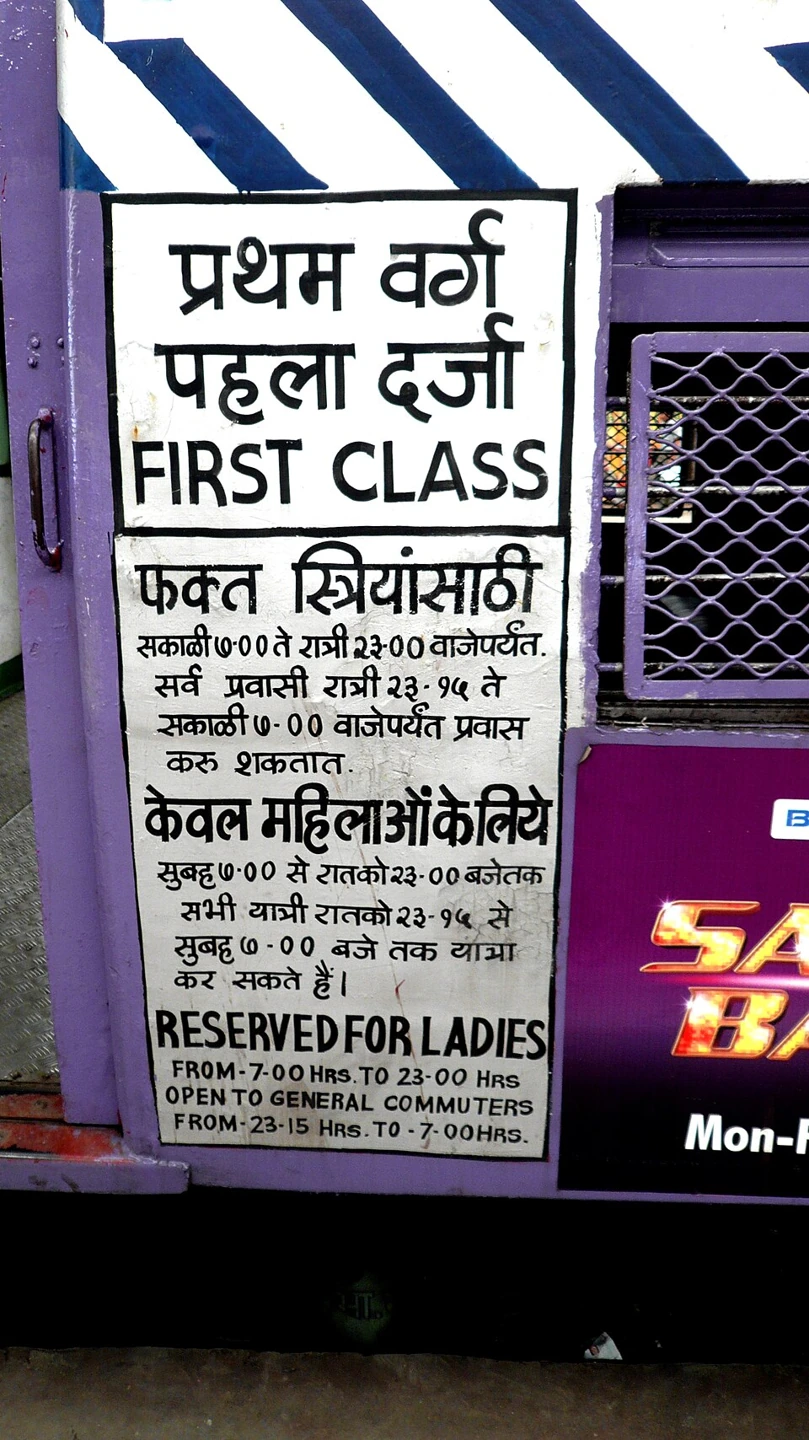
First-class ladies’ compartment sign at Churchgate station, Mumbai; Commons identifies English, Hindi and Marathi. Language identification follows Commons metadata; not independently transcribed.
Saved in Babelbook · resized display copy. Select the image to open it independently of its source.
Cory Doctorow · Source ↗CC BY-SA 2.0 ↗View the local visual field note
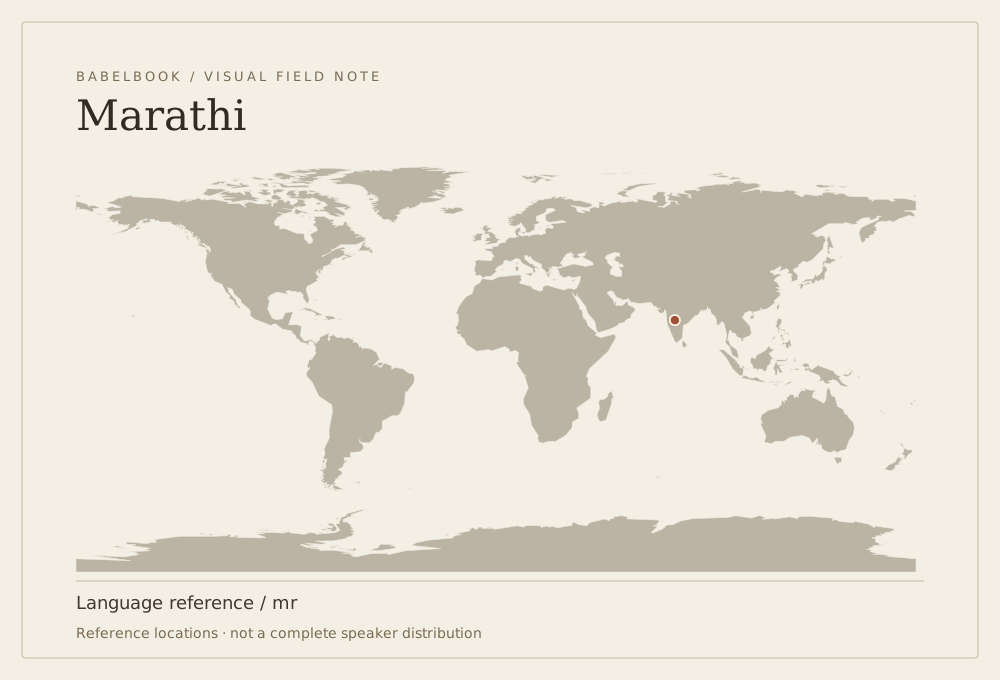
Representative reference points from Glottolog. Historical entries show reference locations, not current speakers. 1 point.
Reference & context ↗Babelbook · original editorial illustration · CC BY 4.0 · Glottolog locations; public-domain Natural Earth land
Source excerpts, selected, shortened and where noted editorially corrected from Marathi language by Wikipedia contributors. Retrieved 2026-10-05. CC BY-SA 4.0. These excerpts are not an independently verified scholarly history; missing accounts are identified above.
Read further in the source
History
Modern Indo-Aryan languages, including Marathi, that belong to the Indo-Aryan language family are derived from Prakrits via Apabhraṃśa. Marathi is one of several languages that further descend from Maharashtri Prakrit. Further changes led to the formation of Apabhraṃśa, followed by Old Marathi. However, this is challenged by Bloch (1970), who states that Apabhraṃśa was formed after Marathi had already separated from the Middle Indo-Aryan dialect. Marathi, a derivative of Maharashtri, is probably first attested in a 739 CE copper-plate inscription found in Satara. Several inscriptions dated to the second half of the 11th century feature Marathi, which is usually appended to Sanskrit or Kannada in these inscriptions. The earliest Marathi-only inscriptions are the ones issued during the Shilahara rule, including a c. 1012 CE stone inscription from Akshi taluka of Raigad district and a 1060 or 1086 CE copper-plate inscription from Dive that records a land grant (agrahara) to a Brahmin. A 2-line 1118 CE Prakrit inscription at Shravanabelagola records a grant by the Hoysalas. These inscriptions suggest that Prakrit was a standard written language by the 12th century. However, after the Gaha Sattasai, there is no record of any literature produced in Marathi until the late 13th century. The 11th-century Svetambara Jain polymath Acharya Hemchandra, the grammarian of Maharashtri Prakrit, played a significant role in the preservation and study of Maharashtri Prakrit. In his grammatical treatise, the Siddha-Hema-Śabdānuśāsana, Hemachandra systematically described and laid down rules for several Middle Indo-Aryan languages, including Maharashtri Prakrit, which was one of the principal literary Prakrits of ancient India. His work remain the most important source for modern scholars studying the grammar, vocabulary, and literary traditions of Maharashtri Prakrit and its influence on later Indo-Aryan languages. He is also revered as the Father of Gujarati language.
Jain Origins
Paumachariyam from around 100 CE, which was written by Acharya Vimalsuri is the earliest known Jain version of the Ramayana and the oldest work of literature written in Maharashtri Prakrit, indicating ancient links of Jainism with Maharashtri Prakrit. Jain authors formed the oldest non-Varkari streams of medieval Marathi literature. Their writings were mainly religious, ethical and didactic, often adapting Jain narrative traditions from Sanskrit, Prakrit and Apabhramsha into regional literary expression. Jain literary activity in Maharashtra was connected with the wider presence of Jain communities in the Deccan and Konkan during the early and later medieval periods. Medieval Jain Marathi works generally emphasised themes such as ahimsa, karma, Jain vegetarianism, soul awareness, renunciation, right conduct and spiritual discipline. Jain poets also contributed to narrative and moral literature, including religious biographies of Tirthankars, stories and instructional compositions. The Sahitya Akademi history of Marathi literature records Jain contributions as part of the development of classical Marathi literature. One later medieval Jain author associated with Marathi writing was Gunakirti, who is credited with the Marathi text Dharmamrita. Such works show that Jain scholars used Marathi not only for literary expression but also for communicating religious and ethical teachings to lay communities.
Geographic distribution
Marathi is primarily spoken in Maharashtra, with 68% of the State's population as their mother tongue, and some parts of neighbouring states of Gujarat (majorly in Vadodara, and among a small number of population in Surat), Madhya Pradesh (in the districts of Burhanpur, Betul, Chhindwara and Balaghat), Goa, Chhattisgarh, Tamil Nadu (in Thanjavur) and Karnataka (in the districts of Belagavi, Karwar, Bagalkote, Vijayapura, Kalaburagi and Bidar), Telangana, union-territories of Daman and Diu and Dadra and Nagar Haveli. The former Maratha ruled cities of Baroda, Indore, Gwalior, Jabalpur, and Tanjore have had sizeable Marathi-speaking populations for centuries. Marathi is also spoken by Maharashtrian migrants to other parts of India and overseas. For instance, the people from western India who emigrated to Mauritius in the early 19th century also speak Marathi. There were 83 million native Marathi speakers in India, according to the 2011 census, making it the third most spoken native language after Hindi and Bengali. Native Marathi speakers form 6.86% of India's population. Native speakers of Marathi formed 68% of the population in Maharashtra, 10.89% in Goa, 7.01% in Dadra and Nagar Haveli, 4.53% in Daman and Diu, 3.38% in Karnataka, 1.7% in Madhya Pradesh, and 1.52% in Gujarat.
Status
Marathi is the official language of Maharashtra and additional official language in the state of Goa. In Goa, Konkani is the sole official language; however, Marathi may also be used for any or all official purposes in case any request is received in Marathi. Marathi is included among the languages that are part of the Eighth Schedule of the Constitution of India, thus granting it the status of a "scheduled language". The Government of Maharashtra has applied to the Ministry of Culture to grant classical language status to Marathi language, which was approved by the Government of India on 3 October 2024. The contemporary grammatical rules described by Maharashtra Sahitya Parishad and endorsed by the Government of Maharashtra are supposed to take precedence in standard written Marathi. Traditions of Marathi Linguistics and the above-mentioned rules give special status to tatsamas, words adapted from Sanskrit. This special status expects the rules for tatsamas to be followed as in Sanskrit. This practice provides Marathi with a large corpus of Sanskrit words to cope with the demands of new technical words whenever needed. Currently there are many different dialects spoken across India for example, Konkani,Mumbaikar etc. In addition to all universities in Maharashtra, Maharaja Sayajirao University of Baroda in Vadodara, Osmania University in Hyderabad, Karnataka University in Dharwad, Gulbarga University in Kalaburagi, Devi Ahilya University in Indore and Goa University in Goa have special departments for higher studies in Marathi linguistics. Jawaharlal Nehru University (New Delhi) has announced plans to establish a special department for Marathi. Marathi Day is celebrated on 27 February, the birthday of the poet Kusumagraj (Vishnu Vaman Shirwadkar).
Dialects
Standard Marathi is based on dialects used by academics and the print media. Indic scholars distinguish 42 dialects of spoken Marathi. Dialects bordering other major language areas have many properties in common with those languages, further differentiating them from standard spoken Marathi. The bulk of the variation within these dialects is primarily lexical and phonological (e.g. accent placement and pronunciation). Although the number of dialects is considerable, the degree of intelligibility within these dialects is relatively high.
Writing systems
The Kadamba script and its variants have been historically used to write Marathi in the form of inscriptions on stones and copper plates. The Marathi variant of Devanagari, called Balbodh, is similar to the Hindi Devanagari alphabet except for its use for certain words. Some words in Marathi preserve the schwa, which has been omitted in other languages which use Devanagari. For example, the word 'रंग' (colour) is pronounced as 'ranga' in Marathi & 'rang' in other languages using Devanagari, and 'खरं' (true), despite the anuswara, is pronounced as 'khara'. The anuswara in this case is used to avoid schwa deletion in pronunciation; most other languages using Devanagari show schwa deletion in pronunciation despite the presence of schwa in the written spelling. From the 13th century until the beginning of British rule in the 19th century, Marathi was written in the Modi script for administrative purposes but in Devanagari for literature. Since 1950 it has been written in the Balbodh style of Devanagari. Except for Father Thomas Stephens' Krista Purana in the Latin script in the 1600s, Marathi has mainly been printed in Devanagari because William Carey, the pioneer of printing in Indian languages, was only able to print in Devanagari. He later tried printing in Modi but by that time, Balbodh Devanagari had been accepted for printing.