Malay
Malay (UK: mə-LAY; endonym: Bahasa Melayu, Jawi script: بهاس ملايو) is an Austronesian pluricentric macrolanguage native to several islands of Maritime Southeast Asia and the Malay Peninsula on mainland Asia. The language is an official language of Brunei, Malaysia, and Singapore, where the standardised forms are known as Standard Malay. Within the Malay language family, another standardised form which is known as Indonesian is the official language in Indonesia and also one of the working languages of Timor-Leste. Malay is the ethnic language of Malays in Sumatra, Borneo and surrounding islands in Indonesia, the Malay Peninsula, southeast Philippines, southern Thailand, and the Southern Province of Sri Lanka. Altogether, it is spoken as a first language by about 80 million people and as a first or second language by close to 300 million. The language is pluricentric and a macrolanguage, i.e., a group of mutually intelligible speech varieties, or dialect continuum, that have no traditional name in common, and which may be considered distinct languages by their speakers.
Translate in Malay ↗Malay (UK: mə-LAY; endonym: Bahasa Melayu, Jawi script: بهاس ملايو) is an Austronesian pluricentric macrolanguage native to several islands of Maritime Southeast Asia and the Malay Peninsula on mainland Asia. The language is an official language of Brunei, Malaysia, and Singapore, where the standardised forms are known as Standard Malay. Within the Malay language family, another standardised form which is known as Indonesian is the official language in Indonesia and also one of the working languages of Timor-Leste. Malay is the ethnic language of Malays in Sumatra, Borneo and surrounding islands in Indonesia, the Malay Peninsula, southeast Philippines, southern Thailand, and the Southern Province of Sri Lanka. Altogether, it is spoken as a first language by about 80 million people and as a first or second language by close to 300 million. The language is pluricentric and a macrolanguage, i.e., a group of mutually intelligible speech varieties, or dialect continuum, that have no traditional name in common, and which may be considered distinct languages by their speakers.
Southeast Asia
Present-day use
The captured source does not contain a separate current-use account.
Origins
Malay historical linguists agree on the likelihood of the Malayic homeland being in western Borneo. A form known as Proto-Malayic was spoken in Borneo at least by 1000 BCE, it has been argued to be the ancestral language of all subsequent Malayic languages. Its ancestor, Proto-Malayo-Polynesian, a descendant of the Proto-Austronesian language, began to break up by at least 2000 BCE, possibly as a result of the southward expansion of Austronesian peoples into Maritime Southeast Asia from the island of Taiwan.
Development
The history of the Malay language can be divided into five periods: Old Malay, the Transitional Period, Classical Malay, Late Modern Malay and Modern Malay. Old Malay is believed to be the actual ancestor of Classical Malay. Old Malay was influenced by Sanskrit, the ancient Indo-Aryan language of India. Sanskrit loan words can be found in Old Malay vocabulary. The earliest known stone inscription in the Old Malay language was found on the island of Sumatra. Written in the Pallava variety of the Grantha alphabet, it is dated 1 May 683. Known as the Kedukan Bukit inscription, it was discovered by the Dutchman C. J. Batenburg on 29 November 1920 at Kedukan Bukit, on the banks of the Tatang River, a tributary of the Musi River, near Palembang, in what is now South Sumatra, Indonesia. The stone measures approximately 45 by 80 centimetres (18 by 31 in). For centuries, Srivijaya, a maritime empire based on the island of Sumatra from the 7th to the 11th centuries, was responsible for the spread of Old Malay throughout the Malay Peninsula and the Malay Archipelago through its expansion and economic power. Old Malay served as the lingua franca of traders and was widely used in various ports and marketplaces across the region. The Tanjung Tanah Law was a 14th-century pre-Islamic legal text that was produced during the reign of Adityawarman (1345–1377) of the Melayu Kingdom (also known as Malayu or Dharmasraya Kingdom), a Hindu-Buddhist kingdom that arose after the end of Srivijayan rule in Sumatra. The laws were for the Minangkabau people, who today still live in the highlands of Sumatra, Indonesia. The Terengganu Inscription Stone (Malay: Batu Bersurat Terengganu; Jawi: باتو برسورت ترڠݢانو) is a granite stele bearing an inscription in Jawi script, discovered in Terengganu, on the east coast of the Malay Peninsula (in what is now Malaysia). It is considered the earliest evidence of Classical Malay.
Writing
Malay is now written using the Latin script, known as Rumi in Brunei, Malaysia and Singapore or Latin in Indonesia, although an Arabic script called Arab Melayu or Jawi also exists. Latin script is official in Malaysia, Singapore, and Indonesia. Malay uses Hindu-Arabic numerals. Rumi (Latin) and Jawi are co-official in Brunei and Malaysia only. Names of institutions and organisations have to use Jawi and Rumi (Latin) scripts in Brunei and some parts of Malaysia. Jawi is used fully in schools, especially the religious school, sekolah agama, which is compulsory during the afternoon for Muslim students aged from around 6–7 up to 12–14. Efforts are currently being undertaken to preserve Jawi in Malaysia, and students taking Malay language examinations in Malaysia have the option of answering questions using Jawi. The Latin script, however, is the most commonly used in Brunei and Malaysia, both for official and informal purposes. Historically, Malay has been written using various scripts. Before the introduction of Arabic script in the Malay region, Malay was written using the Pallava, Kawi and Rencong scripts; these scripts are no longer frequently used, but similar scripts such as the Cham alphabet are used by the Chams of Vietnam and Cambodia. Old Malay was written using Pallava and Kawi script, as evident from several inscription stones in the Malay region. Starting from the era of kingdom of Pasai and throughout the golden age of the Malacca Sultanate, Jawi gradually replaced these scripts as the most commonly used script in the Malay region. Starting from the 17th century, under Dutch and British influence, Jawi was gradually replaced by the Rumi script.
Beyond the typeface.
Signs, manuscripts, published pages and contextual photographs, with their place, period, source and reuse terms. Captions identify historical spellings, regional examples, community references and character imagery.
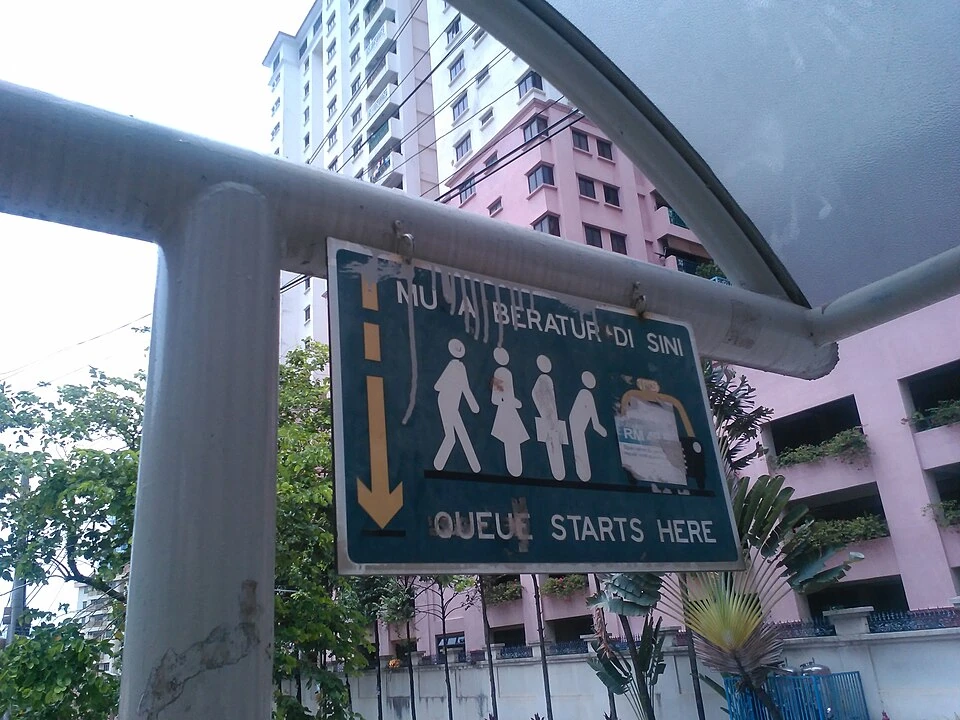
Malay queue instruction on a sign in the Kuala Lumpur area. Language identification follows the source description; not independently transcribed.
Saved in Babelbook · resized display copy. Select the image to open it independently of its source.
WhisperToMe · Source ↗CC0 1.0 ↗View the local visual field note
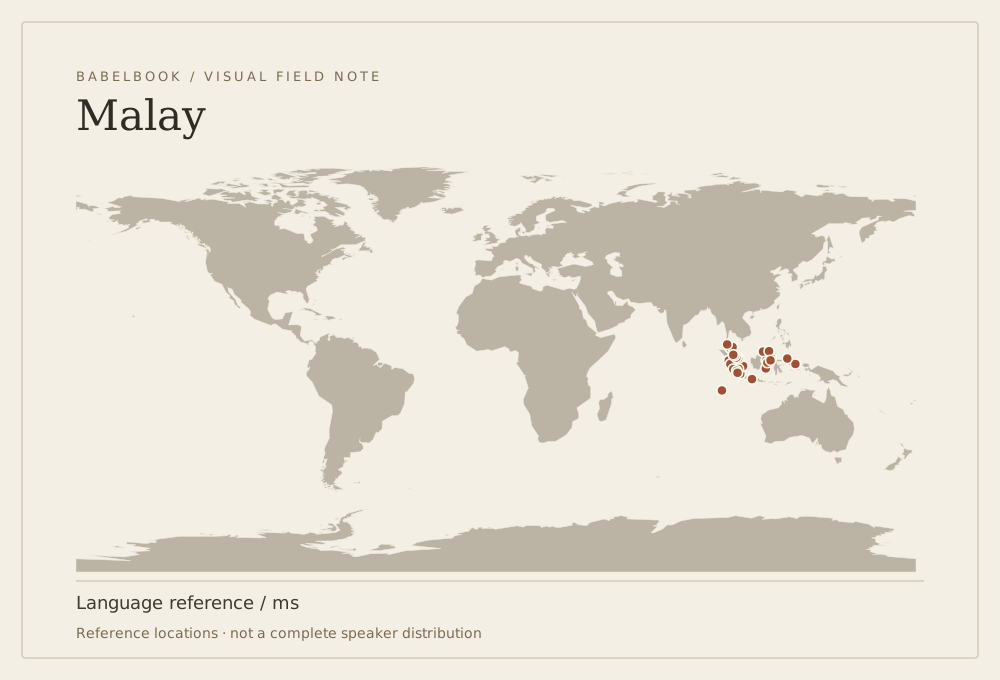
Representative reference points from Glottolog. Historical entries show reference locations, not current speakers. 36 points.
Reference & context ↗Babelbook · original editorial illustration · CC BY 4.0 · Glottolog locations; public-domain Natural Earth land
Source excerpts, selected, shortened and where noted editorially corrected from Malay language by Wikipedia contributors. Retrieved 2026-10-05. CC BY-SA 4.0. These excerpts are not an independently verified scholarly history; missing accounts are identified above.
Read further in the source
Origin
Malay historical linguists agree on the likelihood of the Malayic homeland being in western Borneo. A form known as Proto-Malayic was spoken in Borneo at least by 1000 BCE, it has been argued to be the ancestral language of all subsequent Malayic languages. Its ancestor, Proto-Malayo-Polynesian, a descendant of the Proto-Austronesian language, began to break up by at least 2000 BCE, possibly as a result of the southward expansion of Austronesian peoples into Maritime Southeast Asia from the island of Taiwan.
History
The history of the Malay language can be divided into five periods: Old Malay, the Transitional Period, Classical Malay, Late Modern Malay and Modern Malay. Old Malay is believed to be the actual ancestor of Classical Malay. Old Malay was influenced by Sanskrit, the ancient Indo-Aryan language of India. Sanskrit loan words can be found in Old Malay vocabulary. The earliest known stone inscription in the Old Malay language was found on the island of Sumatra. Written in the Pallava variety of the Grantha alphabet, it is dated 1 May 683. Known as the Kedukan Bukit inscription, it was discovered by the Dutchman C. J. Batenburg on 29 November 1920 at Kedukan Bukit, on the banks of the Tatang River, a tributary of the Musi River, near Palembang, in what is now South Sumatra, Indonesia. The stone measures approximately 45 by 80 centimetres (18 by 31 in). For centuries, Srivijaya, a maritime empire based on the island of Sumatra from the 7th to the 11th centuries, was responsible for the spread of Old Malay throughout the Malay Peninsula and the Malay Archipelago through its expansion and economic power. Old Malay served as the lingua franca of traders and was widely used in various ports and marketplaces across the region. The Tanjung Tanah Law was a 14th-century pre-Islamic legal text that was produced during the reign of Adityawarman (1345–1377) of the Melayu Kingdom (also known as Malayu or Dharmasraya Kingdom), a Hindu-Buddhist kingdom that arose after the end of Srivijayan rule in Sumatra. The laws were for the Minangkabau people, who today still live in the highlands of Sumatra, Indonesia. The Terengganu Inscription Stone (Malay: Batu Bersurat Terengganu; Jawi: باتو برسورت ترڠݢانو) is a granite stele bearing an inscription in Jawi script, discovered in Terengganu, on the east coast of the Malay Peninsula (in what is now Malaysia). It is considered the earliest evidence of Classical Malay. Dated approximately to 702 AH (1303 CE), it represents the oldest known evidence of Jawi writing in the Malay world and stands as one of the earliest testimonies to the advent of Islam as a state religion in the region. The inscription contains a proclamation issued by a ruler of Terengganu, referred to as Seri Paduka Tuan, urging his subjects to uphold and propagate Islam, while outlining 10 basic Sharia laws as guidance. Classical Malay came into widespread use as the lingua franca of the region during the Malacca Sultanate era (1402–1511), a powerful maritime kingdom strategically located along the Strait of Malacca that became a hub of international trade and Islamic learning in the region. During this period, the Malay language developed rapidly under the influence of Islamic literature, which brought about significant linguistic changes, including a massive infusion of Arabic vocabulary, as well as continued influence from Sanskrit and Tamil. This enriched form of the language came to be known as Classical Malay. It was during this time the language evolved into a form recognisable to speakers of modern Malay. After the Capture of Malacca by the Portuguese in 1511, marking the fall of the Malacca Sultanate, the royal court re-established itself as the Johor Sultanate. The court continued to use Classical Malay as its literary and administrative language. Over time, this literary tradition became strongly associated with the territories under the sultanate, including the present-day Malaysian state of Johor and the Indonesian province of Riau Islands. As a result, many assumed that the spoken Malay of Johor and Riau was closely related to Classical Malay. However, while the literary language used in the region reflects the classical tradition, the local spoken dialects differ. The fall of Malacca led to the dispersal of Malay literary centres, as many literati and scholars sought refuge in areas outside the immediate control of European colonial powers. As a result, new Malay literary works began to emerge from Aceh, Java, Makassar, the Moluccas, Champa, and other regions. Among the oldest surviving letters written in Malay are the letters from Sultan Abu Hayat of Ternate, in the Maluku Islands of present-day Indonesia, dated around 1521–1522. The text is addressed to the king of Portugal, following contact with Portuguese explorer Francisco Serrão. The letters show a sign of non-native usage, as the Ternateans used (and still use) the unrelated Ternate language, a West Papuan language, as their first language. Malay was used solely as a lingua franca for inter-ethnic communications. The 19th century marked a period of strong Western political and commercial domination in the Malay Peninsula and the Malay Archipelago. The colonial demarcation brought by the 1824 Anglo-Dutch Treaty led to Dutch East India Company effectively colonising the East Indies in the south, while the British Empire held several colonies and protectorates in the Malay peninsula and Borneo in the north. Both colonial powers used the Malay language as a tool of centralisation and modernisation. They made use of each other's scholarly publications in developing the standardised versions of the Malay language. The flourishing of pre-modern Malay literature in the 19th century led to the rise of intellectual movements among the locals and the emergence of new communities of Malay linguists.
Writing system
Malay is now written using the Latin script, known as Rumi in Brunei, Malaysia and Singapore or Latin in Indonesia, although an Arabic script called Arab Melayu or Jawi also exists. Latin script is official in Malaysia, Singapore, and Indonesia. Malay uses Hindu-Arabic numerals.
Rumi (Latin) and Jawi are co-official in Brunei and Malaysia only. Names of institutions and organisations have to use Jawi and Rumi (Latin) scripts in Brunei and some parts of Malaysia. Jawi is used fully in schools, especially the religious school, sekolah agama, which is compulsory during the afternoon for Muslim students aged from around 6–7 up to 12–14. Efforts are currently being undertaken to preserve Jawi in Malaysia, and students taking Malay language examinations in Malaysia have the option of answering questions using Jawi. The Latin script, however, is the most commonly used in Brunei and Malaysia, both for official and informal purposes. Historically, Malay has been written using various scripts. Before the introduction of Arabic script in the Malay region, Malay was written using the Pallava, Kawi and Rencong scripts; these scripts are no longer frequently used, but similar scripts such as the Cham alphabet are used by the Chams of Vietnam and Cambodia. Old Malay was written using Pallava and Kawi script, as evident from several inscription stones in the Malay region. Starting from the era of kingdom of Pasai and throughout the golden age of the Malacca Sultanate, Jawi gradually replaced these scripts as the most commonly used script in the Malay region. Starting from the 17th century, under Dutch and British influence, Jawi was gradually replaced by the Rumi script.