Maltese
Maltese (Maltese: Malti, also L-Ilsien Malti or Lingwa Maltija) is a Central Semitic language derived from late medieval Sicilian Arabic. It is the only Semitic language officially written in the Latin script. It is spoken by the Maltese people and is a national language of Malta, and is the only official Semitic and Afroasiatic language of the European Union. The pioneering Maltese linguists Canon Giovanni Pietro Francesco Agius de Soldanis and Mikiel Anton Vassalli both mistakenly hypothesised that Maltese originated from the Punic language. Later scholars like John L. Hayes considered it to be descended from a North African dialect of Colloquial Arabic, which was introduced to Malta when the Aghlabids captured it in the 9th century. However, genetic studies and historical evidence have established that Malta was depopulated after that raid, and that the island was subsequently repopulated by settlers from Sicily and Calabria who spoke Siculo-Arabic, which had developed as a Maghrebi Arabic dialect in the Emirate of Sicily between 831 and 1091. As a result of the Norman invasion of Malta and the subsequent re-Christianisation of the islands, Maltese evolved independently of Classical Arabic in a gradual process of Latinisation. It is therefore exceptional as a variety of historical Arabic that has no diglossic relationship with Classical or Modern Standard Arabic. Maltese is thus classified separately from the 30 varieties constituting the modern Arabic macrolanguage.
Translate in Maltese ↗Ethnologue reports a total of 530,000 Maltese speakers: 450,000 in Malta and 79,000 in the diaspora. Most speakers also use English, usually the local dialect known as Maltese English. The largest diaspora community of Maltese speakers is in Australia, with 36,000 speakers reported in 2006 (down from 45,000 in 1996, and expected to decline further). The Maltese linguistic community in Tunisia originated in the 18th century. Numbering several thousand in the 19th century, it was reported to be only 100 to 200 people as of 2017.
Europe
Present-day use
The captured source does not contain a separate current-use account.
Origins
The captured article does not contain a separate origins section. See the historical account and linked source.
Development
The origins of the Maltese language are attributed to the arrival, early in the 11th century, of settlers from neighbouring Sicily, where Siculo-Arabic was spoken, reversing the Fatimid Caliphate's conquest of the island at the end of the 9th century. The Norman conquest in 1091, followed by the expulsion of the Muslims, complete by 1249, permanently isolated the vernacular from its Arabic source, creating the conditions for its evolution into a distinct language. In contrast to Sicily, where Siculo-Arabic became extinct and was replaced by Sicilian, the vernacular in Malta continued to develop alongside Italian, eventually replacing it as official language in 1934, alongside English. The first written reference to the Maltese language is in a will of 1436, where it is called lingua maltensi. The oldest known document in Maltese, Il-Kantilena (Xidew il-Qada) by Pietru Caxaro, dates from the 15th century. The earliest known Maltese dictionary was a 16th-century manuscript entitled "Maltese-Italiano"; it was included in the Biblioteca Maltese of Mifsud in 1764, but is now lost. A list of Maltese words was included in both the Thesaurus Polyglottus (1603) and Propugnaculum Europae (1606) of Hieronymus Megiser, who had visited Malta in 1588–1589; Domenico Magri gave the etymologies of some Maltese words in his Hierolexicon, sive sacrum dictionarium (1677). An early manuscript dictionary, Dizionario Italiano e Maltese, was discovered in the Biblioteca Vallicelliana in Rome in the 1980s, together with a grammar, the Regole per la Lingua Maltese, attributed to a French knight named Thezan. The first systematic lexicon is that of Giovanni Pietro Francesco Agius de Soldanis, who also wrote the first systematic grammar of the language and proposed a standard orthography. The use of the language declined heavily under the British administration of Malta compared with English.
Writing
Since Maltese evolved after the Italo-Normans ended Arab rule of the islands, a written form of the language was not developed for a long time after the expulsion of the Arabs in the middle of the thirteenth century. Under the rule of the Knights Hospitaller, both French and Italian were used for official documents and correspondence. During the British colonial period, the use of English was encouraged through education, with Italian being regarded as the next most important language. In the late 18th century and throughout the 19th century philologists and academics such as Mikiel Anton Vassalli made a concerted effort to standardise written Maltese. Many examples of written Maltese exist from before this period, always in the Latin alphabet, Il-Kantilena from the 15th century being the earliest example of written Maltese. In 1934 Maltese was recognised as an official language.
Beyond the typeface.
Signs, manuscripts, published pages and contextual photographs, with their place, period, source and reuse terms. Captions identify historical spellings, regional examples, community references and character imagery.
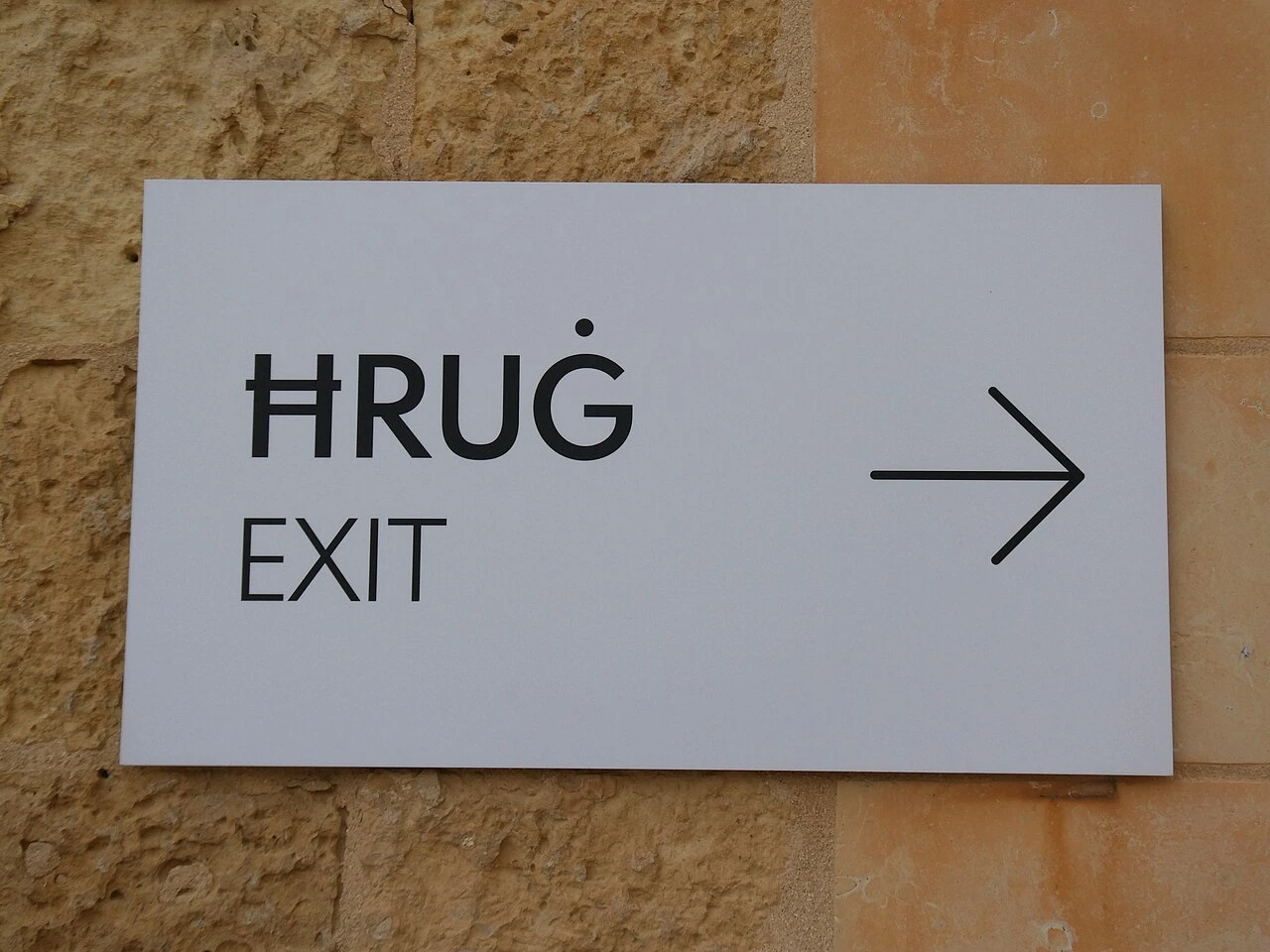
Maltese and English exit sign at Fort Saint Elmo, photographed in December 2025. Language identification follows Commons descriptions or categories; not independently transcribed.
Saved in Babelbook · resized display copy. Select the image to open it independently of its source.
Wainuio · Source ↗CC BY-SA 4.0 ↗View the local visual field note
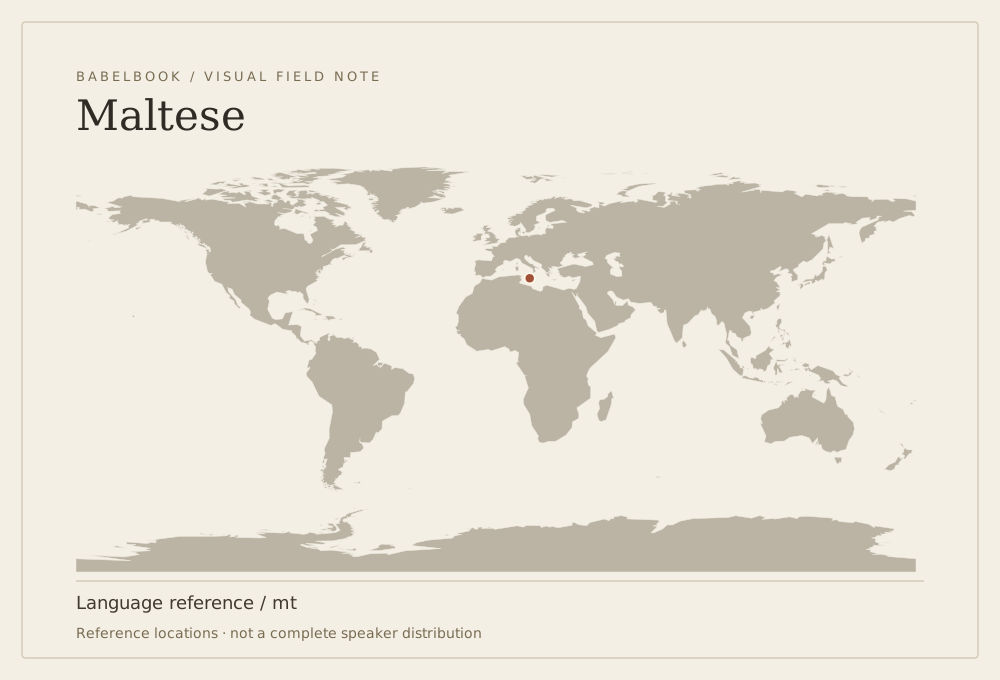
Representative reference points from Glottolog. Historical entries show reference locations, not current speakers. 1 point.
Reference & context ↗Babelbook · original editorial illustration · CC BY 4.0 · Glottolog locations; public-domain Natural Earth land
Source excerpts, selected, shortened and where noted editorially corrected from Maltese language by Wikipedia contributors. Retrieved 2026-10-05. CC BY-SA 4.0. These excerpts are not an independently verified scholarly history; missing accounts are identified above.
Read further in the source
History
The origins of the Maltese language are attributed to the arrival, early in the 11th century, of settlers from neighbouring Sicily, where Siculo-Arabic was spoken, reversing the Fatimid Caliphate's conquest of the island at the end of the 9th century. The Norman conquest in 1091, followed by the expulsion of the Muslims, complete by 1249, permanently isolated the vernacular from its Arabic source, creating the conditions for its evolution into a distinct language. In contrast to Sicily, where Siculo-Arabic became extinct and was replaced by Sicilian, the vernacular in Malta continued to develop alongside Italian, eventually replacing it as official language in 1934, alongside English. The first written reference to the Maltese language is in a will of 1436, where it is called lingua maltensi. The oldest known document in Maltese, Il-Kantilena (Xidew il-Qada) by Pietru Caxaro, dates from the 15th century. The earliest known Maltese dictionary was a 16th-century manuscript entitled "Maltese-Italiano"; it was included in the Biblioteca Maltese of Mifsud in 1764, but is now lost. A list of Maltese words was included in both the Thesaurus Polyglottus (1603) and Propugnaculum Europae (1606) of Hieronymus Megiser, who had visited Malta in 1588–1589; Domenico Magri gave the etymologies of some Maltese words in his Hierolexicon, sive sacrum dictionarium (1677). An early manuscript dictionary, Dizionario Italiano e Maltese, was discovered in the Biblioteca Vallicelliana in Rome in the 1980s, together with a grammar, the Regole per la Lingua Maltese, attributed to a French knight named Thezan. The first systematic lexicon is that of Giovanni Pietro Francesco Agius de Soldanis, who also wrote the first systematic grammar of the language and proposed a standard orthography. The use of the language declined heavily under the British administration of Malta compared with English. Following the independence of Malta, language reforms under the Dom Mintoff government saw the language increase in use and today it is used regularly in Malta.
Dialects
Urban varieties of Maltese are closer to Standard Maltese than rural varieties, which have some characteristics that distinguish them from Standard Maltese. They tend to show some archaic features such as the realisation of ⟨kh⟩ and ⟨gh⟩ and the imāla of Arabic ā into ē (or ī especially in Gozo), considered archaic because they are reminiscent of 15th-century transcriptions of this sound. Another archaic feature is the realisation of Standard Maltese ā as ō in rural dialects. There is also a tendency to diphthongise simple vowels, e.g. ū becomes eo or eu. Rural dialects also tend to employ more Semitic roots and broken plurals than Standard Maltese. In general rural Maltese is less distant from its Siculo-Arabic ancestor than is Standard Maltese.
Written Maltese
Since Maltese evolved after the Italo-Normans ended Arab rule of the islands, a written form of the language was not developed for a long time after the expulsion of the Arabs in the middle of the thirteenth century. Under the rule of the Knights Hospitaller, both French and Italian were used for official documents and correspondence. During the British colonial period, the use of English was encouraged through education, with Italian being regarded as the next most important language. In the late 18th century and throughout the 19th century philologists and academics such as Mikiel Anton Vassalli made a concerted effort to standardise written Maltese. Many examples of written Maltese exist from before this period, always in the Latin alphabet, Il-Kantilena from the 15th century being the earliest example of written Maltese. In 1934 Maltese was recognised as an official language.