Burmese
Burmese is a Tibeto-Burman language spoken in Myanmar, where it is the official language, lingua franca, and the native language of the Bamar, the country's largest ethnic group. The Constitution of Myanmar officially refers to it as the Myanmar language in English, though most English speakers continue to refer to the language as Burmese, after Burma—a name with co-official status until 1989 (see Names of Myanmar). Burmese is the most widely spoken language in the country. In 2019, Burmese was spoken by 42.9 million people globally, including by 32.9 million speakers as a first language and 10 million as a second language. A 2023 World Bank survey found that 80% of the country's population speaks Burmese. Burmese dialects are also spoken by some of the indigenous tribes in Bangladesh's Chittagong Hill Tracts, China's Yunnan province, and India's northeastern states, as well as by Burmese diaspora. Burmese is a tonal, pitch-register, and syllable-timed language, largely monosyllabic and agglutinative with a subject–object–verb word order. Burmese is distinguished from other major Southeast Asian languages by its extensive case marking system and rich morphological inventory. It is a member of the Lolo-Burmese grouping of the Sino-Tibetan language family. The Burmese alphabet ultimately descends from a Brahmic script, either the Kadamba or Pallava alphabet. The use of writing systems in Tibeto-Burman languages appears to be very restricted.
Translate in Burmese ↗Burmese is a Tibeto-Burman language spoken in Myanmar, where it is the official language, lingua franca, and the native language of the Bamar, the country's largest ethnic group. The Constitution of Myanmar officially refers to it as the Myanmar language in English, though most English speakers continue to refer to the language as Burmese, after Burma—a name with co-official status until 1989 (see Names of Myanmar). Burmese is the most widely spoken language in the country. In 2019, Burmese was spoken by 42.9 million people globally, including by 32.9 million speakers as a first language and 10 million as a second language. A 2023 World Bank survey found that 80% of the country's population speaks Burmese. Burmese dialects are also spoken by some of the indigenous tribes in Bangladesh's Chittagong Hill Tracts, China's Yunnan province, and India's northeastern states, as well as by Burmese diaspora. Burmese is a tonal, pitch-register, and syllable-timed language, largely monosyllabic and agglutinative with a subject–object–verb word order. Burmese is distinguished from other major Southeast Asian languages by its extensive case marking system and rich morphological inventory. It is a member of the Lolo-Burmese grouping of the Sino-Tibetan language family. The Burmese alphabet ultimately descends from a Brahmic script, either the Kadamba or Pallava alphabet. The use of writing systems in Tibeto-Burman languages appears to be very restricted. Burmese is one of four Tibeto-Burman languages with an old written tradition (the other three being Tibetan, Meitei, also called Manipuri, and Newar), in accordance to the Tribhuvan University and the University of Michigan.
Southeast Asia
Present-day use
Modern Burmese emerged in the mid-18th century. By this time, male literacy in Burma stood at nearly 50%, which enabled the wide circulation of legal texts, royal chronicles, and religious texts. A major reason for the Burmese language's uniformity was the near-universal presence of Buddhist monasteries (kyaung) in Burmese villages. These served as the foundation of the pre-colonial monastic education system, which fostered uniformity of the language throughout the Upper Irrawaddy valley, the traditional homeland of Burmese speakers. The 1891 Census of India, conducted five years after the annexation of the entire Konbaung Kingdom, found that the former kingdom had an "unusually high male literacy" rate of 62.5% for Upper Burmans aged 25 and above. For all of British Burma, the literacy rate was 49% for men and 5.5% for women (by contrast, British India more broadly had a male literacy rate of 8.44%). The expansion of the Burmese language into Lower Burma also coincided with the emergence of Modern Burmese. As late as the mid-1700s, Mon, an Austroasiatic language, was the principal language of Lower Burma, employed by the Mon people who inhabited the region. Lower Burma's shift from Mon to Burmese was accelerated by the Burmese-speaking Konbaung Dynasty's victory over the Mon-speaking Restored Hanthawaddy Kingdom in 1757. By 1830, an estimated 90% of the population in Lower Burma self-identified as Burmese-speaking Bamars; huge swaths of former Mon-speaking territory, from the Irrawaddy Delta to upriver in the north, spanning Bassein (now Pathein) and Rangoon (now Yangon) to Tharrawaddy, Toungoo, Prome (now Pyay), and Henzada (now Hinthada), were now Burmese-speaking. The language shift has been ascribed to a combination of population displacement, intermarriage, and voluntary changes in self-identification among increasingly Mon–Burmese bilingual populations in the region. Standardized tone marking in written Burmese was not achieved until the 18th century.
Origins
The captured article does not contain a separate origins section. See the historical account and linked source.
Development
The Burmese language's early forms include Old Burmese and Middle Burmese. Old Burmese dates from the 11th to the 16th century (Pagan to Ava dynasties); Middle Burmese from the 16th to the 18th century (Toungoo to early Konbaung dynasties); modern Burmese from the mid-18th century. Burmese phonology has evolved significantly, but word order, grammatical structure, and vocabulary have remained markedly stable well into Modern Burmese, with the exception of lexical content (e.g., function words).
Writing
The Burmese alphabet consists of 33 letters and 12 vowels and is written from left to right. It requires no spaces between words, although modern writing usually contains spaces after each clause to enhance readability. Characterized by its circular letters and diacritics, the script is an abugida, with all letters having an inherent vowel အ a. [a̰] or [ə]. The consonants are arranged into six consonant groups (called ဝဂ် vag) based on articulation, like other Brahmi scripts. Tone markings and vowel modifications are written as diacritics placed to the left, right, top, and bottom of letters. Orthographic changes subsequent to shifts in phonology (such as the merging of the [-l-] and [-ɹ-] medials) rather than transformations in Burmese grammatical structure and phonology, which by contrast has remained stable between Old Burmese and modern Burmese. For example, during the Pagan era, the medial [-l-] ္လ was transcribed in writing, which has been replaced by medials [-j-] ျ and [-ɹ-] ြ in modern Burmese (e.g. "school" in old Burmese က္လောင် [klɔŋ] → ကျောင်း [tɕã́ʊ̃] in modern Burmese). Likewise, written Burmese has preserved all nasalized finals [-n, -m, -ŋ], which have merged to [-ɰ̃] in spoken Burmese. (The exception is [-ɲ], which, in spoken Burmese, can be one of many open vowels [i, e, ɛ].) Similarly, other consonantal finals [-s, -p, -t, -k] have been reduced to [-ʔ]. Similar mergers are seen in other Sino-Tibetan languages like Shanghainese and, to a lesser extent, Cantonese. Written Burmese dates to the early Pagan period. Burmese orthography originally followed a square block format, but the cursive format took hold from the 17th century when increased literacy and the resulting explosion of Burmese literature led to wider use of palm leaves and folded paper known as parabaiks (ပုရပိုက်). Burmese has no official romanization system. There have been attempts to make one, but none have succeeded. Replicating Burmese sounds in Latin script is complicated.
Beyond the typeface.
Signs, manuscripts, published pages and contextual photographs, with their place, period, source and reuse terms. Captions identify historical spellings, regional examples, community references and character imagery.
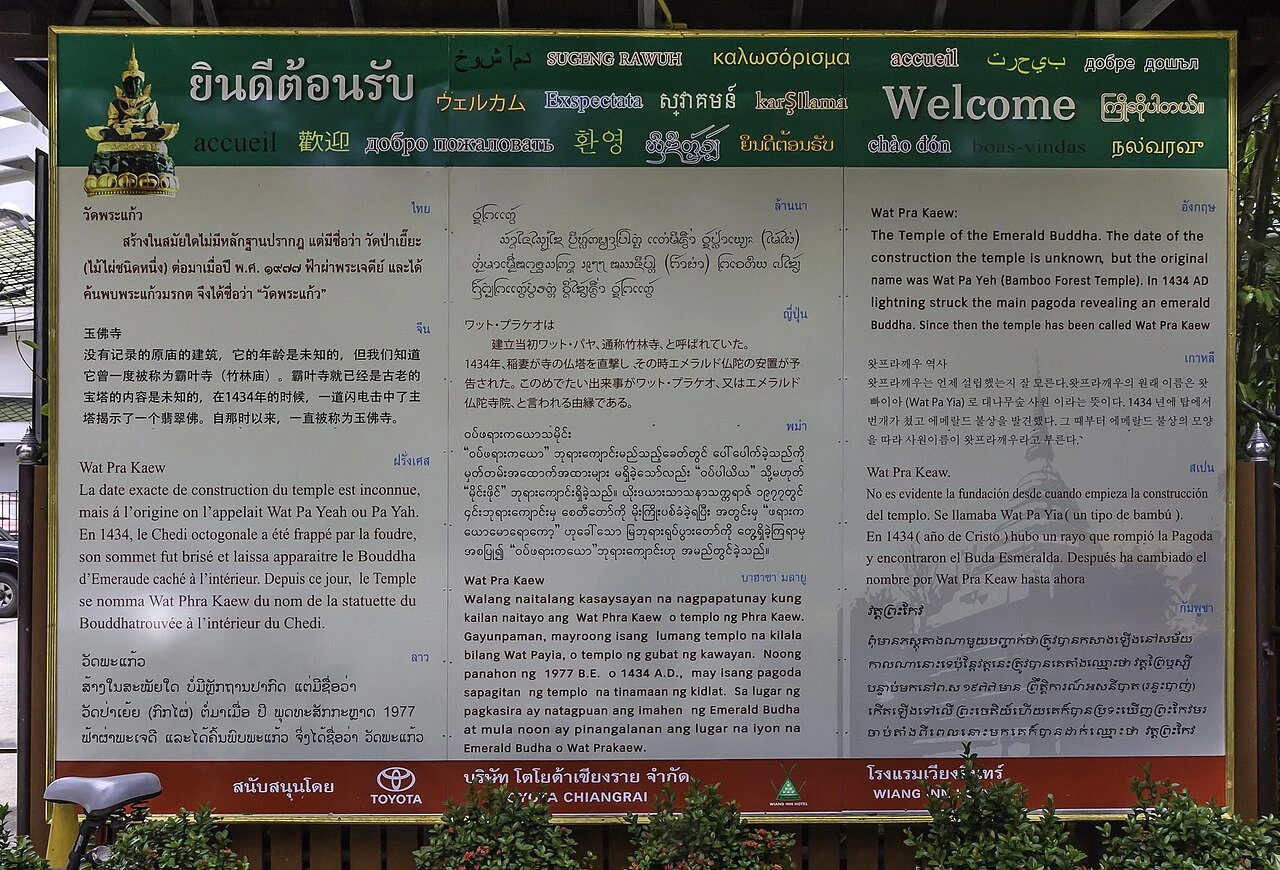
Multilingual information board at Wat Phra Kaeo, Chiang Rai. Commons explicitly lists Burmese, Khmer and Lao among its languages. Language identification follows Commons metadata; not independently transcribed.
Saved in Babelbook · resized display copy. Select the image to open it independently of its source.
Stefan Fussan · Source ↗CC BY-SA 3.0 ↗View the local visual field note
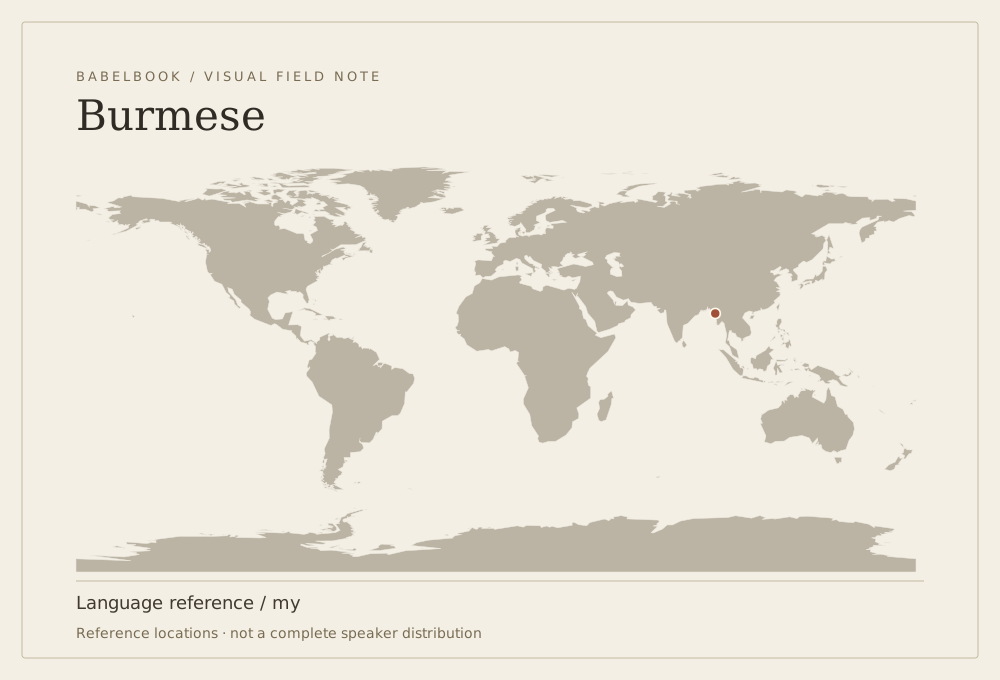
Representative reference points from Glottolog. Historical entries show reference locations, not current speakers. 1 point.
Reference & context ↗Babelbook · original editorial illustration · CC BY 4.0 · Glottolog locations; public-domain Natural Earth land
Source excerpts, selected, shortened and where noted editorially corrected from Burmese language by Wikipedia contributors. Retrieved 2026-10-05. CC BY-SA 4.0. These excerpts are not an independently verified scholarly history; missing accounts are identified above.
Read further in the source
Dialects
Most Burmese speakers, who live throughout the Irrawaddy River Valley, use variants of standard Burmese, while a minority speak non-standard dialects found in the peripheral areas of the country. These dialects include:
Tanintharyi Region: Merguese (Myeik, Beik), Tavoyan (Dawei), and Palaw Magway Region: Yaw Shan State: Intha, Taungyo, and Danu Arakanese in Rakhine State and Marma in India are also sometimes considered dialects of Burmese and sometimes separate languages. Burmese dialects mostly share a common set of tones, consonant clusters, and written script. Several Burmese dialects differ substantially from standard Burmese with respect to vocabulary, lexical particles, and rhymes. Below is a summary of lexical similarity between major Burmese dialects:
History
The Burmese language's early forms include Old Burmese and Middle Burmese. Old Burmese dates from the 11th to the 16th century (Pagan to Ava dynasties); Middle Burmese from the 16th to the 18th century (Toungoo to early Konbaung dynasties); modern Burmese from the mid-18th century. Burmese phonology has evolved significantly, but word order, grammatical structure, and vocabulary have remained markedly stable well into Modern Burmese, with the exception of lexical content (e.g., function words).
Writing system
The Burmese alphabet consists of 33 letters and 12 vowels and is written from left to right. It requires no spaces between words, although modern writing usually contains spaces after each clause to enhance readability. Characterized by its circular letters and diacritics, the script is an abugida, with all letters having an inherent vowel အ a. [a̰] or [ə]. The consonants are arranged into six consonant groups (called ဝဂ် vag) based on articulation, like other Brahmi scripts. Tone markings and vowel modifications are written as diacritics placed to the left, right, top, and bottom of letters. Orthographic changes subsequent to shifts in phonology (such as the merging of the [-l-] and [-ɹ-] medials) rather than transformations in Burmese grammatical structure and phonology, which by contrast has remained stable between Old Burmese and modern Burmese. For example, during the Pagan era, the medial [-l-] ္လ was transcribed in writing, which has been replaced by medials [-j-] ျ and [-ɹ-] ြ in modern Burmese (e.g. "school" in old Burmese က္လောင် [klɔŋ] → ကျောင်း [tɕã́ʊ̃] in modern Burmese). Likewise, written Burmese has preserved all nasalized finals [-n, -m, -ŋ], which have merged to [-ɰ̃] in spoken Burmese. (The exception is [-ɲ], which, in spoken Burmese, can be one of many open vowels [i, e, ɛ].) Similarly, other consonantal finals [-s, -p, -t, -k] have been reduced to [-ʔ]. Similar mergers are seen in other Sino-Tibetan languages like Shanghainese and, to a lesser extent, Cantonese. Written Burmese dates to the early Pagan period. Burmese orthography originally followed a square block format, but the cursive format took hold from the 17th century when increased literacy and the resulting explosion of Burmese literature led to wider use of palm leaves and folded paper known as parabaiks (ပုရပိုက်).
Computer fonts and standard keyboard layout
The Burmese alphabet can be entered from a standard QWERTY keyboard and is supported by the Unicode standard, meaning it can be read and written on most modern computers and smartphones. Burmese has complex character rendering requirements, where tone markings and vowel modifications are noted with diacritics. These can be placed before consonants (as with ေ), above them (as with ိ), or around them (as with ြ). These character clusters are built with multiple keystrokes. In particular, the inconsistent placement of diacritics as a feature of the language presents a conflict between an intuitive WYSIWYG typing approach and a logical consonant-first storage approach. Since its introduction in 2007, the most popular Burmese font, Zawgyi, has been near-ubiquitous in Myanmar. Linguist Justin Watkins argues that its ubiquitous use harms Myanmar languages, including Burmese, by preventing efficient sorting, searching, processing and analyzing Myanmar text through flexible diacritic ordering. Zawgyi is not Unicode-compliant, but occupies the same code space as Unicode Myanmar font. As it is not defined as a standard character encoding, Zawgyi is not built into any major operating systems as standard. However, due to its position as the de facto (but largely undocumented) standard within the country, telcos and major smartphone distributors (such as Huawei and Samsung) ship phones with Zawgyi font overwriting standard Unicode-compliant fonts, which are installed on most internationally distributed hardware. Facebook also supports Zawgyi as an additional language encoding for their app and website. As a result, almost all SMS alerts (including those from telcos to their customers), social media posts, and other web resources may be incomprehensible on these devices without the custom Zawgyi font installed at the operating system level. These may include devices purchased overseas or distributed by companies that do not customize software for the local market. Keyboards with a Zawgyi layout are the most commonly available for purchase domestically. Until recently, Unicode compliant fonts have been more difficult to type than Zawgyi, as they have a stricter, less forgiving and arguably less intuitive method for ordering diacritics. However, intelligent input software such as Keymagic and recent versions of smartphone soft-keyboards including Gboard and ttKeyboard allow for more forgiving input sequences and Zawgyi keyboard layouts which produce Unicode-compliant text. A number of Unicode-compliant Burmese fonts exist. The national standard keyboard layout is known as the Myanmar3 layout, and it was published along with the Myanmar3 Unicode font. The layout, developed by the Myanmar Unicode and NLP Research Center, has a smart input system to cover the complex structures of Burmese and related scripts. In addition to the development of computer fonts and standard keyboard layout, much research remains to be done on Burmese, specifically for Natural Language Processing (NLP) areas like WordNet, Search Engine, development of parallel corpus for Burmese, and development of a formally standardized and dense domain-specific corpus of Burmese. The Myanmar government has designated 1 October 2019 as "U-Day" to officially switch to Unicode. The full transition is estimated to take two years.