Nauru
Nauruan or Nauru (Nauruan: dorerin Naoero) is an Austronesian language, spoken natively in the island country of Nauru, officially the Republic of Naoero.
Translate in Nauru ↗Nauruan or Nauru (Nauruan: dorerin Naoero) is an Austronesian language, spoken natively in the island country of Nauru, officially the Republic of Naoero.
Oceania
Present-day use
These reforms were only partly carried out: the symbols "õ" and "ũ" are still written as such, with tildes. However, the letters "ã" and "ñ" are now only seldom used, being replaced with "e" and "ng", as prescribed by the reform. Likewise, use of the digraphs "bw" and "kw" has been implemented. Although "j" took the place of "ts", certain spellings still use "ts": e.g., the districts Baiti and Ijuw (according to the reform Beiji and Iyu) are still written with the old writing conventions. The "y" has become generally accepted. Today the following 30 Latin letters are used. Vowels: a, ã, e, i, o, õ, u, ũ Consonants: b, c, d, f, g, h, j, k, l, m, n, ñ, p, q, r, s, t, v, w, x, y, z
Origins
In the original writing system for Nauruan, 17 letters were used: The five vowels: a, e, i, o, u Twelve consonants: b, d, g, j, k, m, n, p, q, r, t, w The letters c, f, h, l, s, v, x, y, and z were not included. With the growing influence of foreign languages, in particular German, English, Gilbertese, and part of the Pama-Nyungan family, more letters were incorporated into the Nauruan alphabet. In addition, phonetic differences of a few vowels arose, so that umlauts and other similar sounds were indicated with a tilde.
Development
Writing was introduced to Nauru by Christian missionaries during the 19th century, comparatively later than other islands in the region. The language was alphabetised by German missionary Philip Delaporte beginning in 1899.
Writing
These reforms were only partly carried out: the symbols "õ" and "ũ" are still written as such, with tildes. However, the letters "ã" and "ñ" are now only seldom used, being replaced with "e" and "ng", as prescribed by the reform. Likewise, use of the digraphs "bw" and "kw" has been implemented. Although "j" took the place of "ts", certain spellings still use "ts": e.g., the districts Baiti and Ijuw (according to the reform Beiji and Iyu) are still written with the old writing conventions. The "y" has become generally accepted. Today the following 30 Latin letters are used. Vowels: a, ã, e, i, o, õ, u, ũ Consonants: b, c, d, f, g, h, j, k, l, m, n, ñ, p, q, r, s, t, v, w, x, y, z
Beyond the typeface.
Signs, manuscripts, published pages and contextual photographs, with their place, period, source and reuse terms. Captions identify historical spellings, regional examples, community references and character imagery.
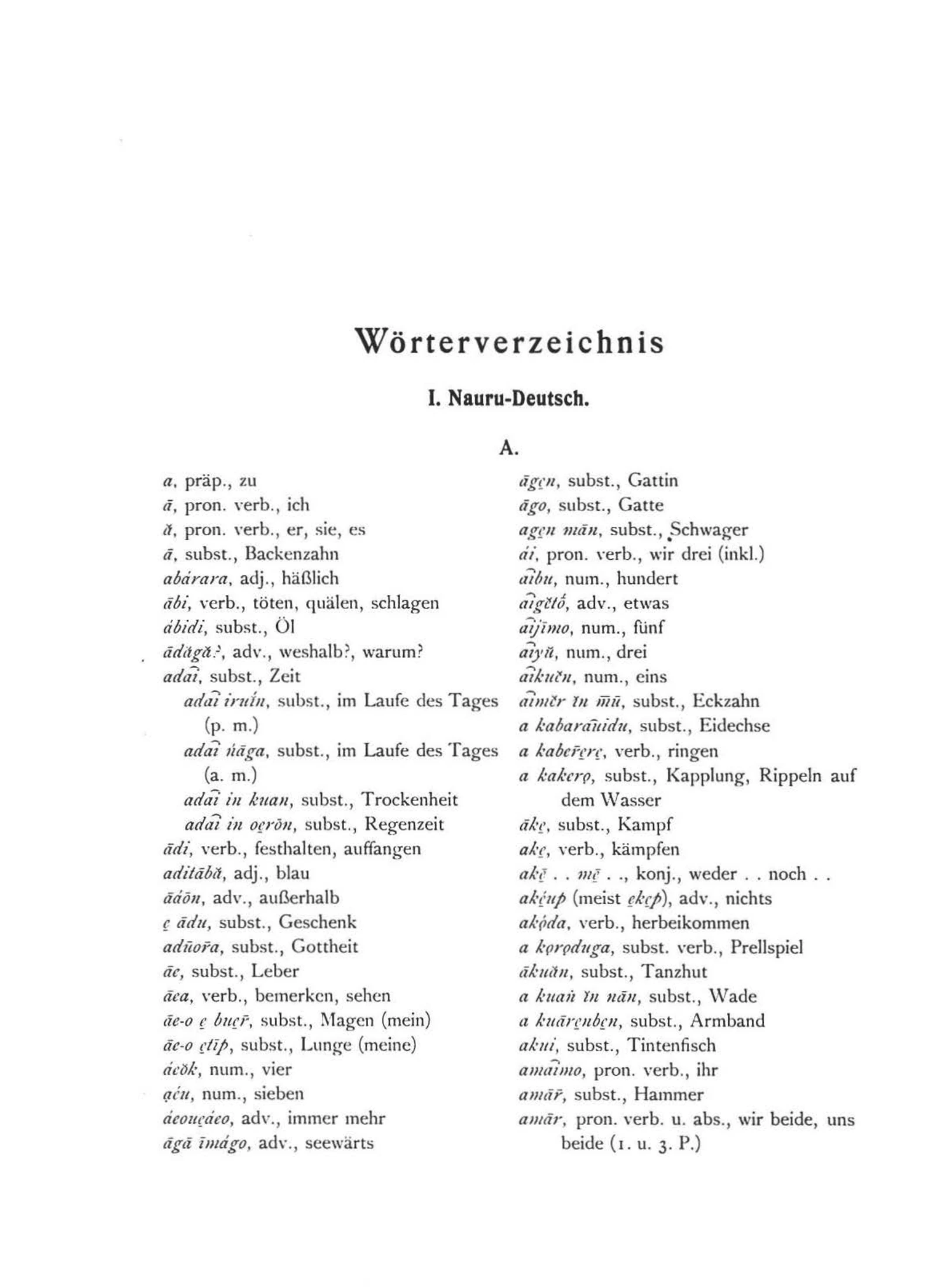
First page of the Nauruan–German wordlist in Paul Hambruch’s 1914 Nauru, headed Wörterverzeichnis — I. Nauru-Deutsch. It prints Nauruan vocabulary with German definitions in two columns. The spellings document this historical publication and are not presented as current standard Nauruan orthography.
Saved in Babelbook · resized display copy. Select the image to open it independently of its source.
Paul Hambruch (author); published by L. Friederichsen & Co., Hamburg; historical library scan distributed through Wikimedia Commons · Source ↗Public domain ↗View the local visual field note
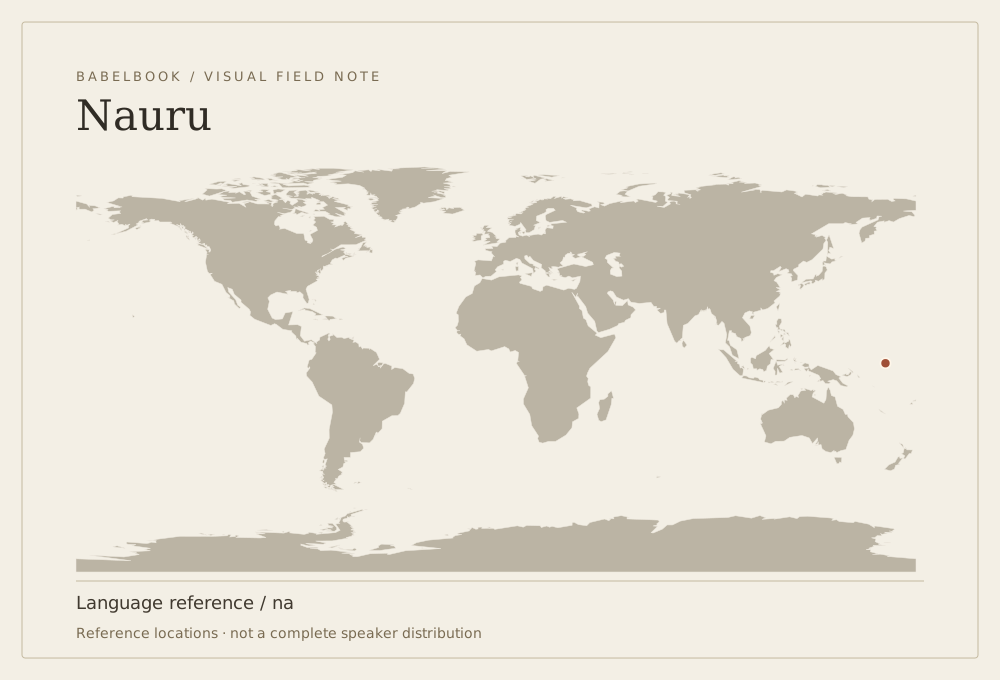
Representative reference points from Glottolog. Historical entries show reference locations, not current speakers. 1 point.
Reference & context ↗Babelbook · original editorial illustration · CC BY 4.0 · Glottolog locations; public-domain Natural Earth land
Source excerpts, selected, shortened and where noted editorially corrected from Nauruan language by Wikipedia contributors. Retrieved 2026-10-05. CC BY-SA 4.0. These excerpts are not an independently verified scholarly history; missing accounts are identified above.
Read further in the source
Dialects
According to a report published in 1937 in Sydney, Australia, there was a diversity of dialects until Nauru became a colony of Germany in 1888 and the first texts in Nauruan began to be published. The varieties were so divergent that people from different districts often had problems understanding each other completely. With the increasing influence of foreign languages and the rise in the number of Nauruan texts, the dialects blended into a standardized language, which was promoted through dictionaries and translations by Alois Kayser and Philip Delaporte. Today there is significantly less dialectal variation. In the district of Yaren and the surrounding area there is an eponymous dialect spoken, which is only slightly different from other varieties.
History
Writing was introduced to Nauru by Christian missionaries during the 19th century, comparatively later than other islands in the region. The language was alphabetised by German missionary Philip Delaporte beginning in 1899.
Original
In the original writing system for Nauruan, 17 letters were used:
The five vowels: a, e, i, o, u Twelve consonants: b, d, g, j, k, m, n, p, q, r, t, w The letters c, f, h, l, s, v, x, y, and z were not included. With the growing influence of foreign languages, in particular German, English, Gilbertese, and part of the Pama-Nyungan family, more letters were incorporated into the Nauruan alphabet. In addition, phonetic differences of a few vowels arose, so that umlauts and other similar sounds were indicated with a tilde.
Modern orthography
These reforms were only partly carried out: the symbols "õ" and "ũ" are still written as such, with tildes. However, the letters "ã" and "ñ" are now only seldom used, being replaced with "e" and "ng", as prescribed by the reform. Likewise, use of the digraphs "bw" and "kw" has been implemented. Although "j" took the place of "ts", certain spellings still use "ts": e.g., the districts Baiti and Ijuw (according to the reform Beiji and Iyu) are still written with the old writing conventions. The "y" has become generally accepted. Today the following 30 Latin letters are used.
Vowels: a, ã, e, i, o, õ, u, ũ Consonants: b, c, d, f, g, h, j, k, l, m, n, ñ, p, q, r, s, t, v, w, x, y, z