Norwegian Bokmål
Bokmål (Urban East Norwegian: [ˈbûːkmoːɫ] ; UK: , US: ; lit. 'book-tongue') is one of the official written standards for the Norwegian language, alongside Nynorsk. Bokmål is by far the most used written form of Norwegian today, as it is adopted by around 90% of the population in Norway. There is no countrywide standard or agreement on the pronunciation of Bokmål and the spoken dialects vary greatly. Bokmål is regulated by the governmental Language Council of Norway. A related, more conservative orthographic standard, commonly known as Riksmål, is regulated by the non-governmental Norwegian Academy for Language and Literature. The written standard is a Norwegianised variety of the Danish language. The first Bokmål orthography was officially adopted in 1907 under the name Riksmål after being under development since 1879. The architects behind the reform were Marius Nygaard and Jacob Jonathan Aars. It was an adaptation of written Danish—commonly used since the past union with Denmark—to Dano-Norwegian, the koiné spoken by the Norwegian urban elite, especially in the capital. When the large conservative newspaper Aftenposten adopted the 1907 orthography in 1923, Danish writing was practically out of use in Norway. The name Bokmål was officially adopted in 1929 after a proposition to call the written language Dano-Norwegian lost by a single vote in the Lagting. The government does not regulate spoken Bokmål and recommends that normalised pronunciation should follow the phonology of the speaker's local dialect.
Translate in Norwegian Bokmål ↗Bokmål (Urban East Norwegian: [ˈbûːkmoːɫ] ; UK: , US: ; lit. 'book-tongue') is one of the official written standards for the Norwegian language, alongside Nynorsk. Bokmål is by far the most used written form of Norwegian today, as it is adopted by around 90% of the population in Norway. There is no countrywide standard or agreement on the pronunciation of Bokmål and the spoken dialects vary greatly. Bokmål is regulated by the governmental Language Council of Norway. A related, more conservative orthographic standard, commonly known as Riksmål, is regulated by the non-governmental Norwegian Academy for Language and Literature. The written standard is a Norwegianised variety of the Danish language. The first Bokmål orthography was officially adopted in 1907 under the name Riksmål after being under development since 1879. The architects behind the reform were Marius Nygaard and Jacob Jonathan Aars. It was an adaptation of written Danish—commonly used since the past union with Denmark—to Dano-Norwegian, the koiné spoken by the Norwegian urban elite, especially in the capital. When the large conservative newspaper Aftenposten adopted the 1907 orthography in 1923, Danish writing was practically out of use in Norway. The name Bokmål was officially adopted in 1929 after a proposition to call the written language Dano-Norwegian lost by a single vote in the Lagting. The government does not regulate spoken Bokmål and recommends that normalised pronunciation should follow the phonology of the speaker's local dialect.
Europe
Present-day use
The captured source does not contain a separate current-use account.
Origins
The captured article does not contain a separate origins section. See the historical account and linked source.
Development
Up until about 1300, the written language of Norway, Old Norwegian, was essentially the same as the other Old Norse dialects. The speech, however, was gradually differentiated into local and regional dialects. As long as Norway remained an independent kingdom, the written language remained essentially constant. In 1380, Norway entered into a personal union with Denmark. By the early 16th century, Norway had lost its separate political institutions, and together with Denmark formed the political unit known as Denmark–Norway until 1814, progressively becoming the weaker member of the union. During this period, the modern Danish and Norwegian languages emerged. Norwegian went through a Middle Norwegian transition, and a Danish written language more heavily influenced by Low German was gradually standardised. This process was aided by the Reformation, which prompted Christiern Pedersen's translation of the Bible into Danish. Remnants of written Old Norse and Norwegian were thus displaced by the Danish standard, which became used for virtually all administrative documents. Norwegians used Danish primarily in writing, but it gradually came to be spoken by urban elites on formal or official occasions. Although Danish never became the spoken language of the vast majority of the population, by the time Norway's ties with Denmark were severed in 1814, a Dano-Norwegian vernacular often called the "educated daily speech" had become the mother tongue of elites in most Norwegian cities, such as Bergen, Kristiania and Trondheim. This Dano-Norwegian koiné could be described as Danish with regional Norwegian pronunciation (see Norwegian dialects), some Norwegian vocabulary, and simplified grammar. With the gradual subsequent process of Norwegianisation of the written language used in the cities of Norway, from Danish to Bokmål and Riksmål, the upper-class sociolects in the cities changed accordingly.
Writing
Latin or customary script (catalog classification; see the source for context).
Beyond the typeface.
Signs, manuscripts, published pages and contextual photographs, with their place, period, source and reuse terms. Captions identify historical spellings, regional examples, community references and character imagery.
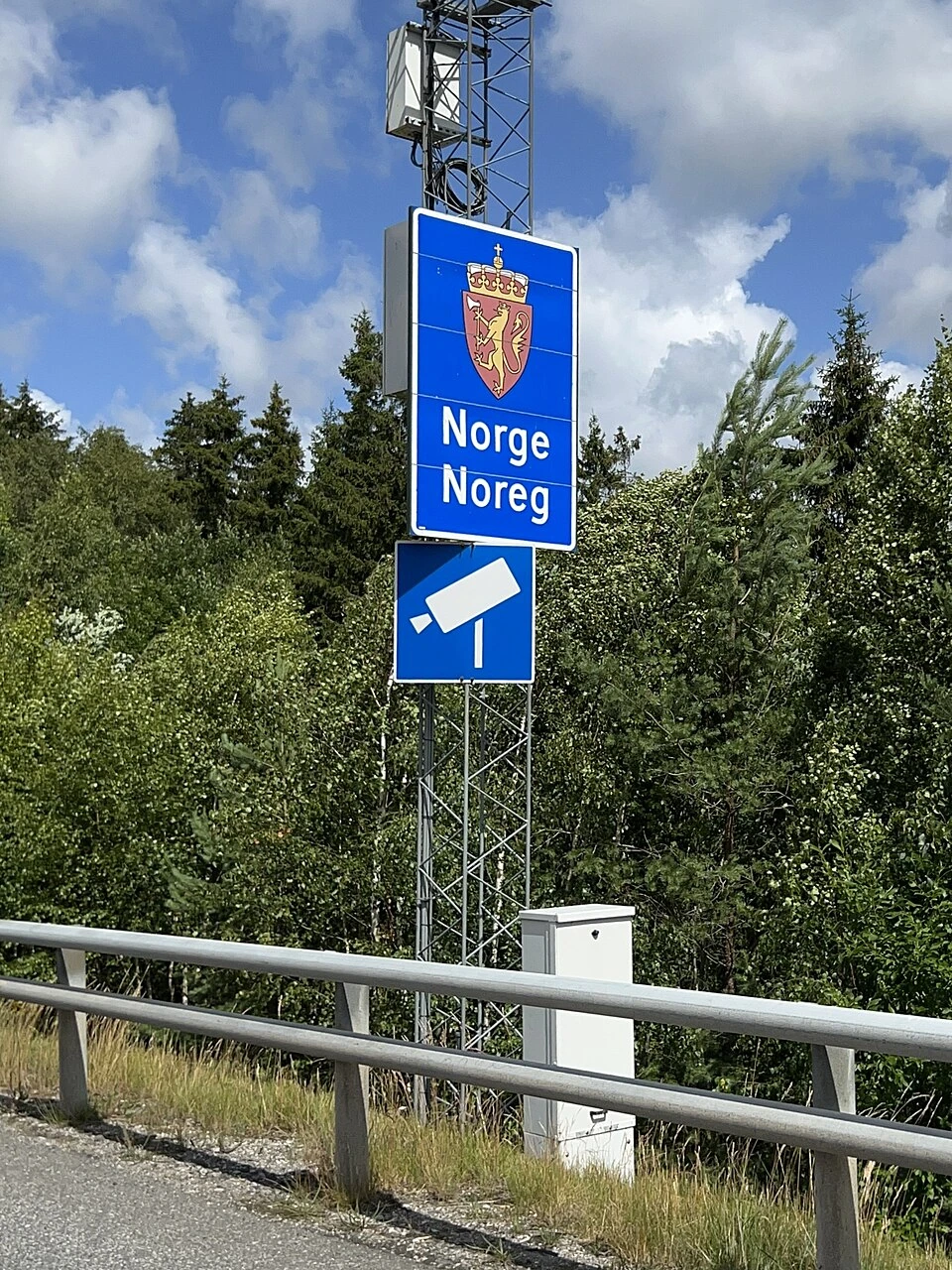
Norwegian border sign on Svinesund Bridge showing Norge (Bokmål) and Noreg (Nynorsk). Language identification follows Commons metadata; not independently transcribed.
Saved in Babelbook · resized display copy. Select the image to open it independently of its source.
Sebbog13 · Source ↗CC BY-SA 4.0 ↗View the local visual field note
Representative reference points from Glottolog. Historical entries show reference locations, not current speakers. 1 point.
Reference & context ↗Babelbook · original editorial illustration · CC BY 4.0 · Glottolog locations; public-domain Natural Earth land
Source excerpts, selected, shortened and where noted editorially corrected from Bokmål by Wikipedia contributors. Retrieved 2026-10-05. CC BY-SA 4.0. These excerpts are not an independently verified scholarly history; missing accounts are identified above.
Read further in the source
History
Up until about 1300, the written language of Norway, Old Norwegian, was essentially the same as the other Old Norse dialects. The speech, however, was gradually differentiated into local and regional dialects. As long as Norway remained an independent kingdom, the written language remained essentially constant. In 1380, Norway entered into a personal union with Denmark. By the early 16th century, Norway had lost its separate political institutions, and together with Denmark formed the political unit known as Denmark–Norway until 1814, progressively becoming the weaker member of the union. During this period, the modern Danish and Norwegian languages emerged. Norwegian went through a Middle Norwegian transition, and a Danish written language more heavily influenced by Low German was gradually standardised. This process was aided by the Reformation, which prompted Christiern Pedersen's translation of the Bible into Danish. Remnants of written Old Norse and Norwegian were thus displaced by the Danish standard, which became used for virtually all administrative documents. Norwegians used Danish primarily in writing, but it gradually came to be spoken by urban elites on formal or official occasions. Although Danish never became the spoken language of the vast majority of the population, by the time Norway's ties with Denmark were severed in 1814, a Dano-Norwegian vernacular often called the "educated daily speech" had become the mother tongue of elites in most Norwegian cities, such as Bergen, Kristiania and Trondheim. This Dano-Norwegian koiné could be described as Danish with regional Norwegian pronunciation (see Norwegian dialects), some Norwegian vocabulary, and simplified grammar.
With the gradual subsequent process of Norwegianisation of the written language used in the cities of Norway, from Danish to Bokmål and Riksmål, the upper-class sociolects in the cities changed accordingly. In 1814, when Norway was ceded from Denmark to Sweden, Norway defied Sweden and its allies, declared independence and adopted a democratic constitution. Although compelled to submit to a dynastic union with Sweden, this spark of independence continued to burn, influencing the evolution of language in Norway. Old language traditions were revived by the patriotic poet Henrik Wergeland (1808–1845), who championed an independent non-Danish written language. Haugen indicates that:
Within the first generation of liberty, two solutions emerged and won adherents, one based on the speech of the upper class and one on that of the common people. The former called for Norwegianisation of the Danish writing, the latter for a brand new start. The more conservative of the two language transitions was advanced by the work of writers like Peter Asbjørnsen and Jørgen Moe, schoolmaster and agitator for language reform Knud Knudsen, and Knudsen's famous disciple, Bjørnstjerne Bjørnson, as well as a more cautious Norwegianisation by Henrik Ibsen. In particular, Knudsen's work on language reform in the mid-19th century was important for the 1907 orthography and a subsequent reform in 1917, so much so that he is now often called the "father of Bokmål".
Differences from the traditional Oslo dialect
Most natives of Oslo today speak a dialect that is an amalgamation of vikværsk (which is the technical term for the traditional dialects in the Oslofjord area) and written Danish; and subsequently Riksmål and Bokmål, which primarily inherited their non-Oslo elements from Danish. The present-day Oslo dialect is also influenced by other Eastern Norwegian dialects. The following table shows some important cases where traditional Bokmål and Standard Østnorsk followed Danish rather than the traditional Oslo dialect as it is commonly portrayed in literature about Norwegian dialects. In many of these cases, radical Bokmål follows the traditional Oslo dialect and Nynorsk, and these forms are also given.