North Ndebele
Northern Ndebele (English: ), also called Ndebele, isiNdebele saseNyakatho, Zimbabwean Ndebele, isiNdebele or North Ndebele, associated with the term Matabele, is a Nguni language spoken by the Northern Ndebele people which belongs to the Nguni group of languages. Ndebele is a term used to refer to a collection of many different African cultures in Zimbabwe. As a language, it is by no means similar to the Ndebele language spoken in kwaNdebele in South Africa although, like many Nguni dialects, some words will be shared. Many of the natives that were colonized by the Matabele were assimilated into Mzilikazi's kingdom and are an of-shoot of the Zulu tribe. The Matebele people of Zimbabwe descend from the Zulu due to a Zulu leader Mzilikazi (one of Zulu King Shaka's generals), who left the Zulu Kingdom in the early 19th century, during the Mfecane, arriving in present-day Zimbabwe in 1839. Although there are some differences in grammar, lexicon and intonation between Zulu and Northern Ndebele, the two languages share more than 85% of their lexicon. To prominent Nguni linguists like Anthony Trevor Cope and Cyril Nyembezi, Northern Ndebele is a dialect of Zulu. To others like Langa Khumalo, it is a language.
Translate in North Ndebele ↗Northern Ndebele (English: ), also called Ndebele, isiNdebele saseNyakatho, Zimbabwean Ndebele, isiNdebele or North Ndebele, associated with the term Matabele, is a Nguni language spoken by the Northern Ndebele people which belongs to the Nguni group of languages. Ndebele is a term used to refer to a collection of many different African cultures in Zimbabwe. As a language, it is by no means similar to the Ndebele language spoken in kwaNdebele in South Africa although, like many Nguni dialects, some words will be shared. Many of the natives that were colonized by the Matabele were assimilated into Mzilikazi's kingdom and are an of-shoot of the Zulu tribe. The Matebele people of Zimbabwe descend from the Zulu due to a Zulu leader Mzilikazi (one of Zulu King Shaka's generals), who left the Zulu Kingdom in the early 19th century, during the Mfecane, arriving in present-day Zimbabwe in 1839. Although there are some differences in grammar, lexicon and intonation between Zulu and Northern Ndebele, the two languages share more than 85% of their lexicon. To prominent Nguni linguists like Anthony Trevor Cope and Cyril Nyembezi, Northern Ndebele is a dialect of Zulu. To others like Langa Khumalo, it is a language. Distinguishing between a language and a dialect for language varieties that are very similar is difficult, with the decision often being based not on objective linguistic criteria but on more subjective, often politicised considerations. Northern Ndebele and Southern Ndebele (or Transvaal Ndebele), which is spoken in South Africa, are separate but related languages with some degree of mutual intelligibility, although the former is more closely related to Zulu. Southern Ndebele, while maintaining its Nguni roots, has been influenced by the Sotho languages.
Global / other
Present-day use
The captured source does not contain a separate current-use account.
Origins
The captured article does not contain a separate origins section. See the historical account and linked source.
Development
The captured article does not contain a distinct historical account. No chronology has been invented.
Writing
Latin or customary script (catalog classification; see the source for context).
Beyond the typeface.
Signs, manuscripts, published pages and contextual photographs, with their place, period, source and reuse terms. Captions identify historical spellings, regional examples, community references and character imagery.
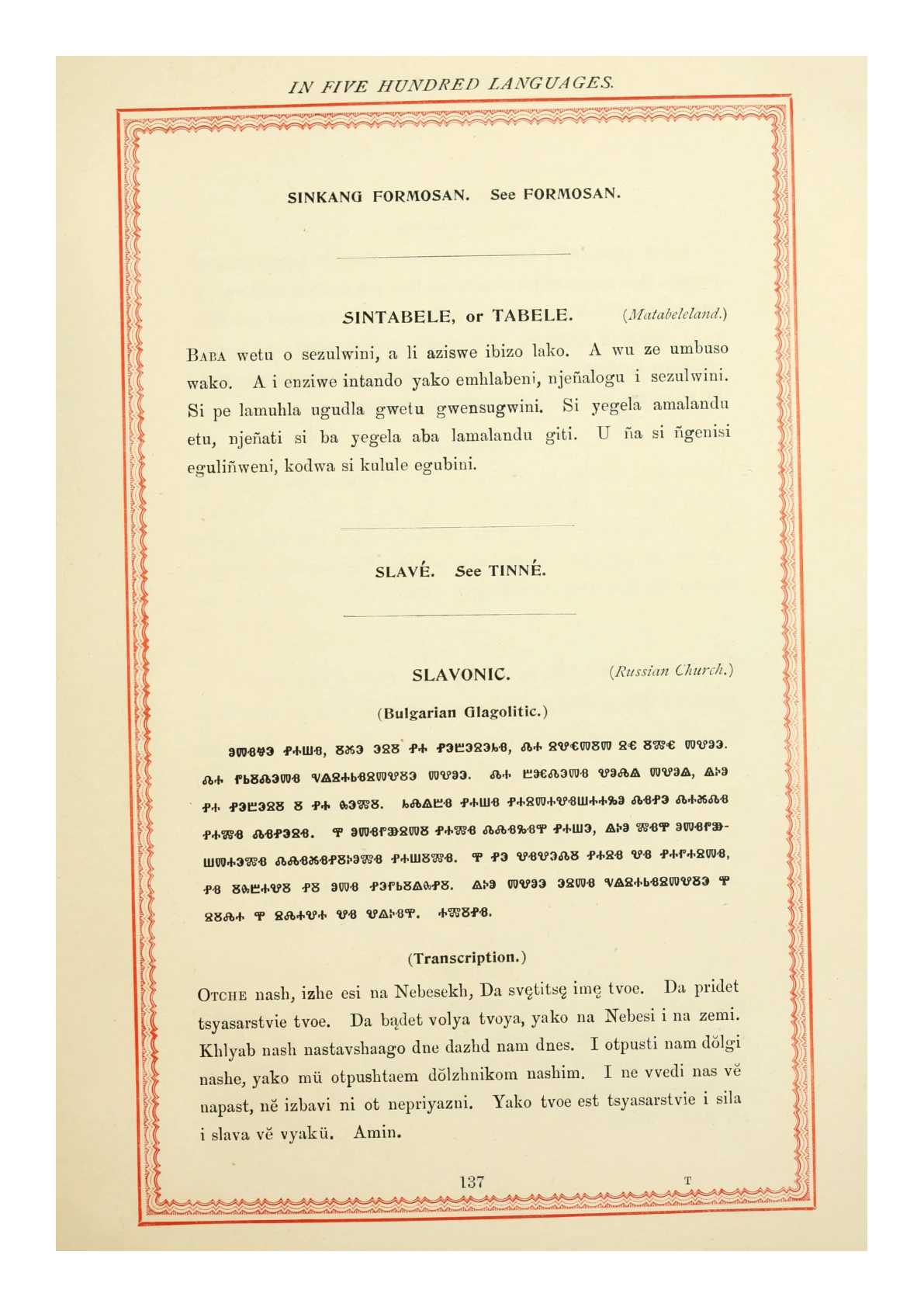
Historical printed prayer headed “SINTABELE, or TABELE” in The Lord’s Prayer in Five Hundred Languages, printed page 137. This older label is cross-referenced to North Ndebele by the linked language authority. The Commons record dates the compilation to 1905; this copy also contains a publisher note dated June 1908. Orthography and translation reflect the historical source, not a modern usage standard. Other languages appear on the same page. The source includes period terminology and editorial annotations; these are historical evidence, not Babelbook’s current terminology or claims.
Saved in Babelbook · resized display copy. Select the image to open it independently of its source.
Reinhold Rost (compiler); Gilbert & Rivington / Wm. Clowes & Sons (publishers); Internet Archive scan · Source ↗Public domain ↗View the local visual field note
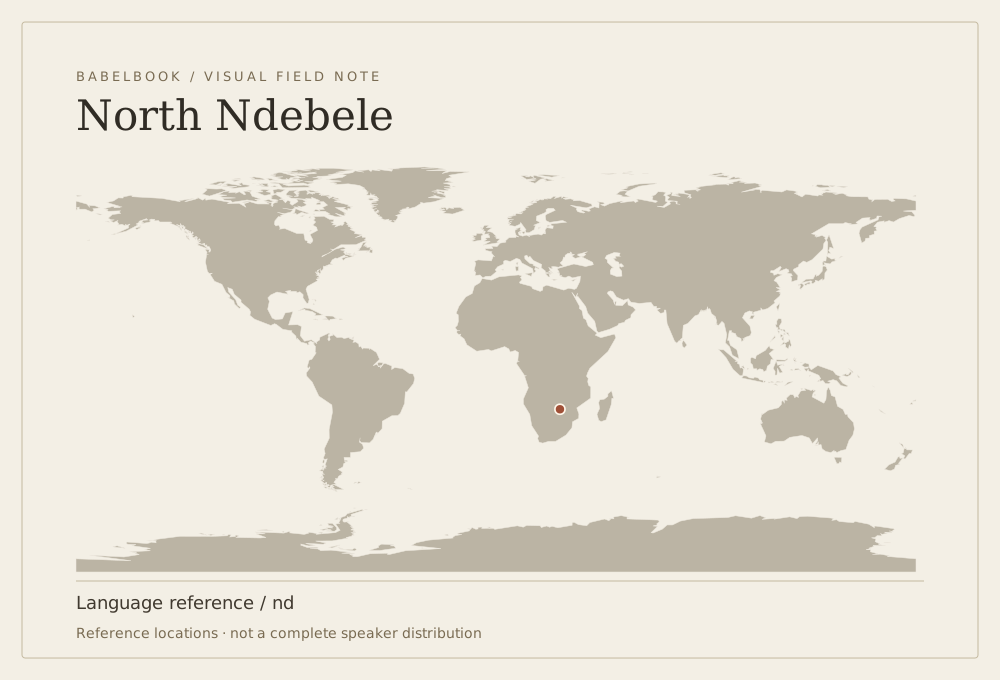
Representative reference points from Glottolog. Historical entries show reference locations, not current speakers. 1 point.
Reference & context ↗Babelbook · original editorial illustration · CC BY 4.0 · Glottolog locations; public-domain Natural Earth land
Source excerpts, selected, shortened and where noted editorially corrected from Northern Ndebele language by Wikipedia contributors. Retrieved 2026-10-05. CC BY-SA 4.0. These excerpts are not an independently verified scholarly history; missing accounts are identified above.