Nepali
Nepali (Devanagari: नेपाली) is the official and most-widely spoken language of Nepal, where it also serves as a lingua franca. It is also extensively used beyond Nepal's borders in the Himalayas. It is an Indo-Aryan language, belonging to the Indo-Iranian branch within the Indo-European language family, native to the Himalayan region of South Asia. Nepali has official status in the Indian state of Sikkim and in the Gorkhaland Territorial Administration, a semi-autonomous region of West Bengal, being a majority language in both of these places. It is also spoken by about a quarter of Bhutan. Nepali also has a significant number of speakers in the Indian states of Arunachal Pradesh, Assam, Himachal Pradesh, Manipur, Meghalaya, Mizoram and Uttarakhand. In Myanmar, it is spoken by the Burmese Gurkhas community. The Nepali diaspora in the Middle East, Brunei, Australia and around the world also use the language. Overall, Nepali is spoken by approximately 19 million native speakers and additional 14 million as a second language. Nepali is commonly classified within the Eastern Pahari group of the Northern zone of Indo-Aryan. The language originated in the Sinja Valley of Karnali Province, which served as the capital of the Khasa Kingdom around the 10th and 14th centuries. It developed in close contact with several Indo-Aryan languages, particularly other Pahari languages. Nepali was originally spoken by the Khas people, an Indo-Aryan ethno-linguistic group native to the Himalayan region of South Asia.
Translate in Nepali ↗Nepali written in the Devanagari script is the official language of Nepal. On 31 August 1992, Nepali was added to the list of scheduled languages of India. Nepali is the official language of the state of Sikkim and Gorkhaland of West Bengal. Despite being spoken by about a quarter of the population, Nepali has no official status in Bhutan.
South Asia
Present-day use
The modern period of Nepali begins in the early 20th century. During this time the ruling Rana dynasty made various attempts to make Nepali the language of education, notably by Dev Shumsher and Chandra Shumsher Jung Bahadur Rana, who established Gorkhapatra and the Gorkha Bhasa Prakashini Samiti, respectively. At this time, when Nepali had a limited literature compared to the Hindi and Bengali languages, a movement notably in Varanasi, and Darjeeling was started to create uniformed Nepali identity, which was later adopted in Nepal following the 1951 Nepalese revolution and during the Panchayat system. In 1957, Royal Nepal Academy was established with the objectives of developing and promoting Nepali literature, culture, art and science. During Panchayat, Nepal adopted a "One King, One Dress, One Language, One Nation" ideology, which promoted Nepali language as basis for Nepali nationalism. This time is considered to be a Golden Age for the language. In West Bengal, Nepali language was recognised by West Bengal Government in 1961 as the official language for the Darjeeling district, and Kalimpong and Kurseong. The Nepali Language Movement took place in India around the 1980s to include Nepali language in the Eighth Schedule to the Constitution of India. In 1977, Nepali was officially accepted by Sahitya Academy, an organisation dedicated to the promotion of Indian literature. After Sikkim was annexed by India, the Sikkim Official Languages Act, 1977, made Nepali as one of the official languages of state. On 20 August 1992, the Lok Sabha passed a motion to add the Nepali language to the Eighth Schedule. Nepali written in the Devanagari script is the official language of Nepal. On 31 August 1992, Nepali was added to the list of scheduled languages of India. Nepali is the official language of the state of Sikkim and Gorkhaland of West Bengal. Despite being spoken by about a quarter of the population, Nepali has no official status in Bhutan.
Origins
The term Nepali derived from Nepal was officially adopted by the Government of Nepal in 1933, when Gorkha Bhasa Prakashini Samiti (Gorkha Language Publishing Committee), a government institution established in 1913 (B.S. 1970) for advancement of Gorkha Bhasa, renamed itself as Nepali Bhasa Prakashini Samiti (Nepali Language Publishing Committee) in 1933 (B.S. 1990), which is currently known as Sajha Prakashan. Conversely, the term Gorkhali in the former national anthem entitled "Shriman Gambhir" was changed to Nepali in 1951. However, the term Nepali was used before the official adoption notably by Jaya Prithvi Bahadur Singh, now considered one of the national heroes of Nepal, who advocated for embracing the term. The initial name of Nepali language was "Khas Kura" (खस कुरा), meaning language or speech of the Khas people, who are descended from the ancient Khasas of Mahabharata, as the language developed during the rule of the Khasa Kingdom in the western Nepal. Following the Unification of Nepal led by Shah dynasty's Prithvi Narayan Shah, Nepali language became known as Gorakhā Bhāṣā (गोरखा भाषा; language of the Gorkhas) as it was spoken by Gorkhas. The people living in the Pahad or the hilly region, where it does not generally contain snow, called the language Parvate Kurā (पर्वते कुरा), meaning "the speech of the hills". Early forms of present-day Nepali developed from the Middle Indo-Aryan apabhraṃśa Vernaculars of present-day western Nepal in the 10th–14th centuries, during the times of the Khasa Kingdom. The language evolved from Sanskrit, Prakrit, and Apabhraṃśa. Following the decline of the Khasa Kingdom, it was divided into Baise Rajya (22 principalities) in Karnali-Bheri region and Chaubise rajya (24 principalities) in Gandaki region.
Development
Early forms of present-day Nepali developed from the Middle Indo-Aryan apabhraṃśa Vernaculars of present-day western Nepal in the 10th–14th centuries, during the times of the Khasa Kingdom. The language evolved from Sanskrit, Prakrit, and Apabhraṃśa. Following the decline of the Khasa Kingdom, it was divided into Baise Rajya (22 principalities) in Karnali-Bheri region and Chaubise rajya (24 principalities) in Gandaki region. The currently popular variant of Nepali is believed to have originated around 500 years ago with the mass migration of a branch of Khas people from the Karnali-Bheri-Seti eastward to settle in lower valleys of the Karnali and the Gandaki basin. During the times of Sena dynasty, who ruled a vast area in Terai and central hills of Nepal, Nepali language became influenced by the Indian languages including Awadhi, Bhojpuri, Braj Bhasha and Maithili. Nepali speakers and Senas had a close connect, subsequently, the language became the lingua franca in the area. As a result, the grammar became simplified, vocabulary was expanded, and its phonology was softened, after it was syncretised, Nepali lost much of the complex declensional system present in the older languages. In the Kathmandu Valley (then known as Nepal Mandala), Nepali language inscriptions can be seen during the reigns of Lakshmi Narasimha Malla and Pratap Malla, which indicates the significant increment of Nepali speakers in Kathmandu Valley. It was during this period of growth that Nepali borrowed many words from various Sino-Tibetan languages, primarily Newar. This is evident from the fact that the borrowed words match the older form of the languages in question.
Writing
Nepali is generally written in Devanagari script. In certain regions, the Tibetan script was also used in regions with predominantly Tibetic population, with common Tibetan expressions and pronunciation. In the section below Nepali is represented in Latin transliteration using the IAST scheme and IPA. The chief features are: subscript dots for retroflex consonants; macrons for etymologically, contrastively long vowels; h denoting aspirated plosives. Tildes denote nasal vowels.
Beyond the typeface.
Signs, manuscripts, published pages and contextual photographs, with their place, period, source and reuse terms. Captions identify historical spellings, regional examples, community references and character imagery.
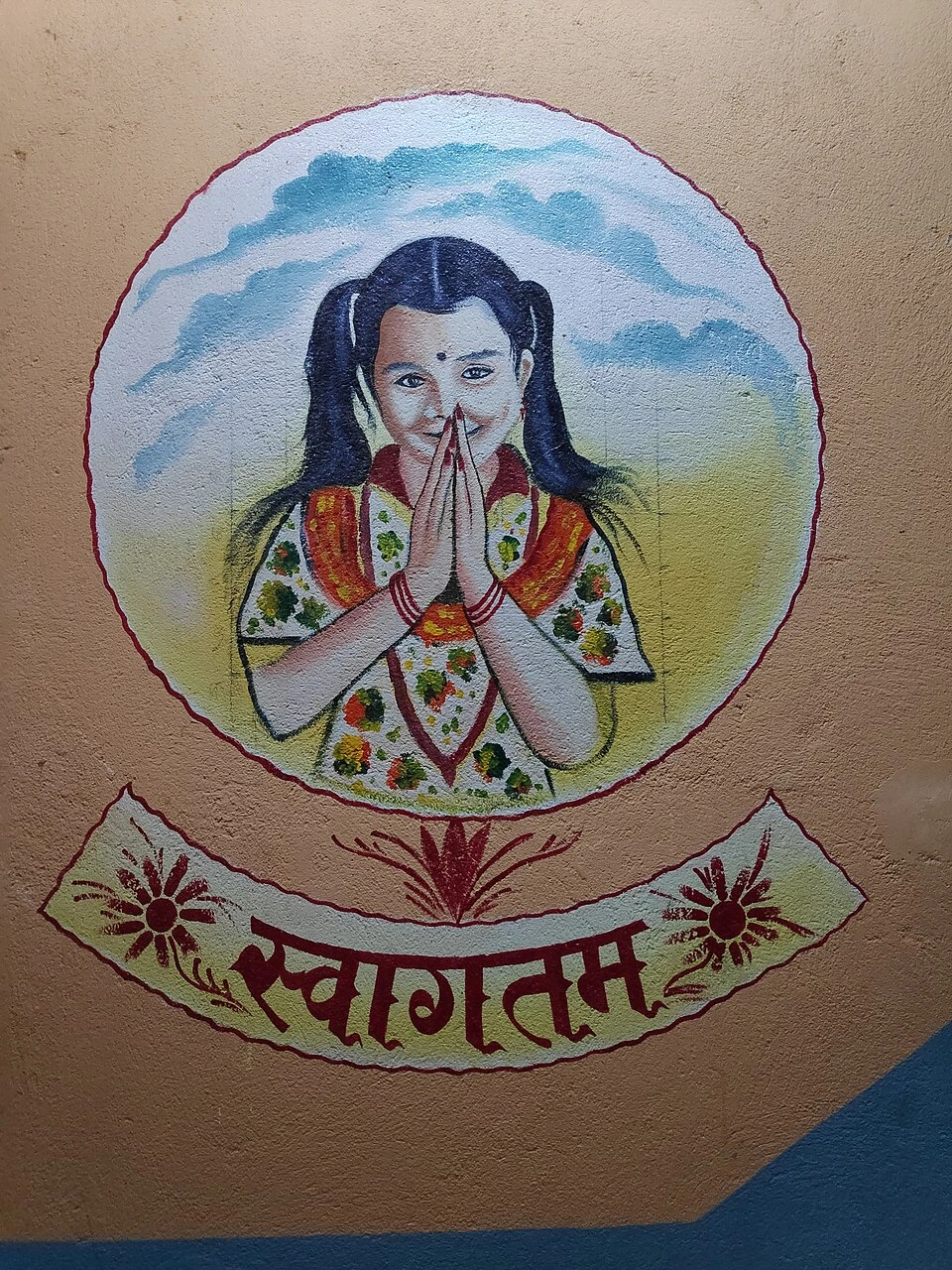
A photographed welcome message explicitly identified as Nepali by its photographer.
Saved in Babelbook · resized display copy. Select the image to open it independently of its source.
Gaurav Dhwaj Khadka · Source ↗CC BY-SA 4.0 ↗View the local visual field note
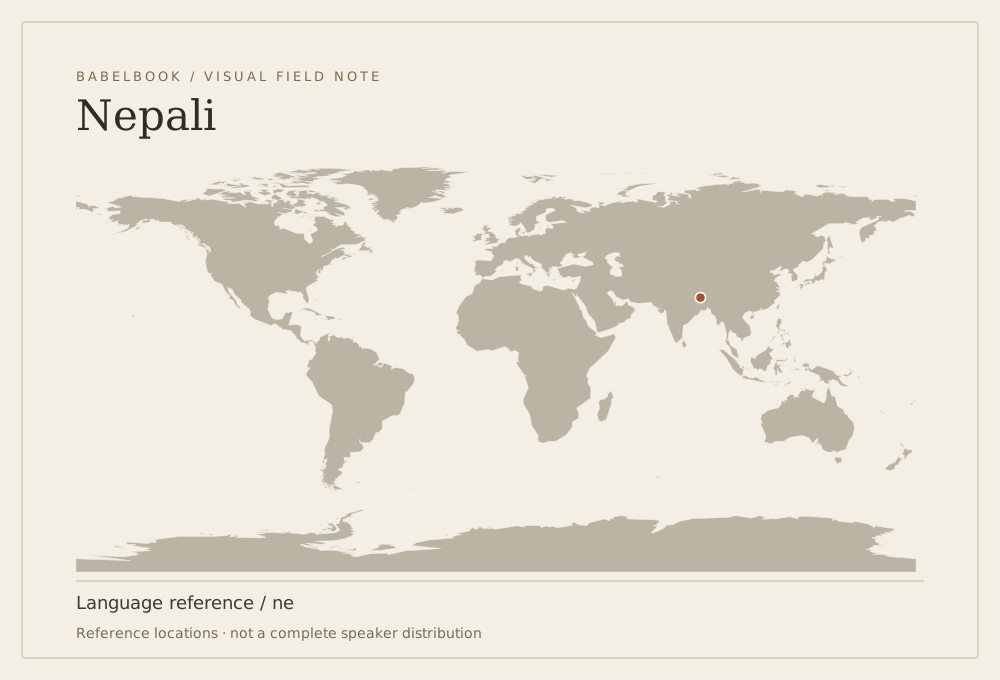
Representative reference points from Glottolog. Historical entries show reference locations, not current speakers. 1 point.
Reference & context ↗Babelbook · original editorial illustration · CC BY 4.0 · Glottolog locations; public-domain Natural Earth land
Source excerpts, selected, shortened and where noted editorially corrected from Nepali language by Wikipedia contributors. Retrieved 2026-10-05. CC BY-SA 4.0. These excerpts are not an independently verified scholarly history; missing accounts are identified above.
Read further in the source
Origin and development
Early forms of present-day Nepali developed from the Middle Indo-Aryan apabhraṃśa Vernaculars of present-day western Nepal in the 10th–14th centuries, during the times of the Khasa Kingdom. The language evolved from Sanskrit, Prakrit, and Apabhraṃśa. Following the decline of the Khasa Kingdom, it was divided into Baise Rajya (22 principalities) in Karnali-Bheri region and Chaubise rajya (24 principalities) in Gandaki region. The currently popular variant of Nepali is believed to have originated around 500 years ago with the mass migration of a branch of Khas people from the Karnali-Bheri-Seti eastward to settle in lower valleys of the Karnali and the Gandaki basin. During the times of Sena dynasty, who ruled a vast area in Terai and central hills of Nepal, Nepali language became influenced by the Indian languages including Awadhi, Bhojpuri, Braj Bhasha and Maithili. Nepali speakers and Senas had a close connect, subsequently, the language became the lingua franca in the area. As a result, the grammar became simplified, vocabulary was expanded, and its phonology was softened, after it was syncretised, Nepali lost much of the complex declensional system present in the older languages. In the Kathmandu Valley (then known as Nepal Mandala), Nepali language inscriptions can be seen during the reigns of Lakshmi Narasimha Malla and Pratap Malla, which indicates the significant increment of Nepali speakers in Kathmandu Valley. It was during this period of growth that Nepali borrowed many words from various Sino-Tibetan languages, primarily Newar. This is evident from the fact that the borrowed words match the older form of the languages in question.
Official status
Nepali written in the Devanagari script is the official language of Nepal. On 31 August 1992, Nepali was added to the list of scheduled languages of India. Nepali is the official language of the state of Sikkim and Gorkhaland of West Bengal. Despite being spoken by about a quarter of the population, Nepali has no official status in Bhutan.
Writing system
Nepali is generally written in Devanagari script. In certain regions, the Tibetan script was also used in regions with predominantly Tibetic population, with common Tibetan expressions and pronunciation. In the section below Nepali is represented in Latin transliteration using the IAST scheme and IPA. The chief features are: subscript dots for retroflex consonants; macrons for etymologically, contrastively long vowels; h denoting aspirated plosives. Tildes denote nasal vowels.
Dialects
Dialects of Nepali include Acchami, Baitadeli, Bajhangi, Bajurali, Bheri, Dadeldhuri, Dailekhi, Darchulali, Darchuli, Gandakeli, Humli, Purbeli, and Soradi. These dialects can be distinct from Standard Nepali. Mutual intelligibility between Baitadeli, Bajhangi, Bajurali (Bajura), Humli and Acchami is low. The dialect of the Nepali language spoken in Karnali Province is not mutually intelligible with Standard Nepali. The language is known by its old name as Khas Bhasa in Karnali.