Dutch
Dutch (Endonym: Nederlands [ˈneːdərlɑnts] , Nederlandse taal) is a West Germanic language of the Indo-European language family, spoken by about 25 million people as a first language and 5 million as a second language and is the third most spoken Germanic language. In Europe, Dutch is the native language of most of the population of the Netherlands and Flanders (which includes 60% of the population of Belgium). Dutch was one of the official languages of South Africa until 1925, when it was replaced by Afrikaans, a separate but partially mutually intelligible daughter language of Dutch. Afrikaans, depending on the definition used, may be considered a sister language, spoken, to some degree, by at least 16 million people, mainly in South Africa and Namibia, and evolving from Cape Dutch dialects. In South America, Dutch is the native language of the majority of the population of Suriname, and spoken as a second or third language in the multilingual Caribbean island countries of Aruba, Curaçao and Sint Maarten. All these countries have recognised Dutch as one of their official languages, and are involved in one way or another in the Dutch Language Union. The Dutch Caribbean municipalities (St. Eustatius, Saba and Bonaire) have Dutch as one of the official languages. In Asia, Dutch was used in the Dutch East Indies (now mostly Indonesia) by a limited educated elite of around 2% of the total population, including over 1 million indigenous Indonesians, until it was banned in 1957, but the ban was lifted afterwards.
Translate in Dutch ↗Dutch is an official language of the Netherlands proper (not enshrined in the constitution but in administrative law), Belgium, Suriname, the Dutch Caribbean municipalities (St. Eustatius, Saba and Bonaire), Aruba, Curaçao and Sint Maarten. Dutch is also an official language of several international organisations, such as the European Union, Union of South American Nations and the Caribbean Community. At an academic level, Dutch is taught in about 175 universities in 40 countries. About 15,000 students worldwide study Dutch at university.
Europe
Present-day use
A process of standardisation started in the Middle Ages, especially under the influence of the Burgundian Ducal Court in Dijon (Brussels after 1477). The dialects of Flanders and Brabant were the most influential around this time. The process of standardisation became much stronger at the start of the 16th century, mainly based on the urban dialect of Antwerp. The 1585 fall of Antwerp to the Spanish army led to a flight to the northern Netherlands, where the Dutch Republic declared its independence from Spain. This influenced the urban dialects of the province of Holland. In 1637, a further important step was made towards a unified language, when the Statenvertaling, the first major Bible translation into Dutch, was created that people from all over the new republic could understand. It used elements from various, even Dutch Low Saxon, dialects but was predominantly based on the urban dialects of Holland of post 16th century. In the Southern Netherlands (now Belgium and Luxembourg), developments were different. Under subsequent Spanish, Austrian and French rule, the standardisation of Dutch language came to a standstill. The state, law, and increasingly education used French, yet more than half the Belgian population were speaking a variety of Dutch. In the course of the 19th century, the Flemish Movement stood up for the rights of Dutch speakers, mostly referred to as "Flemish". However, the dialect variation was a serious disadvantage in the face of the standardised francophony. Since standardisation is a lengthy process, Dutch-speaking Belgium associated itself with the standard language that had already developed in the Netherlands over the centuries. Therefore, the situation in Belgium is essentially no different from that in the Netherlands, although there are recognisable differences in pronunciation, comparable to the pronunciation differences between standard British and standard American English.
Origins
Among the Indo-European languages, Dutch is grouped within the Germanic languages, meaning it shares a common ancestor with languages such as English, German, and the Scandinavian languages. All Germanic languages are subject to the Grimm's law and Verner's law sound shifts, which originated in the Proto-Germanic language and define the basic features differentiating them from other Indo-European languages. This is assumed to have taken place in approximately the mid-first millennium BCE in the pre-Roman Northern European Iron Age. The Germanic languages are traditionally divided into three groups: East (now extinct), West, and North Germanic. They remained mutually intelligible throughout the Migration Period. Dutch is part of the West Germanic group, which also includes English, Scots, Frisian, Low German (Old Saxon) and High German. It is characterised by a number of phonological and morphological innovations not found in North or East Germanic.
Development
Old Dutch can be discerned more or less around the same time as Old English (Anglo-Saxon), Old High German, Pre-Old Frisian, and Old Saxon. These names are derived from the modern standard languages. In this age no standard languages had yet developed, while a perfect West Germanic dialect continuum remained present; the division reflects the contingent future contribution dialect groups would have to the later languages. The early form of Dutch was a set of Franconian dialects spoken by the Salian Franks in the 5th century. These happened to develop through Middle Dutch to Modern Dutch over the course of fifteen centuries. During that period, they forced Old Frisian back from the western coast to the north of the Low Countries, and influenced or even replaced Old Saxon spoken in the east (contiguous with the Low German area). On the other hand, Dutch has been replaced in adjacent lands in present-day France and Germany. The division into Old, Middle and Modern Dutch is mostly conventional, since the transition between them was very gradual. One of the few moments when linguists can detect something of a revolution is when the Dutch standard language emerged and quickly established itself. The development of the Dutch language is illustrated by the following sentence in Old, Middle and Modern Dutch: Irlôsin sol an frithe sêla mîna fan thên thia ginâcont mi, wanda under managon he was mit mi (Old Dutch) Erlossen sal [hi] in vrede siele mine van dien die genaken mi, want onder menegen hi was met mi (Middle Dutch) Verlossen zal hij in vrede ziel mijn van degenen die genaken mij, want onder menigen hij was met mij (Modern Dutch, same word order) Hij zal mijn ziel in vrede verlossen van degenen die mij genaken, want onder menigen was hij met mij (Modern Dutch, default word order) He will deliver my soul in peace from those who approach me, because, amongst many, he was with me (English)
Writing
Dutch is written using the Latin script. Dutch uses one additional character beyond the standard alphabet, the digraph ⟨ij⟩. It has a relatively high proportion of doubled letters, both vowels and consonants, due to the formation of compound words and also to the spelling devices for distinguishing the many vowel sounds in the Dutch language. An example of five consecutive doubled letters is the word voorraaddoos (food storage container). The diaeresis (Dutch: trema) is used to mark vowels that are pronounced separately when involving a pre- or suffix, and a hyphen is used when the problem occurs in compound words, e.g. beïnvloed (influenced), de zeeën (the seas) but zee-eend (scoter; lit. sea duck). Generally, other diacritical marks occur only in loanwords. However, the acute accent can also be used for emphasis or to differentiate between two forms, and its most common use is to differentiate between the indefinite article een /ən/ "a, an" and the numeral één /eːn/ "one". Since the 1980s, the Dutch Language Union has been given the mandate to review and make recommendations on the official spelling of Dutch. Spelling reforms undertaken by the union occurred in 1995 and 2005. In the Netherlands, the official spelling is currently given legal basis by the Spelling Act of September 15, 2005. The Spelling Act gives the Committee of Ministers of the Dutch Language Union the authority to determine the spelling of Dutch by ministerial decision. In addition, the law requires that this spelling be followed "at the governmental bodies, at educational institutions funded from the public purse, as well as at the exams for which legal requirements have been established". In other cases, it is recommended, but it is not mandatory to follow the official spelling. The Decree on the Spelling Regulations 2005 of 2006 contains the annexed spelling rules decided by the Committee of Ministers on April 25, 2005.
Beyond the typeface.
Signs, manuscripts, published pages and contextual photographs, with their place, period, source and reuse terms. Captions identify historical spellings, regional examples, community references and character imagery.

Dutch no-fishing notice at the Oosterscheldekering storm-surge barrier, photographed in 2022. Source-identified language; displayed without additional cropping.
Saved in Babelbook · resized display copy. Select the image to open it independently of its source.
Dietmar Rabich / Wikimedia Commons · Source ↗CC BY-SA 4.0 ↗View the local visual field note
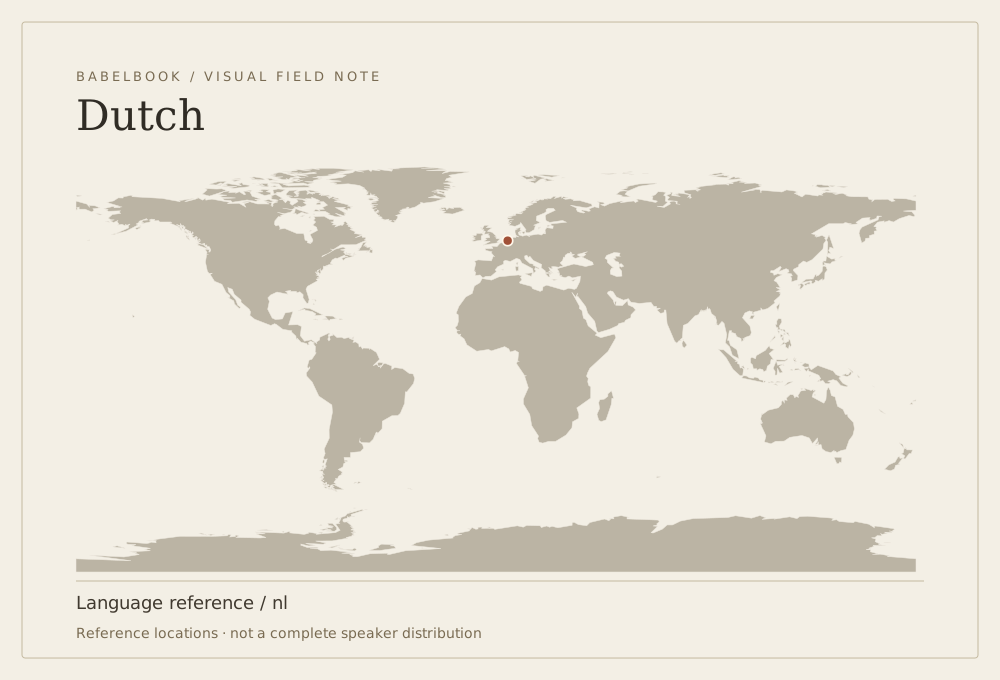
Representative reference points from Glottolog. Historical entries show reference locations, not current speakers. 1 point.
Reference & context ↗Babelbook · original editorial illustration · CC BY 4.0 · Glottolog locations; public-domain Natural Earth land
Source excerpts, selected, shortened and where noted editorially corrected from Dutch language by Wikipedia contributors. Retrieved 2026-10-05. CC BY-SA 4.0. These excerpts are not an independently verified scholarly history; missing accounts are identified above.
Read further in the source
History
Old Dutch can be discerned more or less around the same time as Old English (Anglo-Saxon), Old High German, Pre-Old Frisian, and Old Saxon. These names are derived from the modern standard languages. In this age no standard languages had yet developed, while a perfect West Germanic dialect continuum remained present; the division reflects the contingent future contribution dialect groups would have to the later languages. The early form of Dutch was a set of Franconian dialects spoken by the Salian Franks in the 5th century. These happened to develop through Middle Dutch to Modern Dutch over the course of fifteen centuries. During that period, they forced Old Frisian back from the western coast to the north of the Low Countries, and influenced or even replaced Old Saxon spoken in the east (contiguous with the Low German area). On the other hand, Dutch has been replaced in adjacent lands in present-day France and Germany. The division into Old, Middle and Modern Dutch is mostly conventional, since the transition between them was very gradual. One of the few moments when linguists can detect something of a revolution is when the Dutch standard language emerged and quickly established itself. The development of the Dutch language is illustrated by the following sentence in Old, Middle and Modern Dutch:
Irlôsin sol an frithe sêla mîna fan thên thia ginâcont mi, wanda under managon he was mit mi (Old Dutch) Erlossen sal [hi] in vrede siele mine van dien die genaken mi, want onder menegen hi was met mi (Middle Dutch) Verlossen zal hij in vrede ziel mijn van degenen die genaken mij, want onder menigen hij was met mij (Modern Dutch, same word order) Hij zal mijn ziel in vrede verlossen van degenen die mij genaken, want onder menigen was hij met mij (Modern Dutch, default word order) He will deliver my soul in peace from those who approach me, because, amongst many, he was with me (English)
Origins
Among the Indo-European languages, Dutch is grouped within the Germanic languages, meaning it shares a common ancestor with languages such as English, German, and the Scandinavian languages. All Germanic languages are subject to the Grimm's law and Verner's law sound shifts, which originated in the Proto-Germanic language and define the basic features differentiating them from other Indo-European languages. This is assumed to have taken place in approximately the mid-first millennium BCE in the pre-Roman Northern European Iron Age. The Germanic languages are traditionally divided into three groups: East (now extinct), West, and North Germanic. They remained mutually intelligible throughout the Migration Period. Dutch is part of the West Germanic group, which also includes English, Scots, Frisian, Low German (Old Saxon) and High German. It is characterised by a number of phonological and morphological innovations not found in North or East Germanic.
Dialects
Dutch dialects are primarily the dialects that are both related with the Dutch language and are spoken in the same language area as the Dutch standard language. Although heavily under the influence of the standard language, some of them remain diverse and are found in the Netherlands and in the Brussels and Flemish regions of Belgium. The areas in which they are spoken often correspond with former medieval counties and duchies. The Netherlands (but not Belgium) distinguishes between a dialect and a streektaal ("regional language"). Those words are actually more political than linguistic because a regional language unites a large group of very different varieties. Such is the case with the Gronings dialect, which is considered a variety of the Dutch Low Saxon regional language, but it is relatively distinct from other Dutch Low Saxon varieties. Also, some Dutch dialects are more remote from the Dutch standard language than some varieties of a regional language are. Within the Netherlands, a further distinction is made between a regional language and a separate language, which is the case with the (standardised) West Frisian language. It is spoken alongside Dutch in the province of Friesland. Dutch dialects and regional languages are not spoken as often as they used to be, especially in the Netherlands. Recent research by Geert Driessen shows that the use of dialects and regional languages among both Dutch adults and youth is in heavy decline. In 1995, 27 percent of the Dutch adult population spoke a dialect or regional language on a regular basis, but in 2011, that was no more than 11 percent. In 1995, 12 percent of children of primary school age spoke a dialect or regional language, but in 2011, that had declined to four percent. Of the officially recognised regional languages Limburgish is spoken the most (in 2011 among adults 54%, among children 31%) and Dutch Low Saxon the least (adults 15%, children 1%). The decline of the West Frisian language in Friesland occupies a middle position (adults 44%, children 22%). Dialects are most often spoken in rural areas, but many cities have a distinct city dialect. For example, the city of Ghent has very distinct "g", "e" and "r" sounds that greatly differ from its surrounding villages. The Brussels dialect combines Brabantian with words adopted from Walloon and French. Some dialects had, until recently, extensions across the borders of other standard language areas. In most cases, the heavy influence of the standard language has broken the dialect continuum. Examples are the Gronings dialect spoken in Groningen as well as the closely related varieties in adjacent East Frisia (Germany). Kleverlandish is a dialect spoken in southern Gelderland, the northern tip of Limburg, and northeast of North Brabant (Netherlands), but also in adjacent parts of North Rhine-Westphalia (Germany). Limburgish (Limburgs) is spoken in Limburg (Belgium) as well as in the remaining part of Limburg (Netherlands) and extends across the German border. West Flemish (Westvlaams) is spoken in West Flanders, the western part of Zeelandic Flanders and also in French Flanders, where it virtually became extinct to make way for French.
Dialect groups
The West Flemish group of dialects, spoken in West Flanders and Zeeland, is so distinct that it might be considered as a separate language variant, although the strong significance of language in Belgian politics would prevent the government from classifying them as such. An oddity of the dialect is that, the voiced velar fricative (written as "g" in Dutch) shifts to a voiced glottal fricative (written as "h" in Dutch), while the letter "h" becomes mute (as in French). As a result, when West Flemings try to talk Standard Dutch, they are often unable to pronounce the g-sound, and pronounce it similar to the h-sound. This leaves, for example, no difference between "held" (hero) and "geld" (money). Or in some cases, they are aware of the problem, and hyper-correct the "h" into a voiced velar fricative or g-sound, again leaving no difference. The West Flemish variety historically spoken in adjacent parts in France is sometimes called French Flemish and is listed as a French minority language. However, only a very small and aging minority of the French-Flemish population still speaks and understands West Flemish. Hollandic is spoken in Holland and Utrecht, though the original forms of this dialect (which were heavily influenced by a West Frisian substratum and, from the 16th century on, by Brabantian dialects) are now relatively rare. The urban dialects of the Randstad, which are Hollandic dialects, do not diverge from standard Dutch very much, but there is a clear difference between the city dialects of Rotterdam, The Hague, Amsterdam and Utrecht. In some rural Hollandic areas more authentic Hollandic dialects are still being used, especially north of Amsterdam. Another group of dialects based on Hollandic is that spoken in the cities and larger towns of Friesland, where it partially displaced West Frisian in the 16th century and is known as Stadsfries ("Urban Frisian"). Hollandic together with inter alia Kleverlandish and North Brabantian, but without Stadsfries, are the Central Dutch dialects. Brabantian is named after the historical Duchy of Brabant, which corresponded mainly to the provinces of North Brabant and southern Gelderland, the Belgian provinces of Antwerp and Flemish Brabant, as well as Brussels (where its native speakers have become a minority) and the province of Walloon Brabant. Brabantian expands into small parts in the west of Limburg while its strong influence on the East Flemish of East Flanders and eastern Zeelandic Flanders weakens towards the west. In a small area in the northwest of North Brabant (Willemstad), Hollandic is spoken. Conventionally, the Kleverlandish dialects are distinguished from Brabantian, but there are no objective criteria apart from geography to do so. Over 5 million people live in an area with some form of Brabantian being the predominant colloquial language out of the area's 22 million Dutch-speakers. Limburgish, spoken in both Belgian Limburg and Netherlands Limburg and in adjacent parts in Germany, is considered a dialect in Belgium, while having obtained the official status of regional language in the Netherlands. Limburgish has been influenced by the Ripuarian varieties like the Colognian dialect, and has had a somewhat different development since the late Middle Ages.
Geographic distribution
Dutch is an official language of the Netherlands proper (not enshrined in the constitution but in administrative law), Belgium, Suriname, the Dutch Caribbean municipalities (St. Eustatius, Saba and Bonaire), Aruba, Curaçao and Sint Maarten. Dutch is also an official language of several international organisations, such as the European Union, Union of South American Nations and the Caribbean Community. At an academic level, Dutch is taught in about 175 universities in 40 countries. About 15,000 students worldwide study Dutch at university.
Spelling and writing system
Dutch is written using the Latin script. Dutch uses one additional character beyond the standard alphabet, the digraph ⟨ij⟩. It has a relatively high proportion of doubled letters, both vowels and consonants, due to the formation of compound words and also to the spelling devices for distinguishing the many vowel sounds in the Dutch language. An example of five consecutive doubled letters is the word voorraaddoos (food storage container). The diaeresis (Dutch: trema) is used to mark vowels that are pronounced separately when involving a pre- or suffix, and a hyphen is used when the problem occurs in compound words, e.g. beïnvloed (influenced), de zeeën (the seas) but zee-eend (scoter; lit. sea duck). Generally, other diacritical marks occur only in loanwords. However, the acute accent can also be used for emphasis or to differentiate between two forms, and its most common use is to differentiate between the indefinite article een /ən/ "a, an" and the numeral één /eːn/ "one". Since the 1980s, the Dutch Language Union has been given the mandate to review and make recommendations on the official spelling of Dutch. Spelling reforms undertaken by the union occurred in 1995 and 2005. In the Netherlands, the official spelling is currently given legal basis by the Spelling Act of September 15, 2005. The Spelling Act gives the Committee of Ministers of the Dutch Language Union the authority to determine the spelling of Dutch by ministerial decision. In addition, the law requires that this spelling be followed "at the governmental bodies, at educational institutions funded from the public purse, as well as at the exams for which legal requirements have been established". In other cases, it is recommended, but it is not mandatory to follow the official spelling. The Decree on the Spelling Regulations 2005 of 2006 contains the annexed spelling rules decided by the Committee of Ministers on April 25, 2005. In Flanders, the same spelling rules are currently applied by the Decree of the Flemish Government Establishing the Rules of the Official Spelling and Grammar of the Dutch language of June 30, 2006. The Woordenlijst Nederlandse taal, more commonly known as het groene boekje (i.e. "the green booklet", because of its colour), is the authoritative orthographic word list (without definitions) of the Dutch Language Union; a version with definitions can be had as Het Groene Woordenboek; both are published by Sdu.