Norwegian Nynorsk
Nynorsk (Urban East Norwegian: [ˈnŷːnɔʂk] ; lit. 'Modern Norwegian' or 'New Norwegian') is one of the two official written standards of the Norwegian language, the other being Bokmål. From 12 May 1885, it became the state-sanctioned version of Ivar Aasen's standard Norwegian language (Landsmål), parallel to the Dano-Norwegian written standard known as Riksmål. The name Nynorsk was introduced in 1929. After a series of reforms, it is still the written standard closer to Landsmål, whereas Bokmål is closer to Riksmål and Danish. Between 10 and 15 percent of Norwegians (primarily in the west around the city of Bergen) have Nynorsk as their official language form, estimated by the number of students attending secondary schools. Nynorsk is also taught as a mandatory subject in both high school and middle school for all Norwegians who do not have it as their own language form.
Translate in Norwegian Nynorsk ↗Bokmål has a much larger basis in the cities and generally outside of the western part of the country. Most Norwegians do not speak either Nynorsk or Bokmål as written, but a Norwegian dialect that identifies their origins. Nynorsk shares many of the problems that minority languages face. In Norway, each municipality and county can choose to declare either of the two language standards as the official language or remain "standard-neutral". As of 2020, 90 municipalities had declared Nynorsk the official standard, while 118 had chosen Bokmål; another 148 were "neutral" between the two, numbers that have been stable since the 1970s. As for counties, three have declared Nynorsk as their official standard: Møre og Romsdal, Telemark and Vestland. Most municipalities in Rogaland and a few in the "standard-neutral" counties have declared Nynorsk as their official standard. Ålesund Municipality was the largest municipality with Nynorsk as its official language form, until the area of the old Haram Municipality (a Nynorsk-majority area) was separated from the rest of the municipality from 1 January 2024, and the remaining Ålesund Municipality opted for "standard-neutrality". The main standard used in primary schools is decided by referendum within the local school district. The number of school districts and pupils using primarily Nynorsk has decreased from its height in the 1940s, even in Nynorsk municipalities. Nynorsk is also part of the school curriculum in high school and elementary school for all students in Norway, where students are taught to write it. The prevailing regions for Nynorsk are the rural areas of the western counties of Rogaland, Vestland and Møre og Romsdal, where an estimated 90% of the population writes Nynorsk. Some of the rural parts of Innlandet, Buskerud, Telemark and Agder also write primarily in Nynorsk.
Europe
Present-day use
Written Nynorsk is found in all the same types of places and for the same uses (newspapers, commercial products, computer programs, etc.) as other written languages. Most of the biggest newspapers in Norway have certain articles written in Nynorsk, like VG and Aftenposten, but are mainly Bokmål. There are also nationwide newspapers where Nynorsk is the only Norwegian-language form of publication, among them are Dag & Tid and Framtida.no. Many local newspapers have also chosen Nynorsk as the only language form of publication, like Firdaposten, Hallingdølen, Hordaland and Bø blad. Many newspapers are also officially neutral, conforming to either Nynorsk or Bokmål in an article as they see fit, like Klassekampen and Bergens Tidende. Commercial products produced in the Nynorsk areas of Norway are also often distributed with Nynorsk text, like types of Gamalost. Many computer programs and apps that serve the whole country often present a choice between Bokmål and Nynorsk, especially those produced by the Norwegian government. There are also requirements by law that many Norwegian institutions have to follow. These laws are in order to keep Nynorsk and Bokmål as equals, which has been seen as an important case since the creation of the language forms. For instance the State-owned broadcaster NRK is required by law to have at least 25% of their content on broadcast and online media in Nynorsk. There is also a requirement for state organs and universities to have content written in Nynorsk. Every student in the country should be presented the opportunity to take their exam in either Nynorsk or Bokmål.
Origins
The captured article does not contain a separate origins section. See the historical account and linked source.
Development
Norway had its own written and oral language—Norwegian. After the Kalmar Union, Norway became a less important part of Denmark. At that time, Danish was declared the written language of Norway until 1814, and Danish with Norwegian intonation and pronunciation was on occasion spoken in the cities (see Dano-Norwegian). With the independence of Norway from Denmark, Danish became a foreign language and thus lost much of its prestige, and a conservative, written form of Norwegian, Landsmål, had been developed by 1850. By this time, however, the Danish language had been gradually reformed into the written language Riksmål, and no agreement was reached on which of the two forms to use. In 1885, the parliament declared the two forms official and equal. Efforts were made to fuse the two written forms into one language. As a result, Landsmål and Riksmål lost their official status in 1929, and were replaced by the written forms Nynorsk and Bokmål, which were intended to be temporary intermediary stages before their final fusion into one hypothesised official Norwegian language known at the time as Samnorsk. This project was later abandoned and Nynorsk and Bokmål remain the two officially sanctioned standards of what is today called the Norwegian language. Both written languages are in reality fusions between the Norwegian and Danish languages as they were spoken and written around 1850, with Nynorsk closer to Norwegian and Bokmål closer to Danish. The official standard of Nynorsk has been significantly altered during the process to create the common language form Samnorsk. A minor purist fraction of the Nynorsk population has stayed firm with the historical Aasen norm where these alterations of Nynorsk were rejected, which is known as Høgnorsk (English: High Norwegian, analogous to High German).
Writing
Latin or customary script (catalog classification; see the source for context).
Beyond the typeface.
Signs, manuscripts, published pages and contextual photographs, with their place, period, source and reuse terms. Captions identify historical spellings, regional examples, community references and character imagery.
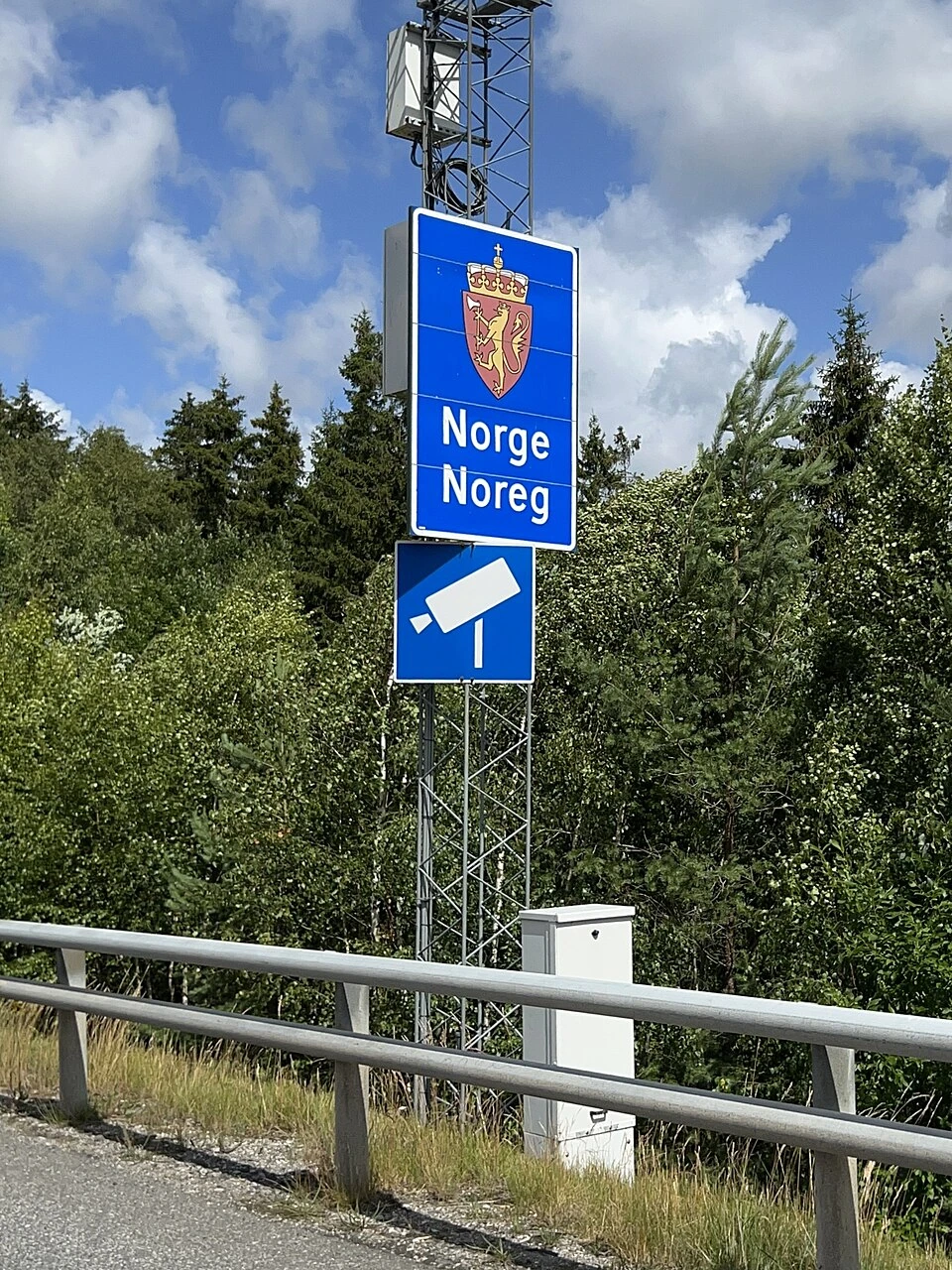
Norwegian border sign on Svinesund Bridge showing Norge (Bokmål) and Noreg (Nynorsk). Language identification follows Commons metadata; not independently transcribed.
Saved in Babelbook · resized display copy. Select the image to open it independently of its source.
Sebbog13 · Source ↗CC BY-SA 4.0 ↗View the local visual field note
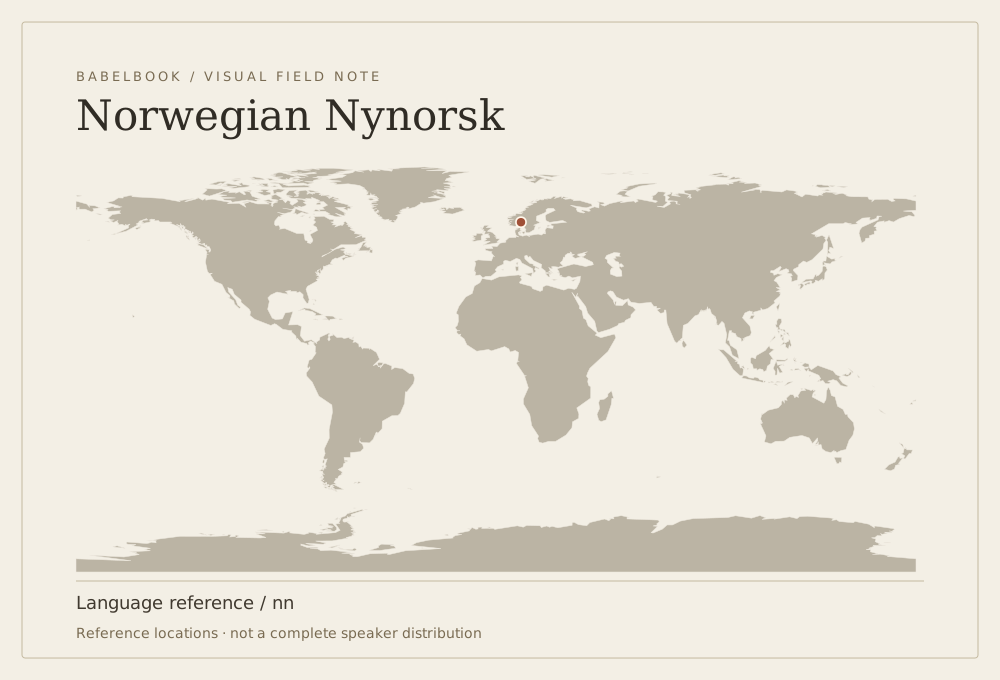
Representative reference points from Glottolog. Historical entries show reference locations, not current speakers. 1 point.
Reference & context ↗Babelbook · original editorial illustration · CC BY 4.0 · Glottolog locations; public-domain Natural Earth land
Source excerpts, selected, shortened and where noted editorially corrected from Nynorsk by Wikipedia contributors. Retrieved 2026-10-05. CC BY-SA 4.0. These excerpts are not an independently verified scholarly history; missing accounts are identified above.
Read further in the source
History
Norway had its own written and oral language—Norwegian. After the Kalmar Union, Norway became a less important part of Denmark. At that time, Danish was declared the written language of Norway until 1814, and Danish with Norwegian intonation and pronunciation was on occasion spoken in the cities (see Dano-Norwegian). With the independence of Norway from Denmark, Danish became a foreign language and thus lost much of its prestige, and a conservative, written form of Norwegian, Landsmål, had been developed by 1850. By this time, however, the Danish language had been gradually reformed into the written language Riksmål, and no agreement was reached on which of the two forms to use. In 1885, the parliament declared the two forms official and equal. Efforts were made to fuse the two written forms into one language. As a result, Landsmål and Riksmål lost their official status in 1929, and were replaced by the written forms Nynorsk and Bokmål, which were intended to be temporary intermediary stages before their final fusion into one hypothesised official Norwegian language known at the time as Samnorsk. This project was later abandoned and Nynorsk and Bokmål remain the two officially sanctioned standards of what is today called the Norwegian language. Both written languages are in reality fusions between the Norwegian and Danish languages as they were spoken and written around 1850, with Nynorsk closer to Norwegian and Bokmål closer to Danish. The official standard of Nynorsk has been significantly altered during the process to create the common language form Samnorsk. A minor purist fraction of the Nynorsk population has stayed firm with the historical Aasen norm where these alterations of Nynorsk were rejected, which is known as Høgnorsk (English: High Norwegian, analogous to High German). Ivar Aasen-sambandet is an umbrella organization of associations and individuals promoting the use of Høgnorsk, whereas Noregs Mållag and Norsk Målungdom advocate the use of Nynorsk in general. The Landsmål (Landsmaal) language standard was constructed by the Norwegian linguist Ivar Aasen during the mid-19th century, to provide a Norwegian-based alternative to Danish, which was commonly written, and to some extent spoken, in Norway at the time. The word Nynorsk also has another meaning. In addition to being the name of the present, official written language standard, Nynorsk can also refer to the Norwegian language in use after Old Norwegian, 11th to 14th centuries, and Middle Norwegian, 1350 to about 1550. The written Norwegian that was used until the period of Danish rule (1536-1814), closely resembles Nynorsk (New Norwegian). A major source of old written material is Diplomatarium Norvegicum in 22 printed volumes. In 2023 Jon Fosse received the Nobel Prize in Literature. He was the first person awarded this prize to write in Nynorsk.
Geographical distribution
Bokmål has a much larger basis in the cities and generally outside of the western part of the country. Most Norwegians do not speak either Nynorsk or Bokmål as written, but a Norwegian dialect that identifies their origins. Nynorsk shares many of the problems that minority languages face. In Norway, each municipality and county can choose to declare either of the two language standards as the official language or remain "standard-neutral". As of 2020, 90 municipalities had declared Nynorsk the official standard, while 118 had chosen Bokmål; another 148 were "neutral" between the two, numbers that have been stable since the 1970s. As for counties, three have declared Nynorsk as their official standard: Møre og Romsdal, Telemark and Vestland. Most municipalities in Rogaland and a few in the "standard-neutral" counties have declared Nynorsk as their official standard. Ålesund Municipality was the largest municipality with Nynorsk as its official language form, until the area of the old Haram Municipality (a Nynorsk-majority area) was separated from the rest of the municipality from 1 January 2024, and the remaining Ålesund Municipality opted for "standard-neutrality". The main standard used in primary schools is decided by referendum within the local school district. The number of school districts and pupils using primarily Nynorsk has decreased from its height in the 1940s, even in Nynorsk municipalities. Nynorsk is also part of the school curriculum in high school and elementary school for all students in Norway, where students are taught to write it. The prevailing regions for Nynorsk are the rural areas of the western counties of Rogaland, Vestland and Møre og Romsdal, where an estimated 90% of the population writes Nynorsk. Some of the rural parts of Innlandet, Buskerud, Telemark and Agder also write primarily in Nynorsk. In the Sunnmøre region of Møre og Romsdal, all municipalities (except the Bokmål-majority Ålesund) have stated Nynorsk as the official standard. In Vestland, almost all municipalities have declared Nynorsk as the official standard – Bergen Municipality and Askøy Municipality being the only two exceptions.
Status of the language form
Written Nynorsk is found in all the same types of places and for the same uses (newspapers, commercial products, computer programs, etc.) as other written languages. Most of the biggest newspapers in Norway have certain articles written in Nynorsk, like VG and Aftenposten, but are mainly Bokmål. There are also nationwide newspapers where Nynorsk is the only Norwegian-language form of publication, among them are Dag & Tid and Framtida.no. Many local newspapers have also chosen Nynorsk as the only language form of publication, like Firdaposten, Hallingdølen, Hordaland and Bø blad. Many newspapers are also officially neutral, conforming to either Nynorsk or Bokmål in an article as they see fit, like Klassekampen and Bergens Tidende. Commercial products produced in the Nynorsk areas of Norway are also often distributed with Nynorsk text, like types of Gamalost. Many computer programs and apps that serve the whole country often present a choice between Bokmål and Nynorsk, especially those produced by the Norwegian government. There are also requirements by law that many Norwegian institutions have to follow. These laws are in order to keep Nynorsk and Bokmål as equals, which has been seen as an important case since the creation of the language forms. For instance the State-owned broadcaster NRK is required by law to have at least 25% of their content on broadcast and online media in Nynorsk. There is also a requirement for state organs and universities to have content written in Nynorsk. Every student in the country should be presented the opportunity to take their exam in either Nynorsk or Bokmål.