Norwegian
Norwegian (endonym: norsk [ˈnɔʂːk] , norsk språk [ˈnɔʂːk sproːk]) is a North Germanic language from the Indo-European language family spoken mainly in Norway, where it is an official language. Along with Swedish and Danish, Norwegian forms a dialect continuum of more or less mutually intelligible local and regional varieties; some Norwegian and Swedish dialects, in particular, are very close. These Scandinavian languages, together with Faroese and Icelandic as well as some extinct languages, constitute the North Germanic languages. Faroese and Icelandic are not mutually intelligible with Norwegian in their spoken form because continental Scandinavian has diverged from them. While the two Germanic languages with the greatest numbers of speakers, English and German, have close similarities with Norwegian, neither is mutually intelligible with it. Norwegian is a descendant of Old Norse, the common language of the Germanic peoples living in Scandinavia during the Viking Age. Today there are two official forms of written Norwegian, Bokmål (Riksmål) and Nynorsk (Landsmål), each with its own variants. Bokmål developed from the Dano-Norwegian language that replaced Middle Norwegian as the elite language after the union of Denmark–Norway in the 16th and 17th centuries and then evolved in Norway, while Nynorsk was developed based upon a collective of spoken Norwegian dialects. Norwegian is one of the two official languages in Norway, along with Sámi, a group of Finno-Ugric languages spoken by the Indigenous people of the same name.
Translate in Norwegian ↗Norwegian (endonym: norsk [ˈnɔʂːk] , norsk språk [ˈnɔʂːk sproːk]) is a North Germanic language from the Indo-European language family spoken mainly in Norway, where it is an official language. Along with Swedish and Danish, Norwegian forms a dialect continuum of more or less mutually intelligible local and regional varieties; some Norwegian and Swedish dialects, in particular, are very close. These Scandinavian languages, together with Faroese and Icelandic as well as some extinct languages, constitute the North Germanic languages. Faroese and Icelandic are not mutually intelligible with Norwegian in their spoken form because continental Scandinavian has diverged from them. While the two Germanic languages with the greatest numbers of speakers, English and German, have close similarities with Norwegian, neither is mutually intelligible with it. Norwegian is a descendant of Old Norse, the common language of the Germanic peoples living in Scandinavia during the Viking Age. Today there are two official forms of written Norwegian, Bokmål (Riksmål) and Nynorsk (Landsmål), each with its own variants. Bokmål developed from the Dano-Norwegian language that replaced Middle Norwegian as the elite language after the union of Denmark–Norway in the 16th and 17th centuries and then evolved in Norway, while Nynorsk was developed based upon a collective of spoken Norwegian dialects. Norwegian is one of the two official languages in Norway, along with Sámi, a group of Finno-Ugric languages spoken by the Indigenous people of the same name. Norwegian is one of the working languages of the Nordic Council.
Europe
Present-day use
In 2010, 86.5% of the pupils in the primary and lower secondary schools in Norway receive education in Bokmål, while 13.0% receive education in Nynorsk. From the eighth grade onwards, pupils are required to learn both. Out of the 431 municipalities in Norway, 161 have declared that they wish to communicate with the central authorities in Bokmål, 116 (representing 12% of the population) in Nynorsk, while 156 are neutral. Of 4,549 state publications in 2000, 8% were in Nynorsk, and 92% in Bokmål. The large national newspapers (Aftenposten, Dagbladet, and VG) are published in Bokmål or Riksmål. Some major regional newspapers (including Bergens Tidende and Stavanger Aftenblad), many political journals, and many local newspapers use both Bokmål and Nynorsk. A newer trend is to write in dialect for informal use. When writing an SMS, Facebook update, or fridge note, many people, especially young ones, write approximations of the way they talk rather than using Bokmål or Nynorsk.
Origins
Like most of the languages in Europe, Norwegian derives from Proto-Indo-European. As early Indo-Europeans spread across Europe, they became isolated from each other and new languages developed. In northwest Europe, the Germanic languages evolved, further branching off into the North Germanic languages, of which Norwegian is one. Proto-Norse is thought to have evolved as a northern dialect of Proto-Germanic during the first centuries AD in what is today Southern Sweden. It is the earliest stage of a characteristically North Germanic language, and the language attested in the Elder Futhark inscriptions, the oldest form of the runic alphabets. A number of inscriptions are memorials to the dead, while others are magical in content. The oldest are carved on loose objects, while later ones are chiseled in runestones. They are the oldest written record of any Germanic language. Around 800 AD, the script was simplified to the Younger Futhark, and inscriptions became more abundant. At the same time, the beginning of the Viking Age led to the spread of Old Norse to Iceland, Greenland, and the Faroe Islands. Viking colonies also existed in parts of the British Isles, France (Normandy), North America, and Kievan Rus. In all of these places except Iceland and the Faroes, Old Norse speakers went extinct or were absorbed into the local population.
Development
The captured article does not contain a distinct historical account. No chronology has been invented.
Writing
In the late Middle Ages, dialects began to develop in Scandinavia because the population was rural and little travel occurred. When the Reformation came from Germany, Martin Luther's High German translation of the Bible was quickly translated into Swedish, Danish, and Icelandic. Norway entered a union with Denmark in 1397 and Danish, over time, replaced Middle Norwegian as the language of the elite, the church, literature, and the law. When the union with Denmark ended in 1814, the Dano-Norwegian koiné had become the mother tongue of around 1% of the population.
Beyond the typeface.
Signs, manuscripts, published pages and contextual photographs, with their place, period, source and reuse terms. Captions identify historical spellings, regional examples, community references and character imagery.
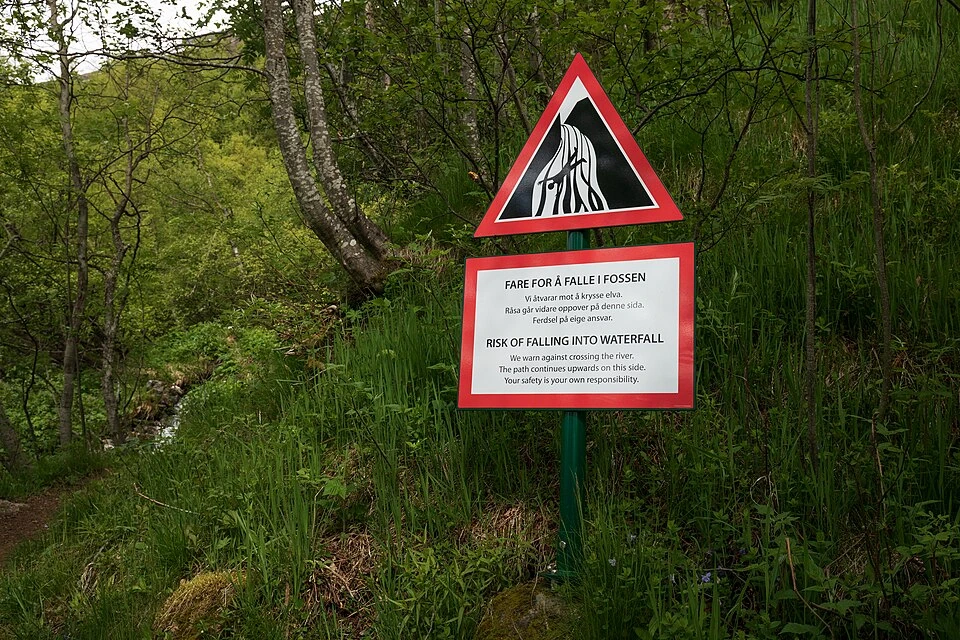
Norwegian and English warning beside the footpath near Gjerdefossen, Norway. Language identification follows the source description; not independently transcribed.
Saved in Babelbook · resized display copy. Select the image to open it independently of its source.
Simo Räsänen · Source ↗CC BY-SA 4.0 ↗View the local visual field note
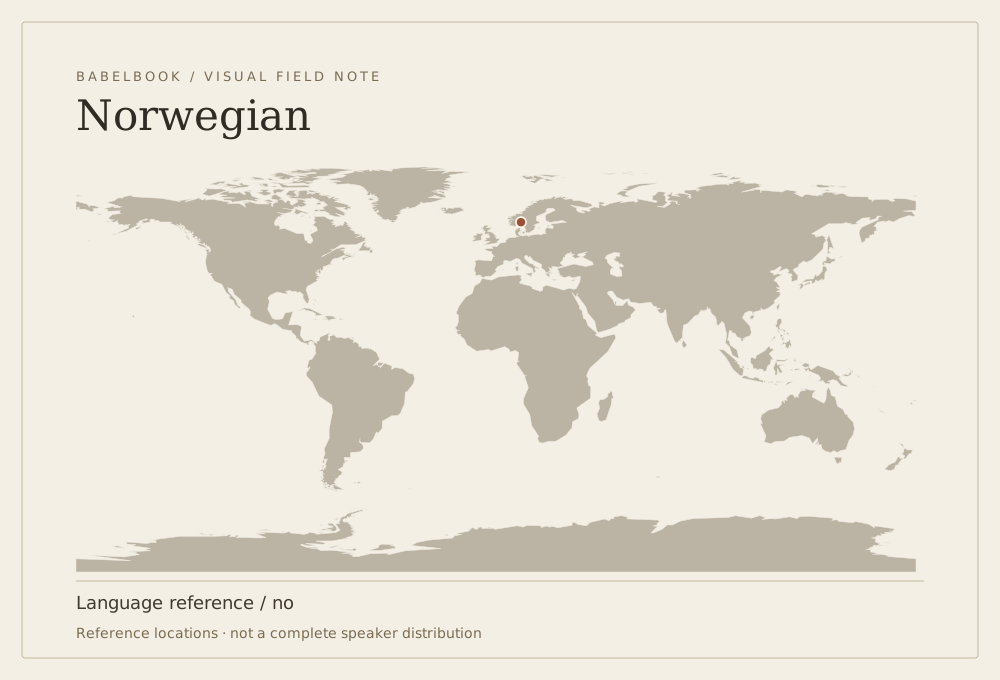
Representative reference points from Glottolog. Historical entries show reference locations, not current speakers. 1 point.
Reference & context ↗Babelbook · original editorial illustration · CC BY 4.0 · Glottolog locations; public-domain Natural Earth land
Source excerpts, selected, shortened and where noted editorially corrected from Norwegian language by Wikipedia contributors. Retrieved 2026-10-05. CC BY-SA 4.0. These excerpts are not an independently verified scholarly history; missing accounts are identified above.
Read further in the source
Origins
Like most of the languages in Europe, Norwegian derives from Proto-Indo-European. As early Indo-Europeans spread across Europe, they became isolated from each other and new languages developed. In northwest Europe, the Germanic languages evolved, further branching off into the North Germanic languages, of which Norwegian is one. Proto-Norse is thought to have evolved as a northern dialect of Proto-Germanic during the first centuries AD in what is today Southern Sweden. It is the earliest stage of a characteristically North Germanic language, and the language attested in the Elder Futhark inscriptions, the oldest form of the runic alphabets. A number of inscriptions are memorials to the dead, while others are magical in content. The oldest are carved on loose objects, while later ones are chiseled in runestones. They are the oldest written record of any Germanic language.
Around 800 AD, the script was simplified to the Younger Futhark, and inscriptions became more abundant. At the same time, the beginning of the Viking Age led to the spread of Old Norse to Iceland, Greenland, and the Faroe Islands. Viking colonies also existed in parts of the British Isles, France (Normandy), North America, and Kievan Rus. In all of these places except Iceland and the Faroes, Old Norse speakers went extinct or were absorbed into the local population.
Decline of written Norwegian
In the late Middle Ages, dialects began to develop in Scandinavia because the population was rural and little travel occurred. When the Reformation came from Germany, Martin Luther's High German translation of the Bible was quickly translated into Swedish, Danish, and Icelandic. Norway entered a union with Denmark in 1397 and Danish, over time, replaced Middle Norwegian as the language of the elite, the church, literature, and the law. When the union with Denmark ended in 1814, the Dano-Norwegian koiné had become the mother tongue of around 1% of the population.
Danish to Norwegian standardisation
From the 1840s, some writers experimented with a Norwegianised form of written Danish. Knud Knudsen proposed to change spelling and inflection in accordance with the Dano-Norwegian koiné, known as "cultivated everyday speech." A small adjustment in this direction was implemented in the first official reform of the Danish language in Norway in 1862 and more extensively after his death in two official reforms in 1907 and 1917. Meanwhile, a nationalistic movement strove for the development of a new written Norwegian. Ivar Aasen, a botanist and self-taught linguist, began his work to create a new Norwegian language at the age of 22. He traveled around the country collecting words and examples of grammar from the dialects and comparing the dialects among the different regions. He examined the development of Icelandic, which had largely escaped the influences under which Norwegian had come. He called his work, which was published in several books from 1848 to 1873, Landsmål, meaning 'national language'. The name Landsmål is sometimes interpreted as 'rural language' or 'country language', but this was clearly not Aasen's intended meaning. The name of the Danish language in Norway was a topic of hot dispute throughout the 19th century. Its proponents claimed that it was a language common to Norway and Denmark, and no more Danish than Norwegian. The proponents of Landsmål thought that the Danish character of the language should not be concealed. In 1899, Bjørnstjerne Bjørnson proposed the neutral name Riksmål, meaning 'national language' like Landsmål, and this was officially adopted along with the 1907 spelling reform. The name Riksmål is sometimes interpreted as 'state language', but this meaning is secondary at best. (Compare to Danish rigsmål from where the name was borrowed.) After the personal union with Sweden was dissolved in 1905, both languages were developed further and reached what is now considered their classic forms after a reform in 1917. Riksmål was, in 1929, officially renamed Bokmål (literally 'book language'), and Landsmål to Nynorsk (literally 'new Norwegian'). A proposition to substitute Danish-Norwegian (dansk-norsk) for Bokmål lost in parliament by a single vote. The name Nynorsk, the linguistic term for modern Norwegian, was chosen to contrast with Danish and emphasise the historical connection to Old Norwegian. Today, this meaning is often lost, and it is commonly mistaken as a "new" Norwegian in contrast to the "real" Norwegian Bokmål. Bokmål and Nynorsk were made closer by a reform in 1938. This was a result of a state policy to merge Nynorsk and Bokmål into a single language, to be called Samnorsk. A 1946 poll showed that this policy was supported by 79% of Norwegians at the time. However, opponents of the official policy still managed to create a massive protest movement against Samnorsk in the 1950s, fighting in particular the use of "radical" forms in Bokmål text books in schools. In the reform in 1959, the 1938 reform was partially reversed in Bokmål, but Nynorsk was changed further towards Bokmål. Since then Bokmål has reverted even further toward traditional Riksmål, while Nynorsk still adheres to the 1959 standard. Therefore, a small minority of Nynorsk enthusiasts use a more conservative standard called Høgnorsk. The Samnorsk policy had little influence after 1960, and was officially abandoned in 2002.
Dialects
There is general agreement that a wide range of differences makes it difficult to estimate the number of different Norwegian dialects. Variations in grammar, syntax, vocabulary, and pronunciation cut across geographical boundaries and can create a distinct dialect at the level of farm clusters. Dialects are in some cases so dissimilar as to be unintelligible to unfamiliar listeners. Many linguists note a trend toward regionalization of dialects that diminishes the differences at such local levels; there is, however, a renewed interest in preserving dialects.