Old Norse
Old Norse was a North Germanic language spoken in Scandinavia and in Norse settlements during the Viking Age and the early Middle Ages (approximately the 8th–14th centuries). It is the conventional term for the medieval West and East Scandinavian dialects (often labelled Old West Norse and Old East Norse) that developed from Proto-Norse and later evolved into the modern North Germanic languages, including Icelandic, Faroese, Norwegian, Danish, and Swedish. Old Norse is attested in runic inscriptions (written in the Younger Futhark) and in numerous medieval manuscripts written with the Latin alphabet; its literary corpus includes the Poetic Edda, the Prose Edda, the Icelandic sagas, skaldic verse, law codes, and religious texts. Contact between Old Norse speakers and other languages — particularly Old English and the Celtic languages — left a substantial legacy of loanwords and toponyms; many common English words such as egg, knife, sky, and window derive from Old Norse. Scholarly usage of the term Old Norse typically covers texts from the 11th to the 14th centuries, though periodization varies within academia based on the theoretical focus and tradition of the particular source.
Translate in Old Norse ↗Old Icelandic was close to Old Norwegian, and together they formed Old West Norse, which was also spoken in Norse settlements in Greenland, the Faroes, Ireland, Scotland, the Isle of Man, northwest England (particularly Cumbria), and Normandy. Old East Norse was spoken in Denmark, Sweden, Kievan Rus', eastern England, and Danish settlements in Normandy. The Old Gutnish dialect was spoken in Gotland and in various settlements in the East. In the 11th century, Old Norse was the most widely spoken European language, ranging from Vinland in the West to the Volga River in the East. In Kievan Rus', it survived the longest in Veliky Novgorod, probably lasting into the 14th century there. The age of the Swedish-speaking population of Finland is strongly contested, but Swedish settlement had spread the language into the region by the time of the Second Swedish Crusade in the 13th century at the latest.
Europe
Present-day use
The modern descendants of the Old West Norse dialect are the West Scandinavian languages of Icelandic, Faroese, Norwegian, and the extinct Norn language of Orkney and Shetland, although Norwegian was heavily influenced by the East dialect, and is today more similar to East Scandinavian (Danish and Swedish) than to Icelandic and Faroese. The descendants of the Old East Norse dialect are the East Scandinavian languages of Danish, Swedish and Övdalian, although Övdalian was heavily influenced by the West Dialect, and is sometimes considered to form its own group. Among these, the grammar of Icelandic, Faroese and Övdalian have changed the least from Old Norse in the last thousand years, though the pronunciations of Icelandic and Faroese both have changed considerably from Old Norse. With Danish rule of the Faroe Islands, Faroese has also been influenced by Danish. Both Middle English (especially northern English dialects within the area of the Danelaw) and Early Scots (including Lowland Scots) were strongly influenced by Norse and contained many Old Norse loanwords. Consequently, Modern English (including Scottish English), inherited a significant proportion of its vocabulary directly from Norse. The development of Norman French was also influenced by Norse. Through Norman, to a smaller extent, so was modern French. Written modern Icelandic derives from the Old Norse phonemic writing system. Contemporary Icelandic-speakers can read Old Norse, which varies slightly in spelling as well as semantics and word order. However, pronunciation, particularly of the vowel phonemes, has changed at least as much in Icelandic as in the other North Germanic languages. Faroese retains many similarities but is influenced by Danish, Norwegian, and Gaelic. Although Swedish, Danish and Norwegian have diverged the most, they still retain considerable mutual intelligibility.
Origins
The captured article does not contain a separate origins section. See the historical account and linked source.
Development
The captured article does not contain a distinct historical account. No chronology has been invented.
Writing
Unlike Proto-Norse, which was written with the Elder Futhark, runic Old Norse was originally written with the Younger Futhark, which had only 16 letters. Because of the limited number of runes, several runes were used for different sounds, and long and short vowels were not distinguished in writing. Medieval runes came into use some time later. As for the Latin alphabet, there was no standardized orthography in use in the Middle Ages. A modified version of the letter wynn called vend was used briefly for the sounds /u/, /v/, and /w/. Long vowels were sometimes marked with acutes but also sometimes left unmarked or geminated. The standardized Old Norse spelling was created in the 19th century and is, for the most part, phonemic. The most notable deviation is that the nonphonemic difference between the voiced and the voiceless dental fricative is marked. The oldest texts and runic inscriptions use þ exclusively. Long vowels are denoted with acutes. Most other letters are written with the same glyph as the IPA phoneme's grapheme, except as shown in the above tables.
Beyond the typeface.
Signs, manuscripts, published pages and contextual photographs, with their place, period, source and reuse terms. Captions identify historical spellings, regional examples, community references and character imagery.
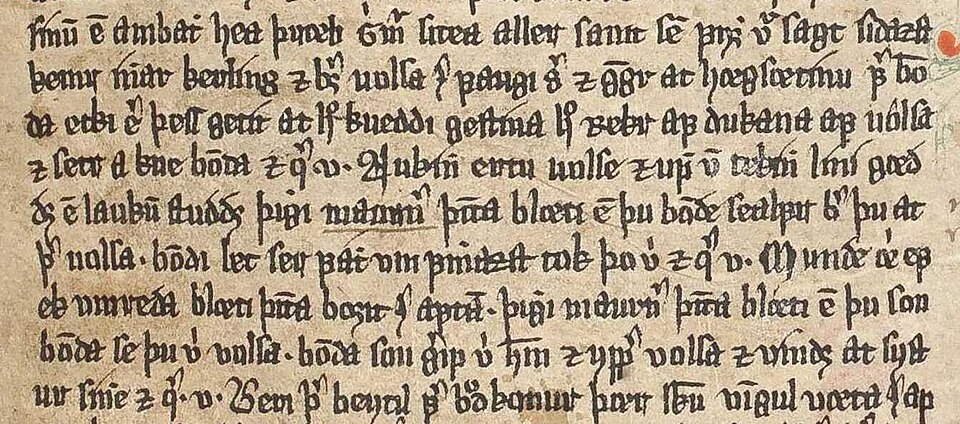
A cropped passage from folio 122r of Flateyjarbók, containing Vǫlsa þáttr; Commons identifies it as an Old Norse manuscript.
Saved in Babelbook · resized display copy. Select the image to open it independently of its source.
Jón Þórðarson and Magnús Þórhallsson · Source ↗CC BY 4.0 ↗View the local visual field note
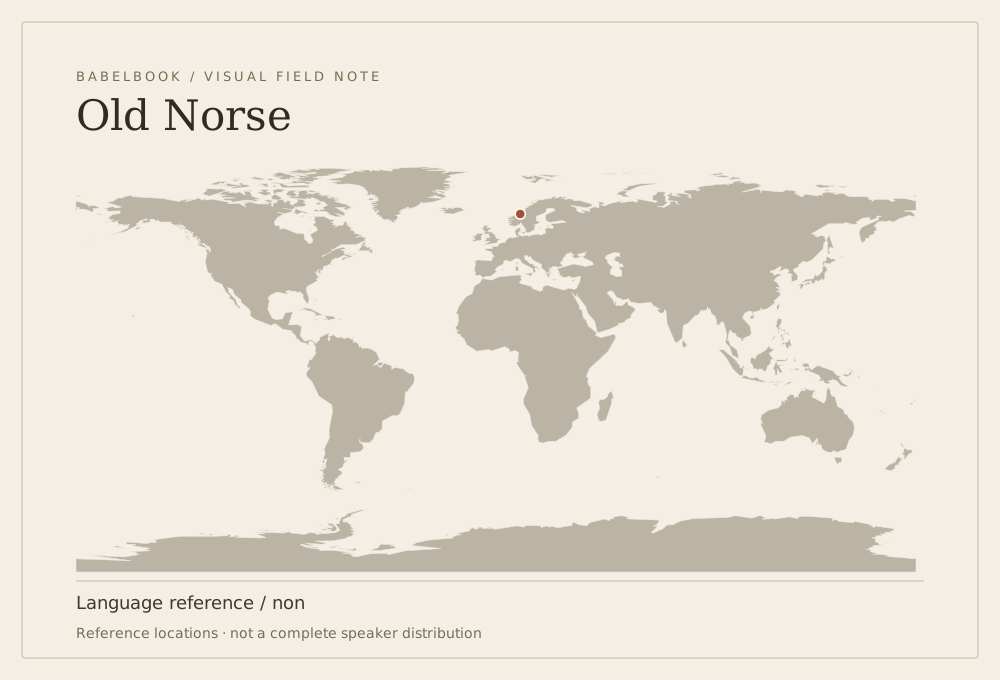
Representative reference points from Glottolog. Historical entries show reference locations, not current speakers. 1 point.
Reference & context ↗Babelbook · original editorial illustration · CC BY 4.0 · Glottolog locations; public-domain Natural Earth land
Source excerpts, selected, shortened and where noted editorially corrected from Old Norse by Wikipedia contributors. Retrieved 2026-10-05. CC BY-SA 4.0. These excerpts are not an independently verified scholarly history; missing accounts are identified above.
Read further in the source
Geographical distribution
Old Icelandic was close to Old Norwegian, and together they formed Old West Norse, which was also spoken in Norse settlements in Greenland, the Faroes, Ireland, Scotland, the Isle of Man, northwest England (particularly Cumbria), and Normandy. Old East Norse was spoken in Denmark, Sweden, Kievan Rus', eastern England, and Danish settlements in Normandy. The Old Gutnish dialect was spoken in Gotland and in various settlements in the East. In the 11th century, Old Norse was the most widely spoken European language, ranging from Vinland in the West to the Volga River in the East. In Kievan Rus', it survived the longest in Veliky Novgorod, probably lasting into the 14th century there. The age of the Swedish-speaking population of Finland is strongly contested, but Swedish settlement had spread the language into the region by the time of the Second Swedish Crusade in the 13th century at the latest.
Orthography
Unlike Proto-Norse, which was written with the Elder Futhark, runic Old Norse was originally written with the Younger Futhark, which had only 16 letters. Because of the limited number of runes, several runes were used for different sounds, and long and short vowels were not distinguished in writing. Medieval runes came into use some time later. As for the Latin alphabet, there was no standardized orthography in use in the Middle Ages. A modified version of the letter wynn called vend was used briefly for the sounds /u/, /v/, and /w/. Long vowels were sometimes marked with acutes but also sometimes left unmarked or geminated. The standardized Old Norse spelling was created in the 19th century and is, for the most part, phonemic. The most notable deviation is that the nonphonemic difference between the voiced and the voiceless dental fricative is marked. The oldest texts and runic inscriptions use þ exclusively. Long vowels are denoted with acutes. Most other letters are written with the same glyph as the IPA phoneme's grapheme, except as shown in the above tables.
Dialects
Most of the innovations that appeared in Old Norse spread evenly through the Old Norse area. As a result, the dialects were similar and considered to be the same language, a language that they sometimes called the Danish tongue (Dǫnsk tunga), sometimes Norse language (Norrœnt mál), as evidenced in the following two quotes from Heimskringla by Snorri Sturluson:
However, some changes were geographically limited and so created a dialectal difference between Old West Norse and Old East Norse. As Proto-Norse evolved into Old Norse, in the 8th century, the effects of the umlauts seem to have been very much the same over the whole Old Norse area. But in later dialects of the language a split occurred mainly between west and east as the use of umlauts began to vary. The typical umlauts (for example fylla < *fullijan) were better preserved in the West due to later generalizations in the east where many instances of umlaut were removed (many archaic Eastern texts as well as eastern runic inscriptions however portray the same extent of umlauts as in later Western Old Norse). All the while, the changes resulting in breaking (for example hiarta < *hertō) were more influential in the East probably once again due to generalizations within the inflectional system. This difference was one of the greatest reasons behind the dialectalization that took place in the 9th and 10th centuries, shaping an Old West Norse dialect in Norway and the Atlantic settlements and an Old East Norse dialect in Denmark and Sweden. Old West Norse and Old Gutnish did not take part in the monophthongization which changed æi (ei) into ē, øy (ey) and au into ø̄, nor did certain peripheral dialects of Swedish, as seen in modern Ostrobothnian dialects. Another difference was that Old West Norse lost certain combinations of consonants. The combinations -mp-, -nt-, and -nk- were assimilated into -pp-, -tt- and -kk- in Old West Norse, but this phenomenon was limited in Old East Norse. Here is a comparison between the two dialects as well as Old Gutnish. It is a transcription from one of the Funbo Runestones in Sweden (U 990) from the eleventh century:
The OEN original text above is transliterated according to traditional scholarly methods, wherein u-umlaut is not regarded in runic Old East Norse. Modern studies have shown that the positions where it applies are the same as for runic Old West Norse. An alternative and probably more accurate transliteration would therefore render the text in OEN as such:
Some past participles and other words underwent i-umlaut in Old West Norse but not in Old East Norse dialects. Examples of that are Icelandic slegið/sleginn and tekið/tekinn, which in Swedish are slagit/slagen and tagit/tagen. This can also be seen in the Icelandic and Norwegian words sterkur and sterk 'strong', which in Swedish is stark as in Old Swedish. These differences can also be seen in comparison between Norwegian and Swedish.
Dialectal information
Greenlandic Norse History of Danish History of Icelandic Old Gutnish Old Norwegian Old Swedish