Navajo
Navajo or Navaho ( NAV-ə-hoh, NAH-və-; Diné bizaad [tìnépìz̥ɑ̀ːt] or Naabeehó bizaad [nɑ̀ːpèːhópìz̥ɑ̀ːt]) is a Southern Athabaskan language of the Na-Dené family, through which it is related to languages spoken across the western areas of North America. Navajo is spoken primarily in the Southwestern United States, especially in the Navajo Nation. It is one of the most widely spoken Native American languages and is the most widely spoken north of the Mexico–United States border, with almost 170,000 Americans speaking Navajo at home as of 2011. The language has struggled to keep a healthy speaker base, although this problem has been alleviated to some extent by extensive education programs in the Navajo Nation. In World War II, speakers of the Navajo language joined the military and developed a code for sending secret messages. These code talkers' messages are widely credited with saving many lives and winning some of the most decisive battles in the war. Navajo has a fairly large phonemic inventory, including several consonants that are not found in English. Its four basic vowel qualities are distinguished for nasality, length, and tone. Navajo has both agglutinative and fusional elements: it uses affixes to modify verbs, and nouns are typically created from multiple morphemes, but in both cases these morphemes are fused irregularly and beyond easy recognition. Basic word order is subject–object–verb, though it is highly flexible to pragmatic factors.
Translate in Navajo ↗In 1968, U.S. President Lyndon B. Johnson signed the Bilingual Education Act, which provided funds for educating young students who are not native English speakers. The Act had mainly been intended for Spanish-speaking children—particularly Mexican Americans—but it applied to all recognized linguistic minorities. Many Native American tribes seized the chance to establish their own bilingual education programs. However, qualified teachers who were fluent in Native languages were scarce, and these programs were largely unsuccessful. However, data collected in 1980 showed that 85 percent of Navajo first-graders were bilingual, compared to 62 percent of Navajo of all ages—early evidence of a resurgence of use of their traditional language among younger people. In 1984, to counteract the language's historical decline, the Navajo Nation Council decreed that the Navajo language would be available and comprehensive for students of all grade levels in schools of the Navajo Nation. This effort was aided by the fact that, largely due to the work of Young and Morgan, Navajo is one of the best-documented Native American languages. In 1980 they published a monumental expansion of their work on the language, organized by word (first initial of vowel or consonant) in the pattern of English dictionaries, as requested by Navajo students. The Navajo Language: A Grammar and Colloquial Dictionary also included a 400-page grammar, making it invaluable for both native speakers and students of the language. Particularly in its organization of verbs, it was oriented to Navajo speakers. They expanded this work again in 1987, with several significant additions, and this edition continues to be used as an important text. The Native American language education movement has been met with adversity, such as by English-only campaigns in some areas in the late 1990s. However, Navajo-immersion programs have cropped up across the Navajo Nation.
North America
Present-day use
In 1968, U.S. President Lyndon B. Johnson signed the Bilingual Education Act, which provided funds for educating young students who are not native English speakers. The Act had mainly been intended for Spanish-speaking children—particularly Mexican Americans—but it applied to all recognized linguistic minorities. Many Native American tribes seized the chance to establish their own bilingual education programs. However, qualified teachers who were fluent in Native languages were scarce, and these programs were largely unsuccessful. However, data collected in 1980 showed that 85 percent of Navajo first-graders were bilingual, compared to 62 percent of Navajo of all ages—early evidence of a resurgence of use of their traditional language among younger people. In 1984, to counteract the language's historical decline, the Navajo Nation Council decreed that the Navajo language would be available and comprehensive for students of all grade levels in schools of the Navajo Nation. This effort was aided by the fact that, largely due to the work of Young and Morgan, Navajo is one of the best-documented Native American languages. In 1980 they published a monumental expansion of their work on the language, organized by word (first initial of vowel or consonant) in the pattern of English dictionaries, as requested by Navajo students. The Navajo Language: A Grammar and Colloquial Dictionary also included a 400-page grammar, making it invaluable for both native speakers and students of the language. Particularly in its organization of verbs, it was oriented to Navajo speakers. They expanded this work again in 1987, with several significant additions, and this edition continues to be used as an important text. The Native American language education movement has been met with adversity, such as by English-only campaigns in some areas in the late 1990s. However, Navajo-immersion programs have cropped up across the Navajo Nation.
Origins
The captured article does not contain a separate origins section. See the historical account and linked source.
Development
The Apachean languages, including Navajo, are thought to have arrived in the American Southwest from the north by 1500, as various peoples migrated through Alberta and Wyoming. Archaeological finds considered indicative of proto-Navajo have been located in far northern New Mexico around the La Plata, Animas and Pine rivers, dating to around 1500. In 1936, linguist Edward Sapir showed how the arrival of the Navajo people in the new arid climate among the corn agriculturalists of the Pueblo area was reflected in their language by tracing the changing meanings of words from Proto-Athabaskan to Navajo. For example, the word *dè:, which in Proto-Athabaskan meant "horn" and "dipper made from animal horn", in Navajo became a-deeʼ, which meant "gourd" or "dipper made from gourd". Likewise, the Proto-Athabaskan word *ł-yəx̣s "snow lies on the ground" in Navajo became yas "snow". Similarly, the Navajo word for "corn" is naadą́ą́', derived from two Proto-Athabaskan roots meaning "enemy" and "food", suggesting that the Navajo originally considered corn to be "food of the enemy" when they first arrived among the Pueblo people.
Writing
Early attempts at a Navajo orthography were made in the late nineteenth and early twentieth centuries. One such attempt was based on the Latin alphabet, particularly the English variety, with some additional letters and diacritics. Anthropologists were frustrated by Navajo's having several sounds that are not found in English and lack of other sounds that are. Finally, the current Navajo orthography was developed between 1935 and 1940 by Young and Morgan. An apostrophe (ʼ) is used to mark ejective consonants (e.g. chʼ, tłʼ) as well as mid-word or final glottal stops. However, initial glottal stops are usually not marked. The voiceless glottal fricative (/h/) is normally written as h, but appears as x after the consonant s (optionally after sh) at syllable boundary (ex: yiyiis-xı̨́), and when it represents the depreciative augment found after stem initial (ex: tsxı̨́įł-go, yi-chxa). The voiced velar fricative is written as y before i and e (where it is palatalized /ʝ/), as w before o (where it is labialized /ɣʷ/), and as gh before a. Navajo represents nasalized vowels with an ogonek ( ˛ ), sometimes described as a reverse cedilla; and represents the voiceless alveolar lateral fricative (/ɬ/) with a barred L (capital Ł, lowercase ł). The ogonek is most often placed centrally under a vowel, but it was imported from Polish and Lithuanian, which do not usually center it nor use it under certain vowels such as o or any vowels with accent marks. For example, in Navajo works, the ogonek below lowercase a is most often shown centered below the letter, whereas fonts with a with ogonek intended for Polish and Lithuanian have its ogonek connected to the bottom right of the letter. Very few Unicode fonts display the ogonek differently in Navajo with language tagging than in Polish or Lithuanian. The first Navajo-capable typewriter was developed in preparation for a Navajo newspaper and dictionary created in the 1940s.
Beyond the typeface.
Signs, manuscripts, published pages and contextual photographs, with their place, period, source and reuse terms. Captions identify historical spellings, regional examples, community references and character imagery.
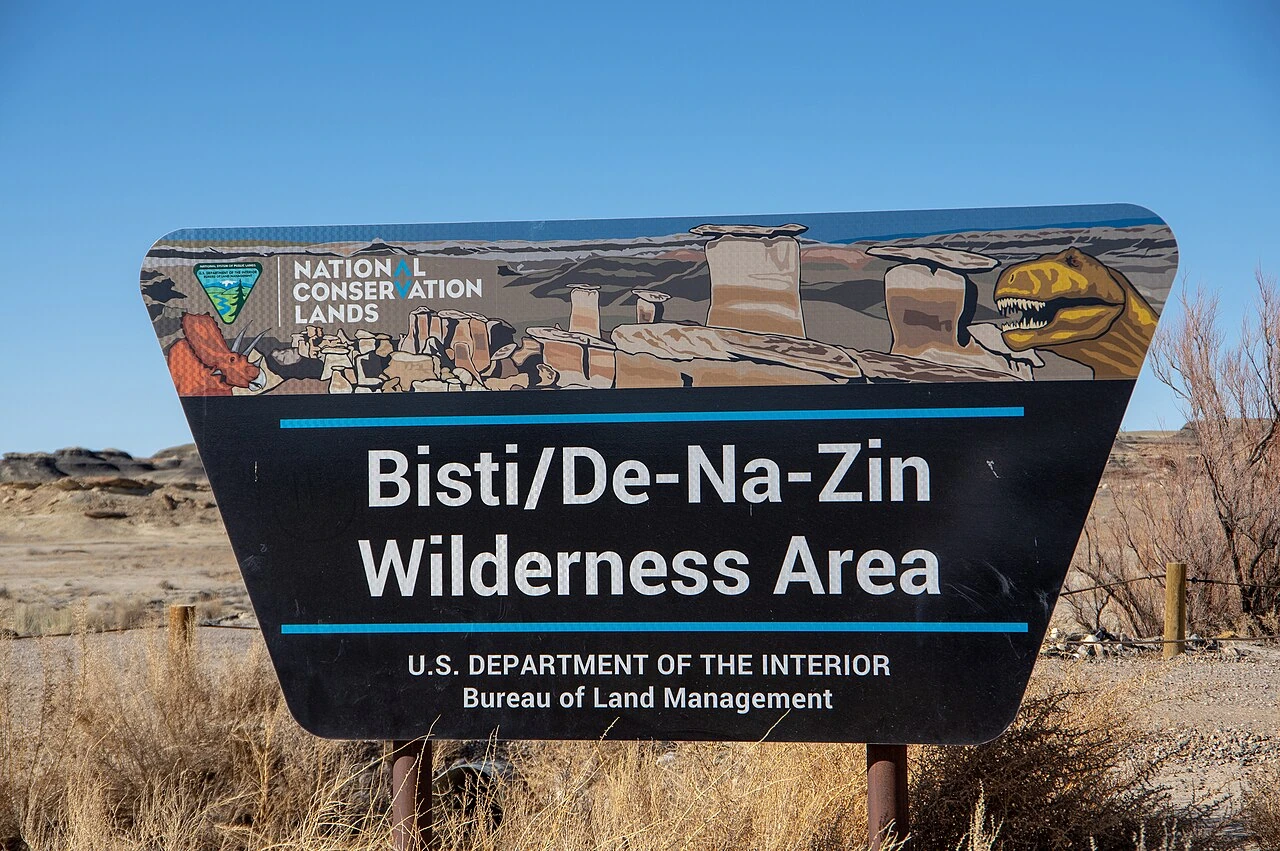
A photographed wilderness sign explicitly identified as Navajo-language writing by the source.
Saved in Babelbook · resized display copy. Select the image to open it independently of its source.
Matthew Dillon · Source ↗CC BY 2.0 ↗View the local visual field note
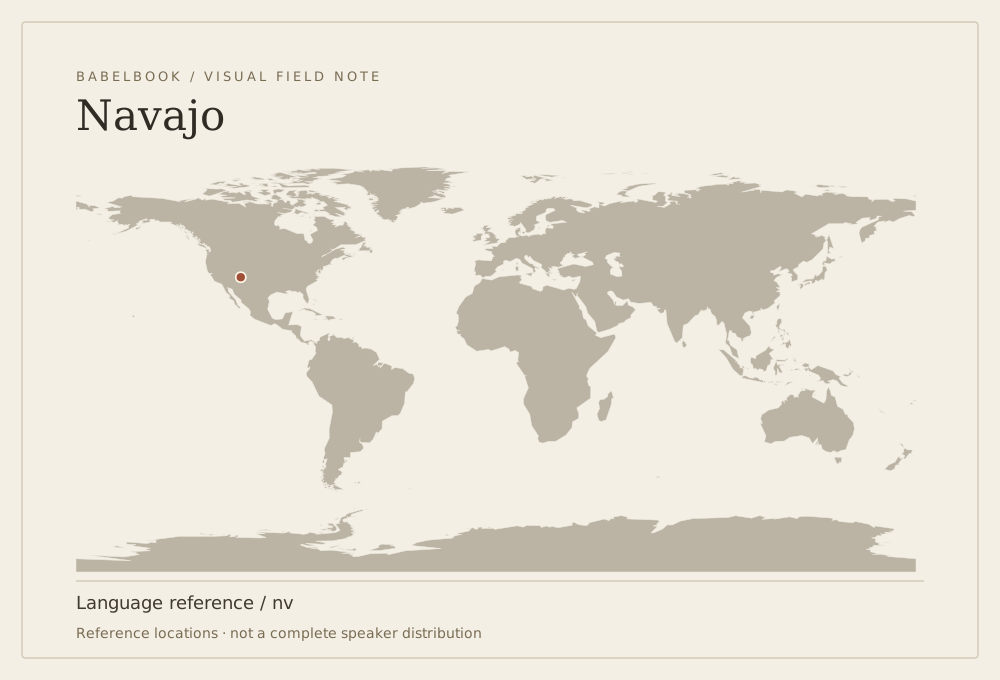
Representative reference points from Glottolog. Historical entries show reference locations, not current speakers. 1 point.
Reference & context ↗Babelbook · original editorial illustration · CC BY 4.0 · Glottolog locations; public-domain Natural Earth land
Source excerpts, selected, shortened and where noted editorially corrected from Navajo language by Wikipedia contributors. Retrieved 2026-10-05. CC BY-SA 4.0. These excerpts are not an independently verified scholarly history; missing accounts are identified above.
Read further in the source
History
The Apachean languages, including Navajo, are thought to have arrived in the American Southwest from the north by 1500, as various peoples migrated through Alberta and Wyoming. Archaeological finds considered indicative of proto-Navajo have been located in far northern New Mexico around the La Plata, Animas and Pine rivers, dating to around 1500. In 1936, linguist Edward Sapir showed how the arrival of the Navajo people in the new arid climate among the corn agriculturalists of the Pueblo area was reflected in their language by tracing the changing meanings of words from Proto-Athabaskan to Navajo. For example, the word *dè:, which in Proto-Athabaskan meant "horn" and "dipper made from animal horn", in Navajo became a-deeʼ, which meant "gourd" or "dipper made from gourd". Likewise, the Proto-Athabaskan word *ł-yəx̣s "snow lies on the ground" in Navajo became yas "snow". Similarly, the Navajo word for "corn" is naadą́ą́', derived from two Proto-Athabaskan roots meaning "enemy" and "food", suggesting that the Navajo originally considered corn to be "food of the enemy" when they first arrived among the Pueblo people.
Revitalization and current status
In 1968, U.S. President Lyndon B. Johnson signed the Bilingual Education Act, which provided funds for educating young students who are not native English speakers. The Act had mainly been intended for Spanish-speaking children—particularly Mexican Americans—but it applied to all recognized linguistic minorities. Many Native American tribes seized the chance to establish their own bilingual education programs. However, qualified teachers who were fluent in Native languages were scarce, and these programs were largely unsuccessful. However, data collected in 1980 showed that 85 percent of Navajo first-graders were bilingual, compared to 62 percent of Navajo of all ages—early evidence of a resurgence of use of their traditional language among younger people. In 1984, to counteract the language's historical decline, the Navajo Nation Council decreed that the Navajo language would be available and comprehensive for students of all grade levels in schools of the Navajo Nation. This effort was aided by the fact that, largely due to the work of Young and Morgan, Navajo is one of the best-documented Native American languages. In 1980 they published a monumental expansion of their work on the language, organized by word (first initial of vowel or consonant) in the pattern of English dictionaries, as requested by Navajo students. The Navajo Language: A Grammar and Colloquial Dictionary also included a 400-page grammar, making it invaluable for both native speakers and students of the language. Particularly in its organization of verbs, it was oriented to Navajo speakers. They expanded this work again in 1987, with several significant additions, and this edition continues to be used as an important text. The Native American language education movement has been met with adversity, such as by English-only campaigns in some areas in the late 1990s. However, Navajo-immersion programs have cropped up across the Navajo Nation. Statistical evidence shows that Navajo-immersion students generally do better on standardized tests than their counterparts educated only in English. Some educators have remarked that students who know their native languages feel a sense of pride and identity validation. Since 1989, Diné College, a Navajo tribal community college, has offered an associate degree in the subject of Navajo. This program includes language, literature, culture, medical terminology, and teaching courses and produces the highest number of Navajo teachers of any institution in the United States. About 600 students attend per semester. One major university that teaches classes in the Navajo language is Arizona State University. In 1992, Young and Morgan published another major work on Navajo: Analytical Lexicon of Navajo, with the assistance of Sally Midgette (Navajo). This work is organized by root, the basis of Athabaskan languages. A 1991 survey of 682 preschoolers on the Navajo Reservation Head Start program found that 54 percent were monolingual English speakers, 28 percent were bilingual in English and Navajo, and 18 percent spoke only Navajo. This study noted that while the preschool staff knew both languages, they spoke English to the children most of the time. In addition, most of the children's parents spoke to the children in English more often than in Navajo. The study concluded that the preschoolers were in "almost total immersion in English". An American Community Survey taken in 2011 found that 169,369 Americans spoke Navajo at home—0.3 percent of Americans whose primary home language was not English. Of primary Navajo speakers, 78.8 percent reported they spoke English "very well", a fairly high percentage overall but less than among other Americans speaking a different Native American language (85.4 percent). Navajo was the only Native American language afforded its own category in the survey; domestic Navajo speakers represented 46.4 percent of all domestic Native language speakers (only 195,407 Americans have a different home Native language). As of July 2014, Ethnologue classes Navajo as "6b" (In Trouble), signifying that few, but some, parents teach the language to their offspring and that concerted efforts at revitalization could easily protect the language. Navajo had a high population for a language in this category. About half of all Navajo people live on Navajo Nation land, an area spanning parts of Arizona, New Mexico, and Utah; others are dispersed throughout the United States. Under tribal law, fluency in Navajo is mandatory for candidates to the office of the President of the Navajo Nation. Both original and translated media have been produced in Navajo. The first works tended to be religious texts translated by missionaries, including the Bible. From 1943 to about 1957, the Navajo Agency of the BIA published Ádahooníłígíí ("Events"), the first newspaper in Navajo and the only one to be written entirely in Navajo. It was edited by Robert W. Young and William Morgan, Sr. (Navajo). They had collaborated on The Navajo Language, a major language dictionary published that same year, and continued to work on studying and documenting the language in major works for the next few decades. Today an AM radio station, KTNN, broadcasts in Navajo and English, with programming including music and NFL games; AM station KNDN broadcasts only in Navajo. When Super Bowl XXX was broadcast in Navajo in 1996, it was the first time a Super Bowl had been carried in a Native American language. In 2013, the 1977 film Star Wars was translated into Navajo. It was the first major motion picture translated into any Native American language. On October 5, 2018, an early beta of a Navajo course was released on Duolingo, a popular language learning app. On December 30, 2024, Navajo Nation President Buu Nygren made Navajo the official language of the Navajo Nation by signing legislation. He said, “One of my priorities coming in as President has always been to make sure that we make Navajo cool again.” This is in order to promote the intergenerational preservation of the Navajo language within the Navajo Nation and intending to work in conjunction with the Diné Language Teachers Association to foster the utilization of the Navajo language.
Orthography
Early attempts at a Navajo orthography were made in the late nineteenth and early twentieth centuries. One such attempt was based on the Latin alphabet, particularly the English variety, with some additional letters and diacritics. Anthropologists were frustrated by Navajo's having several sounds that are not found in English and lack of other sounds that are. Finally, the current Navajo orthography was developed between 1935 and 1940 by Young and Morgan.
An apostrophe (ʼ) is used to mark ejective consonants (e.g. chʼ, tłʼ) as well as mid-word or final glottal stops. However, initial glottal stops are usually not marked. The voiceless glottal fricative (/h/) is normally written as h, but appears as x after the consonant s (optionally after sh) at syllable boundary (ex: yiyiis-xı̨́), and when it represents the depreciative augment found after stem initial (ex: tsxı̨́įł-go, yi-chxa). The voiced velar fricative is written as y before i and e (where it is palatalized /ʝ/), as w before o (where it is labialized /ɣʷ/), and as gh before a. Navajo represents nasalized vowels with an ogonek ( ˛ ), sometimes described as a reverse cedilla; and represents the voiceless alveolar lateral fricative (/ɬ/) with a barred L (capital Ł, lowercase ł). The ogonek is most often placed centrally under a vowel, but it was imported from Polish and Lithuanian, which do not usually center it nor use it under certain vowels such as o or any vowels with accent marks. For example, in Navajo works, the ogonek below lowercase a is most often shown centered below the letter, whereas fonts with a with ogonek intended for Polish and Lithuanian have its ogonek connected to the bottom right of the letter. Very few Unicode fonts display the ogonek differently in Navajo with language tagging than in Polish or Lithuanian.
The first Navajo-capable typewriter was developed in preparation for a Navajo newspaper and dictionary created in the 1940s. The advent of early computers in the 1960s necessitated special fonts to input Navajo text, and the first Navajo font was created in the 1970s. Navajo virtual keyboards were made available for iOS devices in November 2012 and Android devices in August 2013.