Chichewa
Chewa ( ; endonym: Chichewa) is a Bantu language spoken in Malawi and a recognised minority in Eastern Zambia and Tete province of Mozambique. The prefix chi- in front of Chewa means "in the manner of" (the Chewa people). In Malawi, the name was officially changed from Chinyanja to Chichewa in 1968 at the insistence of President Hastings Kamuzu Banda and is still the name most commonly used in Malawi today. Chewa belongs to the same language group (Guthrie Zone N) as Tumbuka, Sena and Nsenga. Throughout the history of Malawi, only Chewa and Tumbuka were official languages of Malawi used by government officials and in school curricula, along with English. However, the Tumbuka language suffered a lot during the rule of President Hastings Kamuzu Banda, as it lost its status as one of Malawi's official languages in 1968 as a result of the president's "one nation, one language" policy. As a result, Tumbuka was removed from the school curriculum, the national radio, and the print media. With the advent of multi-party democracy in 1994, Tumbuka programmes were started again on the radio.
Translate in Chichewa ↗Chewa is one of the widely spoken languages in Malawi, about 34% of the country's population. It is spoken in the Central and some parts of Southern Region of the country. It is also spoken in Eastern Province of Zambia, as well as in Mozambique, in the province of Niassa. It was one of the 55 languages featured on the Voyager spacecraft.
Sub-Saharan Africa
Present-day use
The captured source does not contain a separate current-use account.
Origins
The captured article does not contain a separate origins section. See the historical account and linked source.
Development
The Chewa were a branch of the Maravi people who lived in the Eastern Province of Zambia and in northern Mozambique as far south as the River Zambezi from the 16th century or earlier. The name "Chewa" (in the form Chévas) was first recorded by António Gamitto, who at the age of 26 in 1831 was appointed as second-in-command of an expedition from Tete to the court of King Kazembe in what became Zambia. His route took him through the country of King Undi west of the Dzalanyama mountains, across a corner of present-day Malawi and on into Zambia. Later he wrote an account including some ethnographic and linguistic notes and vocabularies. According to Gamitto, the Malawi or Maravi people (Maraves) were those ruled by King Undi south of the Chambwe stream (not far south of the present border between Mozambique and Zambia), while the Chewa lived north of the Chambwe. Another, more extensive, list of 263 words and phrases of the language was made by the German missionary Sigismund Koelle who, working in Sierra Leone in West Africa, interviewed some 160 former slaves and recorded vocabularies in their languages. He published the results in a book called Polyglotta Africana in 1854. Among other slaves was one Mateke, who spoke what he calls "Maravi". Mateke's language is clearly an early form of Chichewa, but in a southern dialect. For example, the modern Chichewa phrase zaka ziwiri 'two years' was dzaka dziŵiri in Mateke's speech, whereas for Johannes Rebmann's informant Salimini, who came from the Lilongwe region, it was bzaka bziŵiri. The same dialect difference survives today in the word dzala or bzala '(to) plant'. Apart from the few words recorded by Gamitto and Koelle, the first extensive record of the Chewa language was made by Johannes Rebmann in his Dictionary of the Kiniassa Language, published in 1877 but written in 1853–1854.
Writing
The following have written published stories, novels, or plays in the Chewa language: William Chafulumira Samuel Josia Ntara or Nthala John Gwengwe E.J. Chadza Lula Pensulo Steve Chimombo Whyghtone Kamthunzi Francis Moto Bonwell Kadyankena Rodgers Willie Zingani Barnaba Zingani Jolly Maxwell Ntaba
Beyond the typeface.
Signs, manuscripts, published pages and contextual photographs, with their place, period, source and reuse terms. Captions identify historical spellings, regional examples, community references and character imagery.
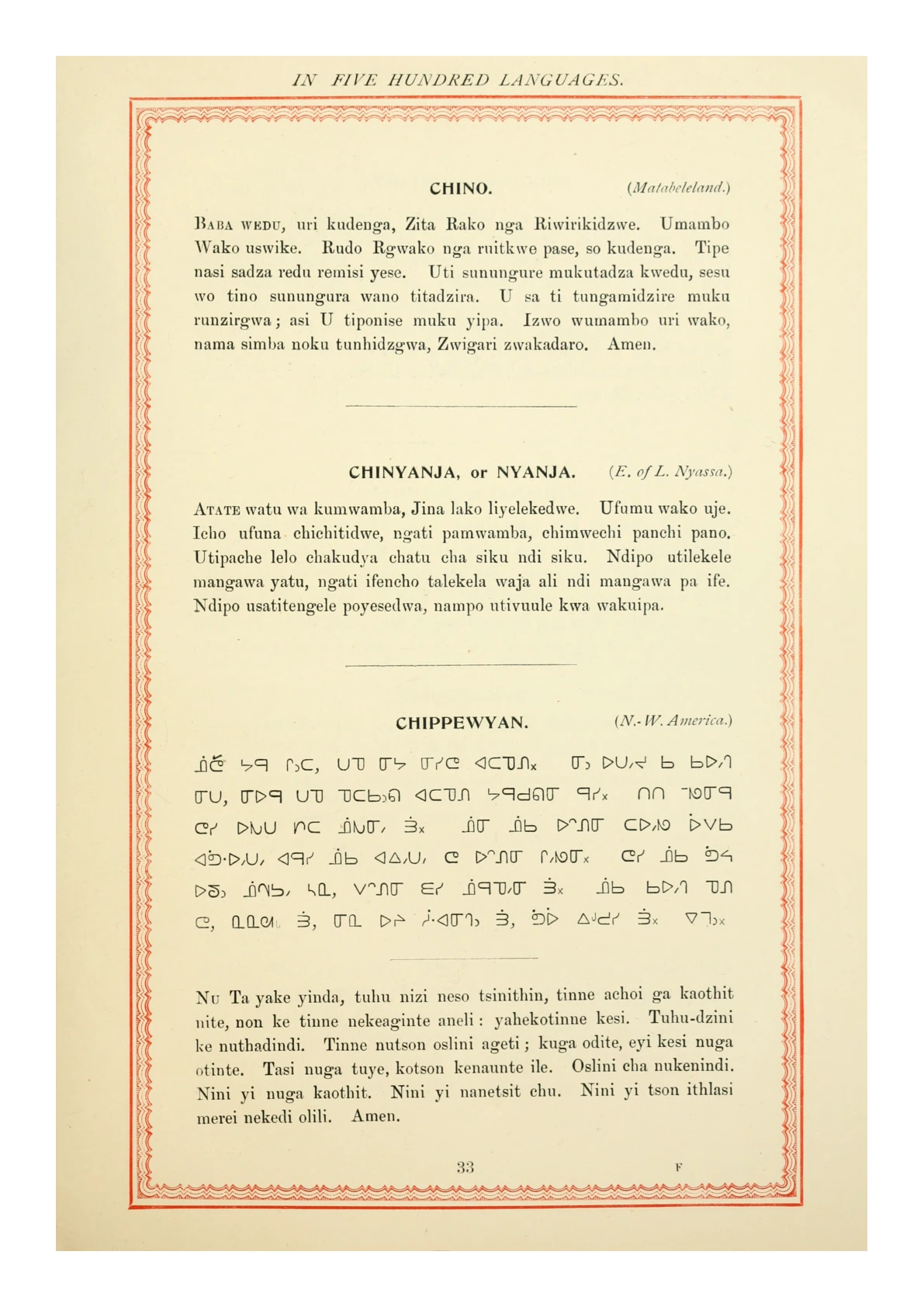
Historical printed prayer headed “CHINYANJA, or NYANJA” in The Lord’s Prayer in Five Hundred Languages, printed page 33. This older label is cross-referenced to Chichewa by the linked language authority. The Commons record dates the compilation to 1905; this copy also contains a publisher note dated June 1908. Orthography and translation reflect the historical source, not a modern usage standard. Other languages appear on the same page. The source includes period terminology and editorial annotations; these are historical evidence, not Babelbook’s current terminology or claims.
Saved in Babelbook · resized display copy. Select the image to open it independently of its source.
Reinhold Rost (compiler); Gilbert & Rivington / Wm. Clowes & Sons (publishers); Internet Archive scan · Source ↗Public domain ↗View the local visual field note
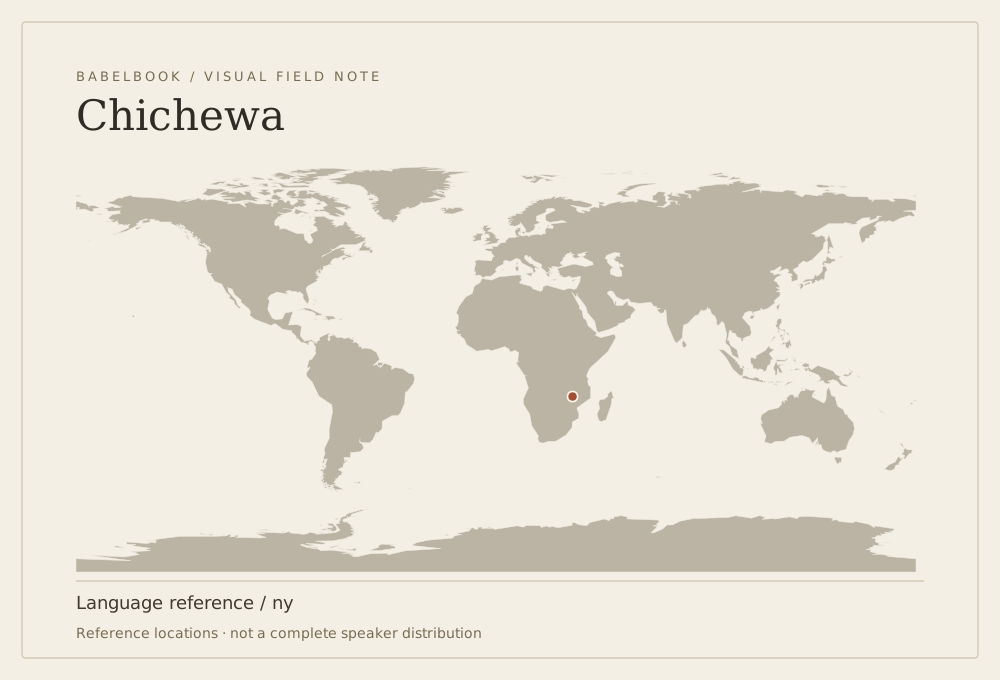
Representative reference points from Glottolog. Historical entries show reference locations, not current speakers. 1 point.
Reference & context ↗Babelbook · original editorial illustration · CC BY 4.0 · Glottolog locations; public-domain Natural Earth land
Source excerpts, selected, shortened and where noted editorially corrected from Chewa language by Wikipedia contributors. Retrieved 2026-10-05. CC BY-SA 4.0. These excerpts are not an independently verified scholarly history; missing accounts are identified above.
Read further in the source
Distribution
Chewa is one of the widely spoken languages in Malawi, about 34% of the country's population. It is spoken in the Central and some parts of Southern Region of the country. It is also spoken in Eastern Province of Zambia, as well as in Mozambique, in the province of Niassa. It was one of the 55 languages featured on the Voyager spacecraft.
History
The Chewa were a branch of the Maravi people who lived in the Eastern Province of Zambia and in northern Mozambique as far south as the River Zambezi from the 16th century or earlier. The name "Chewa" (in the form Chévas) was first recorded by António Gamitto, who at the age of 26 in 1831 was appointed as second-in-command of an expedition from Tete to the court of King Kazembe in what became Zambia. His route took him through the country of King Undi west of the Dzalanyama mountains, across a corner of present-day Malawi and on into Zambia. Later he wrote an account including some ethnographic and linguistic notes and vocabularies. According to Gamitto, the Malawi or Maravi people (Maraves) were those ruled by King Undi south of the Chambwe stream (not far south of the present border between Mozambique and Zambia), while the Chewa lived north of the Chambwe. Another, more extensive, list of 263 words and phrases of the language was made by the German missionary Sigismund Koelle who, working in Sierra Leone in West Africa, interviewed some 160 former slaves and recorded vocabularies in their languages. He published the results in a book called Polyglotta Africana in 1854. Among other slaves was one Mateke, who spoke what he calls "Maravi". Mateke's language is clearly an early form of Chichewa, but in a southern dialect. For example, the modern Chichewa phrase zaka ziwiri 'two years' was dzaka dziŵiri in Mateke's speech, whereas for Johannes Rebmann's informant Salimini, who came from the Lilongwe region, it was bzaka bziŵiri. The same dialect difference survives today in the word dzala or bzala '(to) plant'. Apart from the few words recorded by Gamitto and Koelle, the first extensive record of the Chewa language was made by Johannes Rebmann in his Dictionary of the Kiniassa Language, published in 1877 but written in 1853–1854. Rebmann was a missionary living near Mombasa in Kenya, and he obtained his information from a Malawian slave, known by the Swahili name Salimini, who had been captured in Malawi some ten years earlier. Salimini, who came from a place called Mphande apparently in the Lilongwe region, also noted some differences between his own dialect, which he called Kikamtunda, the "language of the plateau", and the Kimaravi dialect spoken further south; for example, the Maravi gave the name mombo to the tree which he himself called kamphoni. The first grammar, A Grammar of the Chinyanja language as spoken at Lake Nyasa with Chinyanja–English and English–Chinyanja vocabulary, was written by Alexander Riddel in 1880. Further early grammars and vocabularies include A grammar of Chinyanja, a language spoken in British Central Africa, on and near the shores of Lake Nyasa by George Henry (1891) and M.E. Woodward's A vocabulary of English–Chinyanja and Chinyanja–English: as spoken at Likoma, Lake Nyasa (1895). The whole Bible was translated into the Likoma Island dialect of Chichewa by William Percival Johnson and published as Chikalakala choyera: ndicho Malangano ya Kale ndi Malangano ya Chapano in 1912. Another Bible translation, known as the Buku Lopatulika ndilo Mau a Mulungu, was made in a more standard Central Region dialect about 1900–1922 by missionaries of the Dutch Reformed Mission and Church of Scotland with the help of some Malawians. This has recently (2016) been reissued in a revised and slightly modernised version. Another early grammar, concentrating on the Kasungu dialect of the language, was Mark Hanna Watkins' A Grammar of Chichewa (1937). This book, the first grammar of any African language to be written by an American, was a work of cooperation between a young black PhD student and young student from Nyasaland studying in Chicago, Hastings Kamuzu Banda, who in 1966 was to become the first President of the Republic of Malawi. This grammar is also remarkable in that it was the first to mark the tones of the words. Modern monographs on aspects of Chichewa grammar include Mtenje (1986), Kanerva (1990), Mchombo (2004) and Downing & Mtenje (2017). In recent years the language has changed considerably, and a dichotomy has grown between the traditional Chichewa of the villages and the language of city-dwellers.
Story-writers and playwrights
The following have written published stories, novels, or plays in the Chewa language:
William Chafulumira Samuel Josia Ntara or Nthala John Gwengwe E.J. Chadza Lula Pensulo Steve Chimombo Whyghtone Kamthunzi Francis Moto Bonwell Kadyankena Rodgers Willie Zingani Barnaba Zingani Jolly Maxwell Ntaba