Occitan
Occitan (English: ; Occitan pronunciation: [utsiˈta, uksiˈta]), also known by its native speakers as lenga d'òc (Occitan: [ˈleŋɡɒ ˈðɔ(k)] ; French: langue d'oc), sometimes also referred to as Provençal, is a Romance language spoken in southern France, Monaco, Italy's Occitan Valleys and the Val d'Aran in northeast Spain; collectively, these regions are sometimes referred to as Occitania. It is also spoken in the southern Italian province of Cosenza (mostly in Guardia Piemontese), where it is referred to as Gardiol, which is considered a separate Occitanic language. The linguistic distance between Catalan and some Occitan dialects (such as the Gascon language) is similar to the distance between different Occitan dialects, and Catalan was considered a dialect of Occitan until the end of the 19th century and still today remains its closest relative. Occitan has a particularly rich lexicon. Lo Panoccinari, considered the most comprehensive dictionary ever published in this language, records over 250,000 unique words (more than 310,000 including dialectal variations). Occitan is an official language of Catalonia, including the Val d'Aran, where a subdialect of Gascon known as Aranese is spoken.
Translate in Occitan ↗The area where Occitan was historically dominant has approximately 16 million inhabitants. Recent research has shown it may be spoken as a first language by approximately 789,000 people in France, Italy, Spain and Monaco. In Monaco, Occitan coexists with Monégasque Ligurian, which is the other native language. Up to seven million people in France understand the language, whereas twelve to fourteen million fully spoke it in 1921. In 1860, Occitan speakers represented more than 39% of the whole French population (52% for francophones proper); they were still 26% to 36% in the 1920s, but less than 7% in 1993.
Europe
Present-day use
The name Occitan comes from the term lenga d'òc ("language of òc"), òc being the Occitan word for yes. While the term would have been in use orally for some time after the decline of Latin, as far as historical records show, the Italian medieval poet Dante was the first to have recorded the term lingua d'oc in writing. In his De vulgari eloquentia, he wrote in Latin, "nam alii oc, alii si, alii vero dicunt oil" ("for some say òc, others sì, yet others say oïl"), thereby highlighting three major Romance literary languages that were well known in Italy, based on each language's word for "yes", the òc language (Occitan), the oïl language (French), and the sì language (Italian). The word òc came from Vulgar Latin hoc ("this"), while oïl originated from Latin hoc illud ("this [is] it"). Old Catalan and now the Catalan of Northern Catalonia also have hoc (òc). Other Romance languages derive their word for "yes" from the Latin sic, "thus [it is], [it was done], etc.", such as Spanish sí, Eastern Lombard sé, Italian sì, or Portuguese sim. In modern Catalan, as in modern Spanish, sí is usually used as a response, although the language retains the word oi, akin to òc, which is sometimes used at the end of yes–no questions and also in higher register as a positive response. French uses si to answer "yes" in response to questions that are asked in the negative sense: for example, "Vous n'avez pas de frères?" "Si, j'en ai sept." ("You don't have any brothers, do you?" "Yes I do, I have seven."). The name "Occitan" was attested around 1300 as occitanus, a crossing of oc and aquitanus (Aquitanian).
Origins
Because the geographical territory in which Occitan is spoken is surrounded by regions in which other Romance languages are used, external influences may have influenced its origin and development. Many factors favored its development as its own language. Mountains and seas: The range of Occitan is naturally bounded by the Mediterranean, Atlantic, Massif Central, Alps, and Pyrenees, respectively. Buffer zones: arid land, marshes, and areas otherwise impractical for farming and resistant of colonization provide further separation (territory between Loire and Garonne, the Aragon desert plateau). Constant populations: Some Occitan-speaking peoples are descended from people living in the region since prehistoric times. Deeper Roman influence: The Romans had established an earlier presence in Southern France in 121 BC beginning with Gallia Narbonensis, where the seeds of the Occitan language were first sown. According to Müller, "France's linguistic separation began with Roman influence" A separate lexicon: Although Occitan is midway between the Gallo-Romance and Iberian Romance languages, it has "around 550 words inherited from Latin that no longer exist in the langues d'oïl or in Franco-Provençal" Lack of Germanic influence: "The Frankish lexicon and its phonetic influence often end above the oc/oïl line"
Development
The name Occitan comes from the term lenga d'òc ("language of òc"), òc being the Occitan word for yes. While the term would have been in use orally for some time after the decline of Latin, as far as historical records show, the Italian medieval poet Dante was the first to have recorded the term lingua d'oc in writing. In his De vulgari eloquentia, he wrote in Latin, "nam alii oc, alii si, alii vero dicunt oil" ("for some say òc, others sì, yet others say oïl"), thereby highlighting three major Romance literary languages that were well known in Italy, based on each language's word for "yes", the òc language (Occitan), the oïl language (French), and the sì language (Italian). The word òc came from Vulgar Latin hoc ("this"), while oïl originated from Latin hoc illud ("this [is] it"). Old Catalan and now the Catalan of Northern Catalonia also have hoc (òc). Other Romance languages derive their word for "yes" from the Latin sic, "thus [it is], [it was done], etc.", such as Spanish sí, Eastern Lombard sé, Italian sì, or Portuguese sim. In modern Catalan, as in modern Spanish, sí is usually used as a response, although the language retains the word oi, akin to òc, which is sometimes used at the end of yes–no questions and also in higher register as a positive response. French uses si to answer "yes" in response to questions that are asked in the negative sense: for example, "Vous n'avez pas de frères?" "Si, j'en ai sept." ("You don't have any brothers, do you?" "Yes I do, I have seven."). The name "Occitan" was attested around 1300 as occitanus, a crossing of oc and aquitanus (Aquitanian). One of the oldest written fragments of the language found dates back to 960, shown here in italics mixed with non-italicized Latin: De ista hora in antea non decebrà Ermengaus filius Eldiarda Froterio episcopo filio Girberga ne Raimundo filio Bernardo vicecomite de castello de Cornone ... no·l li tolrà ni no·l li devedarà ni no l'en decebrà ...
Writing
There are two main linguistic norms currently used for Occitan, one (known as "classical") based on that of Medieval Occitan, and one (sometimes known as "Mistralian", due to its use by Frédéric Mistral) based on modern French orthography. Sometimes, there is conflict between users of each system. The classical norm (or less exactly classical orthography) has the advantage of maintaining a link with earlier stages of the language, and reflects the fact that Occitan is not a variety of French. It is used in all Occitan dialects. It also allows speakers of one dialect of Occitan to write intelligibly for speakers of other dialects (e.g. the Occitan for day is written jorn in the classical norm, but could be jour, joun, journ, or even yourn, depending on the writer's origin, in Mistralian orthography). The Occitan classical orthography and the Catalan orthography are quite similar: they show the very close ties of both languages. The digraphs lh and nh, used in the classical orthography, were adopted by the orthography of Portuguese, presumably by Gerald of Braga, a monk from Moissac, who became bishop of Braga in Portugal in 1047, playing a major role in modernizing written Portuguese using classical Occitan norms. The Mistralian norm (or less exactly Mistralian orthography) has the advantage of being similar to that of French, in which most Occitan speakers are literate. Now, it is used mostly in the Provençal/Niçard dialect, besides the classical norm. It has also been used by a number of eminent writers, particularly in Provençal. However, it is somewhat impractical, because it is based mainly on the Provençal dialect and also uses many digraphs for simple sounds, the most notable one being ou for the [u] sound, as it is in French, written as o under the classical orthography. There are also two other norms but they have a lesser audience.
Beyond the typeface.
Signs, manuscripts, published pages and contextual photographs, with their place, period, source and reuse terms. Captions identify historical spellings, regional examples, community references and character imagery.
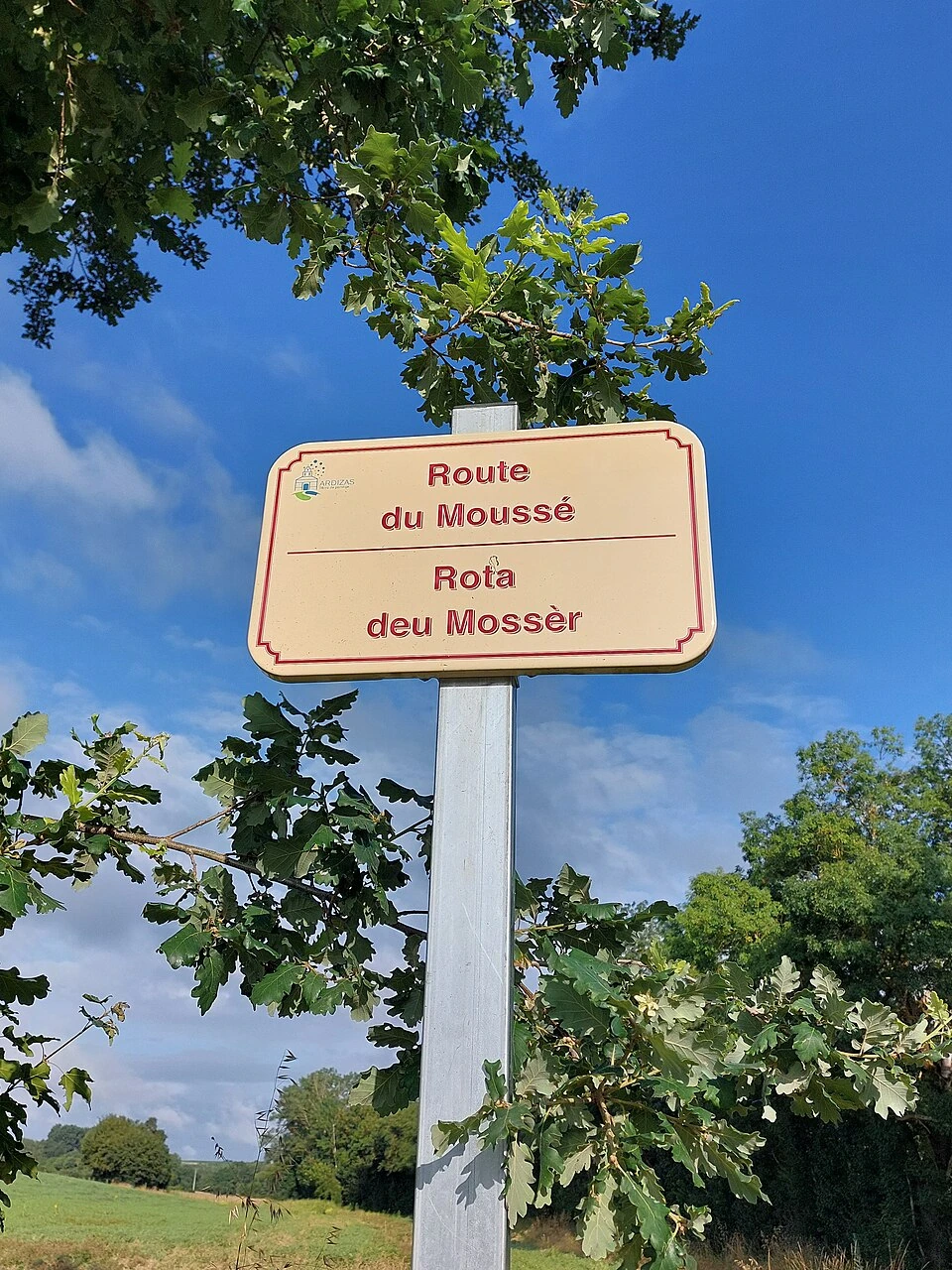
French and Occitan street sign in Ardizas, France. Language identification follows Commons metadata; not independently transcribed.
Saved in Babelbook · resized display copy. Select the image to open it independently of its source.
Jiròni Picas · Source ↗CC BY-SA 4.0 ↗View the local visual field note
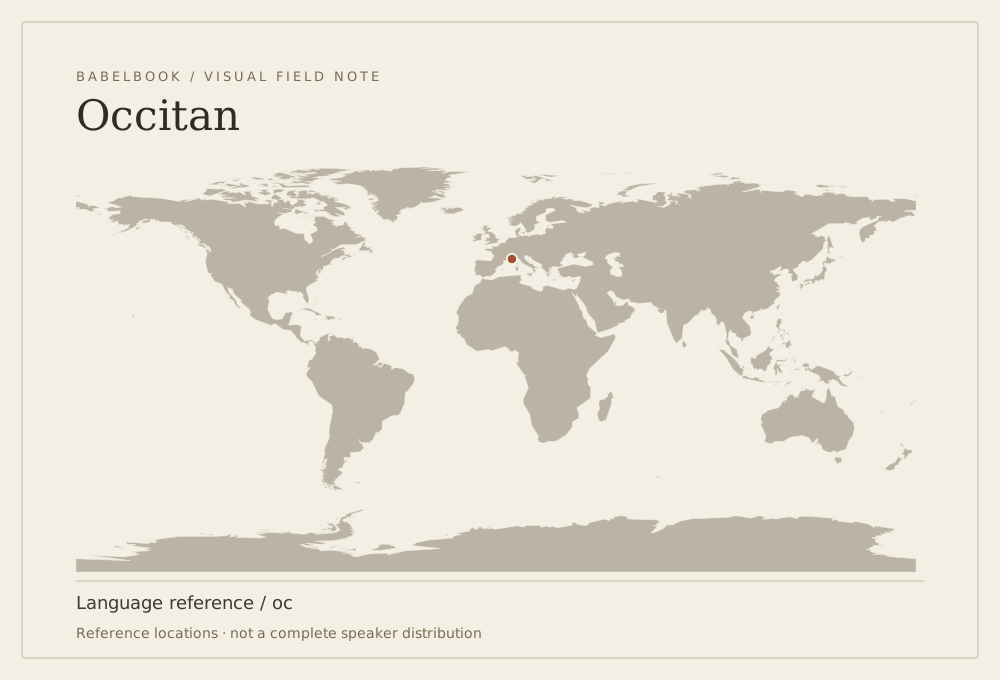
Representative reference points from Glottolog. Historical entries show reference locations, not current speakers. 1 point.
Reference & context ↗Babelbook · original editorial illustration · CC BY 4.0 · Glottolog locations; public-domain Natural Earth land
Source excerpts, selected, shortened and where noted editorially corrected from Occitan language by Wikipedia contributors. Retrieved 2026-10-05. CC BY-SA 4.0. These excerpts are not an independently verified scholarly history; missing accounts are identified above.
Read further in the source
History of the modern term
The name Occitan comes from the term lenga d'òc ("language of òc"), òc being the Occitan word for yes. While the term would have been in use orally for some time after the decline of Latin, as far as historical records show, the Italian medieval poet Dante was the first to have recorded the term lingua d'oc in writing. In his De vulgari eloquentia, he wrote in Latin, "nam alii oc, alii si, alii vero dicunt oil" ("for some say òc, others sì, yet others say oïl"), thereby highlighting three major Romance literary languages that were well known in Italy, based on each language's word for "yes", the òc language (Occitan), the oïl language (French), and the sì language (Italian). The word òc came from Vulgar Latin hoc ("this"), while oïl originated from Latin hoc illud ("this [is] it"). Old Catalan and now the Catalan of Northern Catalonia also have hoc (òc). Other Romance languages derive their word for "yes" from the Latin sic, "thus [it is], [it was done], etc.", such as Spanish sí, Eastern Lombard sé, Italian sì, or Portuguese sim. In modern Catalan, as in modern Spanish, sí is usually used as a response, although the language retains the word oi, akin to òc, which is sometimes used at the end of yes–no questions and also in higher register as a positive response. French uses si to answer "yes" in response to questions that are asked in the negative sense: for example, "Vous n'avez pas de frères?" "Si, j'en ai sept." ("You don't have any brothers, do you?" "Yes I do, I have seven."). The name "Occitan" was attested around 1300 as occitanus, a crossing of oc and aquitanus (Aquitanian).
History
One of the oldest written fragments of the language found dates back to 960, shown here in italics mixed with non-italicized Latin:
De ista hora in antea non decebrà Ermengaus filius Eldiarda Froterio episcopo filio Girberga ne Raimundo filio Bernardo vicecomite de castello de Cornone ... no·l li tolrà ni no·l li devedarà ni no l'en decebrà ... nec societatem non aurà, si per castellum recuperare non o fa, et si recuperare potuerit in potestate Froterio et Raimundo lo tornarà, per ipsas horas quæ Froterius et Raimundus l'en comonrà. Carolingian litanies (c. 780), though the leader sang in Latin, were answered to in Old Occitan by the people (Ora pro nos; Tu lo juva). Other famous pieces include the Boecis, a 258-line-long poem written entirely in the Limousin dialect of Occitan between the year 1000 and 1030 and inspired by Boethius's The Consolation of Philosophy; the Waldensian La nobla leyczon (dated 1100), Cançó de Santa Fe (c. 1054–1076), the Romance of Flamenca (13th century), the Song of the Albigensian Crusade (1213–1219?), Daurel e Betó (12th or 13th century), Las, qu'i non-sun sparvir, astur (11th century) and Tomida femina (9th or 10th century). Occitan was the vehicle for the influential poetry of the medieval troubadours (trobadors) and trobairitz: At that time, the language was understood and celebrated throughout most of educated Europe. It was the maternal language of the English queen Eleanor of Aquitaine and kings Richard I (who wrote troubadour poetry) and John. With the gradual imposition of French royal power over its territory, Occitan declined in status from the 14th century on. The Ordinance of Villers-Cotterêts (1539) decreed that the langue d'oïl (French – though at the time referring to the Francien language and not the larger collection of dialects grouped under the name langues d'oïl) should be used for all French administration. Occitan's greatest decline occurred during the French Revolution, in which diversity of language was considered a threat. In 1903, the four Gospels ("Lis Evangèli", i.e. Matthew, Mark, Luke and John) were translated into Provençal as spoken in Cannes and Grasse. The translation was given the official Roman Catholic Imprimatur by vicar general A. Estellon. The literary renaissance of the late 19th century (in which the 1904 Nobel Prize in Literature winner, Frédéric Mistral, among others, was involved) was attenuated by World War I, when (in addition to the disruption caused by any major war) many Occitan speakers spent extended periods of time alongside French-speaking comrades.
Origins
Because the geographical territory in which Occitan is spoken is surrounded by regions in which other Romance languages are used, external influences may have influenced its origin and development. Many factors favored its development as its own language.
Mountains and seas: The range of Occitan is naturally bounded by the Mediterranean, Atlantic, Massif Central, Alps, and Pyrenees, respectively. Buffer zones: arid land, marshes, and areas otherwise impractical for farming and resistant of colonization provide further separation (territory between Loire and Garonne, the Aragon desert plateau). Constant populations: Some Occitan-speaking peoples are descended from people living in the region since prehistoric times. Deeper Roman influence: The Romans had established an earlier presence in Southern France in 121 BC beginning with Gallia Narbonensis, where the seeds of the Occitan language were first sown. According to Müller, "France's linguistic separation began with Roman influence" A separate lexicon: Although Occitan is midway between the Gallo-Romance and Iberian Romance languages, it has "around 550 words inherited from Latin that no longer exist in the langues d'oïl or in Franco-Provençal" Lack of Germanic influence: "The Frankish lexicon and its phonetic influence often end above the oc/oïl line"
Number of speakers
The area where Occitan was historically dominant has approximately 16 million inhabitants. Recent research has shown it may be spoken as a first language by approximately 789,000 people in France, Italy, Spain and Monaco. In Monaco, Occitan coexists with Monégasque Ligurian, which is the other native language. Up to seven million people in France understand the language, whereas twelve to fourteen million fully spoke it in 1921. In 1860, Occitan speakers represented more than 39% of the whole French population (52% for francophones proper); they were still 26% to 36% in the 1920s, but less than 7% in 1993.
Dialects
Occitan is fundamentally defined by its dialects, rather than being a unitary language, as it lacks an official written standard. Like other languages that fundamentally exist at a spoken, rather than written, level (e.g. the Rhaeto-Romance languages, Franco-Provençal, Astur-Leonese, and Aragonese), every settlement technically has its own dialect, with the whole of Occitania forming a classic dialect continuum that changes gradually along any path from one side to the other. Nonetheless, specialists commonly divide Occitan into six main dialects:
Gascon: includes the Béarnese and Aranese (spoken in Spain). Judeo-Gascon Languedocien (lengadocian) Limousin (lemosin) Auvergnat (auvernhat) Provençal (provençau or prouvençau), including the Niçard subdialect. Judeo-Provençal Judeo-Niçard Vivaro-Alpine (vivaroaupenc), also known as "Alpine" or "Alpine Provençal", and sometimes considered a subdialect of Provençal The northern and easternmost dialects have more morphological and phonetic features in common with the Gallo-Italic and Oïl languages (e.g. nasal vowels; loss of final consonants; initial cha/ja- instead of ca/ga-; uvular ⟨r⟩; the front-rounded sound /ø/ instead of a diphthong, /w/ instead of /l/ before a consonant), whereas the southernmost dialects have more features in common with the Ibero-Romance languages (e.g. betacism; voiced fricatives between vowels in place of voiced stops; -ch- in place of -it-), and Gascon has a number of unusual features not seen in other dialects (e.g. /h/ in place of /f/; loss of /n/ between vowels; intervocalic -r- and final -t/ch in place of medieval -ll-). There are also significant lexical differences, where some dialects have words cognate with French, and others have Catalan and Spanish cognates. Nonetheless, there is a significant amount of mutual intelligibility and some of the words with two cognates can be used in the same dialect as synonymous (totjorn/sempre in provençal or maison/ostau in gascon for instance). There is also no particular geographical distribution of the cognates, with some shared by distant dialects and other not shared with bordering foreign languages (for instance maison in both Gascon and Niçard, cognate of French but not of Spanish or Italian, although these dialects are geographically closer to these languages).
Gascon is the most divergent, and descriptions of the main features of Occitan often consider Gascon separately. Max Wheeler notes that "probably only its copresence within the French cultural sphere has kept [Gascon] from being regarded as a separate language", and compares it to Franco-Provençal, which is considered a separate language from Occitan but is "probably not more divergent from Occitan overall than Gascon is". There is no general agreement about larger groupings of these dialects. Max Wheeler divides the dialects into two groups:
Southwestern (Gascon and Languedocien), more conservative Northeastern (Limousin, Auvergnat, Provençal and Vivaro-Alpine), more innovative Pierre Bec divides the dialects into three groups:
Gascon, standing alone Southern Occitan (Languedocien and Provençal) Northern Occitan (Limousin, Auvergnat, Vivaro-Alpine) In order to overcome the pitfalls of the traditional romanistic view, Bec proposed a "supradialectal" classification that groups Occitan with Catalan as a part of a wider Occitano-Romanic group. One such classification posits three groups:
"Arverno-Mediterranean" (arvèrnomediterranèu), same as Wheeler's northeastern group, i.e. Limousin, Auvergnat, Provençal and Vivaro-Alpine "Central Occitan" (occitan centrau), Languedocien, excepting the Southern Languedocien subdialect "Aquitano-Pyrenean" (aquitanopirenenc), Southern Languedocien, Gascon and Catalan According to this view, Catalan is an ausbau language that became independent from Occitan during the 13th century, but originates from the Aquitano-Pyrenean group. Domergue Sumien proposes a slightly different supradialectal grouping.
Arverno-Mediterranean (arvèrnomediterranèu), same as in Bec and Wheeler, divided further: Niçard-Alpine (niçardoaupenc), Vivaro-Alpine along with the Niçard subdialect of Provençal. Trans-Occitan (transoccitan), the remainder of Provençal along with Limousin and Auvergnat. Pre-Iberian (preïberic). Central Occitan (occitan centrau), same as in Bec. Aquitano-Pyrenean (aquitanopirenenc), same as in Bec.
Jewish dialects
Occitan has 3 dialects spoken by Jewish communities that are all now extinct.
IETF dialect tags
pro: Old Occitan (until the 14th century). sdt: Judeo-Occitan Several IETF language variant tags have been registered:
oc-aranese: Aranese. oc-auvern: Auvergnat. oc-cisaup: Cisalpine, northwestern Italy. oc-creiss: Croissant oc-gascon: Gascon. oc-lemosin: Leimousin. oc-lengadoc: Languedocien. oc-nicard: Niçard. oc-provenc: Provençal. oc-vivaraup: Vivaro-Alpine.
Standardization
All regional varieties of the Occitan language have a written form; thus, Occitan can be considered as a pluricentric language. Standard Occitan, also called occitan larg (i.e., 'wide Occitan') is a synthesis that respects and admits soft regional adaptations (which are based on the convergence of previous regional koinés). The standardization process began with the publication of Gramatica occitana segon los parlars lengadocians ("Grammar of the Languedocien Dialect") by Louis Alibert (1935), followed by the Dictionnaire occitan-français selon les parlers languedociens ("French-Occitan dictionary according to Languedocien") by the same author (1966), completed during the 1970s with the works of Pierre Bec (Gascon), Robèrt Lafont (Provençal), and others. However, the process has not yet been completed as of the present. Standardization is mostly supported by users of the classical norm. Due to the strong situation of diglossia, some users thusly reject the standardization process, and do not conceive Occitan as a language that can be standardized as per other standardized languages.
Writing system
There are two main linguistic norms currently used for Occitan, one (known as "classical") based on that of Medieval Occitan, and one (sometimes known as "Mistralian", due to its use by Frédéric Mistral) based on modern French orthography. Sometimes, there is conflict between users of each system.
The classical norm (or less exactly classical orthography) has the advantage of maintaining a link with earlier stages of the language, and reflects the fact that Occitan is not a variety of French. It is used in all Occitan dialects. It also allows speakers of one dialect of Occitan to write intelligibly for speakers of other dialects (e.g. the Occitan for day is written jorn in the classical norm, but could be jour, joun, journ, or even yourn, depending on the writer's origin, in Mistralian orthography). The Occitan classical orthography and the Catalan orthography are quite similar: they show the very close ties of both languages. The digraphs lh and nh, used in the classical orthography, were adopted by the orthography of Portuguese, presumably by Gerald of Braga, a monk from Moissac, who became bishop of Braga in Portugal in 1047, playing a major role in modernizing written Portuguese using classical Occitan norms. The Mistralian norm (or less exactly Mistralian orthography) has the advantage of being similar to that of French, in which most Occitan speakers are literate. Now, it is used mostly in the Provençal/Niçard dialect, besides the classical norm. It has also been used by a number of eminent writers, particularly in Provençal. However, it is somewhat impractical, because it is based mainly on the Provençal dialect and also uses many digraphs for simple sounds, the most notable one being ou for the [u] sound, as it is in French, written as o under the classical orthography. There are also two other norms but they have a lesser audience. The Escòla dau Pò norm (or Escolo dóu Po norm) is a simplified version of the Mistralian norm and is used only in the Occitan Valleys (Italy), besides the classical norm. The Bonnaudian norm (or écriture auvergnate unifiée, EAU) was created by Pierre Bonnaud and is used only in the Auvergnat dialect, besides the classical norm.
Note that Catalan version was translated from the Spanish, while the Occitan versions were translated from the French. The second part of the Catalan version may also be rendered as "Són dotades de raó i de consciència, i els cal actuar entre si amb un esperit de fraternitat", showing the similarities between Occitan and Catalan.
Orthography IETF subtags
Several IETF language subtags have been registered for the different orthographies:
oc-grclass: Classical Occitan orthography. oc-grital: Italian-inspired Occitan orthography. oc-grmistr: Mistralian-inspired Occitan orthography.
Debates concerning linguistic classification and orthography
The majority of scholars think that Occitan constitutes a single language. Some authors, constituting a minority, reject this opinion and even the name Occitan, thinking that there is a family of distinct lengas d'òc rather than dialects of a single language. Many Occitan linguists and writers, particularly those involved with the pan-Occitan movement centered on the Institut d'Estudis Occitans, disagree with the view that Occitan is a family of languages; instead they believe Limousin, Auvergnat, Languedocien, Gascon, Provençal and Vivaro-Alpine are dialects of a single language. Although there are indeed noticeable differences between these varieties, there is a very high degree of mutual intelligibility between them partly because they share a common literary history; furthermore, academic and literary circles have identified them as a collective linguistic entity—the lenga d'òc—for centuries. Some Provençal authors continue to support the view that Provençal is a separate language. Nevertheless, the vast majority of Provençal authors and associations think that Provençal is a part of Occitan. This debate about the status of Provençal should not be confused with the debate concerning the spelling of Provençal.
The classical orthography is phonemic and diasystemic, and thus more pan-Occitan. It can be used for (and adapted to) all Occitan dialects and regions, including Provençal. Its supporters think that Provençal is a part of Occitan. The Mistralian orthography of Provençal is more or less phonemic but not diasystemic and is closer to the French spelling and therefore more specific to Provençal; its users are divided between the ones who think that Provençal is a part of Occitan and the ones who think that Provençal is a separate language. For example, the classical system writes Polonha, whereas the Mistralian spelling system has Poulougno, for [puˈluɲo], 'Poland'. The question of Gascon is similar. Gascon presents a number of significant differences from the rest of the language; but, despite these differences, Gascon and other Occitan dialects have very important common lexical and grammatical features, so authors such as Pierre Bec argue that they could never be considered as different as, for example, Spanish and Italian. In addition, Gascon's being included in Occitan despite its particular differences can be justified because there is a common elaboration (Ausbau) process between Gascon and the rest of Occitan. The vast majority of the Gascon cultural movement considers itself as a part of the Occitan cultural movement. And the official status of Val d'Aran (Catalonia, Spain), adopted in 1990, says that Aranese is a part of Gascon and Occitan. A grammar of Aranese by Aitor Carrera, published in 2007 in Lleida, presents the same view. The exclusion of Catalan from the Occitan sphere, even though Catalan is closely related, is justified because there has been a consciousness of its being different from Occitan since the later Middle Ages and because the elaboration (Ausbau) processes of Catalan and Occitan (including Gascon) have been quite distinct since the 20th century. Nevertheless, other scholars point out that the process that led to the affirmation of Catalan as a distinct language from Occitan started during the period when the pressure to include Catalan-speaking areas in a mainstream Spanish culture was at its greatest. The answer to the question of whether Gascon or Catalan should be considered dialects of Occitan or separate languages has long been a matter of opinion or convention, rather than based on scientific ground. However, two recent studies support Gascon's being considered a distinct language. For the first time, a quantifiable, statistics-based approach was applied by Stephan Koppelberg in attempt to solve this issue. Based on the results he obtained, he concludes that Catalan, Occitan, and Gascon should all be considered three distinct languages. More recently, Y. Greub and J.P. Chambon (Sorbonne University, Paris) demonstrated that the formation of Proto-Gascon was already complete at the eve of the 7th century, whereas Proto-Occitan was not yet formed at that time. These results induced linguists to do away with the conventional classification of Gascon, favoring the "distinct language" alternative. Both studies supported the early intuition of the late Kurt Baldinger, a specialist of both medieval Occitan and medieval Gascon, who recommended that Occitan and Gascon be classified as separate languages.
Features of some Occitan dialects
Examples of dialect-specific features of the northerly dialects shared with French, but not Catalan:
Palatalization of ca-, ga- to /tʃa, dʒa/. Vocalization of syllable-final /l/ to /w/. Loss of final consonants. Vocalization of syllable-final nasals to nasal vowels. Uvularization of some or all ⟨r⟩ sounds. Examples of dialect-specific features of the southerly dialects (or some of them) shared with Catalan, but not French:
Latin -mb-,-nd- become /m, n/. Betacism: /b/ and /v/ merge (feature shared with Spanish and some Catalan dialects; except for Balearic, Valencian and Algherese Catalan, where /v/ is preserved). Intervocalic voiced stops /b d ɡ/ (from Latin -p-, -t, -c-) become voiced fricatives [β ð ɣ]. Loss of word-final single /n/ (but not /nn/, e.g. an "year" < ānnvm). Examples of Gascon-specific features not shared with French or Catalan:
Latin initial /f/ changed into /h/ (Lat. filivm > Gasc. hilh). This also happened in medieval Spanish, although the /h/ was eventually lost, or reverted to /f/ (before a consonant). The Gascon ⟨h⟩ has retained its aspiration. Loss of /n/ between vowels. This also happened in Portuguese and Galician (and moreover also in Basque). Change of -ll- to ⟨r⟩ /ɾ/, or ⟨th⟩ word-finally (originally the voiceless palatal stop /c/, but now generally either /t/ or /tʃ/, depending on the word). This is a unique characteristic of Gascon and of certain Aragonese dialects. Examples of other dialect-specific features not shared with French or Catalan:
Merging of syllable-final nasals to /ŋ/. This appears to represent a transitional stage before nasalization, and occurs especially in the southerly dialects other than Gascon (which still maintains different final nasals, as in Catalan). Former intervocalic /ð/ (from Latin -d-) becomes /z/ (most dialects, but not Gascon). This appears to have happened in primitive Catalan as well, but Catalan later deleted this sound or converted it to /w/. Palatalization of /jt/ (from Latin ct) to /tʃ/ in most dialects or /(j)t/: lach vs lait (Gascon lèit) 'milk', lucha vs luta (Gascon luta) 'fight'. Weakening of /l/ to /r/ in the Vivaro-Alpine dialect.