Old Chinese
Old Chinese, also called Archaic Chinese in older works, is the oldest attested stage of Chinese, and the ancestor of all modern varieties of Chinese. The earliest examples of Chinese are divinatory inscriptions on oracle bones from around 1250 BC, in the Late Shang period. Bronze inscriptions became plentiful during the following Zhou dynasty. The latter part of the Zhou period saw a flowering of literature, including classical works such as the Analects, the Mencius, and the Zuo Zhuan. These works served as models for Literary Chinese (or Classical Chinese), which remained the written standard until the early twentieth century, thus preserving the vocabulary and grammar of late Old Chinese. Old Chinese was written with several early forms of Chinese characters, including oracle bone, bronze, and seal scripts. Throughout the Old Chinese period, there was a close correspondence between a character and a monosyllabic and monomorphemic word. Although the script is not alphabetic, the majority of characters were created based on phonetic considerations. At first, words that were difficult to represent visually were written using a "borrowed" character for a similar-sounding word (rebus principle). Later on, to reduce ambiguity, new characters were created for these phonetic borrowings by appending a radical that conveys a broad semantic category, resulting in compound xingsheng (phono-semantic) characters.
Translate in Old Chinese ↗Old Chinese, also called Archaic Chinese in older works, is the oldest attested stage of Chinese, and the ancestor of all modern varieties of Chinese. The earliest examples of Chinese are divinatory inscriptions on oracle bones from around 1250 BC, in the Late Shang period. Bronze inscriptions became plentiful during the following Zhou dynasty. The latter part of the Zhou period saw a flowering of literature, including classical works such as the Analects, the Mencius, and the Zuo Zhuan. These works served as models for Literary Chinese (or Classical Chinese), which remained the written standard until the early twentieth century, thus preserving the vocabulary and grammar of late Old Chinese. Old Chinese was written with several early forms of Chinese characters, including oracle bone, bronze, and seal scripts. Throughout the Old Chinese period, there was a close correspondence between a character and a monosyllabic and monomorphemic word. Although the script is not alphabetic, the majority of characters were created based on phonetic considerations. At first, words that were difficult to represent visually were written using a "borrowed" character for a similar-sounding word (rebus principle). Later on, to reduce ambiguity, new characters were created for these phonetic borrowings by appending a radical that conveys a broad semantic category, resulting in compound xingsheng (phono-semantic) characters. For the earliest attested stage of Old Chinese of the late Shang dynasty, the phonetic information implicit in these xingsheng characters which are grouped into phonetic series, known as the xiesheng series, represents the only direct source of phonological data for reconstructing the language.
East Asia
Present-day use
The captured source does not contain a separate current-use account.
Origins
The captured article does not contain a separate origins section. See the historical account and linked source.
Development
The captured article does not contain a distinct historical account. No chronology has been invented.
Writing
Each character of the script represented a single Old Chinese morpheme, originally identical to a word. Most scholars believe that these words were monosyllabic. William Baxter and Laurent Sagart propose that some words consisted of a minor syllable followed by a full syllable, as in modern Khmer, but still written with a single character. The development of characters to signify the words of the language follows the same three stages that characterized Egyptian hieroglyphs, Mesopotamian cuneiform script and the Maya script. Some words could be represented by pictures (later stylized) such as 日 rì 'sun', 人 rén 'person' and 木 mù 'tree, wood', by abstract symbols such as 三 sān 'three' and 上 shàng 'up', or by composite symbols such as 林 lín 'forest' (two trees). About 1,000 of the oracle bone characters, nearly a quarter of the total, are of this type, though 300 of them have not yet been deciphered. Though the pictographic origins of these characters are apparent, they have already undergone extensive simplification and conventionalization. Evolved forms of most of these characters are still in common use today. Next, words that could not be represented pictorially, such as abstract terms and grammatical particles, were signified by borrowing characters of pictorial origin representing similar-sounding words (the "rebus strategy"): The word lì 'tremble' was originally written with the character 栗 for lì 'chestnut'. The pronoun and modal particle qí was written with the character 其 originally representing jī 'winnowing basket'. Sometimes the borrowed character would be modified slightly to distinguish it from the original, as with 毋 wú 'don't', a borrowing of 母 mǔ 'mother'. Later, phonetic loans were systematically disambiguated by the addition of semantic indicators, usually to the less common word: The word lì 'tremble' was later written with the character 慄, formed by adding the symbol 忄, a variant of 心 xīn 'heart'. The less common original word jī 'winnowing…
Beyond the typeface.
Signs, manuscripts, published pages and contextual photographs, with their place, period, source and reuse terms. Captions identify historical spellings, regional examples, community references and character imagery.
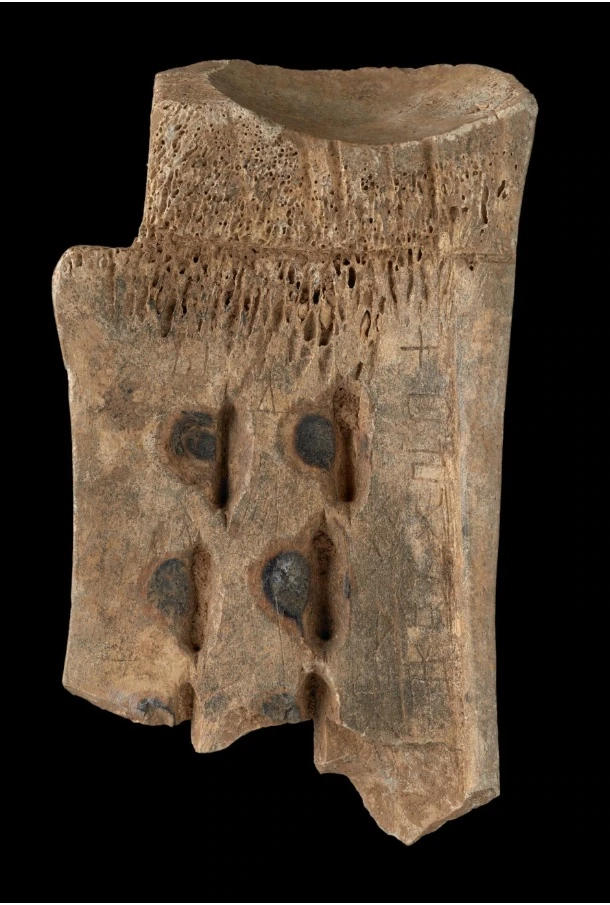
Oracle bone with an eclipse inscription, British Library Or 7694/1595 verso, dated to the twelfth century BCE. Commons explicitly lists Old Chinese as the language.
Saved in Babelbook · resized display copy. Select the image to open it independently of its source.
Anonymous ancient maker; digitization British Library · Source ↗CC0 1.0 ↗View the local visual field note
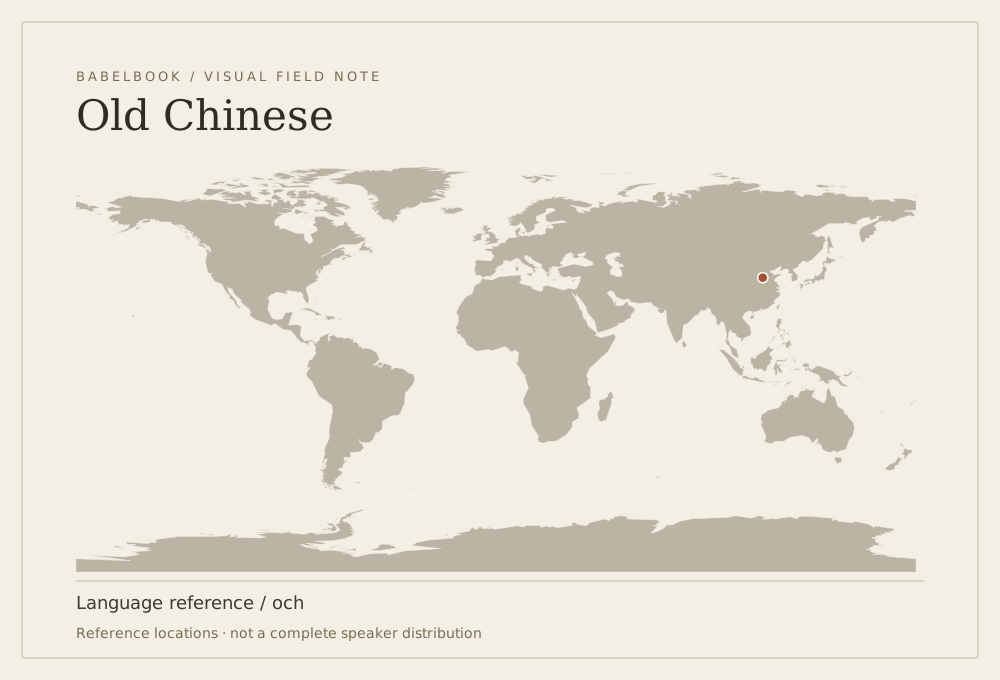
Representative reference points from Glottolog. Historical entries show reference locations, not current speakers. 1 point.
Reference & context ↗Babelbook · original editorial illustration · CC BY 4.0 · Glottolog locations; public-domain Natural Earth land
Source excerpts, selected, shortened and where noted editorially corrected from Old Chinese by Wikipedia contributors. Retrieved 2026-10-05. CC BY-SA 4.0. These excerpts are not an independently verified scholarly history; missing accounts are identified above.