Ojibwe
Ojibwe ( oh-JIB-way), also known as Ojibwa ( oh-JIB-wə), Ojibway, Otchipwe, Ojibwemowin, or Anishinaabemowin, is an indigenous language of North America of the Algonquian language family. The language has various dialects with local names and frequently local writing systems. No single dialect is considered the most prestigious or prominent, and no writing system covers all dialects. Dialects of Ojibwemowin are spoken in Canada, from southwestern Quebec, through Ontario, Manitoba, and parts of Saskatchewan, with outlying communities in Alberta; and in the United States, from Michigan to Wisconsin and Minnesota, with communities in North Dakota and Montana, as well as groups that were removed to Kansas and Oklahoma by the Indian Removal Act. While there is some variation in the classification of its dialects, at least the following are recognized, from east to west: Algonquin, Eastern Ojibwe, Ottawa (Odawa), Western Ojibwe (Saulteaux), Oji-Cree (Severn Ojibwe), Northwestern Ojibwe, and Southwestern Ojibwe (Chippewa). Based upon contemporary field research, J. R. Valentine also recognizes several other dialects: Berens Ojibwe in northwestern Ontario, which he distinguishes from Northwestern Ojibwe; North of (Lake) Superior; and Nipissing.
Translate in Ojibwe ↗Ojibwe communities are found in Canada from southwestern Quebec, through Ontario, southern Manitoba and parts of southern Saskatchewan; and in the United States from northern Michigan through northern Wisconsin and northern Minnesota, with a number of communities in northern North Dakota and northern Montana. Groups of speakers of the Ottawa dialect migrated to Kansas and Oklahoma during the historical period, with a small amount of linguistic documentation of the language in Oklahoma. The presence of Ojibwe in British Columbia has been noted. Current census data indicate that all varieties of Ojibwe are spoken by approximately 56,531 people. This figure reflects census data from the 2000 United States census and the 2006 Canadian census. The Ojibwe language is reported as spoken by a total of 8,791 people in the United States of which 7,355 are Native Americans and by as many as 47,740 in Canada, making it one of the largest Algic languages by numbers of speakers. The Red Lake, White Earth, and Leech Lake reservations are known for their tradition of singing hymns in the Ojibwe language. As of 2011, Ojibwe is the official language of Red Lake. Notable speakers of Anishinaabemowin include: Frederic Baraga (19th century Roman Catholic priest, missionary, and first bishop of the Roman Catholic Diocese of Marquette, who wrote A theoretical and practical grammar of the Otchipwe language) Alonzo Barnard (missionary, who operated a printing press to print Ojibwe language educational and religious material) George Copway (chief, missionary, writer, cultural ambassador) Basil H.
North America
Present-day use
With the remaining population of native speakers declining as older generations pass away, many historians believe we are at a point in the language's history that will determine whether it proliferates or goes extinct. Ojibwe historian Anton Treuer estimates that there are about 1,000 Ojibwe speakers left in the United States, mostly in Minnesota's Red Lake Indian Reservation and in Mille Lacs region. Teacher of the language Keller Paap believes most fluent speakers in the United States are over 70 years old, limiting exposure to spoken Ojibwemowin in many communities. Ojibwe educators and scholars across the region are working with elders who speak Ojibwemowin, known as the First Speakers, to document and learn the language in hopes to preserve it and pass it on to another generation. Treuer has been recording stories told by about 50 different Ojibwe elders in their native language to preserve both the language and pieces of knowledge and history. With his mentor, the Ponemah elder Eugene Stillday, he writes the recorded stories in both Ojibwe and translated English. As of the late 2010s, there has been more of a push toward bringing the Ojibwe language back into more common use, through language classes and programs sponsored by universities, sometimes available to non-students, which are essential to passing on the Ojibwe language. These courses mainly target adults and young adults; however, there are many resources for all age groups, including online games which provide domains for online language use. In the 1980s, The Northern Native-Languages Project was introduced in Ontario to get Indigenous languages such as Ojibwe, to be taught in schools. Years later, the first curriculum was established for the program and it was known as Native Languages 1987. There has also been an increase in published children's literature. The increase in materials published in Ojibwe is essential to increasing the number of speakers.
Origins
The captured article does not contain a separate origins section. See the historical account and linked source.
Development
The captured article does not contain a distinct historical account. No chronology has been invented.
Writing
There is no standard writing system used for all Ojibwe dialects. Local alphabets have been developed by adapting the Latin script, usually based on English or French orthography. A syllabic writing system, not related to English or French writing, is used by some Ojibwe speakers in northern Ontario and Manitoba. Great Lakes Algonquian syllabics are based on the French alphabet with letters organized into syllables. It was used primarily by speakers of Fox, Potawatomi, and Winnebago, but there is some indirect evidence of use by speakers of Southwestern Ojibwe. A widely used Roman character–based writing system is the double vowel system devised by Charles Fiero. Although there is no standard orthography, the double vowel system is used by many Ojibwe language teachers because of its ease of use. A wide range of materials have been published in the system, including a grammar, dictionaries, collections of texts, and pedagogical grammars. In northern Ontario and Manitoba, Ojibwe is most commonly written using the Cree syllabary, a syllabary originally developed by Methodist missionary James Evans around 1840 to write Cree. The syllabic system is based in part on Evans' knowledge of Pitman's shorthand and his prior experience developing a distinctive alphabetic writing system for Ojibwe in southern Ontario.
Beyond the typeface.
Signs, manuscripts, published pages and contextual photographs, with their place, period, source and reuse terms. Captions identify historical spellings, regional examples, community references and character imagery.
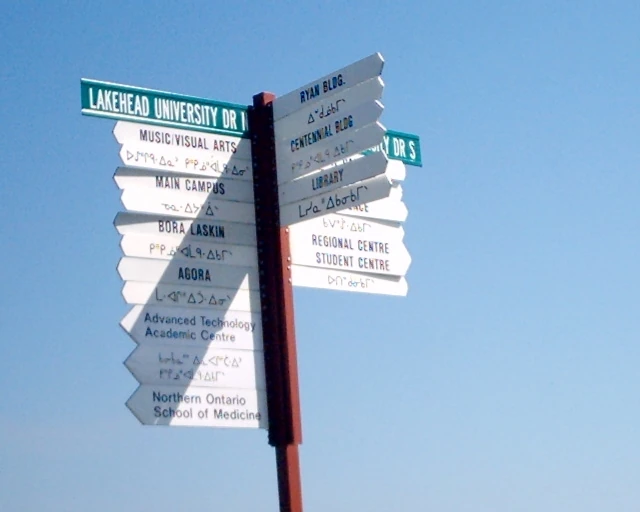
A direction sign in English and Ojibwe at Lakehead University, Thunder Bay.
Saved in Babelbook · resized display copy. Select the image to open it independently of its source.
Vidioman · Source ↗Public domain ↗View the local visual field note
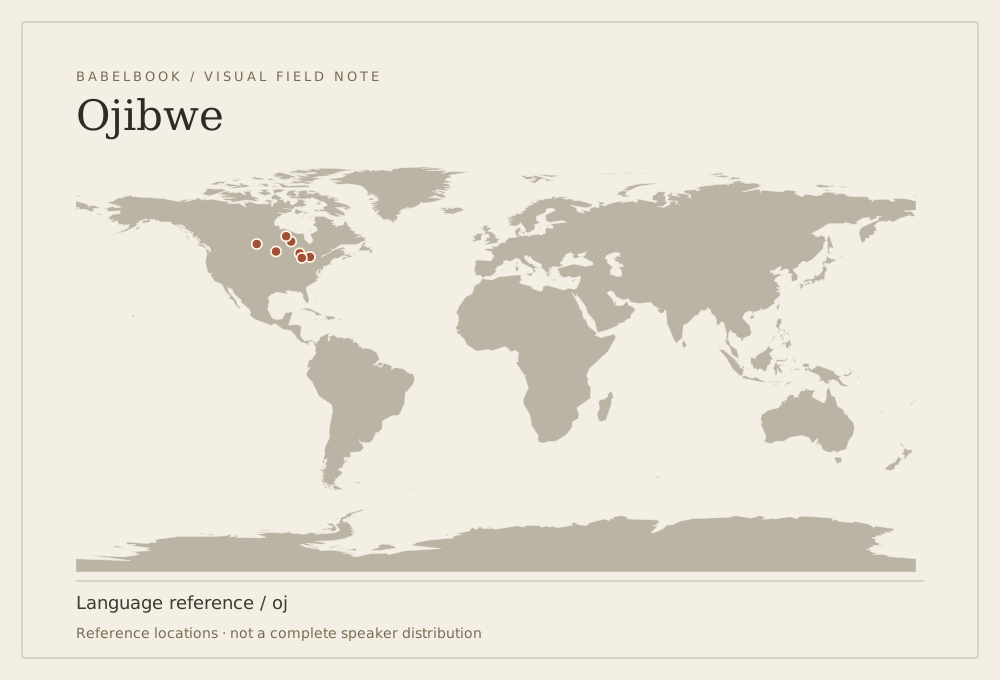
Representative reference points from Glottolog. Historical entries show reference locations, not current speakers. 7 points.
Reference & context ↗Babelbook · original editorial illustration · CC BY 4.0 · Glottolog locations; public-domain Natural Earth land
Source excerpts, selected, shortened and where noted editorially corrected from Ojibwe language by Wikipedia contributors. Retrieved 2026-10-05. CC BY-SA 4.0. These excerpts are not an independently verified scholarly history; missing accounts are identified above.
Read further in the source
Language revitalization
With the remaining population of native speakers declining as older generations pass away, many historians believe we are at a point in the language's history that will determine whether it proliferates or goes extinct. Ojibwe historian Anton Treuer estimates that there are about 1,000 Ojibwe speakers left in the United States, mostly in Minnesota's Red Lake Indian Reservation and in Mille Lacs region. Teacher of the language Keller Paap believes most fluent speakers in the United States are over 70 years old, limiting exposure to spoken Ojibwemowin in many communities. Ojibwe educators and scholars across the region are working with elders who speak Ojibwemowin, known as the First Speakers, to document and learn the language in hopes to preserve it and pass it on to another generation. Treuer has been recording stories told by about 50 different Ojibwe elders in their native language to preserve both the language and pieces of knowledge and history. With his mentor, the Ponemah elder Eugene Stillday, he writes the recorded stories in both Ojibwe and translated English. As of the late 2010s, there has been more of a push toward bringing the Ojibwe language back into more common use, through language classes and programs sponsored by universities, sometimes available to non-students, which are essential to passing on the Ojibwe language. These courses mainly target adults and young adults; however, there are many resources for all age groups, including online games which provide domains for online language use. In the 1980s, The Northern Native-Languages Project was introduced in Ontario to get Indigenous languages such as Ojibwe, to be taught in schools. Years later, the first curriculum was established for the program and it was known as Native Languages 1987. There has also been an increase in published children's literature. The increase in materials published in Ojibwe is essential to increasing the number of speakers. Language revitalization through Ojibwe frameworks also allows for cultural concepts to be conveyed through language. A 2014 study has indicated that learning Indigenous languages such as Ojibwe in school helps in learning the language and language structure; however, it does not help grow the use of the language outside of a school setting. The most effective way of promoting language is being surrounded by the language, especially in a familial setting. This is difficult to replicate in schools, which is why speaking Ojibwe with family and in one's home life is important in growing language revitalization. Research has been done in Ojibwe communities to prove the important role language revitalization has in treating health concerns. The use of language connects a community through shared views and supports the well-being of said community. Researchers found that language and the notion of culture were intertwined together instead of being separate concepts, and the people who regularly practiced their language and culture were often associated with more positive health outcomes, particularly for psychological health and mental well-being. An "Ojibway Language and People" app is an open-source app available for iOS devices. The Ojibwe People's Dictionary is an online language resource created in collaboration with the University of Minnesota. It is an accessible system that allows users to search in English or Ojibwe and includes voice recordings for many of the 17 000 entries in the collection. In 2022 the Mille Lacs Band of Ojibwe announced a partnership with Rosetta Stone to preserve the Ojibwe language and the Mille Lacs dialect through the latter's Endangered Languages Program. As of 2025 three levels of language learning are available.
Geographic distribution
Ojibwe communities are found in Canada from southwestern Quebec, through Ontario, southern Manitoba and parts of southern Saskatchewan; and in the United States from northern Michigan through northern Wisconsin and northern Minnesota, with a number of communities in northern North Dakota and northern Montana. Groups of speakers of the Ottawa dialect migrated to Kansas and Oklahoma during the historical period, with a small amount of linguistic documentation of the language in Oklahoma. The presence of Ojibwe in British Columbia has been noted. Current census data indicate that all varieties of Ojibwe are spoken by approximately 56,531 people. This figure reflects census data from the 2000 United States census and the 2006 Canadian census. The Ojibwe language is reported as spoken by a total of 8,791 people in the United States of which 7,355 are Native Americans and by as many as 47,740 in Canada, making it one of the largest Algic languages by numbers of speakers.
The Red Lake, White Earth, and Leech Lake reservations are known for their tradition of singing hymns in the Ojibwe language. As of 2011, Ojibwe is the official language of Red Lake.
Dialects
Because the dialects of Ojibwe are at least partly mutually intelligible, Ojibwe is usually considered to be a single language with a number of dialects, i.e. Ojibwe is "... conventionally regarded as a single language consisting of a continuum of dialectal varieties since ... every dialect is at least partly intelligible to the speakers of the neighboring dialects." The degree of mutual intelligibility between nonadjacent dialects varies considerably; recent research has shown that there is strong differentiation between the Ottawa dialect spoken in southern Ontario and northern Michigan; the Severn Ojibwa dialect spoken in northern Ontario and Manitoba; and the Algonquin dialect spoken in southwestern Quebec. Valentine notes that isolation is the most plausible explanation for the distinctive linguistic features found in these three dialects. Many communities adjacent to these relatively sharply differentiated dialects show a mix of transitional features, reflecting overlap with other nearby dialects. While each of these dialects has undergone innovations that make them distinctive, their status as part of the Ojibwe language complex is not in dispute. The relatively low degrees of mutual intelligibility between some nonadjacent Ojibwe dialects led Rhodes and Todd to suggest that Ojibwe should be analyzed as a linguistic subgroup consisting of several languages. While there is some variation in the classification of Ojibwe dialects, at a minimum the following are recognized, proceeding west to east: Western Ojibwe (Saulteaux), Southwestern Ojibwe (Chippewa), Northwestern Ojibwe, Severn Ojibwe (Oji-Cree), Ottawa (Odawa), Eastern Ojibwe, and Algonquin. Based upon contemporary field research, Valentine also recognizes several other dialects: Berens Ojibwe in northwestern Ontario, which he distinguishes from Northwestern Ojibwe; North of (Lake) Superior; and Nipissing. The latter two cover approximately the same territory as Central Ojibwa, which he does not recognize. Two recent analyses of the relationships between the Ojibwe dialects are in agreement on the assignment of the strongly differentiated Ottawa dialect to a separate subgroup, and the assignment of Severn Ojibwe and Algonquin to another subgroup, and differ primarily with respect to the relationships between the less strongly differentiated dialects. Rhodes and Todd recognize several different dialectal subgroupings within Ojibwe: (a) Ottawa; (b) Severn and Algonquian; (c) a third subgroup which is further divided into (i) a subgrouping of Northwestern Ojibwe and Saulteaux, and a subgrouping consisting of Eastern Ojibwe and a further subgrouping comprising Southwestern Ojibwe and Central Ojibwe. Valentine has proposed that Ojibwe dialects are divided into three groups: a northern tier consisting of Severn Ojibwe and Algonquin; a southern tier consisting of "Odawa, Chippewa, Eastern Ojibwe, the Ojibwe of the Border Lakes region between Minnesota and Ontario, and Saulteaux; and third, a transitional zone between these two polar groups, in which there is a mixture of northern and southern features."
Dialect variation
Like any language dialects spanning vast regions, some words that may have had identical meaning at one time have evolved to have different meanings today. For example, zhooniyaans (literally 'small [amount of] money' and used to refer to coins) specifically means 'dime' (10-cent piece) in the United States, but a 'quarter' (25-cent piece) in Canada, or desabiwin (literally 'seat') means 'couch' or 'chair' in Canada, but is used to specifically mean 'saddle' in the United States. Cases like 'battery' and 'coffee' also demonstrate the often great difference between the literal meanings of the individual morphemes in a word, and the overall meaning of the entire word.
Writing system
There is no standard writing system used for all Ojibwe dialects. Local alphabets have been developed by adapting the Latin script, usually based on English or French orthography. A syllabic writing system, not related to English or French writing, is used by some Ojibwe speakers in northern Ontario and Manitoba. Great Lakes Algonquian syllabics are based on the French alphabet with letters organized into syllables. It was used primarily by speakers of Fox, Potawatomi, and Winnebago, but there is some indirect evidence of use by speakers of Southwestern Ojibwe. A widely used Roman character–based writing system is the double vowel system devised by Charles Fiero. Although there is no standard orthography, the double vowel system is used by many Ojibwe language teachers because of its ease of use. A wide range of materials have been published in the system, including a grammar, dictionaries, collections of texts, and pedagogical grammars. In northern Ontario and Manitoba, Ojibwe is most commonly written using the Cree syllabary, a syllabary originally developed by Methodist missionary James Evans around 1840 to write Cree. The syllabic system is based in part on Evans' knowledge of Pitman's shorthand and his prior experience developing a distinctive alphabetic writing system for Ojibwe in southern Ontario.
Notable speakers
Notable speakers of Anishinaabemowin include:
Frederic Baraga (19th century Roman Catholic priest, missionary, and first bishop of the Roman Catholic Diocese of Marquette, who wrote A theoretical and practical grammar of the Otchipwe language) Alonzo Barnard (missionary, who operated a printing press to print Ojibwe language educational and religious material) George Copway (chief, missionary, writer, cultural ambassador) Basil H. Johnston (educator, curator, essayist, cultural ambassador) Peter Jones (missionary, reverend, chief) Maude "Naawakamigookwe" Kegg (narrator, artist, cultural ambassador) Margaret Noodin (educator, writer) Jim Northrup (writer) Keller Paap (educator and author) Francis Xavier Pierz (19th century Roman Catholic priest, poet, and missionary to the Ojibwe in Michigan, Wisconsin, Minnesota, and Ontario) Anton Treuer (historian, author, linguistic professor, first Ojibwe person to graduate from Princeton University) Archie Mosay (medicine man and elder, mentor of Anton Treuer) Anna Gibbs (well-known Ponemah elder, story-teller, and spiritual and ceremonial leader) Wab Kinew (Premier of Manitoba, first Indigenous person to hold this office since John Norquay)