Oromo
Oromo is an Afroasiatic language belonging to the Cushitic branch, primarily spoken by the Oromo people, native to the Ethiopian state of Oromia and northern Kenya. It is used as a lingua franca in Oromia and northeastern Kenya. It is officially written in the Latin script, although traditional scripts are also informally used. With more than 41.7 million speakers making up 33.8% of the total Ethiopian population, Oromo has the largest number of native speakers in Ethiopia and ranks as the second most widely spoken language in Ethiopia by total number of speakers (including second-language speakers), following Amharic. Forms of Oromo are spoken as a first language by an additional half-million people in parts of northern and eastern Kenya. It is also spoken by smaller numbers of emigrants in other African countries such as South Africa, Libya, Egypt and Sudan. Oromo is the most widely spoken Cushitic language and among the five languages of Africa with the largest mother-tongue populations. Oromo serves as one of the official working languages of Ethiopia and is also the working language of several of the states within the Ethiopian federal system, including Oromia, Harari Region, Dire Dawa and Oromia in the Amhara Region. It is a language of primary education in Oromia, Harari, Dire Dawa, Benishangul-Gumuz Region and Addis Ababa. It is used as an internet language for federal websites along with Tigrinya. Under Haile Selassie's government, Oromo was de facto banned in education, in conversation and in administrative matters.
Translate in Oromo ↗About 85 percent of Oromo speakers live in Ethiopia, mainly in the Oromia Region. In addition, in Somalia there are also some speakers of the language. In Kenya, the Ethnologue also lists 627,000 speakers of Borana and Orma, two languages closely related to Ethiopian Oromo. Within Ethiopia, Oromo is the language with the largest number of native speakers. Within Africa, Oromo is the language with the fourth most speakers, after Arabic (if one counts the mutually unintelligible spoken forms of Arabic as a single language and assumes the same for the varieties of Oromo), Swahili and Hausa. Besides first language speakers, a number of members of other ethnicities who are in contact with the Oromo speak it as a second language. See, for example, the Omotic-speaking Bambassi and the Nilo-Saharan-speaking Kwama in northwestern Oromia.
Sub-Saharan Africa
Present-day use
The captured source does not contain a separate current-use account.
Origins
The captured article does not contain a separate origins section. See the historical account and linked source.
Development
The captured article does not contain a distinct historical account. No chronology has been invented.
Writing
Oromo is written with a Latin alphabet called Qubee which was formally adopted in 1991. Various versions of the Latin-based orthography had been used previously, mostly by Oromos outside of Ethiopia and by the OLF by the late 1970s (Heine 1986). With the adoption of Qubee, it is believed more texts were written in the Oromo language between 1991 and 1997 than in the previous 100 years. In Kenya, the Borana and Waata also use Roman letters but with different systems. The Shaaldaa script is an indigenous Oromo script invented by Sheikh Bakri Sapalo (1895–1980, also known by his birth name, Abubaker Usman Odaa) in the late 1950s and used underground afterwards. Despite structural and organizational influences from the Geʽez script and Arabic script, it is a graphically independent creation designed specifically for Oromo phonology. It is an abugida with most characters representing syllables (consonant+vowel), but also has characters to represent standalone vowels and standalone consonants. There are slightly different characters that represent geminated consonants+vowels. There are also "base glyphs" used purely in pedagogical materials, but are not used in writing language. The Arabic script has also been used intermittently in areas with Muslim populations.
Beyond the typeface.
Signs, manuscripts, published pages and contextual photographs, with their place, period, source and reuse terms. Captions identify historical spellings, regional examples, community references and character imagery.
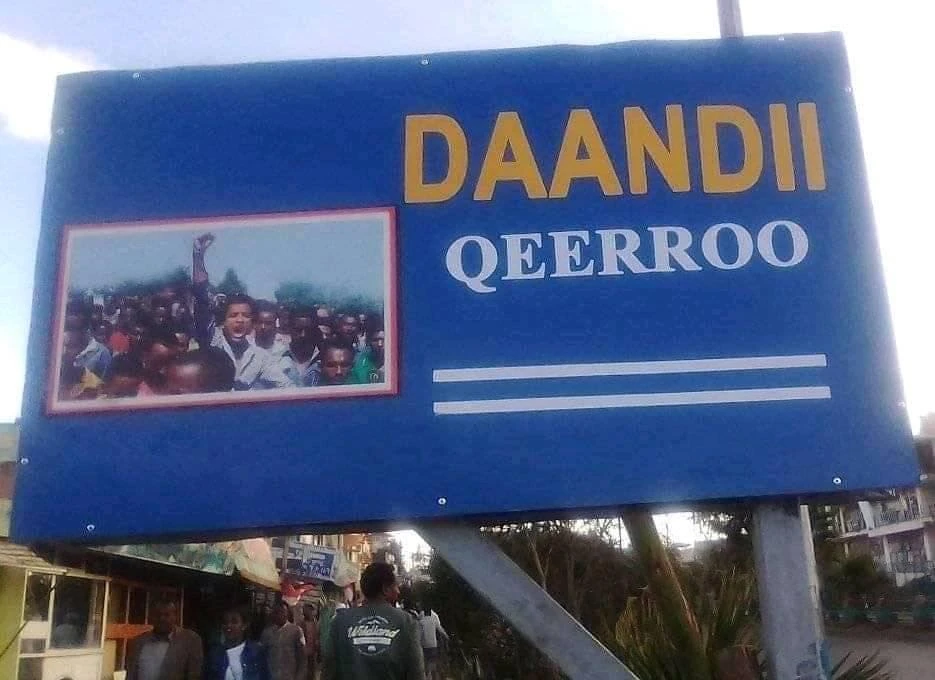
Oromo street sign in Asalla, Ethiopia, photographed in 2019. Language identification follows the explicit Oromo caption and Commons classification; not independently transcribed.
Saved in Babelbook · resized display copy. Select the image to open it independently of its source.
Mohammed (Dotohelp) · Source ↗CC BY-SA 4.0 ↗View the local visual field note
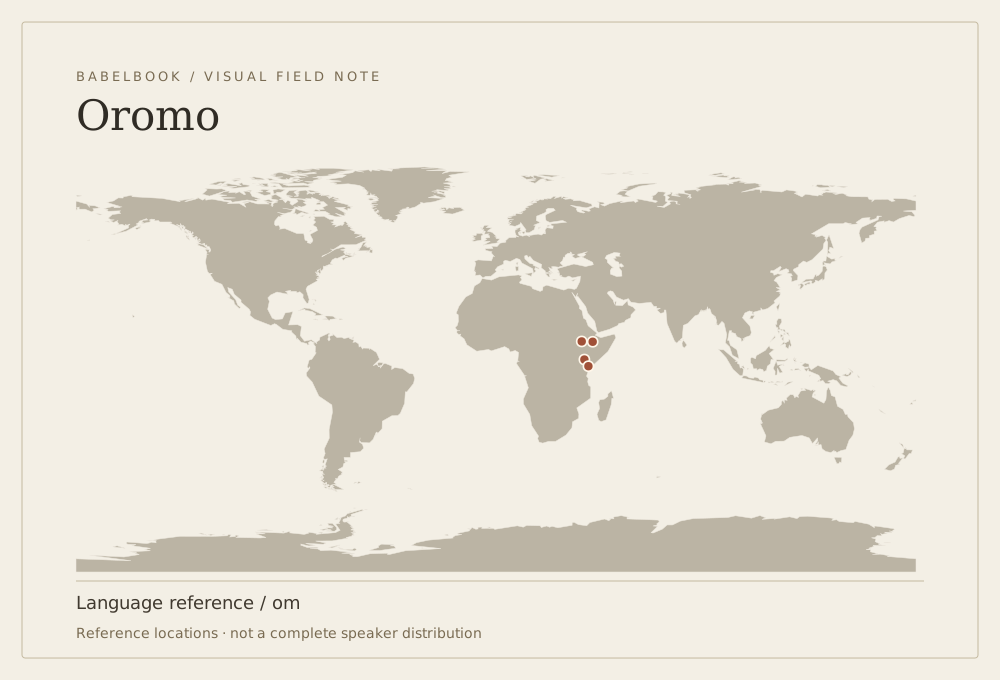
Representative reference points from Glottolog. Historical entries show reference locations, not current speakers. 4 points.
Reference & context ↗Babelbook · original editorial illustration · CC BY 4.0 · Glottolog locations; public-domain Natural Earth land
Source excerpts, selected, shortened and where noted editorially corrected from Oromo language by Wikipedia contributors. Retrieved 2026-10-05. CC BY-SA 4.0. These excerpts are not an independently verified scholarly history; missing accounts are identified above.
Read further in the source
Speakers
About 85 percent of Oromo speakers live in Ethiopia, mainly in the Oromia Region. In addition, in Somalia there are also some speakers of the language. In Kenya, the Ethnologue also lists 627,000 speakers of Borana and Orma, two languages closely related to Ethiopian Oromo. Within Ethiopia, Oromo is the language with the largest number of native speakers. Within Africa, Oromo is the language with the fourth most speakers, after Arabic (if one counts the mutually unintelligible spoken forms of Arabic as a single language and assumes the same for the varieties of Oromo), Swahili and Hausa. Besides first language speakers, a number of members of other ethnicities who are in contact with the Oromo speak it as a second language. See, for example, the Omotic-speaking Bambassi and the Nilo-Saharan-speaking Kwama in northwestern Oromia.
Writing systems
Oromo is written with a Latin alphabet called Qubee which was formally adopted in 1991. Various versions of the Latin-based orthography had been used previously, mostly by Oromos outside of Ethiopia and by the OLF by the late 1970s (Heine 1986). With the adoption of Qubee, it is believed more texts were written in the Oromo language between 1991 and 1997 than in the previous 100 years. In Kenya, the Borana and Waata also use Roman letters but with different systems. The Shaaldaa script is an indigenous Oromo script invented by Sheikh Bakri Sapalo (1895–1980, also known by his birth name, Abubaker Usman Odaa) in the late 1950s and used underground afterwards. Despite structural and organizational influences from the Geʽez script and Arabic script, it is a graphically independent creation designed specifically for Oromo phonology. It is an abugida with most characters representing syllables (consonant+vowel), but also has characters to represent standalone vowels and standalone consonants. There are slightly different characters that represent geminated consonants+vowels. There are also "base glyphs" used purely in pedagogical materials, but are not used in writing language. The Arabic script has also been used intermittently in areas with Muslim populations.