Odia
Odia (ଓଡ଼ିଆ, ISO: Ōṛiā, pronounced [oˈɽia] ), or Oriya, is a classical Indo-Aryan language spoken in the Indian state of Odisha. It is the official language in Odisha where native speakers make up 82% of the population, and it is also spoken in parts of West Bengal, Jharkhand, Andhra Pradesh and Chhattisgarh. Odia is one of the official languages of India; it is the official language of Odisha and the second official language of Jharkhand. The Odia language has various varieties, including the Baleswari Odia (Northern variety), Kataki, Dhenkanalia, Anugulia (central variety), Ganjami Odia (Southern variety), Sundargadi Odia (Northwestern variety), Sambalpuri Odia (Western variety), Desia Odia (South-western variety) and Tribal Community dialects spoken by the tribal groups in Odisha who adopted the Odia language. Odia is the sixth Indian language to be designated a classical language. It traces its linguistic roots to the Eastern Magadhi Prakrit, evolving through stages such as Proto Odia (7th–9th century CE), Old Odia (10th–13th century CE), Middle Odia (14th–17th century CE), and Modern Odia (from the 18th century onward). The language displays a distinct phonological and morphological character shaped by centuries of interaction with tribal and Dravidian tongues. Recognised as a classical language of India, Odia has an unbroken literary tradition, with inscriptions dating back over a thousand years.
Translate in Odia ↗Odia (ଓଡ଼ିଆ, ISO: Ōṛiā, pronounced [oˈɽia] ), or Oriya, is a classical Indo-Aryan language spoken in the Indian state of Odisha. It is the official language in Odisha where native speakers make up 82% of the population, and it is also spoken in parts of West Bengal, Jharkhand, Andhra Pradesh and Chhattisgarh. Odia is one of the official languages of India; it is the official language of Odisha and the second official language of Jharkhand. The Odia language has various varieties, including the Baleswari Odia (Northern variety), Kataki, Dhenkanalia, Anugulia (central variety), Ganjami Odia (Southern variety), Sundargadi Odia (Northwestern variety), Sambalpuri Odia (Western variety), Desia Odia (South-western variety) and Tribal Community dialects spoken by the tribal groups in Odisha who adopted the Odia language. Odia is the sixth Indian language to be designated a classical language. It traces its linguistic roots to the Eastern Magadhi Prakrit, evolving through stages such as Proto Odia (7th–9th century CE), Old Odia (10th–13th century CE), Middle Odia (14th–17th century CE), and Modern Odia (from the 18th century onward). The language displays a distinct phonological and morphological character shaped by centuries of interaction with tribal and Dravidian tongues. Recognised as a classical language of India, Odia has an unbroken literary tradition, with inscriptions dating back over a thousand years.
South Asia
Present-day use
The captured source does not contain a separate current-use account.
Origins
The captured article does not contain a separate origins section. See the historical account and linked source.
Development
Odia is an Eastern Indo-Aryan language belonging to the Indo-Aryan language family. It descends from Odra Prakrit which itself evolved from Magadhi Prakrit. The latter was spoken in east India over 1,500 years ago, and is the primary language used in early Jain and Buddhist texts. Odia appears to have had relatively little influence from Persian and Arabic, compared to other major Indo-Aryan languages. The history of the Odia language is divided into eras: Proto-Odia (Odra Prakrit) (10th century and earlier): Inscriptions from 9th century shows the evolution of proto-Odia, i.e. Odra Prakrit or Oriya Prakrit words used along with Sanskrit. The inscriptions are dated to third quarter of 9th century during the reign of early Eastern Gangas. Old Odia (10th century till 13th century): Inscriptions from the 10th century onwards provide evidence for the existence of the Old Odia language, with the earliest inscription being the Urajam inscription of the Eastern Gangas written in Old Odia in 1051 CE. Old Odia written in the form of connected lines is found in inscription dated to 1249 CE. Early Middle Odia (13th century–15th century): The earliest use of prose can be found in the Madala Panji of the Jagannath Temple at Puri, which dates back to the 12th century. Such works as Sisu Beda, Amarakosa, Gorekha Samhita, Kalasa Chautisa and Saptanga are written in this form of Odia. Middle Odia (15th century–17th century): Sarala Das writes the Mahabharata and Bilanka Ramayana. Towards the 15th century, Panchasakha 'five seer poets' namely Balarama Dasa, Jagannatha Dasa, Achyutananda Dasa, Sisu Ananta Dasa and Jasobanta Dasa wrote a number of popular works, including the Odia Bhagabata, Jagamohana Ramayana, Lakshmi Purana, Haribansa, Gobinda Chandra and more.
Writing
The Odia language uses the Odia script (also known as the Kalinga script). It is a Brahmic script used to write primarily the Odia language and others like Sanskrit and several minor regional languages. The script has developed over nearly 1000 years, with the earliest trace of the script being dated to 1051 AD. Odia is a syllabic alphabet, or an abugida, wherein all consonants have an inherent vowel. Diacritics (which can appear above, below, before, or after the consonant they belong to) are used to change the form of the inherent vowel. When vowels appear at the beginning of a syllable, they are written as independent letters. Also, when certain consonants occur together, special conjunct symbols are used to combine the essential parts of each consonant symbol. The curved appearance of the Odia script is a result of the practice of writing on palm leaves, which have a tendency to tear if too many straight lines are used. Karani Script or Karani Lipi (Odia: କରଣୀ ଲିପି) is a traditional script used primarily in Odisha, India, for administrative and literary purposes during the medieval and early modern periods. Named after the Karana scribes (the traditional writer caste of Odisha), the script was predominantly used in the royal courts and temples, especially for writing on palm leaf manuscripts. It is a cursive form derived from the Odia script, developed to enable faster writing with a stylus or pen. The Karani script is characterised by its flowing, connected style, making it distinct from the formal printed Odia script. Though no longer in widespread use, it remains an important part of Odisha's manuscript heritage and is preserved in temple records, historical documents, and museum collections.
Beyond the typeface.
Signs, manuscripts, published pages and contextual photographs, with their place, period, source and reuse terms. Captions identify historical spellings, regional examples, community references and character imagery.
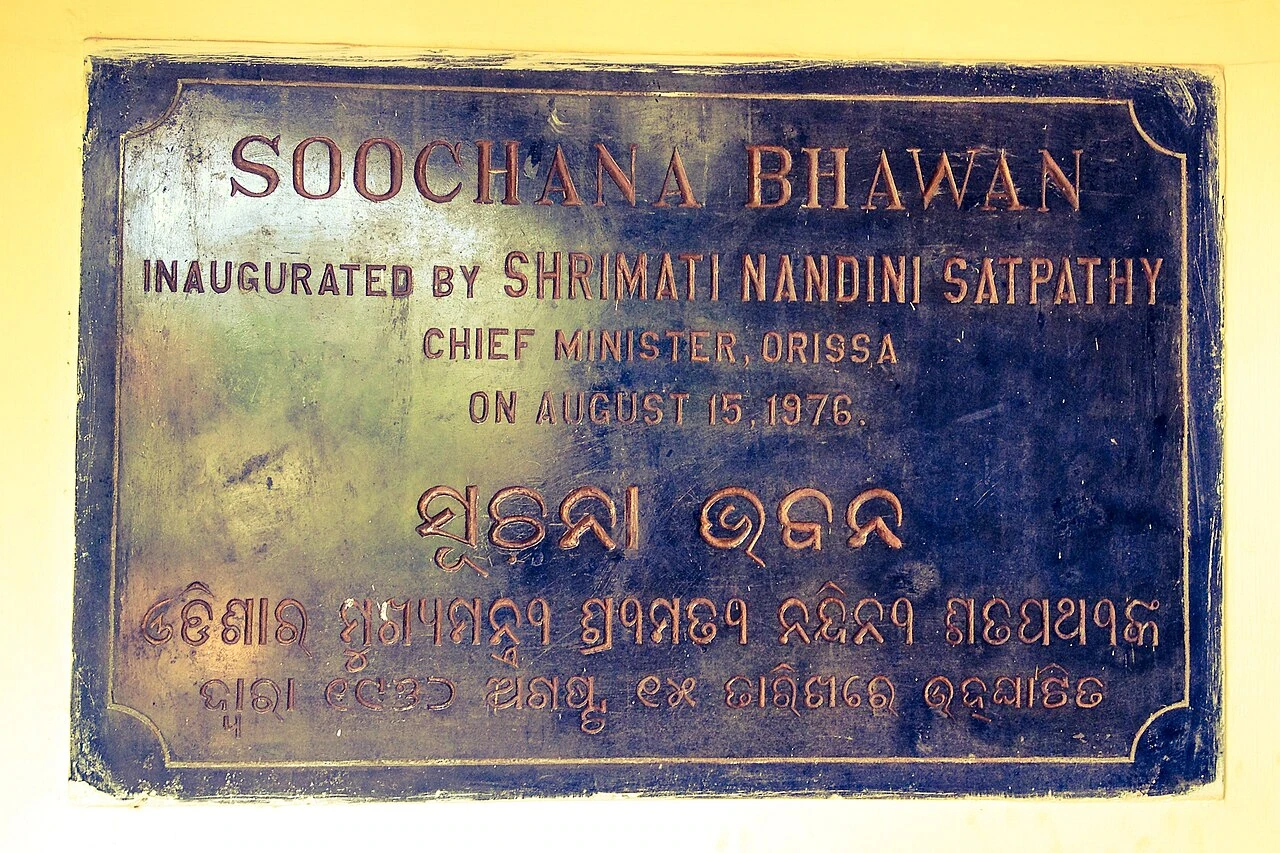
The Odia foundation-stone inscription at Jayadev Bhawan, Bhubaneswar, with handwriting influenced by Karani.
Saved in Babelbook · resized display copy. Select the image to open it independently of its source.
Subhashish Panigrahi · Source ↗CC BY-SA 3.0 ↗View the local visual field note
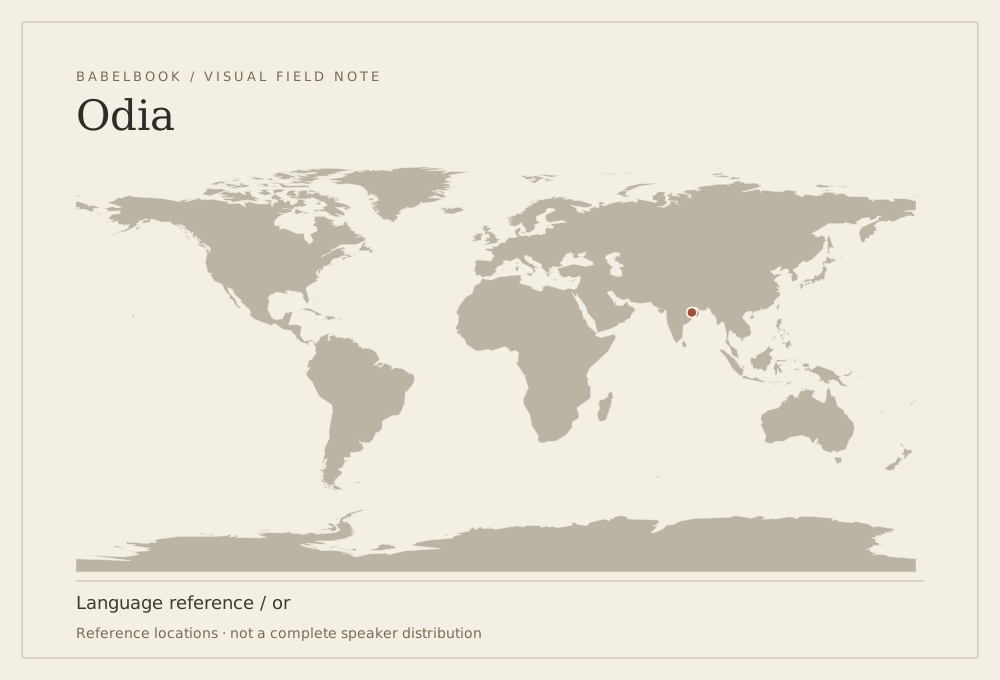
Representative reference points from Glottolog. Historical entries show reference locations, not current speakers. 2 points.
Reference & context ↗Babelbook · original editorial illustration · CC BY 4.0 · Glottolog locations; public-domain Natural Earth land
Source excerpts, selected, shortened and where noted editorially corrected from Odia language by Wikipedia contributors. Retrieved 2026-10-05. CC BY-SA 4.0. These excerpts are not an independently verified scholarly history; missing accounts are identified above.
Read further in the source
History
Odia is an Eastern Indo-Aryan language belonging to the Indo-Aryan language family. It descends from Odra Prakrit which itself evolved from Magadhi Prakrit. The latter was spoken in east India over 1,500 years ago, and is the primary language used in early Jain and Buddhist texts. Odia appears to have had relatively little influence from Persian and Arabic, compared to other major Indo-Aryan languages.
The history of the Odia language is divided into eras:
Proto-Odia (Odra Prakrit) (10th century and earlier): Inscriptions from 9th century shows the evolution of proto-Odia, i.e. Odra Prakrit or Oriya Prakrit words used along with Sanskrit. The inscriptions are dated to third quarter of 9th century during the reign of early Eastern Gangas. Old Odia (10th century till 13th century): Inscriptions from the 10th century onwards provide evidence for the existence of the Old Odia language, with the earliest inscription being the Urajam inscription of the Eastern Gangas written in Old Odia in 1051 CE. Old Odia written in the form of connected lines is found in inscription dated to 1249 CE. Early Middle Odia (13th century–15th century): The earliest use of prose can be found in the Madala Panji of the Jagannath Temple at Puri, which dates back to the 12th century. Such works as Sisu Beda, Amarakosa, Gorekha Samhita, Kalasa Chautisa and Saptanga are written in this form of Odia. Middle Odia (15th century–17th century): Sarala Das writes the Mahabharata and Bilanka Ramayana. Towards the 15th century, Panchasakha 'five seer poets' namely Balarama Dasa, Jagannatha Dasa, Achyutananda Dasa, Sisu Ananta Dasa and Jasobanta Dasa wrote a number of popular works, including the Odia Bhagabata, Jagamohana Ramayana, Lakshmi Purana, Haribansa, Gobinda Chandra and more. Balarama Dasa, Ananta Dasa and Achyutananda Dasa of Pancha Sakha group hailed from Karana community. Late Middle Odia (17th century–Early 19th century): Usabhilasa of Sisu Sankara Dasa, the Rahasya Manjari of Deba Durlabha Dasa and the Rukmini Bibaha of Kartika Dasa were written. Upendra Bhanja took a leading role in this period with his creations Baidehisa Bilasa, Koti Brahmanda Sundari, Labanyabati which emerged as landmarks in Odia Literature. Dinakrushna Dasa's Rasakallola and Abhimanyu Samanta Singhara's Bidagdha Chintamani were prominent latter kabyas. Of the song poets who spearheaded Odissi music, classical music of the state – Upendra Bhanja, Banamali, Kabisurjya Baladeba Ratha, Gopalakrusna were prominent. Bhima Bhoi emerged towards the end of the 19th century. Modern Odia (Late 19th century to present): The first Odia magazine, Bodha Dayini was published in Balasore in 1861. During this time many Bengali scholars claimed that Odia was just a dialect of Bengali to exercise of power by cornering government jobs. For instance Pandit Kanti Chandra Bhattacharya, a teacher of Balasore Zilla School, published a little pamphlet named "Odia Ekti Swatantray Bhasha Noi" (Odia not an independent language) where Bhattacharya claimed that Odia was not a separate and original form of language and was a mere corruption of Bengali. He suggested British Government to abolish all Odia Vernacular Schools from Odisha and to alter into Bengali Vernacular Schools. The first Odia newspaper Utkala Deepika, launched in 1866 under editors Gourishankar Ray and Bichitrananda. In 1869 Bhagavati Charan Das started another newspaper, Utkal Subhakari. More Odia newspapers soon followed like Utkal Patra, Utkal Hiteisini from Cuttack, Utkal Darpan and Sambada Vahika from Balasore and Sambalpur Hiteisini from Deogarh. Fakir Mohan Senapati emerged as a prominent Odia fiction writer of this time and Radhanath Ray as a prominent Odia poet. Other prominent Odia writers who helped promote Odia at this time were Madhusudan Das, Madhusudan Rao, Gangadhar Meher, Chintamani Mohanty, Nanda Kishore Bal, Reba Ray, Gopabandhu Das and Nilakantha Das.
Major tribal and community dialects/sociolects
Bodo Parja (Jharia): spoken by the Parang Proja tribe of Koraput and neighbouring districts of Odisha. Bhatri: language variety spoken by the Bhottada tribe in Odisha and Chhattisgarh. Reli: language variety spoken by the Reli people in the Koraput and Rayagada districts of southern Odisha and bordering districts of Andhra Pradesh. Kupia: language variety spoken by Valmiki people of Odisha and Andhra Pradesh, mostly in Koraput, and Visakhapatnam districts. Minor sociolects Odia minor varieties include:
Bhuyan: Tribal variety spoken in Northern Odisha. Sounti: Spoken in Northern Odisha. Bathudi: Spoken in Northern Odisha. Kondhan: Tribal variety spoken in Western Odisha. Agharia: Spoken by Agharia community in districts of Western Odisha and Chhattisgarh. Bhulia: Spoken by Bhulia community in districts of Western Odisha and Chhattisgarh. Matia: Tribal variety spoken in Southern Odisha.
Writing system
The Odia language uses the Odia script (also known as the Kalinga script). It is a Brahmic script used to write primarily the Odia language and others like Sanskrit and several minor regional languages. The script has developed over nearly 1000 years, with the earliest trace of the script being dated to 1051 AD. Odia is a syllabic alphabet, or an abugida, wherein all consonants have an inherent vowel. Diacritics (which can appear above, below, before, or after the consonant they belong to) are used to change the form of the inherent vowel. When vowels appear at the beginning of a syllable, they are written as independent letters. Also, when certain consonants occur together, special conjunct symbols are used to combine the essential parts of each consonant symbol. The curved appearance of the Odia script is a result of the practice of writing on palm leaves, which have a tendency to tear if too many straight lines are used. Karani Script or Karani Lipi (Odia: କରଣୀ ଲିପି) is a traditional script used primarily in Odisha, India, for administrative and literary purposes during the medieval and early modern periods. Named after the Karana scribes (the traditional writer caste of Odisha), the script was predominantly used in the royal courts and temples, especially for writing on palm leaf manuscripts. It is a cursive form derived from the Odia script, developed to enable faster writing with a stylus or pen. The Karani script is characterised by its flowing, connected style, making it distinct from the formal printed Odia script. Though no longer in widespread use, it remains an important part of Odisha's manuscript heritage and is preserved in temple records, historical documents, and museum collections.