Ossetian
Ossetian ( o-SET-ee-ən, o-SEE-shən, oh-SEE-shən), commonly referred to as Ossetic and rarely as Ossete, is an Eastern Iranic language that is spoken predominantly in Ossetia, a region situated on both sides of the Greater Caucasus, on the Russia-Georgia border. It is the native language of the Ossetian people, and a relative and possibly a descendant of the extinct Scythian, Sarmatian, and Alanic languages. The northern half of the Ossetian region is part of Russia and is known as North Ossetia–Alania, while the southern half is part of the de facto country of South Ossetia (recognized by the United Nations as Russian-occupied territory that is de jure part of Georgia). Ossetian-speakers number about 614,350, with 451,000 recorded in Russia per the 2010 Russian census. Despite Ossetian being the official languages of both North and South Ossetia, since 2009 UNESCO has listed Ossetian as "vulnerable".
Translate in Ossetian ↗Ossetian ( o-SET-ee-ən, o-SEE-shən, oh-SEE-shən), commonly referred to as Ossetic and rarely as Ossete, is an Eastern Iranic language that is spoken predominantly in Ossetia, a region situated on both sides of the Greater Caucasus, on the Russia-Georgia border. It is the native language of the Ossetian people, and a relative and possibly a descendant of the extinct Scythian, Sarmatian, and Alanic languages. The northern half of the Ossetian region is part of Russia and is known as North Ossetia–Alania, while the southern half is part of the de facto country of South Ossetia (recognized by the United Nations as Russian-occupied territory that is de jure part of Georgia). Ossetian-speakers number about 614,350, with 451,000 recorded in Russia per the 2010 Russian census. Despite Ossetian being the official languages of both North and South Ossetia, since 2009 UNESCO has listed Ossetian as "vulnerable".
Europe
Present-day use
The captured source does not contain a separate current-use account.
Origins
The captured article does not contain a separate origins section. See the historical account and linked source.
Development
Ossetian is the spoken and literary language of the Ossetians, an Iranian ethnic group living in the central part of the Caucasus and constituting the basic population of North Ossetia–Alania, which is part of the Russian Federation, and of the de facto country of South Ossetia (recognized by the United Nations as de jure part of the Republic of Georgia). The Ossetian language belongs to the Iranian group of the Indo-European family of languages (as hinted by its endonym: ирон, irōn). Within Iranian, it is placed in the Eastern subgroup and further to a Northeastern sub-subgroup, but these are areal rather than genetic groups. The other Eastern Iranian languages, such as Pashto (spoken in Afghanistan and Pakistan) and Yaghnobi (spoken in Tajikistan), show certain commonalities, but also deep-reaching divergences from Ossetian. From the 7th–8th centuries BCE, the languages of the Iranian group were distributed across a vast territory spanning present-day Iran (Persia), Central Asia, Eastern Europe, and the Caucasus. Ossetian is the sole survivor of the branch of Iranian languages known as Scythian. The Scythian group included numerous tribes, known in ancient sources as the Scythians, the Massagetae, the Saka, the Sarmatians, the Alans, and the Roxolani. The more easterly Khwarazm and Sogdians were also closely affiliated linguistically. Ossetian, together with Kurdish, Tat, and Talysh, is one of the main Iranian languages with a sizable community of speakers in the Caucasus. As it is descended from Alanic, spoken by the medieval Alans, who emerged from the earlier Sarmatians, it is believed to be the only surviving descendant of a Sarmatian language. The closest genetically related language may be the Yaghnobi language of Tajikistan, the only other living Northeastern Iranian language.
Writing
In 1888, an inscription in the Alanian language was found in Abkhazia, which dates back to the 4th century. An Old Ossetic Greek script inscription of the 10th–12th centuries was found in Arkhyz, the oldest known attestation of the Ossetian language. Written Ossetian may be immediately recognized by its use of the Cyrillic letter Æ (Ӕ ӕ), a letter to be found in no other language using Cyrillic script. The father of the modern Ossetian literary language is the national poet Kosta Khetagurov (1859–1906). An Iron literary language was established in the 18th century, written using the Cyrillic script in Russia and the Georgian script in Georgia. The first Ossetian book was published in Cyrillic in 1798, and in 1844 the alphabet was revised by a Russian scientist of Finnish origin, Andreas Sjögren. In the early 1800s, Daniel Chonkadze produced a Russian-Ossetian dictionary and translated Ossetian folklore, paving the way to establishing the Ossetian literature. A new alphabet based on the Latin script was made official in 1923, replacing the 1844 Sjögren alphabet, but in 1938 a revised Cyrillic alphabet was introduced, with digraphs replacing most diacritics of the 1844 alphabet. In 1820, I. Yalguzidze published a Georgian-script alphabetic primer, adding three letters to the Georgian alphabet. The Georgian orthography receded in the 19th century, but was made official in the Georgian SSR's South Ossetian oblast in 1937 with the increased Georgian autonomy allowed by the dissolution of the Transcaucasian SFSR the previous year. As Latin script remained official in the north, this "one nation – two alphabets" issue caused discontent among South Ossetians in 1951, who demanded reunification of the script. In 1954, the Georgian script was replaced with the 1938 Cyrillic alphabet. The table below shows the modern Cyrillic alphabet, used since 1938, with phonetic values for the Iron dialect in the IPA.
Beyond the typeface.
Signs, manuscripts, published pages and contextual photographs, with their place, period, source and reuse terms. Captions identify historical spellings, regional examples, community references and character imagery.
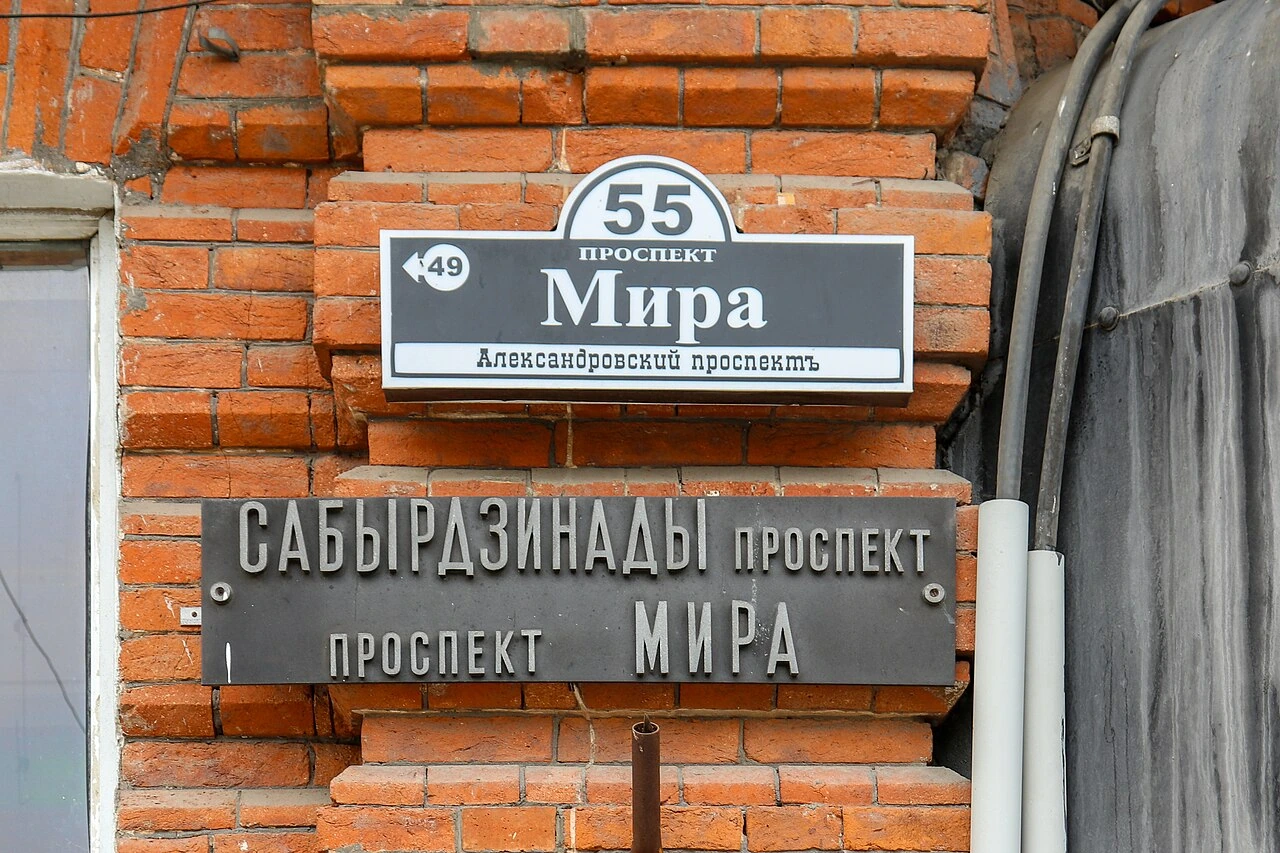
Street sign in Vladikavkaz photographed in 2022. Commons explicitly categorizes this image as both an Ossetian-language street sign and a bilingual Ossetian–Russian sign.
Saved in Babelbook · resized display copy. Select the image to open it independently of its source.
Stolbovsky · Source ↗CC BY-SA 3.0 ↗View the local visual field note
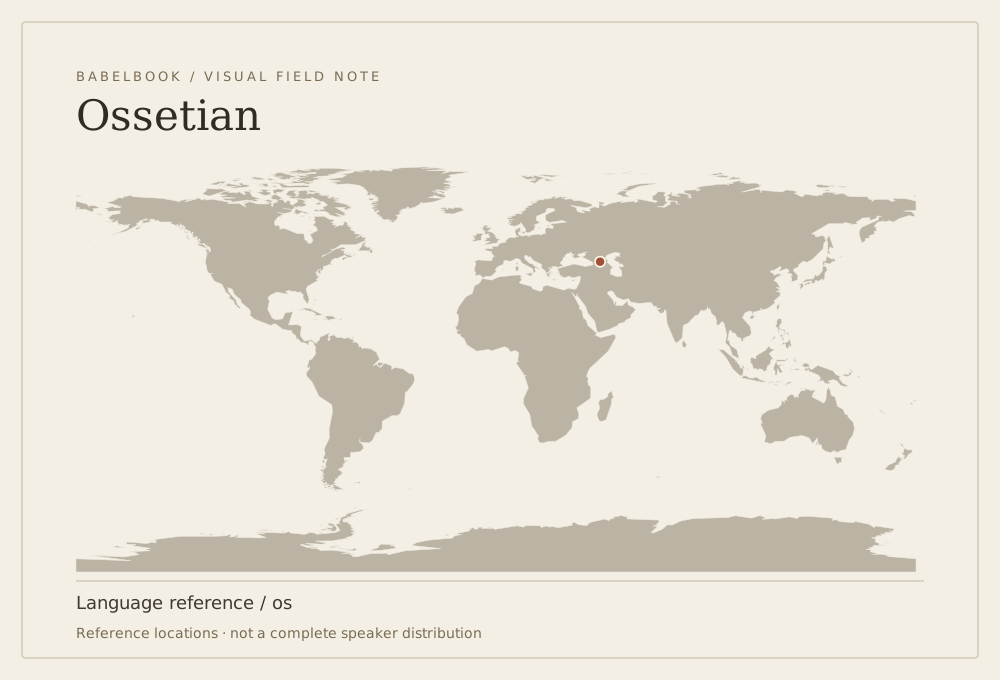
Representative reference points from Glottolog. Historical entries show reference locations, not current speakers. 1 point.
Reference & context ↗Babelbook · original editorial illustration · CC BY 4.0 · Glottolog locations; public-domain Natural Earth land
Source excerpts, selected, shortened and where noted editorially corrected from Ossetian language by Wikipedia contributors. Retrieved 2026-10-05. CC BY-SA 4.0. These excerpts are not an independently verified scholarly history; missing accounts are identified above.
Read further in the source
History and classification
Ossetian is the spoken and literary language of the Ossetians, an Iranian ethnic group living in the central part of the Caucasus and constituting the basic population of North Ossetia–Alania, which is part of the Russian Federation, and of the de facto country of South Ossetia (recognized by the United Nations as de jure part of the Republic of Georgia). The Ossetian language belongs to the Iranian group of the Indo-European family of languages (as hinted by its endonym: ирон, irōn). Within Iranian, it is placed in the Eastern subgroup and further to a Northeastern sub-subgroup, but these are areal rather than genetic groups. The other Eastern Iranian languages, such as Pashto (spoken in Afghanistan and Pakistan) and Yaghnobi (spoken in Tajikistan), show certain commonalities, but also deep-reaching divergences from Ossetian. From the 7th–8th centuries BCE, the languages of the Iranian group were distributed across a vast territory spanning present-day Iran (Persia), Central Asia, Eastern Europe, and the Caucasus. Ossetian is the sole survivor of the branch of Iranian languages known as Scythian. The Scythian group included numerous tribes, known in ancient sources as the Scythians, the Massagetae, the Saka, the Sarmatians, the Alans, and the Roxolani. The more easterly Khwarazm and Sogdians were also closely affiliated linguistically. Ossetian, together with Kurdish, Tat, and Talysh, is one of the main Iranian languages with a sizable community of speakers in the Caucasus. As it is descended from Alanic, spoken by the medieval Alans, who emerged from the earlier Sarmatians, it is believed to be the only surviving descendant of a Sarmatian language. The closest genetically related language may be the Yaghnobi language of Tajikistan, the only other living Northeastern Iranian language. Ossetian has a plural formed by the suffix -ta, a feature it shares with Yaghnobi, Sarmatian and the now-extinct Sogdian; this is taken as evidence of a formerly wide-ranging Iranian-language dialect continuum on the Central Asian steppe. The names of ancient Iranian tribes (as transmitted through Ancient Greek) in fact reflect this pluralization, e.g. Saromatae (Σαρομάται) and Masagetae (Μασαγέται).
Dialects
There are two important dialects: Digoron (distributed in the west of North Ossetia–Alania and Kabardino-Balkaria) which is considered more archaic and Iron (in the rest of the North Ossetia-Alania and in South Ossetia and Karachay-Cherkessia), spoken by one-sixth and five-sixths of the population, respectively. A third dialect of Ossetian, Jassic, was formerly spoken in Hungary.
Writing system
In 1888, an inscription in the Alanian language was found in Abkhazia, which dates back to the 4th century. An Old Ossetic Greek script inscription of the 10th–12th centuries was found in Arkhyz, the oldest known attestation of the Ossetian language. Written Ossetian may be immediately recognized by its use of the Cyrillic letter Æ (Ӕ ӕ), a letter to be found in no other language using Cyrillic script. The father of the modern Ossetian literary language is the national poet Kosta Khetagurov (1859–1906). An Iron literary language was established in the 18th century, written using the Cyrillic script in Russia and the Georgian script in Georgia. The first Ossetian book was published in Cyrillic in 1798, and in 1844 the alphabet was revised by a Russian scientist of Finnish origin, Andreas Sjögren. In the early 1800s, Daniel Chonkadze produced a Russian-Ossetian dictionary and translated Ossetian folklore, paving the way to establishing the Ossetian literature. A new alphabet based on the Latin script was made official in 1923, replacing the 1844 Sjögren alphabet, but in 1938 a revised Cyrillic alphabet was introduced, with digraphs replacing most diacritics of the 1844 alphabet. In 1820, I. Yalguzidze published a Georgian-script alphabetic primer, adding three letters to the Georgian alphabet. The Georgian orthography receded in the 19th century, but was made official in the Georgian SSR's South Ossetian oblast in 1937 with the increased Georgian autonomy allowed by the dissolution of the Transcaucasian SFSR the previous year. As Latin script remained official in the north, this "one nation – two alphabets" issue caused discontent among South Ossetians in 1951, who demanded reunification of the script. In 1954, the Georgian script was replaced with the 1938 Cyrillic alphabet. The table below shows the modern Cyrillic alphabet, used since 1938, with phonetic values for the Iron dialect in the IPA. Di- and tri-graphs in parentheses are not officially letters of the alphabet, but are listed here to represent phonemically distinctive sounds:
In addition, the letters ⟨ё⟩, ⟨ж⟩, ⟨ш⟩, ⟨щ⟩, ⟨ъ⟩, ⟨ь⟩, ⟨э⟩, ⟨ю⟩, and ⟨я⟩ are used to transcribe Russian loans.
In addition, the letters ⟨š⟩ and ⟨ž⟩ were used to transcribe Russian words. The "weak" vowels ⟨ӕ⟩ [ɐ] and ⟨ы⟩ [ɘ] are among the most common vowels in the language.