Ottoman Turkish
Ottoman Turkish (لسان عثمانی, Lisân-ı Osmânî, Turkish pronunciation: [liˈsaːnɯ osˈmaːniː]; Turkish: Osmanlıca; Osmanlı Türkçesi) was the standardized register of the Turkish language in the Ottoman Empire (14th to 20th centuries CE). Written in the Ottoman Turkish alphabet, it borrowed extensively, in all aspects, from Persian and Arabic (through Persian). Ottoman Turkish was largely unintelligible to rural Turks, who continued to use kaba Türkçe ("raw/vulgar Turkish"; compare Vulgar Latin and Demotic Greek), which used far fewer foreign loanwords and is the basis of the modern standard. Terms for the language included lisân-ı Türkî or zebân-ı Türkî ("Turkish language"), or, alternatively during the Ottoman era, lisân-ı Rûm or zebân-ı Rûm ("the language of Rum"). The Tanzimât era (1839–1876) saw the application of the term "Ottoman" when referring to the language (لسان عثمانی lisân-ı Osmânî or عثمانلیجه Osmanlıca). Modern Turkish uses the same terms when referring to the language of that era (Osmanlıca and Osmanlı Türkçesi). More generically, the Turkish language was called تركجه Türkçe or تركی Türkî "Turkish".
Translate in Ottoman Turkish ↗Ottoman Turkish (لسان عثمانی, Lisân-ı Osmânî, Turkish pronunciation: [liˈsaːnɯ osˈmaːniː]; Turkish: Osmanlıca; Osmanlı Türkçesi) was the standardized register of the Turkish language in the Ottoman Empire (14th to 20th centuries CE). Written in the Ottoman Turkish alphabet, it borrowed extensively, in all aspects, from Persian and Arabic (through Persian). Ottoman Turkish was largely unintelligible to rural Turks, who continued to use kaba Türkçe ("raw/vulgar Turkish"; compare Vulgar Latin and Demotic Greek), which used far fewer foreign loanwords and is the basis of the modern standard. Terms for the language included lisân-ı Türkî or zebân-ı Türkî ("Turkish language"), or, alternatively during the Ottoman era, lisân-ı Rûm or zebân-ı Rûm ("the language of Rum"). The Tanzimât era (1839–1876) saw the application of the term "Ottoman" when referring to the language (لسان عثمانی lisân-ı Osmânî or عثمانلیجه Osmanlıca). Modern Turkish uses the same terms when referring to the language of that era (Osmanlıca and Osmanlı Türkçesi). More generically, the Turkish language was called تركجه Türkçe or تركی Türkî "Turkish".
Middle East & North Africa
Present-day use
The captured source does not contain a separate current-use account.
Origins
The captured article does not contain a separate origins section. See the historical account and linked source.
Development
Historically, Ottoman Turkish was transformed in three eras: Eski Osmanlı Türkçesi اسكی عثمانلی توركچهسی (Old Ottoman Turkish): the version of Ottoman Turkish used until the 16th century. It was almost identical with the Turkish used by Seljuk empire and Anatolian beyliks and was often regarded as part of Eski Anadolu Türkçesi اسكی آناطولی توركچهسی (Old Anatolian Turkish). Orta Osmanlı Türkçesi اورتا عثمانلی توركچهسی (Middle Ottoman Turkish) or Klasik Osmanlıca (Classical Ottoman Turkish): the language of poetry and administration from the 16th century until Tanzimat. Yeni Osmanlı Türkçesi یڭی عثمانلی توركچهسی (New Ottoman Turkish): the version shaped from the 1850s to the 20th century under the influence of journalism and Western-oriented literature. Ottoman Turkish was developed and extensively promoted as an imperial and court language during the reign of Mehmed II, with whose encouragement the language became heavily Persianised.
Writing
Most Ottoman Turkish was written in the Ottoman Turkish alphabet (Ottoman Turkish: الفبا, romanized: elifbâ), a variant of the Perso-Arabic script. The Armenian, Greek and Rashi script of Hebrew were sometimes used by Armenians, Greeks and Jews. (See Karamanli Turkish, a dialect of Ottoman written in the Greek script; Armeno-Turkish alphabet)
Beyond the typeface.
Signs, manuscripts, published pages and contextual photographs, with their place, period, source and reuse terms. Captions identify historical spellings, regional examples, community references and character imagery.
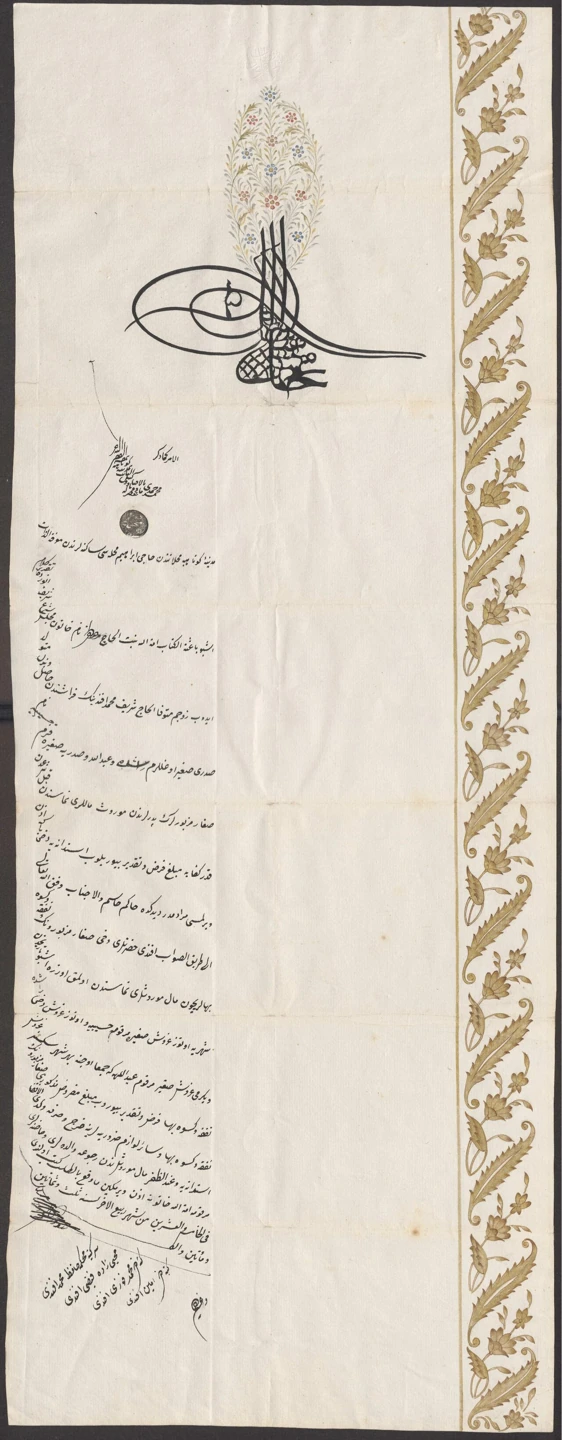
Court petition from Kütahya dated 6 September 1866, Leiden University Libraries Or. 26.771. Commons explicitly identifies Ottoman Turkish; the petition concerns payments for the upkeep of minor children.
Saved in Babelbook · resized display copy. Select the image to open it independently of its source.
Anonymous scribe; digitization Leiden University Libraries · Source ↗CC BY 4.0 ↗View the local visual field note
Representative reference points from Glottolog. Historical entries show reference locations, not current speakers. 1 point.
Reference & context ↗Babelbook · original editorial illustration · CC BY 4.0 · Glottolog locations; public-domain Natural Earth land
Source excerpts, selected, shortened and where noted editorially corrected from Ottoman Turkish by Wikipedia contributors. Retrieved 2026-10-05. CC BY-SA 4.0. These excerpts are not an independently verified scholarly history; missing accounts are identified above.
Read further in the source
History
Historically, Ottoman Turkish was transformed in three eras:
Eski Osmanlı Türkçesi اسكی عثمانلی توركچهسی (Old Ottoman Turkish): the version of Ottoman Turkish used until the 16th century. It was almost identical with the Turkish used by Seljuk empire and Anatolian beyliks and was often regarded as part of Eski Anadolu Türkçesi اسكی آناطولی توركچهسی (Old Anatolian Turkish). Orta Osmanlı Türkçesi اورتا عثمانلی توركچهسی (Middle Ottoman Turkish) or Klasik Osmanlıca (Classical Ottoman Turkish): the language of poetry and administration from the 16th century until Tanzimat. Yeni Osmanlı Türkçesi یڭی عثمانلی توركچهسی (New Ottoman Turkish): the version shaped from the 1850s to the 20th century under the influence of journalism and Western-oriented literature. Ottoman Turkish was developed and extensively promoted as an imperial and court language during the reign of Mehmed II, with whose encouragement the language became heavily Persianised.
Writing system
Most Ottoman Turkish was written in the Ottoman Turkish alphabet (Ottoman Turkish: الفبا, romanized: elifbâ), a variant of the Perso-Arabic script. The Armenian, Greek and Rashi script of Hebrew were sometimes used by Armenians, Greeks and Jews. (See Karamanli Turkish, a dialect of Ottoman written in the Greek script; Armeno-Turkish alphabet)