Punjabi
Punjabi (sometimes spelled Panjabi) is an Indo-Aryan language belonging to the Indo-Iranian branch of the Indo-European language family. It is primarily spoken by the Punjabi people native to the Punjab region of Pakistan and India. With over 156 million speakers across all its varieties, it is the seventh most spoken native language and the twelfth most spoken language by the total number of speakers in the world. Punjabi is the most widely-spoken native language in Pakistan, with 123.2 million speakers across all its language varieties, according to the 2023 census; and the 11th most widely-spoken in India, with 31.1 million native speakers, according to the 2011 census; making it the third most spoken native language in South Asia (after Hindi and Bengali). It is also spoken among a significant overseas diaspora, particularly in Canada, the United Kingdom, the United States, Australia, the Gulf states, and Southeast Asia. Being classified under the Northwestern branch of the Indo-Aryan languages, Punjabi is most closely related to Sindhi. It is the only Indo-Aryan language thought to have descended from more than one Prakrit, which gradually developed into Old Punjabi. The language's earliest writings can be traced to the Nath jogis of the Pothohar Plateau from the 9th century. It further developed during the Islamic period in South Asia, undergoing lexical expansion from Arabic and Persian influence; and raising poets like Baba Farid.
Translate in Punjabi ↗Punjabi is the most widely spoken language in Pakistan, the eleventh-most widely spoken in India, and also present in the Punjabi diaspora in various countries. According to Bhardwaj (2016), Punjabi is spoken by around 102 million people, if including both Eastern and Western dialectal varieties. Despite Punjabi's rich literary history, it was not until 1947 that it would be recognised as an official language. Previous governments in the area of the Punjab had favoured Persian, Hindustani, or even earlier standardised versions of local registers as the language of the court or government. After the annexation of the Sikh Empire by the British East India Company following the Second Anglo-Sikh War in 1849, the British policy of establishing a uniform language for administration was expanded into the Punjab. The British Empire employed Urdu in its administration of North-Central and Northwestern India, while in the North-East of India, Bengali language was used as the language of administration. Despite its lack of official sanction, the Punjabi language continued to flourish as an instrument of cultural production, with rich literary traditions continuing until modern times. The Sikh religion, with its Gurmukhi script, played a special role in standardising and providing education in the language via gurdwaras, while writers of all religions continued to produce poetry, prose, and literature in the language. Ethnologue classifies the language's status as EGIDS 4 (Institutional). In 1916 and 1919 respectively, the LSI estimated (including dialects) that eastern Punjabi was spoken by 12,564,139 people while western Punjabi was spoken by 7,779,138 people. Presently, Punjabi is spoken by over 100 million people, making it the 10th most spoken language. According to Qandeel Hussain (2020), Western Punjabi is spoken by 92,721,700 people while Eastern Punjabi is spoken by 29,258,970 people.
South Asia
Present-day use
Modern Punjabi has two main varieties, Western Punjabi and Eastern Punjabi, which have many dialects and forms, altogether spoken by over 150 million people. The Majhi dialect, which is transitional between the two main varieties, has been adopted as standard Punjabi in India and Pakistan for education and mass media. The Majhi dialect originated in the Majha region of the Punjab. Note: In more formal contexts, hypercorrect Sanskritized versions of these words (ਪ੍ਰਧਾਨ pradhān for ਪਰਧਾਨ pardhān and ਪਰਿਵਾਰ parivār for ਪਰਵਾਰ parvār) may be used. After independence of Pakistan and India, Najm Hossein Syed, Fakhar Zaman and Afzal Ahsan Randhawa, Shafqat Tanvir Mirza, Ahmad Salim, and Najm Hosain Syed, Munir Niazi, Ali Arshad Mir, Pir Hadi Abdul Mannan enriched Punjabi literature in Pakistan, whereas Jaswant Singh Kanwal (1919–2020), Amrita Pritam (1919–2005), Jaswant Singh Rahi (1930–1996), Shiv Kumar Batalvi (1936–1973), Surjit Patar (1944–) and Pash (1950–1988) are some of the more prominent poets and writers from India. Despite Punjabi's rich literary history, it was not until 1947 that it would be recognised as an official language. Previous governments in the area of the Punjab had favoured Persian, Hindustani, or even earlier standardised versions of local registers as the language of the court or government. After the annexation of the Sikh Empire by the British East India Company following the Second Anglo-Sikh War in 1849, the British policy of establishing a uniform language for administration was expanded into the Punjab. The British Empire employed Urdu in its administration of North-Central and Northwestern India, while in the North-East of India, Bengali language was used as the language of administration. Despite its lack of official sanction, the Punjabi language continued to flourish as an instrument of cultural production, with rich literary traditions continuing until modern times.
Origins
The word Punjabi (sometimes spelled Panjabi) has been derived from the word Panj-āb, Persian for 'Five Waters', referring to the five major eastern tributaries of the Indus River. The name of the region was introduced by the Turko-Persian conquerors of South Asia and was a translation of the Sanskrit name, Panchanada, which means 'Land of the Five Rivers'. Panj is cognate with other Indo-European languages' words for five, like Sanskrit pañca (पञ्च), Greek pénte (πέντε) and Lithuanian penki, but also English five; āb is cognate with Sanskrit áp (अप्) and with the Av- of Avon. The historical Punjab region, now divided between India and Pakistan, is defined physiographically by the Indus River and these five tributaries. One of the five, the Beas River, is a tributary of another, the Sutlej. Punjabi developed from Prakrit languages and later Apabhraṃśa (Sanskrit: अपभ्रंश, 'deviated' or 'non-grammatical speech') From 600 BC, Sanskrit developed as the standard literary and administrative language and Prakrit languages evolved into many regional languages in different parts of India. All these languages are called Prakrit languages (Sanskrit: प्राकृत, prākṛta) collectively. Paishachi Prakrit was one of these Prakrit languages, which was spoken in north and north-western India and Punjabi developed from this Prakrit. Later in northern India Paishachi Prakrit gave rise to Paishachi Apabhraṃśa, a descendant of Prakrit. Punjabi emerged as an Apabhramsha, a form of Prakrit, in the 7th century AD and became stable by the 10th century. Padam (1954) believed that eastern Punjabi emerged from Shauraseni while Lahnda emerged from Paishachi.
Development
The captured article does not contain a distinct historical account. No chronology has been invented.
Writing
The Punjabi language is written in multiple scripts (a phenomenon known as synchronic digraphia). Each of the major scripts currently in use is typically associated with a particular religious group, although the association is not absolute or exclusive. In India, Punjabi Sikhs use Gurmukhi, a script of the Brahmic family, which has official status in the state of Punjab. In Pakistan, Punjabi Muslims use Shahmukhi, a variant of the Perso-Arabic script and closely related to the Urdu alphabet. Sometimes Punjabi is recorded in the Devanagari script in India, albeit rarely. The Punjabi Hindus in India had a preference for Devanagari, another Brahmic script also used for Hindi, and in the first decades since independence raised objections to the uniform adoption of Gurmukhi in the state of Punjab, but most have now switched to Gurmukhi and so the use of Devanagari is rare. Often in literature, Pakistani Punjabi (written in Shahmukhi) is referred as Western-Punjabi (or West-Punjabi) and Indian Punjabi (written in Gurmukhi) is referred as Eastern-Punjabi (or East-Punjabi), although the underlying language is the same with a very slight shift in vocabulary towards Islamic and Sikh words respectively. The written standard for Shahmukhi also slightly differs from that of Gurmukhi, as it is used for western dialects, whereas Gurumukhi is used to write eastern dialects. Historically, various local Brahmic scripts including Laṇḍā and its descendants were also in use. The Punjabi Braille is used by the visually impaired. There is an altered version of IAST often used for Punjabi in which the diphthongs ai and au are written as e and o, and the long vowels e and o are written as ē and ō.
Beyond the typeface.
Signs, manuscripts, published pages and contextual photographs, with their place, period, source and reuse terms. Captions identify historical spellings, regional examples, community references and character imagery.
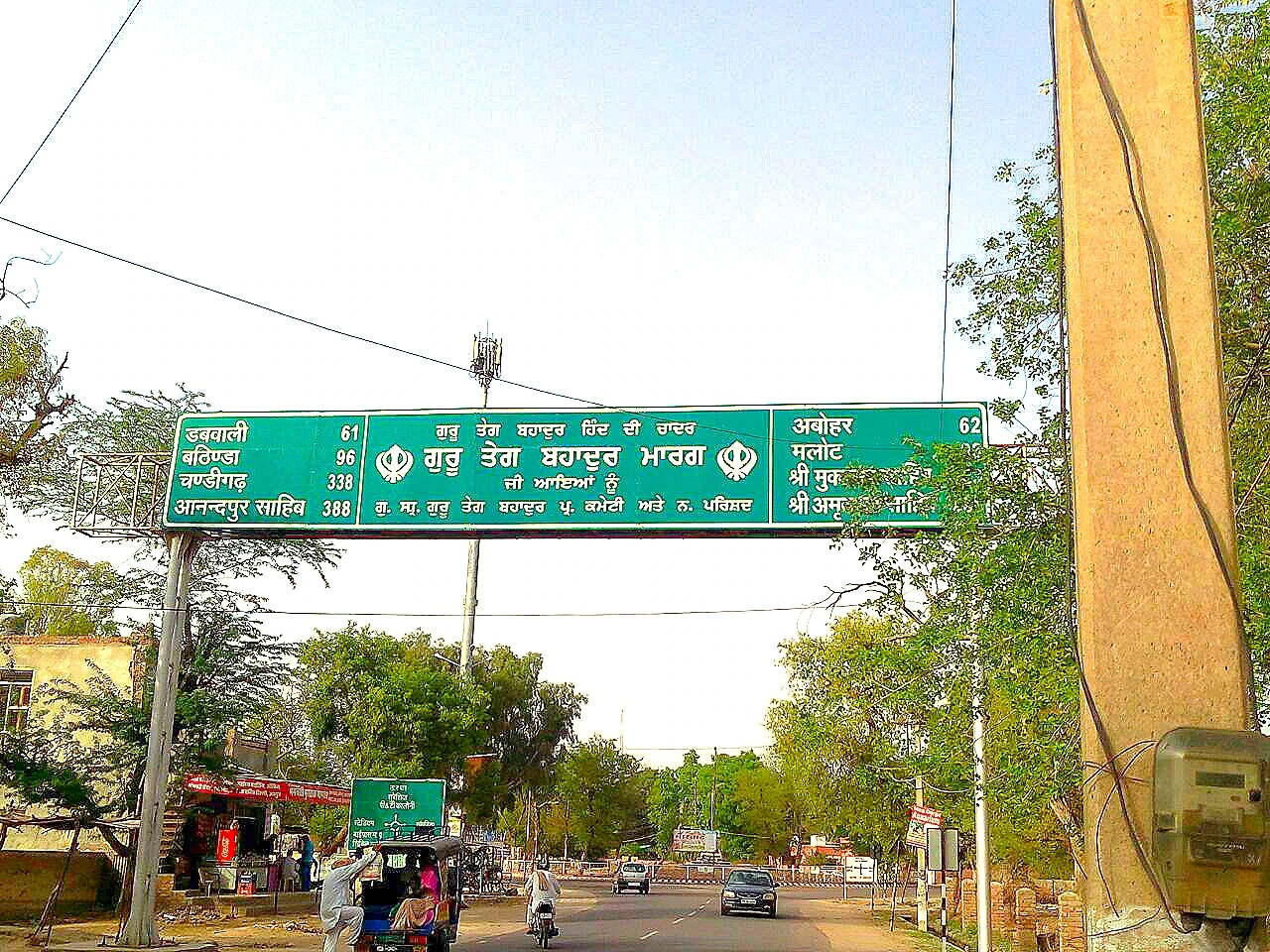
Punjabi sign written in Gurmukhi at Hanumangarh, Rajasthan. Language identification follows Commons metadata; not independently transcribed.
Saved in Babelbook · resized display copy. Select the image to open it independently of its source.
Shemaroo (Sivender) · Source ↗CC BY 4.0 ↗View the local visual field note
Representative reference points from Glottolog. Historical entries show reference locations, not current speakers. 1 point.
Reference & context ↗Babelbook · original editorial illustration · CC BY 4.0 · Glottolog locations; public-domain Natural Earth land
Source excerpts, selected, shortened and where noted editorially corrected from Punjabi language by Wikipedia contributors. Retrieved 2026-10-05. CC BY-SA 4.0. These excerpts are not an independently verified scholarly history; missing accounts are identified above.
Read further in the source
Origin
Punjabi developed from Prakrit languages and later Apabhraṃśa (Sanskrit: अपभ्रंश, 'deviated' or 'non-grammatical speech') From 600 BC, Sanskrit developed as the standard literary and administrative language and Prakrit languages evolved into many regional languages in different parts of India. All these languages are called Prakrit languages (Sanskrit: प्राकृत, prākṛta) collectively. Paishachi Prakrit was one of these Prakrit languages, which was spoken in north and north-western India and Punjabi developed from this Prakrit. Later in northern India Paishachi Prakrit gave rise to Paishachi Apabhraṃśa, a descendant of Prakrit. Punjabi emerged as an Apabhramsha, a form of Prakrit, in the 7th century AD and became stable by the 10th century. Padam (1954) believed that eastern Punjabi emerged from Shauraseni while Lahnda emerged from Paishachi. According to Mangat Bhardwaj, it is possible that now Western and Eastern Punjabi speaking zones may have originally spoken different Apabhraṁśas, with the Lahnda zone being primarily Paiśāchī Apabhraṁśa while the Eastern Punjabi area consisted of a transitional zone of Śaurasenī merging into Paiśāchī, with Śaurasenī being spoken in the neighbouring Western Hindi zone. The earliest writings in Punjabi belong to the Nath Yogi-era from 9th to 14th century. The language of these compositions is morphologically closer to Shauraseni Apbhramsa, though vocabulary and rhythm is surcharged with extreme colloquialism and folklore. Writing in 1317–1318, Amir Khusrau referred to the language spoken by locals around the area of Lahore as Lahauri. There was a long period of literary interaction between Western (Lahnda) and Eastern Punjabi in the subsequent period, showcased in the works of Muslim Sufis and Sikhs.
Geographic distribution
Punjabi is the most widely spoken language in Pakistan, the eleventh-most widely spoken in India, and also present in the Punjabi diaspora in various countries.
According to Bhardwaj (2016), Punjabi is spoken by around 102 million people, if including both Eastern and Western dialectal varieties.
Standard Punjabi
Standard Punjabi (sometimes referred to as Majhi) is the standard form of Punjabi used commonly in education and news broadcasting, and is based on the Majhi dialect. Such as the variety used on Google Translate, Standard Punjabi is also often used in official online services that employ Punjabi. It is widely used in the TV and entertainment industry of Pakistan, which is mainly produced in Lahore. The Standard Punjabi used in India and Pakistan has slight differences. In India, it excludes many of the dialect-specific features of Majhi. In Pakistan, the standard is closer to the Majhi spoken in the urban parts of Lahore.
Writing systems
The Punjabi language is written in multiple scripts (a phenomenon known as synchronic digraphia). Each of the major scripts currently in use is typically associated with a particular religious group, although the association is not absolute or exclusive. In India, Punjabi Sikhs use Gurmukhi, a script of the Brahmic family, which has official status in the state of Punjab. In Pakistan, Punjabi Muslims use Shahmukhi, a variant of the Perso-Arabic script and closely related to the Urdu alphabet. Sometimes Punjabi is recorded in the Devanagari script in India, albeit rarely. The Punjabi Hindus in India had a preference for Devanagari, another Brahmic script also used for Hindi, and in the first decades since independence raised objections to the uniform adoption of Gurmukhi in the state of Punjab, but most have now switched to Gurmukhi and so the use of Devanagari is rare. Often in literature, Pakistani Punjabi (written in Shahmukhi) is referred as Western-Punjabi (or West-Punjabi) and Indian Punjabi (written in Gurmukhi) is referred as Eastern-Punjabi (or East-Punjabi), although the underlying language is the same with a very slight shift in vocabulary towards Islamic and Sikh words respectively. The written standard for Shahmukhi also slightly differs from that of Gurmukhi, as it is used for western dialects, whereas Gurumukhi is used to write eastern dialects. Historically, various local Brahmic scripts including Laṇḍā and its descendants were also in use. The Punjabi Braille is used by the visually impaired. There is an altered version of IAST often used for Punjabi in which the diphthongs ai and au are written as e and o, and the long vowels e and o are written as ē and ō.
Status
Despite Punjabi's rich literary history, it was not until 1947 that it would be recognised as an official language. Previous governments in the area of the Punjab had favoured Persian, Hindustani, or even earlier standardised versions of local registers as the language of the court or government. After the annexation of the Sikh Empire by the British East India Company following the Second Anglo-Sikh War in 1849, the British policy of establishing a uniform language for administration was expanded into the Punjab. The British Empire employed Urdu in its administration of North-Central and Northwestern India, while in the North-East of India, Bengali language was used as the language of administration. Despite its lack of official sanction, the Punjabi language continued to flourish as an instrument of cultural production, with rich literary traditions continuing until modern times. The Sikh religion, with its Gurmukhi script, played a special role in standardising and providing education in the language via gurdwaras, while writers of all religions continued to produce poetry, prose, and literature in the language. Ethnologue classifies the language's status as EGIDS 4 (Institutional).