Middle Persian
Middle Persian, also known by its endonym Pārsīg or, in an earlier form, Pārsīk (Inscriptional Pahlavi script: 𐭯𐭠𐭫𐭮𐭩𐭪, Manichaean script: 𐫛𐫀𐫡𐫘𐫏𐫐, Avestan script: 𐬞𐬀𐬭𐬯𐬍𐬐), is a Western Middle Iranian language which became the literary language of the Sasanian Empire. For some time after the Sasanian collapse, Middle Persian continued to function as a prestige language. It descended from Old Persian, the language of the Achaemenid Empire and is the linguistic ancestor of New Persian, the official language of Iran (also known as Persia), Afghanistan (Dari) and Tajikistan (Tajik).
Translate in Middle Persian ↗Middle Persian, also known by its endonym Pārsīg or, in an earlier form, Pārsīk (Inscriptional Pahlavi script: 𐭯𐭠𐭫𐭮𐭩𐭪, Manichaean script: 𐫛𐫀𐫡𐫘𐫏𐫐, Avestan script: 𐬞𐬀𐬭𐬯𐬍𐬐), is a Western Middle Iranian language which became the literary language of the Sasanian Empire. For some time after the Sasanian collapse, Middle Persian continued to function as a prestige language. It descended from Old Persian, the language of the Achaemenid Empire and is the linguistic ancestor of New Persian, the official language of Iran (also known as Persia), Afghanistan (Dari) and Tajikistan (Tajik).
Middle East & North Africa
Present-day use
There are some phonological differences between Middle Persian and New Persian. Initial consonant clusters were very common in Middle Persian (e.g. سپاس spās "thanks"). However, New Persian does not allow initial consonant clusters, whereas final consonant clusters are common (e.g. اسب asb "horse"). 1 Since some vowels of Middle Persian did not continue in Modern Persian, a number of homophones were created in New Persian. For example, šir and šer, meaning "milk" and "lion", respectively, are now both pronounced šir. In this case, the older pronunciation is maintained in Dari and Tajiki Persian.
Origins
The captured article does not contain a separate origins section. See the historical account and linked source.
Development
The captured article does not contain a distinct historical account. No chronology has been invented.
Writing
Middle Persian has been written in a number of different scripts. The corpora in different scripts also exhibit other linguistic differences that are partly due to their different ages, dialects and scribal traditions. The Pahlavi scripts are abjads derived from the imperial variety of the Aramaic alphabet used in the chancelleries of the Achaemenid Empire. As is typical of abjads, they express primarily the consonants in a word form. What sets them apart from other abjads, however, is the use of Heterograms, and more specifically Aramaeograms, i.e. words written in Aramaic (sometimes, in later periods, with distortions) but pronounced in Middle Persian: e.g. LY (Aramaic 'to me') for man 'me, I'. There were about a thousand of these in the Book Pahlavi variety. In addition, their spelling remained very conservative, expressing the pronunciation of the Arsacid period. The two most important subvarieties are: Inscriptional Pahlavi, used in the inscriptions of Sassanid kings and officials from the 3rd–4th centuries CE. The 22 letters are written separately and still relatively well distinguished compared to later versions: the only formal coincidences of original Aramaic signs are the pair m and q and the triplet w, ʿ and r. Book Pahlavi, used primarily in Zoroastrian books from the 5th century CE on. Most texts are thought to reflect the stage of the language from the 6th to the 10th centuries CE. (6th–7th centuries for the translations of the Avesta and perhaps some didactic and entertainment literature, 9–10th centuries for the dogmatic and legal texts that form most of the corpus) This is the script that the overwhelming majority of Middle Persian texts is recorded in. It is a cursive script characterised by many ligatures and by the formal coincidence of originally different Aramaic letters, reducing the number to just 14 distinct signs.
Beyond the typeface.
Signs, manuscripts, published pages and contextual photographs, with their place, period, source and reuse terms. Captions identify historical spellings, regional examples, community references and character imagery.
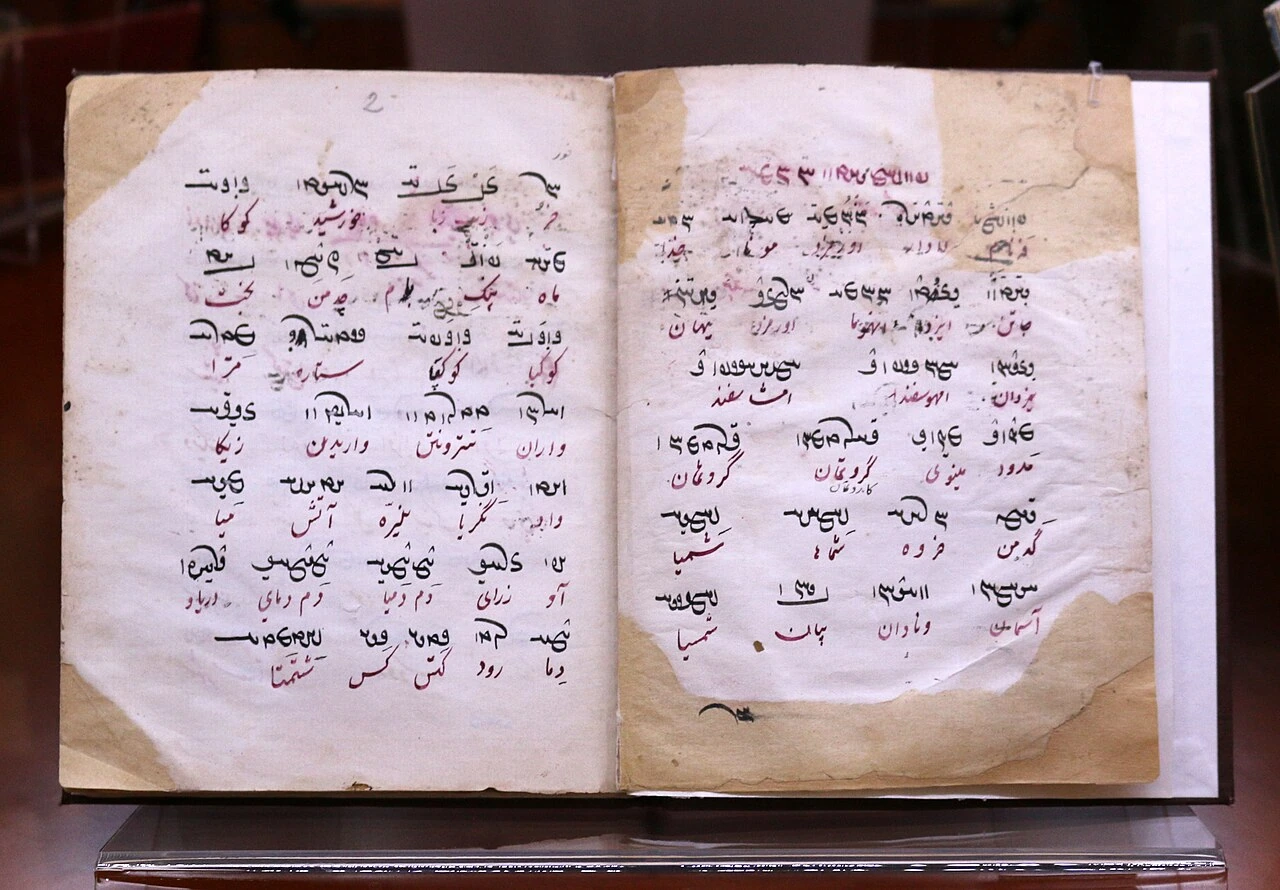
Middle Persian manuscript in the Matenadaran Museum, Yerevan, photographed in 2023. Commons explicitly identifies the language and Pahlavi script. The manuscript itself is not dated here.
Saved in Babelbook · resized display copy. Select the image to open it independently of its source.
PersianDutchNetwork · Source ↗CC BY-SA 4.0 ↗View the local visual field note
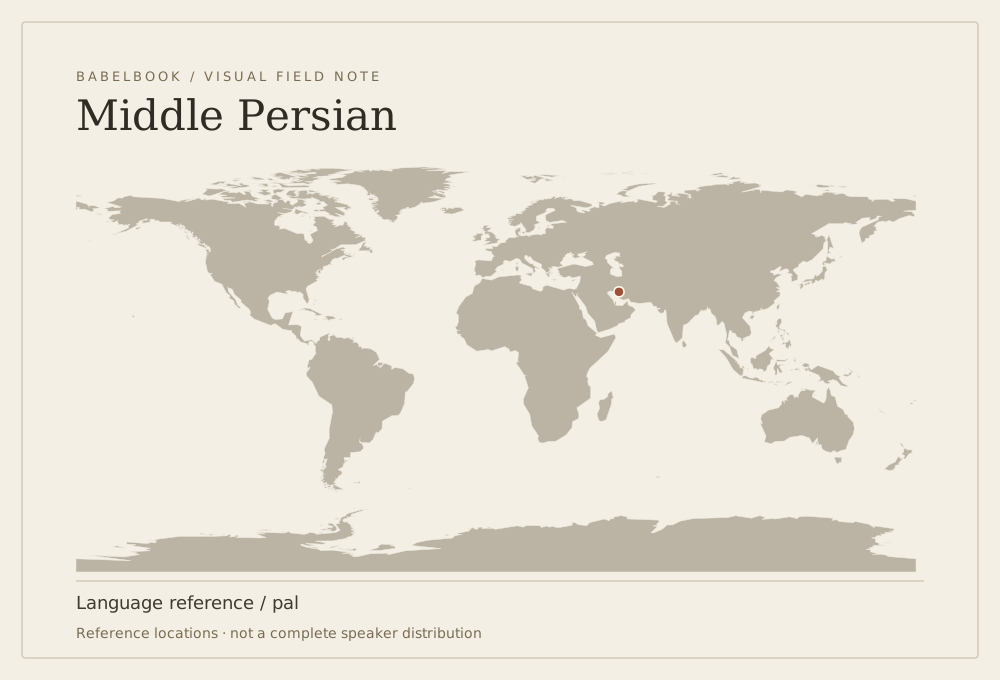
Representative reference points from Glottolog. Historical entries show reference locations, not current speakers. 1 point.
Reference & context ↗Babelbook · original editorial illustration · CC BY 4.0 · Glottolog locations; public-domain Natural Earth land
Source excerpts, selected, shortened and where noted editorially corrected from Middle Persian by Wikipedia contributors. Retrieved 2026-10-05. CC BY-SA 4.0. These excerpts are not an independently verified scholarly history; missing accounts are identified above.