Old Persian
Old Persian is one of two directly attested Old Iranian languages (the other being Avestan) and is the ancestor of Middle Persian (the language of the Sasanian Empire). Like other Old Iranian languages, it was known to its native speakers as ariya (Iranian). Old Persian is close to Avestan and both languages are highly inflected. Old Persian appears primarily in the inscriptions, clay tablets and seals of the Achaemenid era (c. 600 BCE to 300 BCE). Examples of Old Persian have been found in what is now Iran, Armenia, Bahrain, Iraq, Turkey and Egypt, with the most important attestation by far being the contents of the Behistun Inscription (dated to 522 BCE). In 2007, research into the vast Persepolis Administrative Archives at the Oriental Institute at the University of Chicago unearthed Old Persian tablets, which suggest Old Persian was a written language in use for practical recording and not only for royal display. During the peak of the Persian Empire, people in Persia put down their ordinary daily activities in old Persian writing and kept up with the documentation of routine affairs.
Translate in Old Persian ↗Old Persian is one of two directly attested Old Iranian languages (the other being Avestan) and is the ancestor of Middle Persian (the language of the Sasanian Empire). Like other Old Iranian languages, it was known to its native speakers as ariya (Iranian). Old Persian is close to Avestan and both languages are highly inflected. Old Persian appears primarily in the inscriptions, clay tablets and seals of the Achaemenid era (c. 600 BCE to 300 BCE). Examples of Old Persian have been found in what is now Iran, Armenia, Bahrain, Iraq, Turkey and Egypt, with the most important attestation by far being the contents of the Behistun Inscription (dated to 522 BCE). In 2007, research into the vast Persepolis Administrative Archives at the Oriental Institute at the University of Chicago unearthed Old Persian tablets, which suggest Old Persian was a written language in use for practical recording and not only for royal display. During the peak of the Persian Empire, people in Persia put down their ordinary daily activities in old Persian writing and kept up with the documentation of routine affairs.
Middle East & North Africa
Present-day use
The captured source does not contain a separate current-use account.
Origins
As a written language, Old Persian is attested in royal Achaemenid inscriptions. It is an Iranian language and as such a member of the Indo-Iranian branch of the Indo-European language family. The oldest known text written in Old Persian is from the Behistun Inscriptions. Old Persian is one of the oldest Indo-European languages which are attested in original texts. The oldest date of use of Old Persian as a spoken language is not precisely known. According to certain historical assumptions about the early history and origin of ancient Persians in Southwestern Iran (where the Achaemenids hailed from), Old Persian was originally spoken by a tribe called Parsuwash, who arrived in the Iranian Plateau early in the 1st millennium BCE and finally migrated down into the area of present-day Fārs province. Their language, Old Persian, became the official language of the Achaemenid kings. Assyrian records, which in fact appear to provide the earliest evidence for ancient Iranian (Persian and Median) presence on the Iranian Plateau, give a good chronology but only an approximate geographical indication of what seem to be ancient Persians. In these records of the 9th century BCE, Parsuwash (along with Matai, presumably Medians) are first mentioned in the area of Lake Urmia in the records of Shalmaneser III. The exact identity of the Parsuwash is not known for certain, but from a linguistic viewpoint the word matches Old Persian pārsa itself coming directly from the older word *pārćwa. Also, as Old Persian contains many words from another extinct Iranian language, Median, according to P. O. Skjærvø it is probable that Old Persian had already been spoken before the formation of the Achaemenid Empire and was spoken during most of the first half of the first millennium BCE.
Development
By the 4th century BCE, the late Achaemenid period, the inscriptions of Artaxerxes II and Artaxerxes III differ enough from the language of Darius' inscriptions to be called a "pre-Middle Persian," or "post-Old Persian". Old Persian subsequently evolved into Middle Persian, which is in turn the ancestor of New Persian. Professor Gilbert Lazard, a famous Iranologist and the author of the book Persian Grammar, states: The language known as New Persian, which usually is called at this period (early Islamic times) by the name of Parsi-Dari, can be classified linguistically as a continuation of Middle Persian, the official religious and literary language of Sassanian Iran, itself a continuation of Old Persian, the language of the Achaemenids. Unlike the other languages and dialects, ancient and modern, of the Iranian group such as Avestan, Parthian, Soghdian, Pashto, etc., Old, Middle and New Persian represent one and the same language at three states of its history. It had its origin in Fars and is differentiated by dialectical features, still easily recognizable from the dialect prevailing in north-western and eastern Iran. Middle Persian, also sometimes called Pahlavi, is a direct continuation of Old Persian and was used as the written official language of the country. Comparison of the evolution at each stage of the language shows great simplification in grammar and syntax. However, New Persian is a direct descendant of Middle and Old Persian.
Writing
Old Persian texts were written from left to right in the syllabic Old Persian cuneiform script and had 36 phonetic characters and 8 logograms. The usage of logograms is not obligatory. The script was surprisingly not a result of evolution of the script used in the nearby civilisation of Mesopotamia. Despite the fact that Old Persian was written in cuneiform script, the script was not a direct continuation of Mesopotamian tradition and in fact, according to Schmitt, was a "deliberate creation of the sixth century BCE". The origin of the Old Persian cuneiform script and the identification of the date and process of introduction are a matter of debate among Iranian scholars with no general agreement having been reached. The factors making the consensus difficult are, among others, the difficult passage DB (IV lines 88–92) from Darius the Great who speaks of a new "form of writing" being made by himself which is said to be "in Aryan": King Darius says: By the grace of Ahuramazda this is the inscription which I have made. Besides, it was in Aryan ("ariyâ") script, and it was composed on clay tablets and on parchment. Besides, a sculptured figure of myself I made. Also, the analysis of certain Old Persian inscriptions are "supposed or claimed" to predate Darius the Great. Although it is true that the oldest attested Old Persian inscriptions are found on the Behistun monument from Darius, the creation of this "new type of writing" seems, according to Schmitt, "to have begun already under Cyrus the Great". The script shows a few changes in the shape of characters during the period it was used. This can be seen as a standardization of the heights of wedges, which in the beginning (i.e. in DB) took only half the height of a line.
Beyond the typeface.
Signs, manuscripts, published pages and contextual photographs, with their place, period, source and reuse terms. Captions identify historical spellings, regional examples, community references and character imagery.
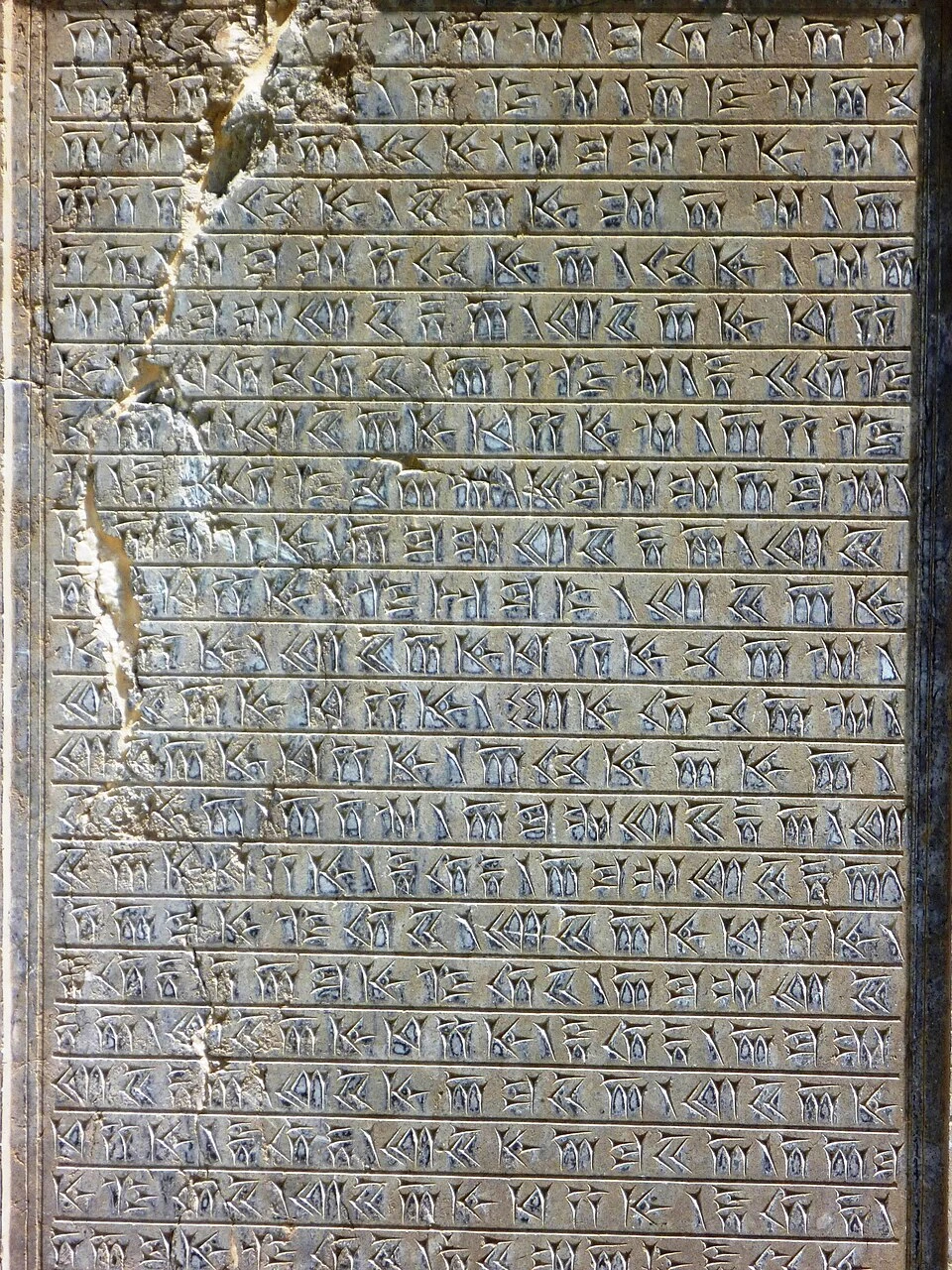
An inscription at Persepolis, Iran, explicitly identified as Old Persian by the Commons description. Photograph from 2014. Not independently transcribed.
Saved in Babelbook · resized display copy. Select the image to open it independently of its source.
Radosław Botev; Fundacja Nomos · Source ↗CC BY 3.0 Poland ↗View the local visual field note
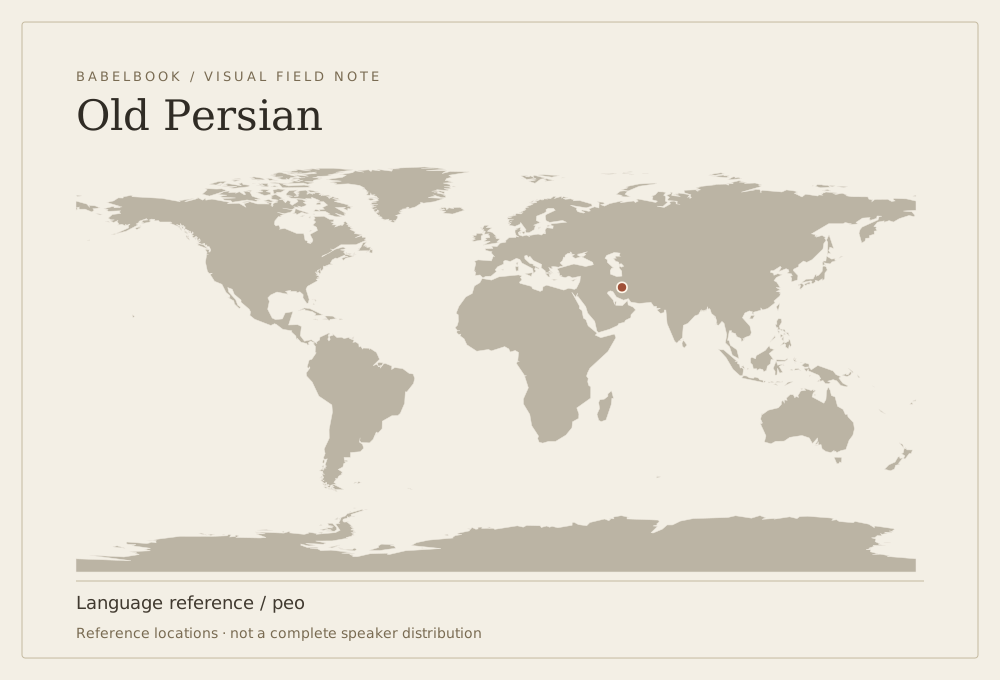
Representative reference points from Glottolog. Historical entries show reference locations, not current speakers. 1 point.
Reference & context ↗Babelbook · original editorial illustration · CC BY 4.0 · Glottolog locations; public-domain Natural Earth land
Source excerpts, selected, shortened and where noted editorially corrected from Old Persian by Wikipedia contributors. Retrieved 2026-10-05. CC BY-SA 4.0. These excerpts are not an independently verified scholarly history; missing accounts are identified above.
Read further in the source
Origin and overview
As a written language, Old Persian is attested in royal Achaemenid inscriptions. It is an Iranian language and as such a member of the Indo-Iranian branch of the Indo-European language family. The oldest known text written in Old Persian is from the Behistun Inscriptions. Old Persian is one of the oldest Indo-European languages which are attested in original texts. The oldest date of use of Old Persian as a spoken language is not precisely known. According to certain historical assumptions about the early history and origin of ancient Persians in Southwestern Iran (where the Achaemenids hailed from), Old Persian was originally spoken by a tribe called Parsuwash, who arrived in the Iranian Plateau early in the 1st millennium BCE and finally migrated down into the area of present-day Fārs province. Their language, Old Persian, became the official language of the Achaemenid kings. Assyrian records, which in fact appear to provide the earliest evidence for ancient Iranian (Persian and Median) presence on the Iranian Plateau, give a good chronology but only an approximate geographical indication of what seem to be ancient Persians. In these records of the 9th century BCE, Parsuwash (along with Matai, presumably Medians) are first mentioned in the area of Lake Urmia in the records of Shalmaneser III. The exact identity of the Parsuwash is not known for certain, but from a linguistic viewpoint the word matches Old Persian pārsa itself coming directly from the older word *pārćwa. Also, as Old Persian contains many words from another extinct Iranian language, Median, according to P. O. Skjærvø it is probable that Old Persian had already been spoken before the formation of the Achaemenid Empire and was spoken during most of the first half of the first millennium BCE.
Language evolution
By the 4th century BCE, the late Achaemenid period, the inscriptions of Artaxerxes II and Artaxerxes III differ enough from the language of Darius' inscriptions to be called a "pre-Middle Persian," or "post-Old Persian". Old Persian subsequently evolved into Middle Persian, which is in turn the ancestor of New Persian. Professor Gilbert Lazard, a famous Iranologist and the author of the book Persian Grammar, states:
The language known as New Persian, which usually is called at this period (early Islamic times) by the name of Parsi-Dari, can be classified linguistically as a continuation of Middle Persian, the official religious and literary language of Sassanian Iran, itself a continuation of Old Persian, the language of the Achaemenids. Unlike the other languages and dialects, ancient and modern, of the Iranian group such as Avestan, Parthian, Soghdian, Pashto, etc., Old, Middle and New Persian represent one and the same language at three states of its history. It had its origin in Fars and is differentiated by dialectical features, still easily recognizable from the dialect prevailing in north-western and eastern Iran. Middle Persian, also sometimes called Pahlavi, is a direct continuation of Old Persian and was used as the written official language of the country. Comparison of the evolution at each stage of the language shows great simplification in grammar and syntax. However, New Persian is a direct descendant of Middle and Old Persian.