Phoenician
Phoenician ( fə-NEE-shən; Phoenician: śpt knʿn 𐤔𐤐𐤕𐤟𐤊𐤍𐤏𐤍 lit. 'language of Canaan') is an extinct Canaanite language of the Semitic language family originally spoken by the Phoenicians. Extensive Tyro-Sidonian trade and commercial dominance led to Phoenician becoming a lingua franca of the maritime Mediterranean during the Iron Age. The Phoenician alphabet spread to Greece during this period, where it became the source of all modern European scripts. Phoenician belongs to the Canaanite languages and as such is quite similar to Biblical Hebrew and other languages of the group, at least in its early stages, and is therefore mutually intelligible with them. The area in which Phoenician was spoken, which the Phoenicians called Pūt, includes the northern Levant, specifically the areas now including Lebanon, the Western Galilee, parts of Cyprus, some parts of Syria, some adjacent areas of Anatolia, and, at least as a prestige language, the rest of Anatolia. Phoenician was also spoken in the Phoenician colonies along the coasts of the southwestern Mediterranean Sea, including those of modern Tunisia, Morocco, Libya and Algeria as well as Malta, the west of Sicily, southwest Sardinia, the Balearic Islands and southernmost Spain. It developed into the Punic language in North Africa. In modern times, the language was first decoded by Jean-Jacques Barthélemy in 1758, who noted that the name "Phoenician" was first given to the language by Samuel Bochart in his Geographia Sacra seu Phaleg et Canaan.
Translate in Phoenician ↗Phoenician ( fə-NEE-shən; Phoenician: śpt knʿn 𐤔𐤐𐤕𐤟𐤊𐤍𐤏𐤍 lit. 'language of Canaan') is an extinct Canaanite language of the Semitic language family originally spoken by the Phoenicians. Extensive Tyro-Sidonian trade and commercial dominance led to Phoenician becoming a lingua franca of the maritime Mediterranean during the Iron Age. The Phoenician alphabet spread to Greece during this period, where it became the source of all modern European scripts. Phoenician belongs to the Canaanite languages and as such is quite similar to Biblical Hebrew and other languages of the group, at least in its early stages, and is therefore mutually intelligible with them. The area in which Phoenician was spoken, which the Phoenicians called Pūt, includes the northern Levant, specifically the areas now including Lebanon, the Western Galilee, parts of Cyprus, some parts of Syria, some adjacent areas of Anatolia, and, at least as a prestige language, the rest of Anatolia. Phoenician was also spoken in the Phoenician colonies along the coasts of the southwestern Mediterranean Sea, including those of modern Tunisia, Morocco, Libya and Algeria as well as Malta, the west of Sicily, southwest Sardinia, the Balearic Islands and southernmost Spain. It developed into the Punic language in North Africa. In modern times, the language was first decoded by Jean-Jacques Barthélemy in 1758, who noted that the name "Phoenician" was first given to the language by Samuel Bochart in his Geographia Sacra seu Phaleg et Canaan.
Middle East & North Africa
Present-day use
The captured source does not contain a separate current-use account.
Origins
The captured article does not contain a separate origins section. See the historical account and linked source.
Development
The Phoenicians were the first state-level society to make extensive use of the Semitic alphabet. The Phoenician alphabet is one of the oldest verified consonantal alphabets, or abjad. It has become conventional to refer to the script as "Proto-Canaanite" until the mid-11th century BC, when it is first attested on inscribed bronze arrowheads, and as "Phoenician" only after 1050 BC. The Phoenician phonetic alphabet is generally believed to be at least the partial ancestor of almost all modern alphabets. From a traditional linguistic perspective, Phoenician was composed of a variety of dialects. According to some sources, Phoenician developed into distinct Tyro-Sidonian and Byblian dialects. By this account, the Tyro-Sidonian dialect, from which the Punic language eventually emerged, spread across the Mediterranean through trade and colonisation, whereas the ancient dialect of Byblos, known from a corpus of only a few dozen extant inscriptions, played no expansionary role. However, the very slight differences in language and the insufficient records of the time make it unclear whether Phoenician formed a separate and united dialect or was merely a superficially defined part of a broader language continuum. Through their maritime trade, the Phoenicians spread the use of the alphabet to the Maghreb and Europe, where it was adopted by the Greeks. Later, the Etruscans adopted a modified version for their own use, which, in turn, was modified and adopted by the Romans and became the Latin alphabet. In the east of the Mediterranean region, the language was in use as late as the 1st century BC, when it seems to have gone extinct there. Punic colonisation spread Phoenician to the western Mediterranean, where the distinct Punic language developed. Punic also died out, but it seems to have survived far longer than Phoenician, until the sixth century, perhaps even into the ninth century.
Writing
Phoenician was written with the Phoenician script, an abjad (consonantary) originating from the Proto-Canaanite alphabet that also became the basis for the Greek alphabet and, via an Etruscan adaptation, the Latin alphabet. The Punic form of the script gradually developed somewhat different and more cursive letter shapes; in the 3rd century BC, it also began to exhibit a tendency to mark the presence of vowels, especially final vowels, with an aleph or sometimes an ayin. Furthermore, around the time of the Second Punic War, an even more cursive form began to develop, which gave rise to a variety referred to as Neo-Punic and existed alongside the more conservative form and became predominant some time after the destruction of Carthage (c. 149 BC). Neo-Punic, in turn, tended to designate vowels with matres lectionis ("consonantal letters") more frequently than the previous systems had and also began to systematically use different letters for different vowels, in the way explained in more detail below. Finally, a number of late inscriptions from what is now Constantine, Algeria dated to the first century BC make use of the Greek alphabet to write Punic, and many inscriptions from Tripolitania, in the third and fourth centuries AD use the Latin alphabet for that purpose. In Phoenician writing, unlike that of abjads such as those of Aramaic, Biblical Hebrew and Arabic, even long vowels remained generally unexpressed, regardless of their origin (even if they originated from diphthongs, as in bt /beːt/ 'house', for earlier *bayt-; Hebrew spelling has byt). Eventually, Punic writers began to implement systems of marking of vowels by means of matres lectionis.
Beyond the typeface.
Signs, manuscripts, published pages and contextual photographs, with their place, period, source and reuse terms. Captions identify historical spellings, regional examples, community references and character imagery.
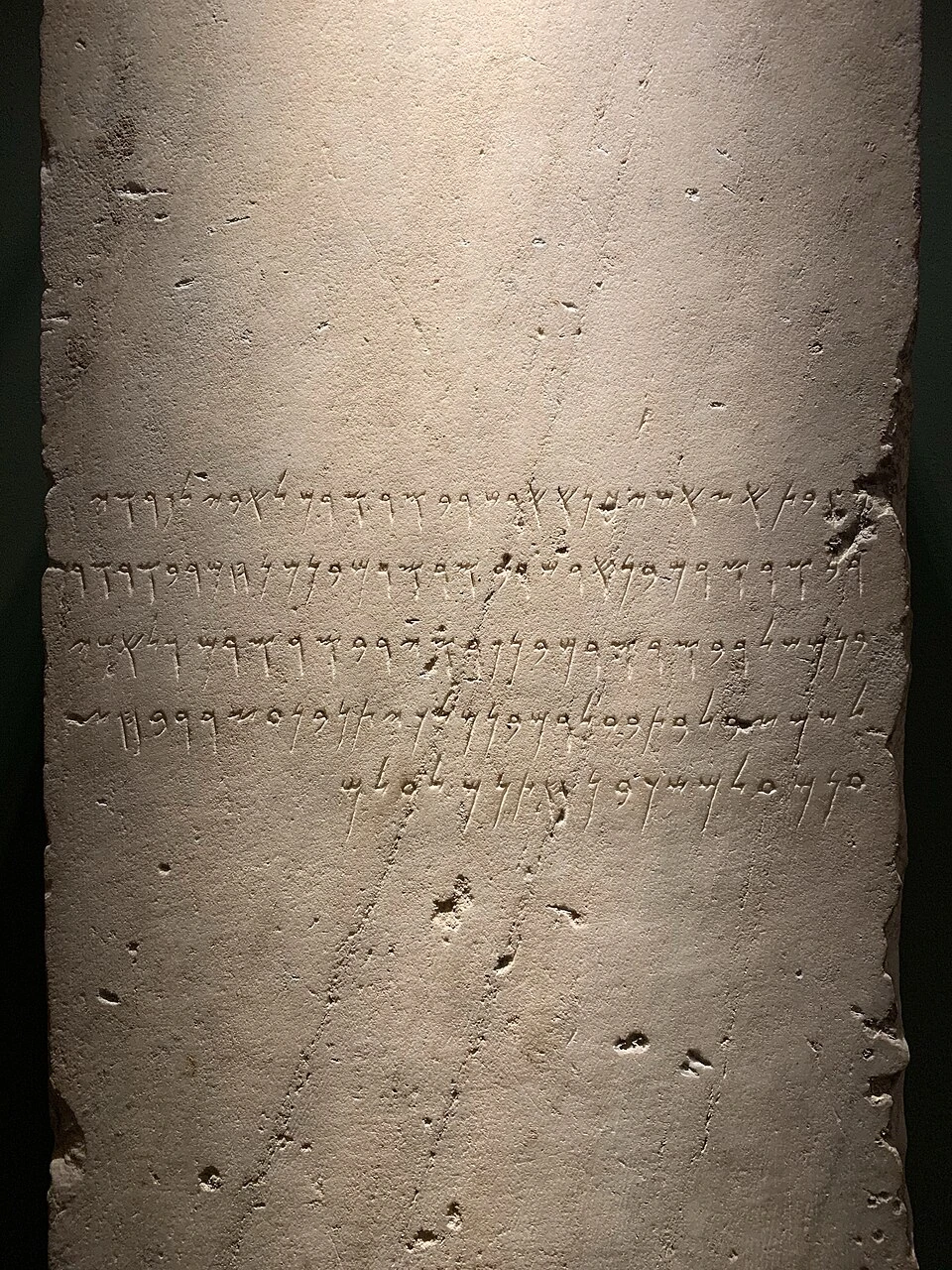
Close-up of inscription KAI 34 from Kition, Cyprus, in the British Museum. Commons explicitly identifies the inscription as Phoenician. Not independently transcribed.
Saved in Babelbook · resized display copy. Select the image to open it independently of its source.
Onceinawhile · Source ↗CC BY-SA 4.0 ↗View the local visual field note
Representative reference points from Glottolog. Historical entries show reference locations, not current speakers. 1 point.
Reference & context ↗Babelbook · original editorial illustration · CC BY 4.0 · Glottolog locations; public-domain Natural Earth land
Source excerpts, selected, shortened and where noted editorially corrected from Phoenician language by Wikipedia contributors. Retrieved 2026-10-05. CC BY-SA 4.0. These excerpts are not an independently verified scholarly history; missing accounts are identified above.
Read further in the source
History
The Phoenicians were the first state-level society to make extensive use of the Semitic alphabet. The Phoenician alphabet is one of the oldest verified consonantal alphabets, or abjad. It has become conventional to refer to the script as "Proto-Canaanite" until the mid-11th century BC, when it is first attested on inscribed bronze arrowheads, and as "Phoenician" only after 1050 BC. The Phoenician phonetic alphabet is generally believed to be at least the partial ancestor of almost all modern alphabets.
From a traditional linguistic perspective, Phoenician was composed of a variety of dialects. According to some sources, Phoenician developed into distinct Tyro-Sidonian and Byblian dialects. By this account, the Tyro-Sidonian dialect, from which the Punic language eventually emerged, spread across the Mediterranean through trade and colonisation, whereas the ancient dialect of Byblos, known from a corpus of only a few dozen extant inscriptions, played no expansionary role. However, the very slight differences in language and the insufficient records of the time make it unclear whether Phoenician formed a separate and united dialect or was merely a superficially defined part of a broader language continuum. Through their maritime trade, the Phoenicians spread the use of the alphabet to the Maghreb and Europe, where it was adopted by the Greeks. Later, the Etruscans adopted a modified version for their own use, which, in turn, was modified and adopted by the Romans and became the Latin alphabet. In the east of the Mediterranean region, the language was in use as late as the 1st century BC, when it seems to have gone extinct there. Punic colonisation spread Phoenician to the western Mediterranean, where the distinct Punic language developed. Punic also died out, but it seems to have survived far longer than Phoenician, until the sixth century, perhaps even into the ninth century.
Writing system
Phoenician was written with the Phoenician script, an abjad (consonantary) originating from the Proto-Canaanite alphabet that also became the basis for the Greek alphabet and, via an Etruscan adaptation, the Latin alphabet. The Punic form of the script gradually developed somewhat different and more cursive letter shapes; in the 3rd century BC, it also began to exhibit a tendency to mark the presence of vowels, especially final vowels, with an aleph or sometimes an ayin. Furthermore, around the time of the Second Punic War, an even more cursive form began to develop, which gave rise to a variety referred to as Neo-Punic and existed alongside the more conservative form and became predominant some time after the destruction of Carthage (c. 149 BC). Neo-Punic, in turn, tended to designate vowels with matres lectionis ("consonantal letters") more frequently than the previous systems had and also began to systematically use different letters for different vowels, in the way explained in more detail below. Finally, a number of late inscriptions from what is now Constantine, Algeria dated to the first century BC make use of the Greek alphabet to write Punic, and many inscriptions from Tripolitania, in the third and fourth centuries AD use the Latin alphabet for that purpose. In Phoenician writing, unlike that of abjads such as those of Aramaic, Biblical Hebrew and Arabic, even long vowels remained generally unexpressed, regardless of their origin (even if they originated from diphthongs, as in bt /beːt/ 'house', for earlier *bayt-; Hebrew spelling has byt). Eventually, Punic writers began to implement systems of marking of vowels by means of matres lectionis. In the 3rd century BC appeared the practice of using final 'ālep 𐤀 to mark the presence of any final vowel and, occasionally, of yōd 𐤉 to mark a final long [iː]. Later, mostly after the destruction of Carthage in the so-called "Neo-Punic" inscriptions, that was supplemented by a system in which wāw 𐤅 denoted [u], yōd 𐤉 denoted [i], 'ālep 𐤀 denoted [e] and [o], ʿayin 𐤏 denoted [a] and hē 𐤄 and ḥēt 𐤇 could also be used to signify [a]. This latter system was used first with foreign words and was then extended to many native words as well. A third practice reported in the literature is the use of the consonantal letters for vowels in the same way as had occurred in the original adaptation of the Phoenician alphabet to Greek and Latin, which was apparently still transparent to Punic writers: hē 𐤄 for [e] and 'ālep 𐤀 for [a]. Later, Punic inscriptions began to be written in the Latin alphabet, which also indicated the vowels. Those later inscriptions, in addition with some inscriptions in Greek letters and transcriptions of Phoenician names into other languages, represent the main source of knowledge about Phoenician vowels.