Pali
Pāli (; IAST: Pāḷi) is a Middle Indo-Aryan language that is widely studied as the sacred language of Theravada Buddhism and the language of the Tipiṭaka. Pali was designated a classical language of India by the Government of India on 3 October 2024.
Translate in Pali ↗There is persistent confusion regarding the relationship of Pāḷi to the vernacular spoken in the ancient kingdom of Magadha, which was located in what is now Bihar. Beginning in the Theravada commentaries, Pali was identified with 'Magadhi', the language of the kingdom of Magadha, and this was taken to also be the language that the Buddha used during his life. In the 19th century, the British Orientalist Robert Caesar Childers argued that the true or geographical name of the Pali language was Magadhi Prakrit, and that because pāḷi means "line, row, series", the early Buddhists extended the meaning of the term to mean "a series of books", so pāḷibhāsā means "language of the texts". However, modern scholarship has regarded Pali as a mix of several Prakrits from around the 3rd century BCE, combined and partially Sanskritized. There is no attested dialect of Middle Indo-Aryan with all the features of Pali. In the modern era, it has been possible to compare Pali with inscriptions known to be in Magadhi Prakrit, as well as other texts and grammars of that language. While none of the existing sources specifically document pre-Ashokan Magadhi, the available sources suggest that Pali is not equatable with that language. Modern scholars generally regard Pali as having originated from a Western dialect rather than an Eastern one. Pali has some commonalities with both the Junagadh rock inscription of Rudradaman in Kathiawar and the Central-Western Prakrit found in the eastern Hathigumpha inscription. These similarities lead scholars to associate Pali with this region of western India. Nonetheless, Pali does retain some eastern features that have been referred to as Māgadhisms. Pāḷi, as a Middle Indo-Aryan language, differs from Sanskrit more in terms of its dialectal base than in the time of its origin. A number of its morphological and lexical features show that it is not a direct continuation of Ṛgvedic Sanskrit.
South Asia
Present-day use
According to K. R. Norman, differences between different texts within the canon suggest that it contains material from more than a single dialect. He also suggests it is likely that the vihāras in North India had separate collections of material, preserved in the local dialect. In the early period it is likely that no degree of translation was necessary in communicating this material to other areas. Around the time of Ashoka there had been more linguistic divergence, and an attempt was made to assemble all the material. It is possible that a language quite close to the Pali of the canon emerged as a result of this process as a compromise of the various dialects in which the earliest material had been preserved, and this language functioned as a lingua franca among Eastern Buddhists from then on. Following this period, the language underwent a small degree of Sanskritisation (i.e., MIA bamhana > brahmana, tta > tva in some cases). Bhikkhu Bodhi, summarizing the current state of scholarship, states that the language is "closely related to the language (or, more likely, the various regional dialects) that the Buddha himself spoke". He goes on to write: Scholars regard this language as a hybrid showing features of several Prakrit dialects used around the third century BCE, subjected to a partial process of Sanskritization. While the language is not identical with any the Buddha himself would have spoken, it belongs to the same broad language family as those he might have used and originates from the same conceptual matrix. This language thus reflects the thought-world that the Buddha inherited from the wider Indian culture into which he was born, so that its words capture the subtle nuances of that thought-world. According to A. K. Warder, the Pali language is a Prakrit language used in a region of Western India. Warder associates Pali with the realm (janapada) of Avanti, where the Sthavira Nikāya was centered.
Origins
The word 'Pali' is used as a name for the language of the Theravada canon. The word seems to have its origins in commentarial traditions, wherein the Pāli (in the sense of the line of original text quoted) was distinguished from the commentary or vernacular translation that followed it in the manuscript. K. R. Norman suggests that its emergence was based on a misunderstanding of the compound pāli-bhāsa, with pāli being interpreted as the name of a particular language. The name Pali does not appear in the canonical literature, and in commentary literature is sometimes substituted with tanti, meaning a string or lineage. This name seems to have emerged in Sri Lanka early in the second millennium CE during a resurgence in the use of Pali as a courtly and literary language. As such, the name of the language has caused some debate among scholars of all ages; the spelling of the name also varies, being found with both long "ā" [ɑː] and short "a" [a], and also with either a voiced retroflex lateral approximant [ɭ] or non-retroflex [l] "l" sound. Both the long ā and retroflex ḷ are seen in the ISO 15919/ALA-LC rendering, Pāḷi; however, to this day there is no single, standard spelling of the term, and all four possible spellings can be found in textbooks. R. C. Childers translates the word as "series" and states that the language "bears the epithet in consequence of the perfection of its grammatical structure". There is persistent confusion regarding the relationship of Pāḷi to the vernacular spoken in the ancient kingdom of Magadha, which was located in what is now Bihar. Beginning in the Theravada commentaries, Pali was identified with 'Magadhi', the language of the kingdom of Magadha, and this was taken to also be the language that the Buddha used during his life.
Development
Theravada commentaries refer to Pali as "Magadhi Prakrit" or the "language of Magadha". This identification first appears in the commentaries, and may have been an attempt by Buddhists to associate themselves more closely with the Maurya Empire. However, only some of the Buddha's teachings were delivered in the historical territory of Magadha. Scholars consider it likely that he taught in several closely related dialects of Middle Indo-Aryan, which had a high degree of mutual intelligibility. Theravada tradition, as recorded in chronicles like the Mahāvaṃsa, states that the Tipitaka was first committed to writing during the first century BCE. This move away from the previous tradition of oral preservation is described as being motivated by threats to the Sangha (Buddhist community) from famine, war, and the growing influence of the rival tradition of the Abhayagiri Vihāra. This account is generally accepted by scholars, though there are indications that Pali had already begun to be recorded in writing by this date. By this point in its history, scholars consider it likely that Pali had already undergone some initial assimilation with Sanskrit, such as the conversion of the Middle-Indic bahmana to the more familiar Sanskrit brāhmana that contemporary brahmins used to identify themselves. In Sri Lanka, Pali is thought to have entered into a period of decline ending around the 4th or 5th century (as Sanskrit rose in prominence, and simultaneously, as Buddhism's adherents became a smaller portion of the subcontinent), but ultimately survived. The work of Buddhaghosa was largely responsible for the resurgence of Pali as a significant scholarly language in Buddhist thought.
Writing
While Pali is generally recognized as an ancient language, no epigraphical or manuscript evidence has survived from the earliest eras. The earliest samples of Pali discovered are inscriptions believed to date from 5th to 8th century located in mainland Southeast Asia, specifically central Thailand and lower Myanmar. These inscriptions typically consist of short excerpts from the Pali Canon and non-canonical texts, and include several examples of the protective Pratītyasamutpāda gāthā. Ooi and Skilling place the Pali inscriptions of Thailand, Cambodia and Burma in the seventh to ninth centuries, and treat them as the only direct witness to the language as it then stood. Reading a wheel of the law from Chai Nat, they record spellings that depart from later standard Pali: puvve for pubbe, ariyya for ariya, and paṃñā beside paññā within one text. They suggest the inconsistency may point to oral rather than written transmission. The geminate -vv- is characteristic of these inscriptions, appearing also in pahātavvaṃ, sacch(i)kātavvaṃ and bhāvetavvaṃ on a wheel from the Phra Pathommachedi and in pavva[jitena] on a pillar from Sap Champa. Oskar von Hinüber noted the same usage in Vinaya folios of mainland South Asian provenance assigned to the eighth or ninth century. The oldest surviving Pali manuscript was discovered in Nepal dating to the 9th century. It is in the form of four palm-leaf folios using a transitional script deriving from the Gupta script to scribe a fragment of the Cullavagga. The oldest known manuscripts from Sri Lanka and Southeast Asia date to the 13th–15th century, with few surviving examples. Very few manuscripts older than 400 years have survived, and complete manuscripts of the four Nikāyas are only available in examples from the 17th century and later. Emperor Ashoka erected a number of pillars with his edicts in at least three regional Prakrit languages in Brahmi script, all of which are quite similar to Pali.
Beyond the typeface.
Signs, manuscripts, published pages and contextual photographs, with their place, period, source and reuse terms. Captions identify historical spellings, regional examples, community references and character imagery.
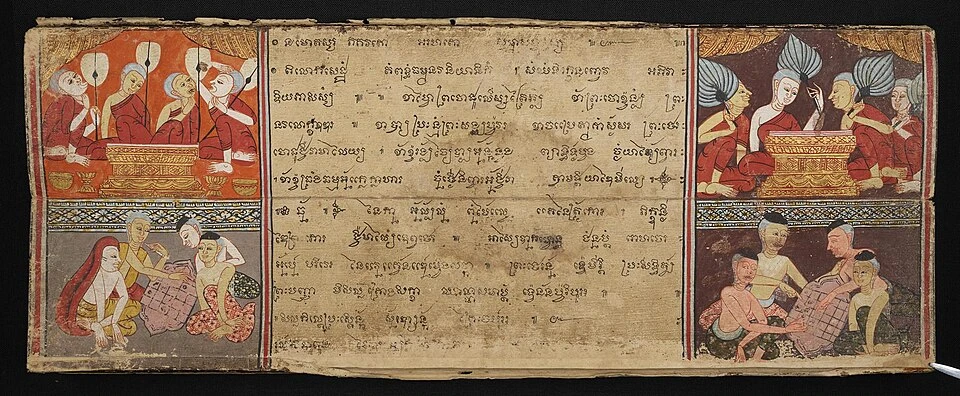
A Pali manuscript used as prompts for funeral chanting, from University of Pennsylvania Ms. Coll.990.
Saved in Babelbook · resized display copy. Select the image to open it independently of its source.
Nang Sombun (scribe); University of Pennsylvania Libraries (digitization) · Source ↗CC0 1.0 ↗View the local visual field note
Representative reference points from Glottolog. Historical entries show reference locations, not current speakers. 1 point.
Reference & context ↗Babelbook · original editorial illustration · CC BY 4.0 · Glottolog locations; public-domain Natural Earth land
Source excerpts, selected, shortened and where noted editorially corrected from Pali by Wikipedia contributors. Retrieved 2026-10-05. CC BY-SA 4.0. These excerpts are not an independently verified scholarly history; missing accounts are identified above.
Read further in the source
Geographic origin
There is persistent confusion regarding the relationship of Pāḷi to the vernacular spoken in the ancient kingdom of Magadha, which was located in what is now Bihar. Beginning in the Theravada commentaries, Pali was identified with 'Magadhi', the language of the kingdom of Magadha, and this was taken to also be the language that the Buddha used during his life. In the 19th century, the British Orientalist Robert Caesar Childers argued that the true or geographical name of the Pali language was Magadhi Prakrit, and that because pāḷi means "line, row, series", the early Buddhists extended the meaning of the term to mean "a series of books", so pāḷibhāsā means "language of the texts". However, modern scholarship has regarded Pali as a mix of several Prakrits from around the 3rd century BCE, combined and partially Sanskritized. There is no attested dialect of Middle Indo-Aryan with all the features of Pali. In the modern era, it has been possible to compare Pali with inscriptions known to be in Magadhi Prakrit, as well as other texts and grammars of that language. While none of the existing sources specifically document pre-Ashokan Magadhi, the available sources suggest that Pali is not equatable with that language. Modern scholars generally regard Pali as having originated from a Western dialect rather than an Eastern one. Pali has some commonalities with both the Junagadh rock inscription of Rudradaman in Kathiawar and the Central-Western Prakrit found in the eastern Hathigumpha inscription. These similarities lead scholars to associate Pali with this region of western India. Nonetheless, Pali does retain some eastern features that have been referred to as Māgadhisms. Pāḷi, as a Middle Indo-Aryan language, differs from Sanskrit more in terms of its dialectal base than in the time of its origin. A number of its morphological and lexical features show that it is not a direct continuation of Ṛgvedic Sanskrit. Instead it descends from one or more dialects that were, despite many similarities, different from Ṛgvedic.
Early history
Theravada commentaries refer to Pali as "Magadhi Prakrit" or the "language of Magadha". This identification first appears in the commentaries, and may have been an attempt by Buddhists to associate themselves more closely with the Maurya Empire. However, only some of the Buddha's teachings were delivered in the historical territory of Magadha. Scholars consider it likely that he taught in several closely related dialects of Middle Indo-Aryan, which had a high degree of mutual intelligibility. Theravada tradition, as recorded in chronicles like the Mahāvaṃsa, states that the Tipitaka was first committed to writing during the first century BCE. This move away from the previous tradition of oral preservation is described as being motivated by threats to the Sangha (Buddhist community) from famine, war, and the growing influence of the rival tradition of the Abhayagiri Vihāra. This account is generally accepted by scholars, though there are indications that Pali had already begun to be recorded in writing by this date. By this point in its history, scholars consider it likely that Pali had already undergone some initial assimilation with Sanskrit, such as the conversion of the Middle-Indic bahmana to the more familiar Sanskrit brāhmana that contemporary brahmins used to identify themselves. In Sri Lanka, Pali is thought to have entered into a period of decline ending around the 4th or 5th century (as Sanskrit rose in prominence, and simultaneously, as Buddhism's adherents became a smaller portion of the subcontinent), but ultimately survived. The work of Buddhaghosa was largely responsible for the resurgence of Pali as a significant scholarly language in Buddhist thought. The Visuddhimagga, and the other commentaries that Buddhaghosa compiled, codified and condensed the Sinhala commentarial tradition that had been preserved and expanded in Sri Lanka since the 3rd century BCE. With only a few possible exceptions, the entire corpus of Pali texts known today is believed to derive from the Anuradhapura Maha Viharaya in Sri Lanka. While literary evidence exists of Theravadins in mainland India surviving into the 13th century, no Pali texts specifically attributable to this tradition have been recovered. Some texts, such as the Milindapañha, may have been composed in India before being transmitted to Sri Lanka, but the surviving versions of the texts are those preserved by the Mahavihara in Sri Lanka and shared with monasteries in Theravada Southeast Asia. The earliest inscriptions in Pali found in mainland Southeast Asia date back to the first millennium CE, with some possibly dating as early as the 4th century. Inscriptions are found in what are now Burma, Laos, Thailand and Cambodia and may have spread from southern India rather than Sri Lanka. By the 11th century, a so-called "Pali renaissance" began in the vicinity of the Pagan Kingdom, gradually spreading to the rest of mainland Southeast Asia as royal dynasties sponsored monastic lineages derived from the Anuradhapura Maha Viharaya. This era was also characterized by the adoption of Sanskrit conventions and poetic forms (such as kavya) that had not been features of earlier Pali literature. This process began as early as the 5th century, but intensified early in the second millennium as Pali texts on poetics and composition modeled on Sanskrit forms began to grow in popularity. One milestone of this period was the publication of the Subodhālaṅkāra in the 14th century, a work attributed to Sangharakkhita Mahāsāmi and modeled on the Sanskrit Kavyadarsha. Peter Masefield devoted considerable research to a form of Pali known as Indochinese Pali, also referred to as 'Kham Pali'. Up until now, this has been considered a degraded form of Pali; however, Masefield states that further examination of a very considerable corpus of texts will likely reveal that this is an internally consistent Pali dialect. The reason for the changes is that some combinations of characters are difficult to write in those scripts. Masefield further states that upon the third reintroduction of Theravada Buddhism into Sri Lanka, records in Thailand state that a large number of texts were also taken. The disappearance of monastic ordination in Sri Lanka was accompanied by the loss of many texts. Therefore, the Sri Lankan Pali canon was first translated into Indo-Chinese Pali and then back into Pali. Despite an expansion of the number and influence of Mahavihara-derived monastics, this resurgence of Pali study resulted in no production of any new surviving literary works in Pali. During this era, correspondences between royal courts in Sri Lanka and mainland Southeast Asia were conducted in Pali, and grammars aimed at speakers of Sinhala, Burmese, and other languages were produced. The emergence of the term 'Pali' as the name of the language of the Theravada canon also occurred during this era.
Writing
Emperor Ashoka erected a number of pillars with his edicts in at least three regional Prakrit languages in Brahmi script, all of which are quite similar to Pali. Historically, the first written record of the Pali canon is believed to have been composed in Sri Lanka, based on a prior oral tradition. According to the Mahavamsa (the chronicle of Sri Lanka), due to a major famine in the country Buddhist monks wrote down the Pali canon during the time of King Vattagamini in 100 BCE. Bilingual coins containing Pali written in the Kharosthi script and Greek writing were used by James Prinsep to decipher the Kharosthi abugida. This script became particularly significant for the study of early Buddhism following the discovery of the Gandharan Buddhist texts. The transmission of written Pali has retained a universal system of alphabetic values, but has expressed those values in a variety of different scripts. In the 1840s, Thai king Mongkut invented the Ariyaka script, adapted from the Greek and Burmese-Mon scripts, as a universal medium for transcribing Pali, intended to replace other existing regional scripts, including Khom Thai and Tai Tham. The script did not come into popular use. Theravada Buddhist-professing regions use distinct scripts to transcribe Pali:
India: Devanāgarī, Ahom script Nepal: Pracalit script Bangladesh: Bengali, Chakma Sri Lanka: Sinhala Myanmar: Mon-Burmese, Lik-Tai (historically, Pyu script). Cambodia: Khmer Thailand: Thai (since 1893; historically Tai Tham, Khom Thai and Ariyaka script) Laos: Lao (since 1930; historically Tai Tham)