Polish
Polish (endonym: język polski, [ˈjɛ̃zɘ̟k ˈpɔlskʲi] , polszczyzna [pɔlˈʂt͡ʂɘ̟zna] or simply polski, [ˈpɔlskʲi] ) is a West Slavic language of the Lechitic subgroup, within the Indo-European language family, and is written in the Latin script. It is primarily spoken in Poland and serves as the official language of the country, as well as the language of the Polish diaspora around the world. In 2024, there were over 39.7 million Polish native speakers. It ranks as the sixth-most-spoken among languages of the European Union. Polish is subdivided into regional dialects. It maintains strict T–V distinction, obligatory honorifics, and other formalities when addressing individuals. The traditional 32-letter Polish alphabet has nine additions (ą, ć, ę, ł, ń, ó, ś, ź, ż) to the letters of the basic 26-letter Latin alphabet, while removing three (x, q, v). Those three letters are at times included in an extended 35-letter alphabet. The traditional set comprises 23 consonants and nine written vowels, including two nasal vowels (ę, ą) denoted by a reversed diacritic hook called an ogonek. Polish is a synthetic and fusional language which has seven grammatical cases. It has fixed penultimate stress and an abundance of palatal consonants. Contemporary Polish developed in the 1700s as the successor to the medieval Old Polish (10th–16th centuries) and Middle Polish (16th–18th centuries). Among the major languages, it is most closely related to Slovak and Czech but differs in terms of pronunciation and general grammar.
Translate in Polish ↗Poland is one of the most linguistically homogeneous European countries; nearly 97% of Poland's citizens declare Polish as their first language. Elsewhere, Poles constitute large minorities in areas which were once administered or occupied by Poland, notably in neighboring Lithuania, Belarus, and Ukraine. Polish is the most widely used minority language in Lithuania's Vilnius County, by 26% of the population, according to the 2001 census results, as Vilnius was part of Poland from 1922 until 1939. Polish is found elsewhere in southeastern Lithuania. In Ukraine, it is most common in the western parts of Lviv and Volyn Oblasts, while in West Belarus it is used by the significant Polish minority, especially in the Brest and Grodno regions and in areas along the Lithuanian border. There are significant numbers of Polish speakers among Polish emigrants and their descendants in many other countries. In the United States, Polish Americans number more than 11 million but most of them cannot speak Polish fluently. According to the 2000 United States census, 667,414 Americans of age five years and over reported Polish as the language spoken at home, which is about 1.4% of people who speak languages other than English, 0.25% of the US population, and 6% of the Polish-American population. The largest concentrations of Polish speakers reported in the census (over 50%) were found in three states: Illinois (185,749), New York (111,740), and New Jersey (74,663). Enough people in these areas speak Polish that PNC Financial Services (which has a large number of branches in all of these areas) offers services available in Polish at all of their cash machines in addition to English and Spanish. According to the 2011 census there are now over 500,000 people in England and Wales who consider Polish to be their "main" language.
Europe
Present-day use
The captured source does not contain a separate current-use account.
Origins
The captured article does not contain a separate origins section. See the historical account and linked source.
Development
Polish began to emerge as a distinct language around the 10th century, the process largely triggered by the establishment and development of the Polish state. At the time, it was a collection of dialect groups with some mutual features, but much regional variation was present. Mieszko I, ruler of the Polans tribe from the Greater Poland region, united a few culturally and linguistically related tribes from the basins of the Vistula and Oder before eventually accepting baptism in 966. With the arrival of Western Christianity, Poland also adopted the Latin alphabet, which made it possible to write down Polish, which until then had existed only as a spoken language. The closest relatives of Polish are the Elbe and Baltic Sea Lechitic dialects (Polabian and Pomeranian varieties). All of them, except Kashubian, are extinct. The precursor to modern Polish is the Old Polish language. Ultimately, Polish descends from the unattested Proto-Slavic language. The Book of Henryków (Polish: Księga henrykowska, Latin: Liber fundationis claustri Sanctae Mariae Virginis in Heinrichau), contains the earliest known sentence written in the Polish language: Day, ut ia pobrusa, a ti poziwai (in modern orthography: Daj, uć ja pobrusza, a ti pocziwaj; the corresponding sentence in modern Polish: Daj, niech ja pomielę, a ty odpoczywaj or Pozwól, że ja będę mełł, a ty odpocznij; and in English: Come, let me grind, and you take a rest), written around 1280. The book is exhibited in the Archdiocesal Museum in Wrocław, in 2015 was added to UNESCO's "Memory of the World" list. The medieval recorder of this phrase, the Cistercian monk Peter of the Henryków monastery, noted that "Hoc est in polonico" ("This is in Polish"). The earliest treatise on Polish orthography was written by Jakub Parkosz around 1470. The first printed book in Polish appeared in either 1508 or 1513, while the oldest Polish newspaper was established in 1661.
Writing
The Polish alphabet derives from the Latin script but includes certain additional letters formed using diacritics. The Polish alphabet was one of three major forms of Latin-based orthography developed for Western and some South Slavic languages, the others being Czech orthography and Croatian orthography, the last of these being a 19th-century invention trying to make a compromise between the first two. Kashubian uses a Polish-based system, Slovak uses a Czech-based system, and Slovene follows the Croatian one; the Sorbian languages blend the Polish and the Czech ones. Historically, Poland's once diverse and multi-ethnic population utilized many forms of scripture to write Polish. For instance, Lipka Tatars and Muslims inhabiting the eastern parts of the former Polish–Lithuanian Commonwealth wrote Polish in the Arabic alphabet. The Cyrillic script is used to a certain extent today by Polish speakers in Western Belarus, especially for religious texts. The diacritics used in the Polish alphabet are the kreska (graphically similar to the acute accent) over the letters ć, ń, ó, ś, ź and through the letter in ł; the kropka (superior dot) over the letter ż, and the ogonek ("little tail") under the letters ą, ę. The letters q, v, x are used only in foreign words and names. Polish orthography is largely phonemic—there is a consistent correspondence between letters (or digraphs and trigraphs) and phonemes (for exceptions see below). The letters of the alphabet and their normal phonemic values are listed in the following table. The following digraphs and trigraphs are used: Voiced consonant letters frequently come to represent voiceless sounds (as shown in the tables); this occurs at the end of words and in certain clusters, due to the neutralization mentioned in the Phonology section above.
Beyond the typeface.
Signs, manuscripts, published pages and contextual photographs, with their place, period, source and reuse terms. Captions identify historical spellings, regional examples, community references and character imagery.
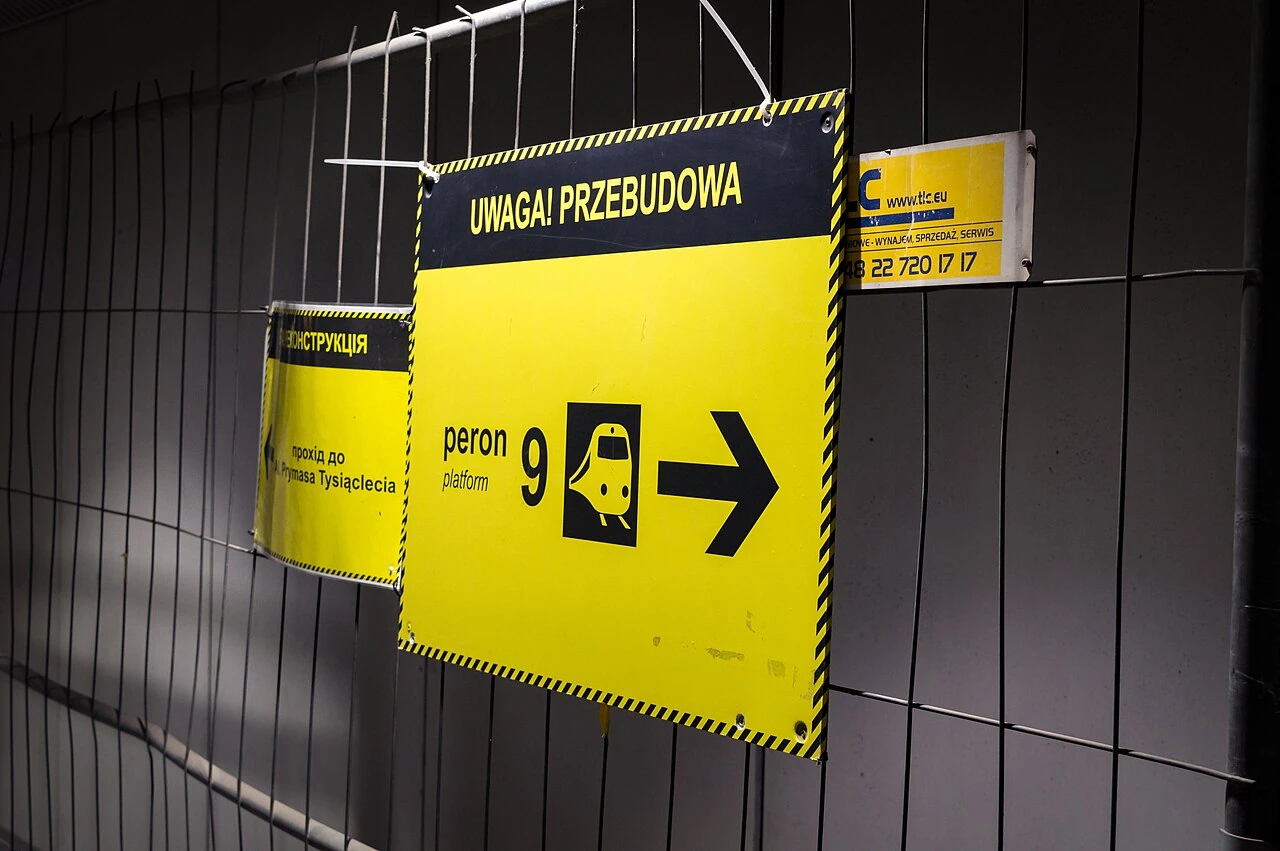
Directions during reconstruction of Warszawa Zachodnia station, 2025. Polish appears alongside English and Ukrainian. Source-identified language; displayed without additional cropping.
Saved in Babelbook · resized display copy. Select the image to open it independently of its source.
RAIL P (RAIL.PHOTOGRAPHY) / CC0 / Wikimedia Commons · Source ↗CC0 1.0 ↗View the local visual field note
Representative reference points from Glottolog. Historical entries show reference locations, not current speakers. 1 point.
Reference & context ↗Babelbook · original editorial illustration · CC BY 4.0 · Glottolog locations; public-domain Natural Earth land
Source excerpts, selected, shortened and where noted editorially corrected from Polish language by Wikipedia contributors. Retrieved 2026-10-05. CC BY-SA 4.0. These excerpts are not an independently verified scholarly history; missing accounts are identified above.
Read further in the source
History
Polish began to emerge as a distinct language around the 10th century, the process largely triggered by the establishment and development of the Polish state. At the time, it was a collection of dialect groups with some mutual features, but much regional variation was present. Mieszko I, ruler of the Polans tribe from the Greater Poland region, united a few culturally and linguistically related tribes from the basins of the Vistula and Oder before eventually accepting baptism in 966. With the arrival of Western Christianity, Poland also adopted the Latin alphabet, which made it possible to write down Polish, which until then had existed only as a spoken language. The closest relatives of Polish are the Elbe and Baltic Sea Lechitic dialects (Polabian and Pomeranian varieties). All of them, except Kashubian, are extinct. The precursor to modern Polish is the Old Polish language. Ultimately, Polish descends from the unattested Proto-Slavic language.
The Book of Henryków (Polish: Księga henrykowska, Latin: Liber fundationis claustri Sanctae Mariae Virginis in Heinrichau), contains the earliest known sentence written in the Polish language: Day, ut ia pobrusa, a ti poziwai (in modern orthography: Daj, uć ja pobrusza, a ti pocziwaj; the corresponding sentence in modern Polish: Daj, niech ja pomielę, a ty odpoczywaj or Pozwól, że ja będę mełł, a ty odpocznij; and in English: Come, let me grind, and you take a rest), written around 1280. The book is exhibited in the Archdiocesal Museum in Wrocław, in 2015 was added to UNESCO's "Memory of the World" list. The medieval recorder of this phrase, the Cistercian monk Peter of the Henryków monastery, noted that "Hoc est in polonico" ("This is in Polish"). The earliest treatise on Polish orthography was written by Jakub Parkosz around 1470. The first printed book in Polish appeared in either 1508 or 1513, while the oldest Polish newspaper was established in 1661. Starting in the 1520s, large numbers of books in the Polish language were published, contributing to increased homogeneity of grammar and orthography. The writing system achieved its overall form in the 16th century, which is also regarded as the "Golden Age of Polish literature". The orthography was modified in the 19th century and in 1936. Tomasz Kamusella notes that "Polish is the oldest, non-ecclesiastical, written Slavic language with a continuous tradition of literacy and official use, which has lasted unbroken from the 16th century to this day." Polish evolved into the main sociolect of the nobles in Poland–Lithuania in the 15th century. The history of Polish as a language of state governance begins in the 16th century in the Kingdom of Poland. Over the later centuries, Polish served as the official language in the Grand Duchy of Lithuania, Congress Poland, the Kingdom of Galicia and Lodomeria, and as the administrative language in the Russian Empire's Western Krai. The growth of the Polish–Lithuanian Commonwealth's influence gave Polish the status of lingua franca in Central and Eastern Europe. The process of standardization began in the 14th century and solidified in the 16th century during the Middle Polish era. Standard Polish was based on various dialectal features, with the Greater Poland dialect group serving as the base. After World War II, Standard Polish became the most widely spoken variant of Polish across the country, and most dialects stopped being the form of Polish spoken in villages.
Geographic distribution
Poland is one of the most linguistically homogeneous European countries; nearly 97% of Poland's citizens declare Polish as their first language. Elsewhere, Poles constitute large minorities in areas which were once administered or occupied by Poland, notably in neighboring Lithuania, Belarus, and Ukraine. Polish is the most widely used minority language in Lithuania's Vilnius County, by 26% of the population, according to the 2001 census results, as Vilnius was part of Poland from 1922 until 1939. Polish is found elsewhere in southeastern Lithuania. In Ukraine, it is most common in the western parts of Lviv and Volyn Oblasts, while in West Belarus it is used by the significant Polish minority, especially in the Brest and Grodno regions and in areas along the Lithuanian border. There are significant numbers of Polish speakers among Polish emigrants and their descendants in many other countries. In the United States, Polish Americans number more than 11 million but most of them cannot speak Polish fluently. According to the 2000 United States census, 667,414 Americans of age five years and over reported Polish as the language spoken at home, which is about 1.4% of people who speak languages other than English, 0.25% of the US population, and 6% of the Polish-American population. The largest concentrations of Polish speakers reported in the census (over 50%) were found in three states: Illinois (185,749), New York (111,740), and New Jersey (74,663). Enough people in these areas speak Polish that PNC Financial Services (which has a large number of branches in all of these areas) offers services available in Polish at all of their cash machines in addition to English and Spanish. According to the 2011 census there are now over 500,000 people in England and Wales who consider Polish to be their "main" language. In Canada, there is a significant Polish Canadian population: There are 242,885 speakers of Polish according to the 2006 census; in particular, there are concentrations of Polish speakers in Toronto (91,810 speakers) and Montreal. The geographical distribution of the Polish language was greatly affected by the territorial changes of Poland immediately after World War II and Polish population transfers (1944–46). Poles settled in the "Recovered Territories" in the west and north, which had previously been mostly German-speaking. Some Poles remained in the previously Polish-ruled territories in the east that were annexed by the USSR, resulting in the present-day Polish-speaking communities in Lithuania, Belarus, and Ukraine, although many Poles were expelled from those areas to areas within Poland's new borders. To the east of Poland, the most significant Polish minority lives in a long strip along either side of the Lithuania-Belarus border. Meanwhile, the flight and expulsion of Germans (1944–50), as well as the expulsion of Ukrainians and Operation Vistula, the 1947 migration of Ukrainian minorities in the Recovered Territories in the west of the country, contributed to the country's linguistic homogeneity.
Dialects
The inhabitants of different regions of Poland still speak Polish somewhat differently, although the differences between modern-day vernacular varieties and standard Polish (język ogólnopolski) appear relatively slight. Most of the middle aged and young speak vernaculars close to standard Polish, while the traditional dialects are preserved among older people in rural areas. First-language speakers of Polish have no trouble understanding each other, and non-native speakers may have difficulty recognizing the regional and social differences. The modern standard dialect, often termed as "correct Polish", is spoken or at least understood throughout the entire country. Polish has traditionally been described as consisting of three to five main regional dialects:
Greater Polish, spoken in the west Lesser Polish, spoken in the south and southeast Masovian, spoken throughout the central and eastern parts of the country Silesian and Kashubian, spoken in Upper Silesia and Pomerania respectively, are thought of as either Polish dialects or distinct languages, depending on the criteria used. Kashubian contains a number of features not found elsewhere in Poland, e.g. nine distinct oral vowels (vs. the six of standard Polish) and (in the northern dialects) phonemic word stress, an archaic feature preserved from Common Slavic times and not found anywhere else among the West Slavic languages. However, it was described by some linguists as lacking most of the linguistic and social determinants of language-hood. Many linguistic sources categorize Silesian as a regional language separate from Polish, while some consider Silesian to be a dialect of Polish. Many Silesians consider themselves a separate ethnicity and have been advocating for the recognition of Silesian as a regional language in Poland. The law recognizing it as such was passed by the Sejm and Senate in April 2024, but was vetoed by President Andrzej Duda in late May 2024. According to the last official census in Poland in 2011, over half a million people declared Silesian as their native language. Many sociolinguists (e.g. Tomasz Kamusella, Agnieszka Pianka, Alfred F. Majewicz, Tomasz Wicherkiewicz) assume that extralinguistic criteria decide whether a lect is an independent language or a dialect: speakers of the speech variety or/and political decisions, and this is dynamic (i.e. it changes over time). Also, research organizations such as SIL International and resources for the academic field of linguistics such as Ethnologue, Linguist List and others, for example the Ministry of Administration and Digitization recognized the Silesian language. In July 2007, the Silesian language was recognized by ISO, and was attributed an ISO code of szl. Some additional characteristic but less widespread regional dialects include:
The distinctive dialect of the Gorals (Góralski) occurs in the mountainous area bordering the Czech Republic and Slovakia. The Gorals ("Highlanders") take great pride in their culture and the dialect. It exhibits some cultural influences from the Vlach shepherds in the 14th–17th centuries. The Poznański dialect, spoken in Poznań and to some extent in the whole region of the former Prussian Partition (excluding Upper Silesia), with noticeable German influences. In the northern and western (formerly German) regions where Poles from the territories annexed by the Soviet Union resettled after World War II, the older generation speaks a dialect of Polish characteristic of the Kresy that includes a longer pronunciation of vowels. Poles living in Lithuania (particularly in the Vilnius region), in Belarus (particularly the northwest), and in the northeast of Poland continue to speak the Eastern Borderlands dialect, which sounds "slushed" (in Polish described as zaciąganie z ruska, "speaking with a Ruthenian drawl") and is easily distinguishable. Some city dwellers, especially the less affluent population, had their own distinctive dialects – for example, the Warsaw dialect, still spoken by some of the population of Praga on the eastern bank of the Vistula. However, these city dialects are now mostly extinct due to assimilation with standard Polish. Many Poles living in emigrant communities (for example, in Brazil and the United States), whose families left Poland during the 20th century, retain a number of minor features of Polish vocabulary as spoken in the first half of that century that now sound archaic to contemporary visitors from Poland. Polish linguistics has been characterized by a strong strive towards promoting prescriptive ideas of language intervention and usage uniformity, along with normatively oriented notions of language "correctness" (unusual by Western standards).
Consonant distribution
Polish permits complex consonant clusters, which historically often arose from the disappearance of yers. Polish can have word-initial and word-medial clusters of up to four consonants, whereas word-final clusters can have up to five consonants. Examples of such clusters can be found in words such as [bɛzˈvzɡlɛndnɨ] ('absolute' or 'heartless', 'ruthless'), [ˈʑd͡ʑbwɔ] ('blade of grass'), [ˈfstʂɔw̃s] ('shock'), and krnąbrność [ˈkrnɔmbrnɔɕt͡ɕ] ('disobedience'). A popular Polish tongue-twister (from a verse by Jan Brzechwa) is [fʂt͡ʂɛbʐɛˈʂɨɲɛ ˈxʂɔw̃ʂt͡ʂ ˈbʐmi fˈtʂt͡ɕiɲɛ] ('In Szczebrzeszyn a beetle buzzes in the reed'). Unlike languages such as Czech, Polish does not have syllabic consonants – the nucleus of a syllable is always a vowel. The consonant /j/ is restricted to positions adjacent to a vowel. It also cannot precede or follow the letter Y.
Orthography
The Polish alphabet derives from the Latin script but includes certain additional letters formed using diacritics. The Polish alphabet was one of three major forms of Latin-based orthography developed for Western and some South Slavic languages, the others being Czech orthography and Croatian orthography, the last of these being a 19th-century invention trying to make a compromise between the first two. Kashubian uses a Polish-based system, Slovak uses a Czech-based system, and Slovene follows the Croatian one; the Sorbian languages blend the Polish and the Czech ones. Historically, Poland's once diverse and multi-ethnic population utilized many forms of scripture to write Polish. For instance, Lipka Tatars and Muslims inhabiting the eastern parts of the former Polish–Lithuanian Commonwealth wrote Polish in the Arabic alphabet. The Cyrillic script is used to a certain extent today by Polish speakers in Western Belarus, especially for religious texts. The diacritics used in the Polish alphabet are the kreska (graphically similar to the acute accent) over the letters ć, ń, ó, ś, ź and through the letter in ł; the kropka (superior dot) over the letter ż, and the ogonek ("little tail") under the letters ą, ę. The letters q, v, x are used only in foreign words and names. Polish orthography is largely phonemic—there is a consistent correspondence between letters (or digraphs and trigraphs) and phonemes (for exceptions see below). The letters of the alphabet and their normal phonemic values are listed in the following table.
The following digraphs and trigraphs are used:
Voiced consonant letters frequently come to represent voiceless sounds (as shown in the tables); this occurs at the end of words and in certain clusters, due to the neutralization mentioned in the Phonology section above. Occasionally also voiceless consonant letters can represent voiced sounds in clusters. The spelling rule for the palatal sounds /ɕ/, /ʑ/, /tɕ/, /dʑ/ and /ɲ/ is as follows: before the vowel i the plain letters s, z, c, dz, n are used; before other vowels the combinations si, zi, ci, dzi, ni are used; when not followed by a vowel the diacritic forms ś, ź, ć, dź, ń are used. For example, the s in siwy ("grey-haired"), the si in siarka ("sulfur") and the ś in święty ("holy") all represent the sound /ɕ/. The exceptions to the above rule are certain loanwords from Latin, Italian, French, Russian or English—where s before i is pronounced as s, e.g. sinus, sinologia, do re mi fa sol la si do, Saint-Simon i saint-simoniści, Sierioża, Siergiej, Singapur, singiel. In other loanwords the vowel i is changed to y, e.g. asymilacja. The following table shows the correspondence between the sounds and spelling: Digraphs and trigraphs are used:
Similar principles apply to /kʲ/, /ɡʲ/, /xʲ/ and /lʲ/, except that these can only occur before vowels, so the spellings are k, g, (c)h, l before i, and ki, gi, (c)hi, li otherwise. Most Polish speakers, however, do not consider palatalization of k, g, (c)h or l as creating new sounds. Except in the cases mentioned above, the letter i if followed by another vowel in the same word usually represents /j/, yet a palatalization of the previous consonant is always assumed. The reverse case, where the consonant remains unpalatalized but is followed by a palatalized consonant, is written by using j instead of i: for example, zjeść, "to eat up". The letters ą and ę, when followed by plosives and affricates, represent an oral vowel followed by a nasal consonant, rather than a nasal vowel. For example, ą in dąb ("oak") is pronounced [ɔm], and ę in tęcza ("rainbow") is pronounced [ɛn] (the nasal assimilates to the following consonant). When followed by l or ł (for example przyjęli, przyjęły), ę is pronounced as just e. When ę is at the end of the word it is often pronounced as just [ɛ]. Depending on the word, the phoneme /x/ can be spelt h or ch, the phoneme /ʐ/ can be spelt ż or rz, and /u/ can be spelt u or ó. In several cases it determines the meaning, for example: może ("maybe") and morze ("sea"). In occasional words, letters that normally form a digraph are pronounced separately. For example, rz represents /rz/, not /ʐ/, in words like zamarzać ("freeze") and in the name Tarzan. Doubled letters are usually pronounced as a single, lengthened consonant, however, some speakers might pronounce the combination as two separate sounds. There are certain clusters where a written consonant would not be pronounced. For example, the ł in the word jabłko ("apple") might be omitted in ordinary speech, leading to the pronunciation japko.