Old Provençal
Old Occitan (Modern Occitan: occitan ancian, Catalan: occità antic), also called Old Provençal, was the earliest form of the Occitano-Romance languages, as attested in writings dating from the 8th to the 14th centuries. Old Occitan generally includes Early and Old Occitan. Middle Occitan is sometimes included in Old Occitan, sometimes in Modern Occitan. As the term occitanus appeared around the year 1300, Old Occitan is referred to as "Romance" (Occitan: romans) or "Provençal" (Occitan: proensals) in medieval texts.
Translate in Old Provençal ↗Old Occitan (Modern Occitan: occitan ancian, Catalan: occità antic), also called Old Provençal, was the earliest form of the Occitano-Romance languages, as attested in writings dating from the 8th to the 14th centuries. Old Occitan generally includes Early and Old Occitan. Middle Occitan is sometimes included in Old Occitan, sometimes in Modern Occitan. As the term occitanus appeared around the year 1300, Old Occitan is referred to as "Romance" (Occitan: romans) or "Provençal" (Occitan: proensals) in medieval texts.
Europe
Present-day use
The captured source does not contain a separate current-use account.
Origins
The captured article does not contain a separate origins section. See the historical account and linked source.
Development
Among the earliest records of Occitan are the Tomida femina, the Boecis and the Cançó de Santa Fe. Old Occitan, the language used by the troubadours, was the first Romance language with a literary corpus and had an enormous influence on the development of lyric poetry in other European languages. The interpunct was a feature of its orthography and survives today in Catalan and Gascon. The official language of the sovereign principality of the Viscounty of Béarn was the local vernacular Bearnès dialect of Old Occitan. It was the spoken language of law courts and of business and it was the written language of customary law. Although vernacular languages were increasingly preferred to Latin in western Europe in the late Middle Ages, the status of Occitan in Béarn was unusual because its use was required by law: "lawyers will draft their petitions and pleas in the vernacular language of the present country, both in speech and in writing". Old Catalan and Old Occitan diverged between the 11th and the 14th centuries. Catalan never underwent the shift from /u/ to /y/ or the shift from /o/ to /u/ (except in unstressed syllables in some dialects) and so had diverged phonologically before those changes affected Old Occitan.
Writing
Latin or customary script (catalog classification; see the source for context).
Beyond the typeface.
Signs, manuscripts, published pages and contextual photographs, with their place, period, source and reuse terms. Captions identify historical spellings, regional examples, community references and character imagery.
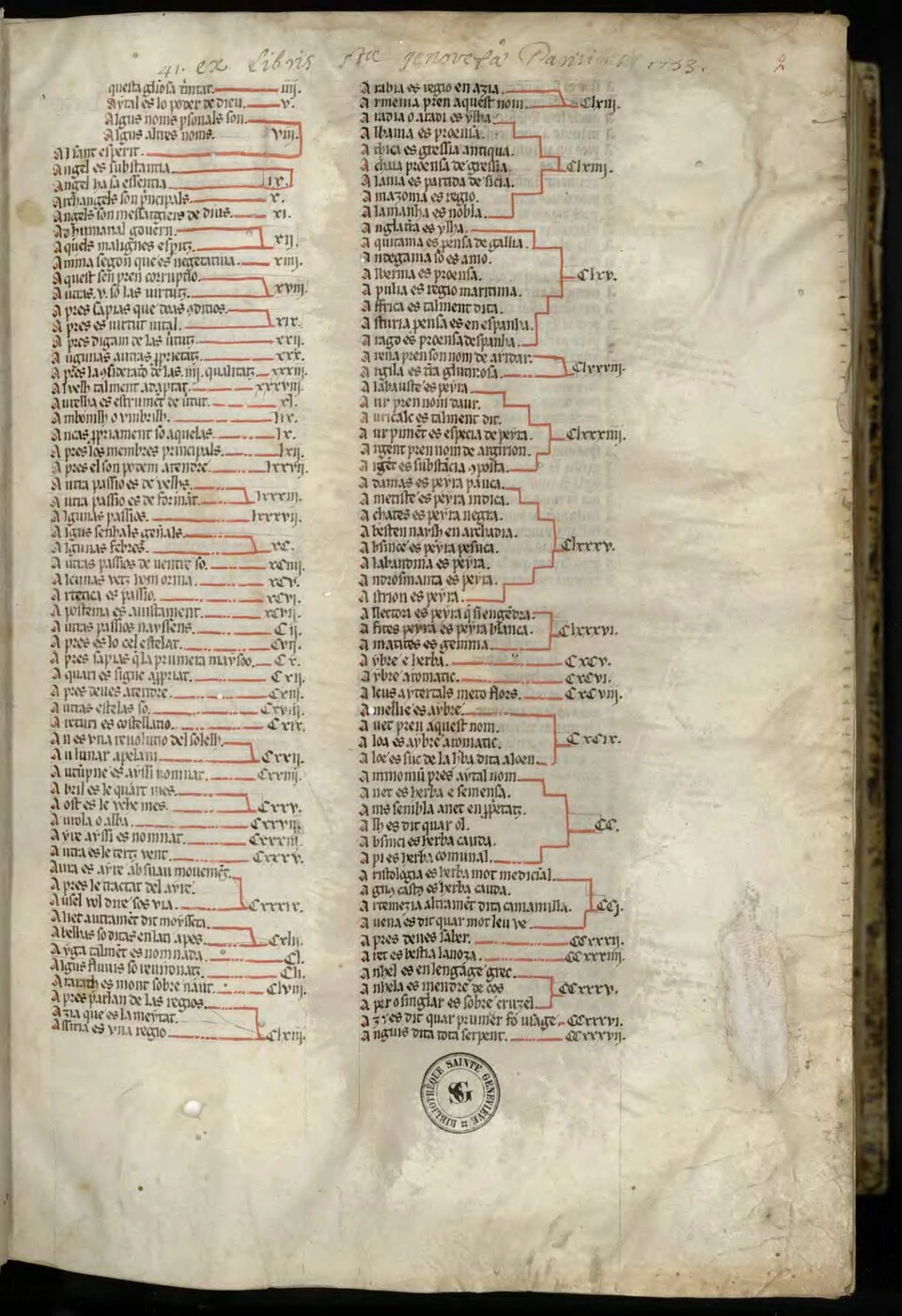
Manuscript index page from De proprietatibus rerum in Old Provençal, Bibliothèque Sainte-Geneviève MS 1029. Commons explicitly identifies Old Provençal and attributes the translation to Gaston Fébus. Scan page 13 was visually checked: it contains two columns of medieval text and red index marks, not a blank flyleaf. A later Latin ownership inscription appears at the top.
Saved in Babelbook · resized display copy. Select the image to open it independently of its source.
Bartholomew Anglicus; translation attributed to Gaston Fébus; Bibliothèque Sainte-Geneviève MS 1029 · Source ↗Public domain ↗View the local visual field note
Representative reference points from Glottolog. Historical entries show reference locations, not current speakers. 1 point.
Reference & context ↗Babelbook · original editorial illustration · CC BY 4.0 · Glottolog locations; public-domain Natural Earth land
Source excerpts, selected, shortened and where noted editorially corrected from Old Occitan by Wikipedia contributors. Retrieved 2026-10-05. CC BY-SA 4.0. These excerpts are not an independently verified scholarly history; missing accounts are identified above.
Read further in the source
History
Among the earliest records of Occitan are the Tomida femina, the Boecis and the Cançó de Santa Fe. Old Occitan, the language used by the troubadours, was the first Romance language with a literary corpus and had an enormous influence on the development of lyric poetry in other European languages. The interpunct was a feature of its orthography and survives today in Catalan and Gascon. The official language of the sovereign principality of the Viscounty of Béarn was the local vernacular Bearnès dialect of Old Occitan. It was the spoken language of law courts and of business and it was the written language of customary law. Although vernacular languages were increasingly preferred to Latin in western Europe in the late Middle Ages, the status of Occitan in Béarn was unusual because its use was required by law: "lawyers will draft their petitions and pleas in the vernacular language of the present country, both in speech and in writing". Old Catalan and Old Occitan diverged between the 11th and the 14th centuries. Catalan never underwent the shift from /u/ to /y/ or the shift from /o/ to /u/ (except in unstressed syllables in some dialects) and so had diverged phonologically before those changes affected Old Occitan.