Pashto
Pashto (, PASH-toh; پښتو, Pəx̌tó, [pəʂˈto, pʊxˈto, pəʃˈto, pəçˈto]) is an Eastern Iranian language, belonging to the Indo-European language family, natively spoken in northwestern Pakistan and southern and eastern Afghanistan. It is one of the two official languages of Afghanistan. In historical Persian literature, it was also referred to as Afghani (افغانی, Afghāni). Spoken as a native language mainly by ethnic Pashtuns, it is one of the two official languages of Afghanistan alongside Dari, and the second-largest language in Pakistan, spoken mainly in Khyber Pakhtunkhwa and the northern districts of Balochistan. Likewise, it is the primary language of the Pashtun diaspora around the world. The total number of Pashto speakers is estimated at around 35 million to 55 million. Pashto is "one of the primary markers of ethnic identity" amongst Pashtuns.
Translate in Pashto ↗A national language of Afghanistan, Pashto is primarily spoken in the east, south, and southwest, but also in some northern and western parts of the country. The exact number of speakers is unavailable, but different estimates show that Pashto is the mother tongue of 35–45% of the total population of Afghanistan. In Pakistan, Pashto is spoken by 18.1% of its population, mainly in the northwestern province of Khyber Pakhtunkhwa and northern districts of Balochistan province. Pashto speakers are also found in the Punjab province, Islamabad and in the other major cities of Pakistan, most notably Karachi, Sindh, which may have the largest Pashtun population in the world. Other communities of Pashto speakers are found in India, Tajikistan, and northeastern Iran (primarily in South Khorasan Province to the east of Qaen, near the Afghan border). In India most ethnic Pashtun (Pathan) peoples speak the geographically native Hindi-Urdu language rather than Pashto, but there are small numbers of Pashto speakers, such as the Sheen Khalai in Rajasthan, and the Pathan community in the city of Kolkata, often nicknamed the Kabuliwala ("people of Kabul"). Pashtun diaspora communities in other countries around the world speak Pashto, especially the sizable communities in the United Arab Emirates and Saudi Arabia.
Middle East & North Africa
Present-day use
The captured source does not contain a separate current-use account.
Origins
The captured article does not contain a separate origins section. See the historical account and linked source.
Development
Some linguists have argued that Pashto is descended from Avestan or a variety very similar to it, while others have attempted to place it closer to Bactrian. However, neither position is universally agreed upon. What scholars do agree on is the fact that Pashto is an Eastern Iranian language sharing characteristics with Eastern Middle Iranian languages such as Bactrian, Khwarezmian and Sogdian. Comparison with other Eastern Iranian Languages and Old Avestan: Strabo, who lived between 64 BCE and 24 CE, explains that the tribes inhabiting the lands west of the Indus River were part of Ariana. This was around the time when the area inhabited by the Pashtuns was governed by the Greco-Bactrian Kingdom. From the 3rd century CE onward, they are mostly referred to by the name Afghan (Abgan). Abdul Hai Habibi believed that the earliest modern Pashto work dates back to Amir Kror Suri of the early Ghurid period in the 8th century, and they used the writings found in Pə́ṭa Xazāná. Pə́ṭa Xazāná (پټه خزانه) is a Pashto manuscript claimed to be written by Mohammad Hotak under the patronage of the Pashtun emperor Hussain Hotak in Kandahar; containing an anthology of Pashto poets. However, its authenticity is disputed by scholars such as David Neil MacKenzie and Lucia Serena Loi. Nile Green comments in this regard: "In 1944, Habibi claimed to have discovered an eighteenth-century manuscript anthology containing much older biographies and verses of Pashto poets that stretched back as far as the eighth century. It was an extraordinary claim, implying as it did that the history of Pashto literature reached back further in time than Persian, thus supplanting the hold of Persian over the medieval Afghan past.
Writing
Pashto employs the Pashto alphabet, a modified form of the Perso-Arabic alphabet or Arabic script. In the 16th century, Bayazid Pir Roshan introduced 13 new letters to the Pashto alphabet. The alphabet was further modified over the years. The Pashto alphabet consists of 45 to 46 letters and 4 diacritic marks. Latin Pashto is also used. In Latin transliteration, stress is represented by the following markers over vowels: ә́, á, ā́, ú, ó, í and é. The following table (read from left to right) gives the letters' isolated forms, along with possible Latin equivalents and typical IPA values:
Beyond the typeface.
Signs, manuscripts, published pages and contextual photographs, with their place, period, source and reuse terms. Captions identify historical spellings, regional examples, community references and character imagery.
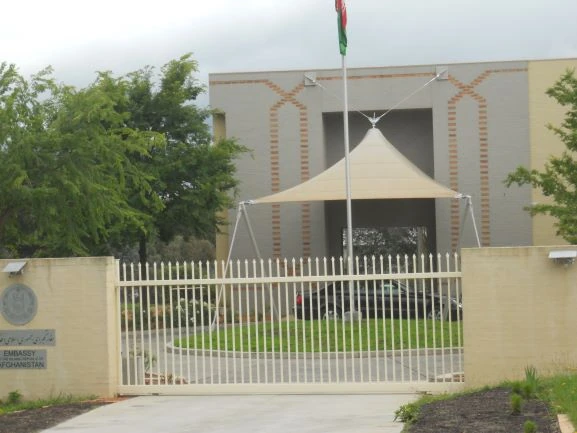
Pashto and English on an Afghan embassy sign in Canberra, photographed in 2011. Historical photograph; original resolution 577 × 433. Language identification follows Commons descriptions or categories; not independently transcribed.
Saved in Babelbook · resized display copy. Select the image to open it independently of its source.
Nomisztif · Source ↗CC BY-SA 4.0 ↗View the local visual field note
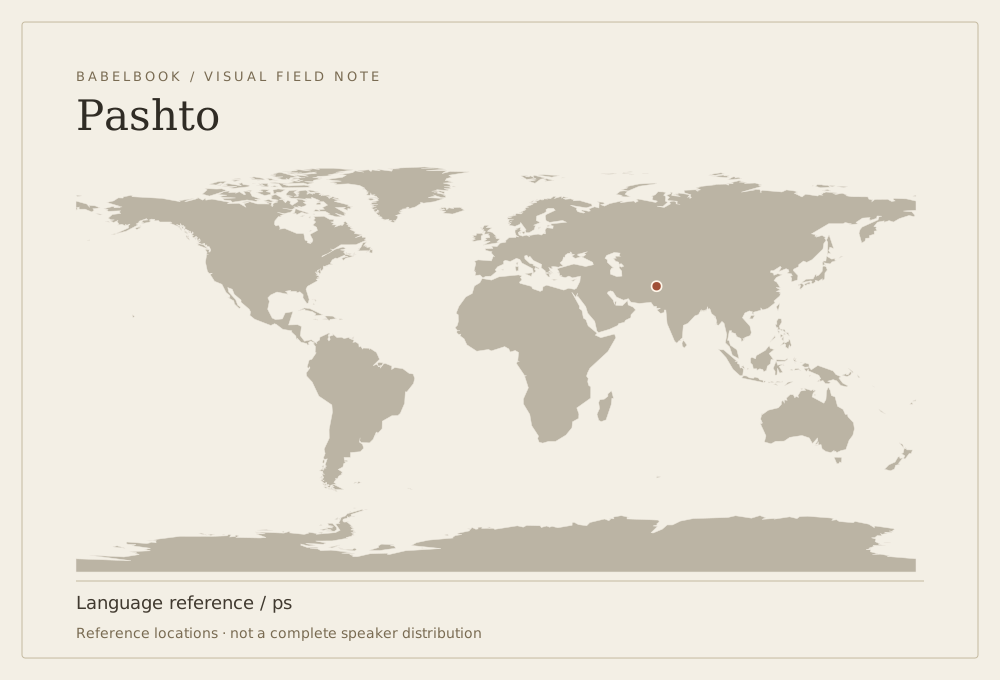
Representative reference points from Glottolog. Historical entries show reference locations, not current speakers. 1 point.
Reference & context ↗Babelbook · original editorial illustration · CC BY 4.0 · Glottolog locations; public-domain Natural Earth land
Source excerpts, selected, shortened and where noted editorially corrected from Pashto by Wikipedia contributors. Retrieved 2026-10-05. CC BY-SA 4.0. These excerpts are not an independently verified scholarly history; missing accounts are identified above.
Read further in the source
Geographic distribution
A national language of Afghanistan, Pashto is primarily spoken in the east, south, and southwest, but also in some northern and western parts of the country. The exact number of speakers is unavailable, but different estimates show that Pashto is the mother tongue of 35–45% of the total population of Afghanistan. In Pakistan, Pashto is spoken by 18.1% of its population, mainly in the northwestern province of Khyber Pakhtunkhwa and northern districts of Balochistan province. Pashto speakers are also found in the Punjab province, Islamabad and in the other major cities of Pakistan, most notably Karachi, Sindh, which may have the largest Pashtun population in the world. Other communities of Pashto speakers are found in India, Tajikistan, and northeastern Iran (primarily in South Khorasan Province to the east of Qaen, near the Afghan border). In India most ethnic Pashtun (Pathan) peoples speak the geographically native Hindi-Urdu language rather than Pashto, but there are small numbers of Pashto speakers, such as the Sheen Khalai in Rajasthan, and the Pathan community in the city of Kolkata, often nicknamed the Kabuliwala ("people of Kabul"). Pashtun diaspora communities in other countries around the world speak Pashto, especially the sizable communities in the United Arab Emirates and Saudi Arabia.
History
Some linguists have argued that Pashto is descended from Avestan or a variety very similar to it, while others have attempted to place it closer to Bactrian. However, neither position is universally agreed upon. What scholars do agree on is the fact that Pashto is an Eastern Iranian language sharing characteristics with Eastern Middle Iranian languages such as Bactrian, Khwarezmian and Sogdian. Comparison with other Eastern Iranian Languages and Old Avestan:
Strabo, who lived between 64 BCE and 24 CE, explains that the tribes inhabiting the lands west of the Indus River were part of Ariana. This was around the time when the area inhabited by the Pashtuns was governed by the Greco-Bactrian Kingdom. From the 3rd century CE onward, they are mostly referred to by the name Afghan (Abgan). Abdul Hai Habibi believed that the earliest modern Pashto work dates back to Amir Kror Suri of the early Ghurid period in the 8th century, and they used the writings found in Pə́ṭa Xazāná. Pə́ṭa Xazāná (پټه خزانه) is a Pashto manuscript claimed to be written by Mohammad Hotak under the patronage of the Pashtun emperor Hussain Hotak in Kandahar; containing an anthology of Pashto poets. However, its authenticity is disputed by scholars such as David Neil MacKenzie and Lucia Serena Loi. Nile Green comments in this regard:
"In 1944, Habibi claimed to have discovered an eighteenth-century manuscript anthology containing much older biographies and verses of Pashto poets that stretched back as far as the eighth century. It was an extraordinary claim, implying as it did that the history of Pashto literature reached back further in time than Persian, thus supplanting the hold of Persian over the medieval Afghan past. Although it was later convincingly discredited through formal linguistic analysis, Habibi's publication of the text under the title Pata Khazana ('Hidden Treasure') would (in Afghanistan at least) establish his reputation as a promoter of the wealth and antiquity of Afghanistan's Pashto culture." From the 16th century, Pashto poetry became popular among the Pashtuns. Some notable poets and authors who wrote in Pashto include Pir Roshan (inventor of the Pashto alphabet), Khushal Khan Khattak, Rahman Baba, Nazo Tokhi, and Ahmad Shah Durrani, founder of the Durrani Empire, precursor of the modern state of Afghanistan. The Pashtun literary tradition grew in the backdrop to weakening Pashtun power following Mughal rule: Khushal Khan Khattak used Pashto poetry to rally for Pashtun unity and Pir Bayazid as an expedient means to spread his message to the Pashtun masses. For instance Khushal Khattak laments in :
"The Afghans (Pashtuns) are far superior to the Mughals at the sword, Were but the Afghans, in intellect, a little discreet. If the different tribes would but support each other,
Kings would have to bow down in prostration before them"
Writing system
Pashto employs the Pashto alphabet, a modified form of the Perso-Arabic alphabet or Arabic script. In the 16th century, Bayazid Pir Roshan introduced 13 new letters to the Pashto alphabet. The alphabet was further modified over the years. The Pashto alphabet consists of 45 to 46 letters and 4 diacritic marks. Latin Pashto is also used. In Latin transliteration, stress is represented by the following markers over vowels: ә́, á, ā́, ú, ó, í and é. The following table (read from left to right) gives the letters' isolated forms, along with possible Latin equivalents and typical IPA values:
Dialects
Pashto dialects are divided into two categories, the "soft" southern grouping of Paṣ̌tō, and the "hard" northern grouping of Pax̌tō (Pakhtu). Each group is further divided into a number of dialects. The Southern dialect of Tareeno is the most distinctive Pashto dialect. 1. Southern variety
Abdaili or Kandahar dialect (or South Western dialect) Kakar dialect (or South Eastern dialect) Shirani dialect Mandokhel dialect Marwat-Bettani dialect Southern Karlani group Khattak dialect Wazirwola dialect Dawarwola dialect Masidwola dialect Banisi (Banu) dialect 2. Northern variety
Central Ghilji dialect (or North Western dialect) Yusapzai and Momand dialect (or North Eastern dialect) Northern Karlani group Wardak dialect Taniwola dialect Mangal tribe dialect Khosti dialect Zadran dialect Bangash-Orakzai-Turi-Zazi dialect Afridi dialect Khogyani dialect