Portuguese
Portuguese (endonym: português) is a Western Romance language of the Indo-European language family, written in the Latin script. With approximately 267 million native speakers, it is the fifth-most spoken native language in the world, and the most widely spoken language in the Southern Hemisphere. It is the official language of eight countries — Portugal, Brazil, Angola, Mozambique, Cape Verde, Guinea-Bissau, São Tomé and Príncipe, and Timor-Leste — and is co-official with other languages in Macau and Equatorial Guinea. Portuguese-speaking people or nations are known as Lusophone (lusófono). As a result of expansion during colonial times, a cultural presence of Portuguese speakers is also found around the world. Portuguese is part of the Ibero-Romance group, which evolved from several dialects of Vulgar Latin in the medieval Kingdom of Galicia and the County of Portugal, and has retained some Celtic phonology. Portuguese language structure reflects both its Latin roots and centuries of outside influences. These are seen in phonology, orthography, grammar, and vocabulary. Phonologically, Portuguese has a rich system of nasal vowels, complex consonant variations, and different types of guttural R – as well as other sounds in its European and Brazilian varieties. Its spelling, based similarly to English on the Latin alphabet, is largely phonemic but is influenced by etymology and tradition. Recent spelling reforms have attempted to create a unified spelling for the Portuguese language across all countries that use it.
Translate in Portuguese ↗Portuguese is spoken by approximately 200 million people in South America, 30 million in Africa, 15 million in Europe, 5 million in North America and 0.33 million in Asia and Oceania. It is the native language of the vast majority of the people in Portugal, Brazil and São Tomé and Príncipe (95%). Around 45% of the population of urban Angola speaks Portuguese natively, with approximately 85% fluent; these rates are lower in the countryside. Just over 50% (and rapidly increasing) of the population of Mozambique are native speakers of Portuguese, and 70% are fluent, according to the 2007 census. Portuguese is also spoken natively by 30% of the population in Guinea-Bissau, and a Portuguese-based creole is understood by all. Almost 50% of the East Timorese are fluent in Portuguese. No data is available for Cape Verde, but almost all the population is bilingual, and the monolingual population speaks the Portuguese-based Cape Verdean Creole. Portuguese is mentioned in the Constitution of South Africa as one of the languages spoken by communities within the country for which the Pan South African Language Board was charged with promoting and ensuring respect. There are also significant Portuguese-speaking immigrant communities in many territories including Andorra (17.1%), Bermuda, Canada (400,275 people in the 2006 census), France (1,625,000 people), Japan (400,000 people), Jersey, Luxembourg (about 25% of the population as of 2021), Namibia (about 4–5% of the population, mainly refugees from Angola in the north of the country), Paraguay (10.7% or 636,000 people), Switzerland (550,000 in 2019, learning + mother tongue), Venezuela (554,000), and the United States (868,900). In some parts of former Portuguese India, namely Goa, the language is still spoken by about 10,000 people. In 2014, an estimated 1,500 students were learning Portuguese in Goa.
Europe
Present-day use
The Community of Portuguese Language Countries (in Portuguese Comunidade dos Países de Língua Portuguesa, with the Portuguese acronym CPLP) consists of the nine independent countries that have Portuguese as an official language: Angola, Brazil, Cape Verde, East Timor, Equatorial Guinea, Guinea-Bissau, Mozambique, Portugal and São Tomé and Príncipe. Equatorial Guinea made a formal application for full membership to the CPLP in June 2010, a status given only to states with Portuguese as an official language. Portuguese became its third official language (besides Spanish and French) in 2011, and in July 2014, the country was accepted as a member of the CPLP. Portuguese is also one of the official languages of the Special Administrative Region of the People's Republic of China of Macau (alongside Chinese) and of several international organizations, including Mercosul, the Organization of Ibero-American States, the Union of South American Nations, the Organization of American States, the African Union, the Economic Community of West African States, the Southern African Development Community and the European Union. Portuguese, being a language spread on all continents, has official status in several international organizations.
Origins
Prior to Roman expansion, the territory corresponding to modern Portugal was inhabited by a heterogeneous set of peoples, including the Gallaeci, Lusitanians, Celts, Iberians, Phoenicians, Greeks, and Ligurians. These groups spoke a variety of languages that were gradually supplanted following Roman conquest, but not without leaving a substratum of lexical and morphological influence. A significant number of Portuguese words — often associated with the natural environment, agriculture, and material culture — are attributed to these pre-Roman sources. The Roman presence in the Iberian Peninsula began in 218 BC during the Second Punic War, initially as part of military operations against Carthage. Roman control expanded progressively, with the defeat of Carthaginian forces completed by 209 BC, although full territorial consolidation was not achieved until 19 BC under the rule of Augustus, following campaigns in the northern regions of Asturias and Cantabria. During this period, the territory was administratively organized into provinces such as Hispania Citerior and Hispania Ulterior, later restructured into Tarraconensis, Baetica, and Lusitania. By the late Roman Empire, the northwestern region was designated as the province of Gallaecia (approximately modern-day Galicia). Latin served as the administrative and ecclesiastical language of the Roman Empire, and proficiency in it was associated with access to public office and social advancement. The degree of Romanization varied regionally: southern areas, particularly Baetica, underwent rapid cultural assimilation and early adoption of Latin, whereas the northern regions, including Gallaecia, remained comparatively isolated and retained indigenous practices for a longer period.
Development
Portuguese expansion beyond the Iberian Peninsula began in the 15th century, following the conquest of Ceuta in 1415. Portuguese contact with sub-Saharan Africa proceeded in stages along the Atlantic and Indian Ocean coasts. Settlement and exploration extended to Madeira and the Azores (1425–1439), followed by Cape Verde (1444), Guinea (1446), Angola (1483), and São Tomé and Príncipe (1485). The Portuguese navigator Vasco da Gama reached Mozambique in 1498, though the consolidation of Portuguese there was gradual and shaped by prolonged contact with Bantu languages. Between the 16th and 18th centuries, Portuguese functioned as a lingua franca in major ports across India and Southeast Asia. Portuguese established a network of commercial and administrative bases at Goa (1510), Malacca (1511), Hormuz (1515), Macau (1557), and Timor. Following the Treaty of Tordesillas, the territory now known as Brazil was claimed for the Portuguese Empire on 22 April 1500 with the arrival of the Portuguese fleet commanded by Pedro Álvares Cabral. At the time of Portuguese arrival, the region was inhabited by Indigenous peoples who spoke more than 1,175 languages, with the Tupi–Guarani languages predominating along the coast. Portuguese therefore did not become the majority language immediately. From 1549, Jesuit missionaries systematized several indigenous languages into grammars, among them Joseph of Anchieta's grammar of Old Tupi (1595). The transatlantic slave trade brought speakers of an estimated 200 to 300 African languages to Brazil, primarily from West African and Bantu-speaking regions. Enslaved Africans were prohibited from using their native languages, and adopted Portuguese under conditions of irregular transmission. The discovery of gold in Minas Gerais in the 1690s prompted large-scale internal migration and a wave of immigration from Portugal, strengthening the presence of Portuguese in the centre-south of the colony.
Writing
Latin or customary script (catalog classification; see the source for context).
Beyond the typeface.
Signs, manuscripts, published pages and contextual photographs, with their place, period, source and reuse terms. Captions identify historical spellings, regional examples, community references and character imagery.
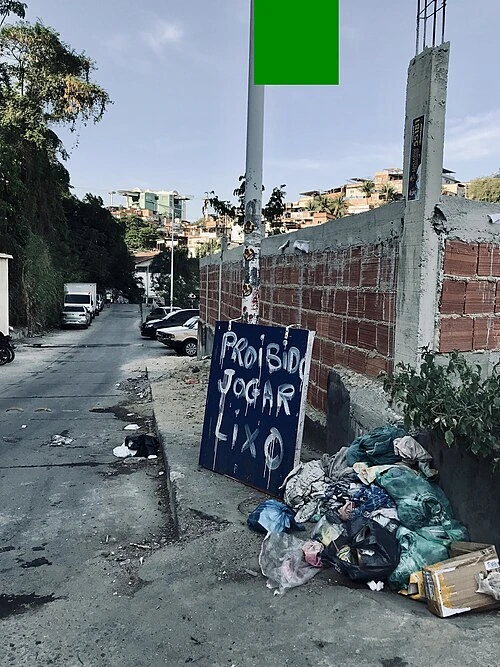
Portuguese no-dumping notice, Proibido jogar lixo, in Complexo do Alemão, photographed in 2024. Source-identified language; displayed without additional cropping.
Saved in Babelbook · resized display copy. Select the image to open it independently of its source.
Josiie23 · Source ↗CC BY-SA 4.0 ↗View the local visual field note
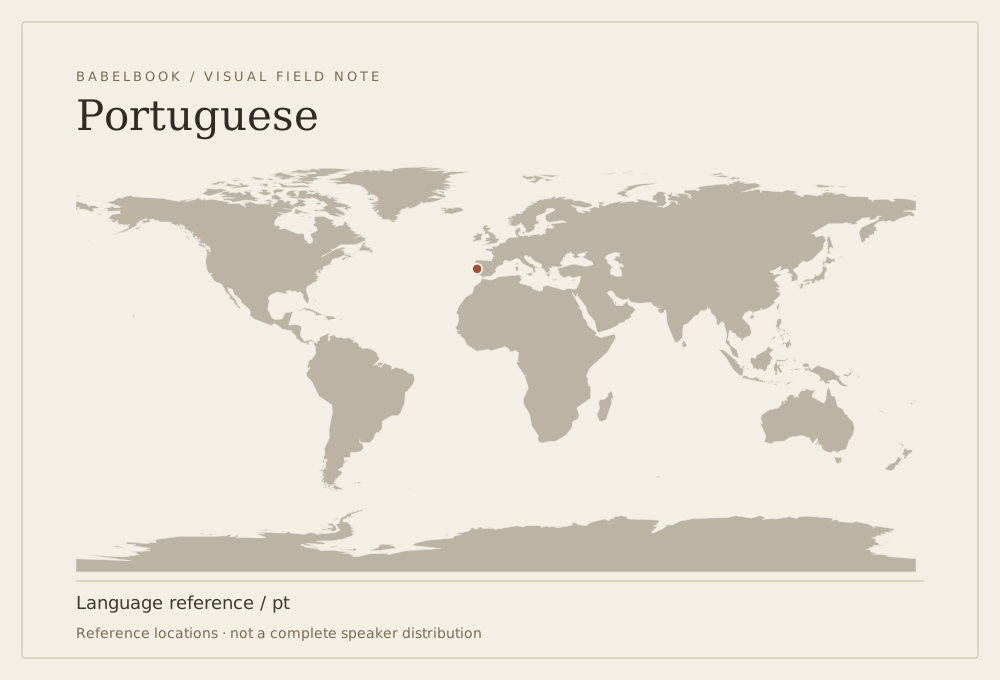
Representative reference points from Glottolog. Historical entries show reference locations, not current speakers. 1 point.
Reference & context ↗Babelbook · original editorial illustration · CC BY 4.0 · Glottolog locations; public-domain Natural Earth land
Source excerpts, selected, shortened and where noted editorially corrected from Portuguese language by Wikipedia contributors. Retrieved 2026-10-05. CC BY-SA 4.0. These excerpts are not an independently verified scholarly history; missing accounts are identified above.
Read further in the source
Origins and Roman period
Prior to Roman expansion, the territory corresponding to modern Portugal was inhabited by a heterogeneous set of peoples, including the Gallaeci, Lusitanians, Celts, Iberians, Phoenicians, Greeks, and Ligurians. These groups spoke a variety of languages that were gradually supplanted following Roman conquest, but not without leaving a substratum of lexical and morphological influence. A significant number of Portuguese words — often associated with the natural environment, agriculture, and material culture — are attributed to these pre-Roman sources. The Roman presence in the Iberian Peninsula began in 218 BC during the Second Punic War, initially as part of military operations against Carthage. Roman control expanded progressively, with the defeat of Carthaginian forces completed by 209 BC, although full territorial consolidation was not achieved until 19 BC under the rule of Augustus, following campaigns in the northern regions of Asturias and Cantabria. During this period, the territory was administratively organized into provinces such as Hispania Citerior and Hispania Ulterior, later restructured into Tarraconensis, Baetica, and Lusitania. By the late Roman Empire, the northwestern region was designated as the province of Gallaecia (approximately modern-day Galicia). Latin served as the administrative and ecclesiastical language of the Roman Empire, and proficiency in it was associated with access to public office and social advancement. The degree of Romanization varied regionally: southern areas, particularly Baetica, underwent rapid cultural assimilation and early adoption of Latin, whereas the northern regions, including Gallaecia, remained comparatively isolated and retained indigenous practices for a longer period. Latin spread from urban centers outward through cities, educational institutions and administrative networks, where proficiency in Latin was closely tied to the acquisition of Roman citizenship; the variety spoken by soldiers, settlers and officials was known as Vulgar Latin (sermo vulgaris), as distinct from Classical Latin, which was used in literary texts. In the northwestern periphery of the empire, the Vulgar Latin spoken in Gallaecia developed distinctive features, attributed in part to reduced contact with the imperial center. The most diagnostic phonetic change was the loss of intervocalic l and n, as in luna to lua ('moon'), dolor to dor ('pain'), and moneta to moeda ('coin') — a development not attested in neighbouring varieties such as Spanish. Geminate consonants were also simplified, as in caballu to cavalo ('horse') and annu to ano ('year'), and initial consonant clusters cl-, fl-, and pl- evolved into palatal sounds, as in flamma to chama ('flame'), pluvia to chuva ('rain'), and plumbum to chumbo ('lead'). In 409, the Iberian Peninsula was invaded by several Germanic and Iranian peoples, including the Vandals, Suebi, and Alans. The Visigoths of the Visigothic Kingdom, already established in Aquitaine and closely connected to Roman institutions, extended their rule over most of the peninsula during the 5th and 6th centuries. Their integration with the Hispano-Roman population was facilitated by measures such as the legalization of intermarriage under Leovigild, the conversion of Reccared I to Catholic Christianity in 586, and the promulgation of a unified legal code in 654 under Recceswinth. These developments contributed to the consolidation of a Romano-Visigothic society in which the vernacular remained a form of Hispano-Romance derived from Vulgar Latin. The Visigothic linguistic contribution to Portuguese was limited, consisting of fewer than forty commonly cited lexical items of Gothic origin, many shared with other Romance languages. Examples include guerra ('war'), espora ('spur'), roupa ('clothing'), and ganso ('goose').
Geographic distribution
Portuguese is spoken by approximately 200 million people in South America, 30 million in Africa, 15 million in Europe, 5 million in North America and 0.33 million in Asia and Oceania. It is the native language of the vast majority of the people in Portugal, Brazil and São Tomé and Príncipe (95%). Around 45% of the population of urban Angola speaks Portuguese natively, with approximately 85% fluent; these rates are lower in the countryside. Just over 50% (and rapidly increasing) of the population of Mozambique are native speakers of Portuguese, and 70% are fluent, according to the 2007 census. Portuguese is also spoken natively by 30% of the population in Guinea-Bissau, and a Portuguese-based creole is understood by all. Almost 50% of the East Timorese are fluent in Portuguese. No data is available for Cape Verde, but almost all the population is bilingual, and the monolingual population speaks the Portuguese-based Cape Verdean Creole. Portuguese is mentioned in the Constitution of South Africa as one of the languages spoken by communities within the country for which the Pan South African Language Board was charged with promoting and ensuring respect. There are also significant Portuguese-speaking immigrant communities in many territories including Andorra (17.1%), Bermuda, Canada (400,275 people in the 2006 census), France (1,625,000 people), Japan (400,000 people), Jersey, Luxembourg (about 25% of the population as of 2021), Namibia (about 4–5% of the population, mainly refugees from Angola in the north of the country), Paraguay (10.7% or 636,000 people), Switzerland (550,000 in 2019, learning + mother tongue), Venezuela (554,000), and the United States (868,900). In some parts of former Portuguese India, namely Goa, the language is still spoken by about 10,000 people. In 2014, an estimated 1,500 students were learning Portuguese in Goa. Portuguese was also used to file cases in the legal system of Daman and Diu up to the 1970s, with many laws still officially remaining written in Portuguese. Approximately 2% of the people of Macau, China are fluent speakers of Portuguese. Additionally, the language is being very actively studied in the Chinese school system right up to the doctorate level. The Kristang people in Malaysia speak Kristang, a Portuguese-Malay creole; however, the Portuguese language itself is not widely spoken in the country.
Official status
The Community of Portuguese Language Countries (in Portuguese Comunidade dos Países de Língua Portuguesa, with the Portuguese acronym CPLP) consists of the nine independent countries that have Portuguese as an official language: Angola, Brazil, Cape Verde, East Timor, Equatorial Guinea, Guinea-Bissau, Mozambique, Portugal and São Tomé and Príncipe. Equatorial Guinea made a formal application for full membership to the CPLP in June 2010, a status given only to states with Portuguese as an official language. Portuguese became its third official language (besides Spanish and French) in 2011, and in July 2014, the country was accepted as a member of the CPLP. Portuguese is also one of the official languages of the Special Administrative Region of the People's Republic of China of Macau (alongside Chinese) and of several international organizations, including Mercosul, the Organization of Ibero-American States, the Union of South American Nations, the Organization of American States, the African Union, the Economic Community of West African States, the Southern African Development Community and the European Union.
Current status and importance
Portuguese, being a language spread on all continents, has official status in several international organizations. It is one of twenty official languages of the European Union, an official language of NATO, the Organization of American States (alongside Spanish, French and English), and one of eighteen official languages of the European Space Agency. Portuguese is a working language in nonprofit organisations such as the Red Cross (alongside English, German, Spanish, French, Arabic and Russian), Amnesty International (alongside 32 other languages of which English is the most used, followed by Spanish, French, German, and Italian), and Médecins sans Frontières (used alongside English, Spanish, French and Arabic), in addition to being the official legal language in the African Court on Human and Peoples' Rights, also in Community of Portuguese Language Countries, an international organization formed essentially by lusophone countries.
Dialects, accents and varieties
Modern Standard European Portuguese (português padrão or português continental) is based on the Portuguese spoken in the area including and surrounding the cities of Coimbra and Lisbon, in central Portugal. Standard European Portuguese is also the preferred standard by the Portuguese-speaking African countries. As such, and despite the fact that its speakers are dispersed around the world, Portuguese has only two dialects used for learning: the European and the Brazilian. Some aspects and sounds found in many dialects of Brazil are exclusive to South America, and cannot be found in Europe. The same occur with the Santomean, Mozambican, Bissau-Guinean, Angolan and Cape Verdean dialects, being exclusive to Africa. See Portuguese in Africa. Audio samples of some dialects and accents of Portuguese are available below. There are some differences between the areas but these are the best approximations possible. IPA transcriptions refer to the names in local pronunciation.