Quechua
Quechua (; Spanish: [ˈketʃwa]), also called Runa simi in Southern Quechua (pronounced [ˈɾʊna ˈsɪmɪ], 'people's language'), is an indigenous language family that originated in central Peru and thereafter spread to other countries of the Andes. Derived from a common ancestral "Proto-Quechua" language, it is the most widely spoken pre-Columbian language family of the Americas, with an estimated 8–10 million speakers in 2004, and just under 7 million from the most recent census data available up to 2011. Approximately 13.9% (3.7 million) of Peruvians speak a Quechua language. Although Quechua began expanding many centuries before the Incas, that previous expansion also meant that it was the primary language family within the Inca Empire. The Spanish tolerated its use until the Peruvian struggle for independence in the 1780s. As a result, various Quechua languages are still widely spoken, being the majority language in a number of regions of Peru, the most-spoken or co-official language in many others, and, as the Kichwa language, the second most-spoken language of Ecuador, after Spanish.
Translate in Quechua ↗In 1975, Peru became the first country to recognize Quechua as one of its official languages. Ecuador conferred official status on the language in its 2006 constitution, and in 2009, Bolivia adopted a new constitution that recognized Quechua and several other indigenous languages as official languages of the country. The major obstacle to the usage and teaching of Quechua languages is the lack of written materials, such as books, newspapers, software, and magazines. The Bible has been translated into Quechua and is distributed by certain missionary groups. Quechua, along with Aymara and minor indigenous languages, remains essentially a spoken language. In recent years, Quechua has been introduced in intercultural bilingual education (IBE) in Peru, Bolivia, and Ecuador. Even in these areas, the governments are reaching only a part of the Quechua-speaking populations. Some indigenous people in each of the countries are having their children study in Spanish for social advancement. Radio Nacional del Perú broadcasts news and agrarian programs in Quechua for periods in the mornings. Quechua and Spanish are now heavily intermixed in much of the Andean region, with many hundreds of Spanish loanwords in Quechua. Similarly, Quechua phrases and words are commonly used by Spanish speakers. In southern rural Bolivia, for instance, many Quechua words such as wawa (infant), misi (cat), waska (strap or thrashing), are as commonly used as their Spanish counterparts, even in entirely Spanish-speaking areas. Quechua has also had a significant influence on other native languages of the Americas, such as Mapuche. It is difficult to measure the number of Quechua speakers. The number of speakers given varies widely according to the sources. The total in Ethnologue 16 is 10 million, primarily based on figures published 1987–2002, but with a few dating from the 1960s.
Central & South America
Present-day use
In 1975, Peru became the first country to recognize Quechua as one of its official languages. Ecuador conferred official status on the language in its 2006 constitution, and in 2009, Bolivia adopted a new constitution that recognized Quechua and several other indigenous languages as official languages of the country. The major obstacle to the usage and teaching of Quechua languages is the lack of written materials, such as books, newspapers, software, and magazines. The Bible has been translated into Quechua and is distributed by certain missionary groups. Quechua, along with Aymara and minor indigenous languages, remains essentially a spoken language. In recent years, Quechua has been introduced in intercultural bilingual education (IBE) in Peru, Bolivia, and Ecuador. Even in these areas, the governments are reaching only a part of the Quechua-speaking populations. Some indigenous people in each of the countries are having their children study in Spanish for social advancement. Radio Nacional del Perú broadcasts news and agrarian programs in Quechua for periods in the mornings. Quechua and Spanish are now heavily intermixed in much of the Andean region, with many hundreds of Spanish loanwords in Quechua. Similarly, Quechua phrases and words are commonly used by Spanish speakers. In southern rural Bolivia, for instance, many Quechua words such as wawa (infant), misi (cat), waska (strap or thrashing), are as commonly used as their Spanish counterparts, even in entirely Spanish-speaking areas. Quechua has also had a significant influence on other native languages of the Americas, such as Mapuche.
Origins
At first, Spaniards referred to the language of the Inca empire as the lengua general, the general tongue. The name quichua was first used in 1560 by Domingo de Santo Tomás in his Grammatica o arte de la lengua general de los indios de los reynos del Perú. It is not known what name the native speakers gave to their language before colonial times and whether it was Spaniards who called it quechua. There are two possible etymologies of Quechua as the name of the language. There is a possibility that the name Quechua was derived from *qiĉwa, the native word which originally meant the "temperate valley" altitude ecological zone in the Andes (suitable for maize cultivation) and to its inhabitants. Alternatively, Pedro Cieza de León and Inca Garcilaso de la Vega, the early Spanish chroniclers, mention the existence of a people called Quichua in the present Apurímac Region, and it could be inferred that their name was given to the entire language. The Hispanicised spellings Quechua and Quichua have been used in Peru and Bolivia since the 17th century, especially after the Third Council of Lima. Today, the various local pronunciations of "Quechua" include [ˈqʰeʃwa ~ ˈqʰeswa], [ˈχɪt͡ʃwa], [ˈkit͡ʃwa], and [ˈʔiʈ͡ʂwa]. Another name that native speakers give to their own language is runa simi, "language of man/people"; it also seems to have emerged during the colonial period.
Development
The Quechua linguistic homeland may have been Central Peru. It has been speculated that it may have been used in the Chavín and Wari civilizations. Quechua had already expanded across wide ranges of the central Andes long before the expansion of the Inca Empire. The Inca were one among many peoples in present-day Peru who already spoke a form of Quechua, which in the Cuzco region particularly has been heavily influenced by Aymara, hence some of the characteristics that still distinguish the Cuzco form of Quechua today. Diverse Quechua regional dialects and languages had already developed in different areas, influenced by local languages, before the Inca Empire expanded and further promoted Quechua as the official language of the Empire. After the Spanish conquest of Peru in the 16th century, Quechua continued to be used widely by the indigenous peoples as the "common language". It was officially recognized by the Spanish administration, and many Spaniards learned it in order to communicate with local peoples. The clergy of the Catholic Church adopted Quechua to use as the language of evangelization. The oldest written records of the language are by missionary Domingo de Santo Tomás, who arrived in Peru in 1538 and learned the language from 1540. He published his Grammatica o arte de la lengua general de los indios de los reynos del Perú (Grammar or Art of the General Language of the Indians of the Kingdoms of Peru) in 1560. Given its use by the Catholic missionaries, the range of Quechua continued to expand in some areas. In the late 18th century, colonial officials ended the administrative and religious use of Quechua. They banned it from public use in Peru after the Túpac Amaru II rebellion of indigenous peoples.
Writing
Quechua has been written using the Roman alphabet since the Spanish conquest of Peru. However, written Quechua is rarely used by Quechua speakers due to limited amounts of printed material in the language. Until the 20th century, Quechua was written with a Spanish-based orthography, for example Inca, Huayna Cápac, Collasuyo, Mama Ocllo, Viracocha, quipu, tambo, condor. This orthography is the most familiar to Spanish speakers, and so it has been used for most borrowings into English, which essentially always happen through Spanish. In 1975, the Peruvian government of Juan Velasco Alvarado adopted a new orthography for Quechua. This is the system preferred by the Academia Mayor de la Lengua Quechua, which results in the following spellings of the examples listed above: Inka, Wayna Qhapaq, Qollasuyu, Mama Oqllo, Wiraqocha, khipu, tampu, kuntur. This orthography has the following features: It uses w instead of hu for /w/. It distinguishes velar k from uvular q, both of which were spelled c or qu in the traditional system. It distinguishes simple, ejective, and aspirated stops in dialects that make these distinctions, such as that of the Cusco Region, e.g. the aspirated khipu 'knot'. It continues to use the Spanish five-vowel system. In 1985, a variation of this system was adopted by the Peruvian government that uses the Quechuan three-vowel system, resulting in the following spellings: Inka, Wayna Qhapaq, Qullasuyu, Mama Uqllu, Wiraqucha, khipu, tampu, kuntur. The different orthographies are still highly controversial in Peru. Advocates of the traditional system believe that the new orthographies look too foreign and believe that it makes Quechua harder to learn for people who have first been exposed to written Spanish.
Beyond the typeface.
Signs, manuscripts, published pages and contextual photographs, with their place, period, source and reuse terms. Captions identify historical spellings, regional examples, community references and character imagery.
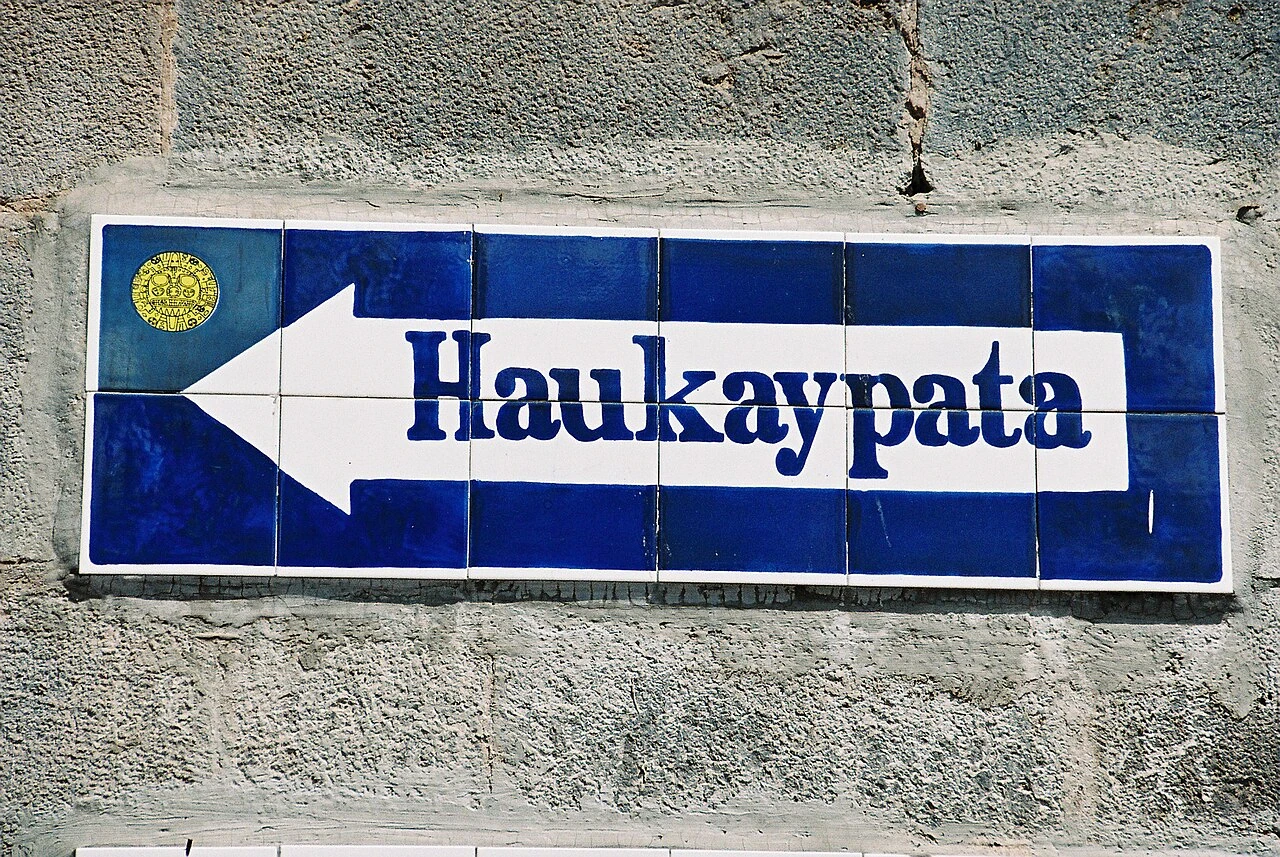
A Quechua place-name used on a street sign in Cusco, Peru.
Saved in Babelbook · resized display copy. Select the image to open it independently of its source.
AgainErick (Eric Bronder) · Source ↗CC BY-SA 3.0 ↗View the local visual field note
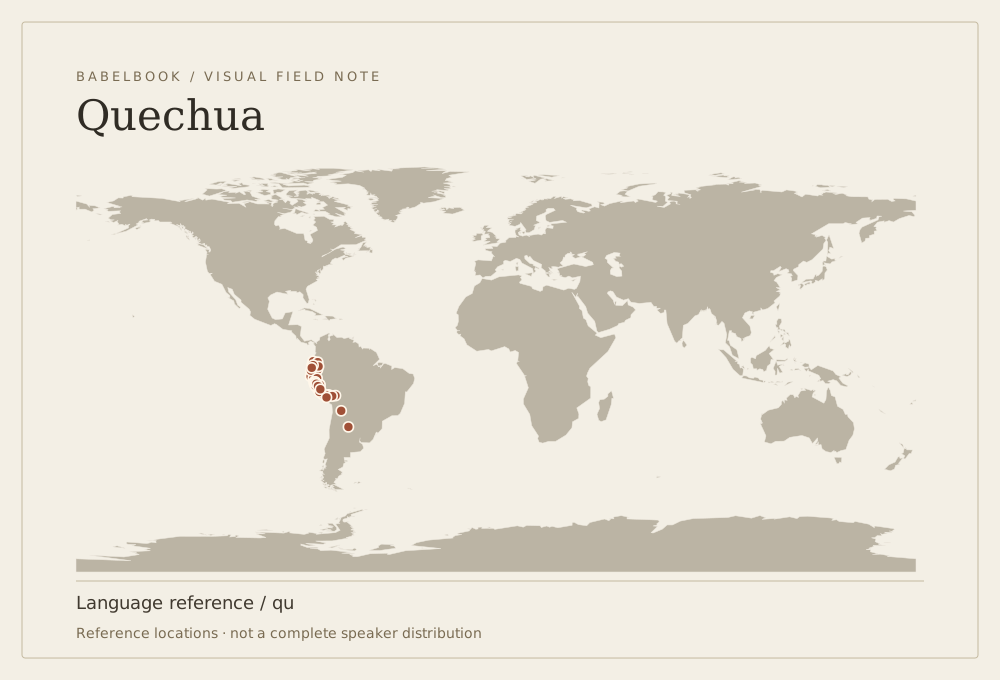
Representative reference points from Glottolog. Historical entries show reference locations, not current speakers. 43 points.
Reference & context ↗Babelbook · original editorial illustration · CC BY 4.0 · Glottolog locations; public-domain Natural Earth land
Source excerpts, selected, shortened and where noted editorially corrected from Quechuan languages by Wikipedia contributors. Retrieved 2026-10-05. CC BY-SA 4.0. These excerpts are not an independently verified scholarly history; missing accounts are identified above.
Read further in the source
History
The Quechua linguistic homeland may have been Central Peru. It has been speculated that it may have been used in the Chavín and Wari civilizations. Quechua had already expanded across wide ranges of the central Andes long before the expansion of the Inca Empire. The Inca were one among many peoples in present-day Peru who already spoke a form of Quechua, which in the Cuzco region particularly has been heavily influenced by Aymara, hence some of the characteristics that still distinguish the Cuzco form of Quechua today. Diverse Quechua regional dialects and languages had already developed in different areas, influenced by local languages, before the Inca Empire expanded and further promoted Quechua as the official language of the Empire. After the Spanish conquest of Peru in the 16th century, Quechua continued to be used widely by the indigenous peoples as the "common language". It was officially recognized by the Spanish administration, and many Spaniards learned it in order to communicate with local peoples. The clergy of the Catholic Church adopted Quechua to use as the language of evangelization. The oldest written records of the language are by missionary Domingo de Santo Tomás, who arrived in Peru in 1538 and learned the language from 1540. He published his Grammatica o arte de la lengua general de los indios de los reynos del Perú (Grammar or Art of the General Language of the Indians of the Kingdoms of Peru) in 1560. Given its use by the Catholic missionaries, the range of Quechua continued to expand in some areas. In the late 18th century, colonial officials ended the administrative and religious use of Quechua. They banned it from public use in Peru after the Túpac Amaru II rebellion of indigenous peoples. The Crown banned "loyal" pro-Catholic texts in Quechua, such as Garcilaso de la Vega's Comentarios Reales. Despite a brief revival of the language immediately after the Latin American nations achieved independence in the 19th century, the prestige of Quechua had decreased sharply. Gradually its use declined so that it was spoken mostly by indigenous people in the more isolated and conservative rural areas. Nevertheless, in the 21st century, Quechua language speakers number roughly 7 million people across South America, more than any other indigenous language family in the Americas. As a result of Inca expansion into Central Chile, there were bilingual Quechua-Mapudungu Mapuche in Central Chile at the time of the Spanish arrival. It has been argued that Mapuche, Quechua, and Spanish coexisted in Central Chile, with significant bilingualism, during the 17th century. Alongside Mapudungun, Quechua is the indigenous language that has influenced Chilean Spanish the most. Quechua-Aymara and mixed Quechua-Aymara-Mapudungu toponymy can be found as far south as Osorno Province in Chile (latitude 41° S). In 2017 the first thesis defense done in Quechua in Europe was done by Peruvian Carmen Escalante Gutiérrez at Pablo de Olavide University (Sevilla). The same year Pablo Landeo wrote the first novel in Quechua without a Spanish translation. A Peruvian student, Roxana Quispe Collantes of the University of San Marcos, completed and defended the first thesis in the language group in 2019; it concerned the works of poet Andrés Alencastre Gutiérrez and it was also the first non-Spanish native language thesis done at that university. Currently, there are different initiatives that promote Quechua in the Andes and across the world: many universities offer Quechua classes, a community-based organization such as Elva Ambía's Quechua Collective of New York promote the language, and governments are training interpreters in Quechua to serve in healthcare, justice, and bureaucratic facilities.
Current status
In 1975, Peru became the first country to recognize Quechua as one of its official languages. Ecuador conferred official status on the language in its 2006 constitution, and in 2009, Bolivia adopted a new constitution that recognized Quechua and several other indigenous languages as official languages of the country. The major obstacle to the usage and teaching of Quechua languages is the lack of written materials, such as books, newspapers, software, and magazines. The Bible has been translated into Quechua and is distributed by certain missionary groups. Quechua, along with Aymara and minor indigenous languages, remains essentially a spoken language. In recent years, Quechua has been introduced in intercultural bilingual education (IBE) in Peru, Bolivia, and Ecuador. Even in these areas, the governments are reaching only a part of the Quechua-speaking populations. Some indigenous people in each of the countries are having their children study in Spanish for social advancement. Radio Nacional del Perú broadcasts news and agrarian programs in Quechua for periods in the mornings. Quechua and Spanish are now heavily intermixed in much of the Andean region, with many hundreds of Spanish loanwords in Quechua. Similarly, Quechua phrases and words are commonly used by Spanish speakers. In southern rural Bolivia, for instance, many Quechua words such as wawa (infant), misi (cat), waska (strap or thrashing), are as commonly used as their Spanish counterparts, even in entirely Spanish-speaking areas. Quechua has also had a significant influence on other native languages of the Americas, such as Mapuche.
Number of speakers
It is difficult to measure the number of Quechua speakers. The number of speakers given varies widely according to the sources. The total in Ethnologue 16 is 10 million, primarily based on figures published 1987–2002, but with a few dating from the 1960s. The figure for Imbabura Highland Quechua in Ethnologue, for example, is 300,000, an estimate from 1977. The missionary organization FEDEPI, on the other hand, estimated one million Imbabura dialect speakers (published 2006). Census figures are also problematic, due to under-reporting. The 2001 Ecuador census reports only 500,000 Quechua speakers, compared to the estimate in most linguistic sources of more than 2 million. The censuses of Peru (2007) and Bolivia (2001) are thought to be more reliable.
Argentina: 900,000 (1971) Bolivia: 2,100,000 (2001 census); 2,800,000 South Bolivian (1987) Chile: few, if any; 8,200 in ethnic group (2002 census) Colombia: 4,402 to 16,000 Ecuador: 2,300,000 (Adelaar 1991) Peru: 3,800,000 (2017 census); 3,500,000 to 4,400,000 (Adelaar 2000) Additionally, there is an unknown number of speakers in emigrant communities.
Geographical distribution
Quechua I (Central Quechua, Waywash) is spoken in Peru's central highlands, from the Ancash Region to Huancayo. It is the most diverse branch of Quechua, to the extent that its divisions are commonly considered different languages. Quechua II (Peripheral Quechua, Wamp'una "Traveler")
II-A: Yunkay Quechua (North Peruvian Quechua) is scattered in Peru's occidental highlands. II-B: Northern Quechua (also known as Runashimi or, especially in Ecuador, Kichwa) is mainly spoken in Colombia and Ecuador. It is also spoken in the Amazonian lowlands of Colombia and Ecuador, and in pockets of Peru. II-C: Southern Quechua, in the highlands further south, from Huancavelica through the Ayacucho, Cusco, and Puno regions of Peru, across much of Bolivia, and in pockets in north-western Argentina. It is the most influential branch, with the largest number of speakers and the most important cultural and literary legacy.
Orthography
Quechua has been written using the Roman alphabet since the Spanish conquest of Peru. However, written Quechua is rarely used by Quechua speakers due to limited amounts of printed material in the language. Until the 20th century, Quechua was written with a Spanish-based orthography, for example Inca, Huayna Cápac, Collasuyo, Mama Ocllo, Viracocha, quipu, tambo, condor. This orthography is the most familiar to Spanish speakers, and so it has been used for most borrowings into English, which essentially always happen through Spanish. In 1975, the Peruvian government of Juan Velasco Alvarado adopted a new orthography for Quechua. This is the system preferred by the Academia Mayor de la Lengua Quechua, which results in the following spellings of the examples listed above: Inka, Wayna Qhapaq, Qollasuyu, Mama Oqllo, Wiraqocha, khipu, tampu, kuntur. This orthography has the following features:
It uses w instead of hu for /w/. It distinguishes velar k from uvular q, both of which were spelled c or qu in the traditional system. It distinguishes simple, ejective, and aspirated stops in dialects that make these distinctions, such as that of the Cusco Region, e.g. the aspirated khipu 'knot'. It continues to use the Spanish five-vowel system. In 1985, a variation of this system was adopted by the Peruvian government that uses the Quechuan three-vowel system, resulting in the following spellings: Inka, Wayna Qhapaq, Qullasuyu, Mama Uqllu, Wiraqucha, khipu, tampu, kuntur. The different orthographies are still highly controversial in Peru. Advocates of the traditional system believe that the new orthographies look too foreign and believe that it makes Quechua harder to learn for people who have first been exposed to written Spanish. Those who prefer the new system maintain that it better matches the phonology of Quechua, and they point to studies showing that teaching the five-vowel system to children later causes reading difficulties in Spanish. For more on this, see Quechuan and Aymaran spelling shift. Writers differ in the treatment of Spanish loanwords. These are sometimes adapted to modern orthography and sometimes left as in Spanish. For instance, "I am Roberto" could be written Robertom kani or Ruwirtum kani. (The -m is not part of the name; it is an evidential suffix, showing how the information is known: firsthand, in this case.) In Cusco, Peru, the ancient capital of the Incas, there is a debate where some scholars claim that Quechua has three vowels while others claim it has five. The Peruvian linguist Rodolfo Cerrón Palomino has proposed an orthographic norm for all of Southern Quechua: this Standard Quechua (el Quechua estándar or Hanan Runasimi) conservatively integrates features of the two widespread dialects Ayacucho Quechua and Cusco Quechua. For instance:
The Spanish-based orthography is now in conflict with Peruvian law. According to article 20 of the decree Decreto Supremo No 004-2016-MC, which approves regulations relative to Law 29735, published in the official newspaper El Peruano on July 22, 2016, adequate spellings of the toponyms in the normalized alphabets of the indigenous languages must progressively be proposed, with the aim of standardizing the spellings used by the National Geographic Institute (Instituto Geográfico Nacional, IGN) The IGN implements the necessary changes on the official maps of Peru.