Romansh
Romansh ( roh-MA(H)NSH; sometimes also spelled Romansch and Rumantsch) is a Romance language of the Gallo-Romance and/or Rhaeto-Romance branch of languages spoken predominantly in the Swiss canton of the Grisons (Graubünden). Romansh has been recognized as a national language of Switzerland since 1938, and as an official language in correspondence with Romansh-speaking citizens since 1996, along with German, French, and Italian. It also has official status in the canton of the Grisons alongside German and Italian and is used as the medium of instruction in schools in Romansh-speaking areas. It is sometimes grouped by linguists with Ladin and Friulian as the Rhaeto-Romance languages, though this is disputed. Romansh is one of the descendant languages of the spoken Latin language of the Roman Empire, which by the 5th century AD replaced the Celtic and Raetic languages previously spoken in the area. Romansh retains a small number of words from these languages. Romansh has also been strongly influenced by German in vocabulary and morphosyntax. The language gradually retreated to its current area over the centuries, being replaced in other areas by Alemannic and Bavarian dialects. The earliest writing identified as Romansh dates from the 10th or 11th century, although major works did not appear until the 16th century, when several regional written varieties began to develop.
Translate in Romansh ↗In Switzerland, official language use is governed by the "territorial principle": Cantonal law determines which of the four national languages enjoys official status in which part of the territory. Only the federal administration is officially quadrilingual. Romansh is an official language at the federal level, one of the three official languages of the Canton of the Grisons, and is a working language in various districts and numerous municipalities within the canton. The first Swiss constitution of 1848, as well as the subsequent revision of 1872, made no mention of Romansh, which at the time was not a working language of the Canton of the Grisons either. The federal government did finance a translation of the constitution into the two Romansh varieties Sursilvan and Vallader in 1872, noting, however, that these did not carry the force of law. Romansh became a national language of Switzerland in 1938, following a referendum. A distinction was introduced between "national languages" and "official languages". The status of a national language was largely symbolic, whereas only official languages were to be used in official documents, a status reserved for German, French, and Italian. The recognition of Romansh as the fourth national language is best seen within the context of the "Spiritual defence" preceding World War II, which aimed to underline the special status of Switzerland as a multinational country. Additionally, this was supposed to discredit the efforts of Italian nationalists to claim Romansh as a dialect of Italian and establish a claim to parts of the Grisons. The Romansh language movement led by the Lia Rumantscha was mostly satisfied with the status as a national but not official language. Their aims at the time were to secure a symbolic "right of residence" for Romansh, and not actual use in official documents. This status did have disadvantages. For instance, official name registers and property titles had to be in German, French, or Italian.
Europe
Present-day use
Romansh originates from the spoken Latin brought to the region by Roman soldiers, merchants, and officials following the conquest of the modern-day Grisons area by the Romans in 15 BC. Before that, the inhabitants spoke Celtic and Raetic languages, with Raetic apparently being spoken mainly in the Lower Engadine valley. Traces of these languages survive mainly in toponyms, including village names such as Tschlin, Scuol, Savognin, Glion, Breil/Brigels, Brienz/Brinzauls, Purtenza, and Trun. Additionally, a small number of pre-Latin words have survived in Romansh, mainly concerning animals, plants, and geological features unique to the Alps, such as camutsch "chamois" and grava "scree". It is unknown how rapidly the Celtic and Raetic inhabitants were Romanized following the conquest of Raetia. Some linguists assume that the area was rapidly Romanized following the Roman conquest, whereas others think that this process did not end until the 4th or 5th century, when more thoroughly Romanized Celts from farther north fled south to avoid invasions by Germanic tribes. The process was certainly complete and the pre-Roman languages extinct by the 5th–6th century, when Raetia became part of the Ostrogothic Kingdom. Around 537 AD, the Ostrogoths handed over the province of Raetia Prima to the Frankish Empire, which continued to have local rulers administering the so-called Duchy of Chur. However, after the death of the last Victorid ruler, Bishop Tello, around 765 AD, Charlemagne assigned a Germanic duke to administer the region. Additionally, the Diocese of Chur was transferred by the (pre-Schism) Roman Catholic Church from the Archdiocese of Milan to the Diocese of Mainz in 843 AD. The combined effect was a cultural reorientation towards the German-speaking north, especially as the ruling élite now comprised almost entirely speakers of German. At the time, Romansh was spoken over a much wider area, stretching north into the present-day cantons of Glarus and St.
Origins
Romansh originates from the spoken Latin brought to the region by Roman soldiers, merchants, and officials following the conquest of the modern-day Grisons area by the Romans in 15 BC. Before that, the inhabitants spoke Celtic and Raetic languages, with Raetic apparently being spoken mainly in the Lower Engadine valley. Traces of these languages survive mainly in toponyms, including village names such as Tschlin, Scuol, Savognin, Glion, Breil/Brigels, Brienz/Brinzauls, Purtenza, and Trun. Additionally, a small number of pre-Latin words have survived in Romansh, mainly concerning animals, plants, and geological features unique to the Alps, such as camutsch "chamois" and grava "scree". It is unknown how rapidly the Celtic and Raetic inhabitants were Romanized following the conquest of Raetia. Some linguists assume that the area was rapidly Romanized following the Roman conquest, whereas others think that this process did not end until the 4th or 5th century, when more thoroughly Romanized Celts from farther north fled south to avoid invasions by Germanic tribes. The process was certainly complete and the pre-Roman languages extinct by the 5th–6th century, when Raetia became part of the Ostrogothic Kingdom. Around 537 AD, the Ostrogoths handed over the province of Raetia Prima to the Frankish Empire, which continued to have local rulers administering the so-called Duchy of Chur. However, after the death of the last Victorid ruler, Bishop Tello, around 765 AD, Charlemagne assigned a Germanic duke to administer the region. Additionally, the Diocese of Chur was transferred by the (pre-Schism) Roman Catholic Church from the Archdiocese of Milan to the Diocese of Mainz in 843 AD. The combined effect was a cultural reorientation towards the German-speaking north, especially as the ruling élite now comprised almost entirely speakers of German. At the time, Romansh was spoken over a much wider area, stretching north into the present-day cantons of Glarus and St.
Development
Romansh originates from the spoken Latin brought to the region by Roman soldiers, merchants, and officials following the conquest of the modern-day Grisons area by the Romans in 15 BC. Before that, the inhabitants spoke Celtic and Raetic languages, with Raetic apparently being spoken mainly in the Lower Engadine valley. Traces of these languages survive mainly in toponyms, including village names such as Tschlin, Scuol, Savognin, Glion, Breil/Brigels, Brienz/Brinzauls, Purtenza, and Trun. Additionally, a small number of pre-Latin words have survived in Romansh, mainly concerning animals, plants, and geological features unique to the Alps, such as camutsch "chamois" and grava "scree". It is unknown how rapidly the Celtic and Raetic inhabitants were Romanized following the conquest of Raetia. Some linguists assume that the area was rapidly Romanized following the Roman conquest, whereas others think that this process did not end until the 4th or 5th century, when more thoroughly Romanized Celts from farther north fled south to avoid invasions by Germanic tribes. The process was certainly complete and the pre-Roman languages extinct by the 5th–6th century, when Raetia became part of the Ostrogothic Kingdom. Around 537 AD, the Ostrogoths handed over the province of Raetia Prima to the Frankish Empire, which continued to have local rulers administering the so-called Duchy of Chur. However, after the death of the last Victorid ruler, Bishop Tello, around 765 AD, Charlemagne assigned a Germanic duke to administer the region. Additionally, the Diocese of Chur was transferred by the (pre-Schism) Roman Catholic Church from the Archdiocese of Milan to the Diocese of Mainz in 843 AD. The combined effect was a cultural reorientation towards the German-speaking north, especially as the ruling élite now comprised almost entirely speakers of German. At the time, Romansh was spoken over a much wider area, stretching north into the present-day cantons of Glarus and St.
Writing
Romansh is written in the Latin alphabet, and mostly follows a phonemic orthography, with a high correspondence between letters and sounds. The orthography varies slightly depending on the variety. The vowel inventories of the five regional written varieties differ widely (in particular in regards to diphthongs), and the pronunciation often differs depending on the dialect even within them. The orthography of Sutsilvan is particularly complex, allowing for different pronunciations of the vowels depending on the regional dialect, and is not treated in this table.
Beyond the typeface.
Signs, manuscripts, published pages and contextual photographs, with their place, period, source and reuse terms. Captions identify historical spellings, regional examples, community references and character imagery.
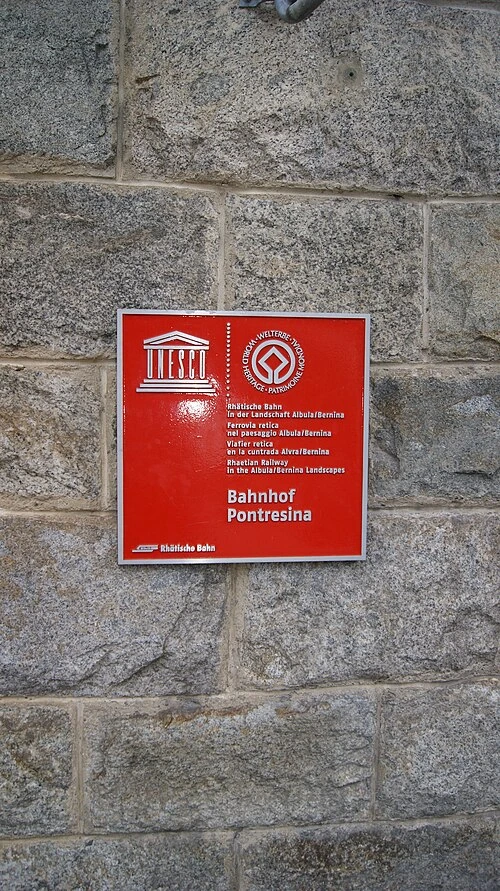
World Heritage plaque at Pontresina railway station; Commons language category identifies Romansh alongside English, French, German and Italian. Language identification follows Commons metadata; not independently transcribed.
Saved in Babelbook · resized display copy. Select the image to open it independently of its source.
Asurnipal · Source ↗CC BY-SA 4.0 ↗View the local visual field note
Representative reference points from Glottolog. Historical entries show reference locations, not current speakers. 1 point.
Reference & context ↗Babelbook · original editorial illustration · CC BY 4.0 · Glottolog locations; public-domain Natural Earth land
Source excerpts, selected, shortened and where noted editorially corrected from Romansh language by Wikipedia contributors. Retrieved 2026-10-05. CC BY-SA 4.0. These excerpts are not an independently verified scholarly history; missing accounts are identified above.
Read further in the source
Dialects
Romansh comprises a group of closely related dialects, which are most commonly divided into five different varieties, each of which has developed a standardized form. These regional standards are referred to as idioms in Romansh to distinguish them from the local vernaculars, which are referred to as dialects. These dialects form a dialect continuum without clear-cut divisions. Historically a continuous speech area, this continuum has now been ruptured by the spread of German, so that Romansh is now geographically divided into at least two non-adjacent parts.
Sursilvan (Sursilvan: ; derived from the name of the Surselva region, which itself is derived from sur "above" and selva "forest") – spoken in the Vorderrhein (Sursilvan: Rein Anteriur) valley, including the Lumnezia, Foppa, and Cadi. It is the most widely spoken variety, with 17,897 people or 54.8% within its historical region (including Imboden/Plaun, where Sursilvan is written but Sutsilvan spoken, with the exception of Sursilvan-speaking Flims/Flem) naming Romansh as a habitually spoken language in the Swiss census of 2000. Sutsilvan (Sutsilvan, Rumantsch Grischun: sutsilvan; Vallader: suotsilvan; Putèr: suotsilvaun; derived from sut "below" and selva "forest") – spoken in the Hinterrhein (Sutsilvan: Ragn Posteriur) valley, including Schams/Schons, Domleschg/Tumleastga, and Heinzenberg/Mantogna. In Imboden/Plaun, with the exception of Sursilvan-speaking Flims/Flem, they speak Sutsilvan but write Sursilvan. Sutsilvan is the least widely spoken Romansh variety, with 1,111 people or 15.4% within its historical area (excluding Imboden/Plaun) naming Romansh as a habitually spoken language. It has become extinct across much of its historical area since the turn of the 20th century. Surmiran (Surmiran: surmiran; derived from sur "above" and meir "wall") – spoken in the Gelgia and Albula/Alvra valleys, including Surses and Sutses. Romansh was named by 3,038 people within the historically Surmiran-writing area (44%) as a habitually spoken language in the census of 2000. Putèr (Romansh: ; probably originally a nickname derived from put "porridge", meaning "porridge-eaters") – spoken in the Upper Engadine (Putèr and Vallader: Engiadin'Ota), as well as in the village of Brail in Zernez, where they, however, write Vallader. Romansh was named by 5,497 people or 30% within the Upper Engadine and Bergün Filisur (where Putèr is written but a non-Putèr dialect is spoken) as a habitually spoken language in the census of 2000. Vallader (Vallader: ; derived from val "valley") – spoken in the Lower Engadine (Vallader and Putèr: Engiadina Bassa), with the exception of Putèr-speaking Brail – where they nevertheless write Vallader – and in the Val Müstair. It is the second most commonly spoken variety of Romansh, with 6,448 people in the Lower Engadine and Val Müstair (79.2%) naming Romansh as a habitually spoken language in the census of 2000. Aside from these five major dialects, two additional varieties are often distinguished. One is the dialect of the Val Müstair, which is closely related to Vallader but often separately referred to as Jauer (Romansh: jauer; derived from the personal pronoun jau "I", i.e. "the jau-sayers"). Less commonly distinguished is the dialect of Tujetsch and the Val Medel, which is markedly different from Sursilvan and is referred to as Tuatschin. Additionally, the standardized variety Rumantsch Grischun, intended for pan-regional use, was introduced in 1982. The dialect of the Val Bregaglia is usually considered a variety of Lombard, and speakers use Italian as their written language, even though the dialect shares many features with the neighboring Putèr dialect of Romansh. As these varieties form a continuum with small transitions from each village to the next, there is no straightforward internal grouping of the Romansh dialects. The Romansh language area can be described best as consisting of two widely divergent varieties, Sursilvan in the west and the dialects of the Engadine in the east, with Sutsilvan and Surmiran forming a transition zone between them. The Engadinese varieties Putèr and Vallader are often referred to as one specific variety known as Ladin (Ladin, Sursilvan, Surmiran, and Rumantsch Grischun: ; Sutsilvan: ladegn), which is not to be confused with the closely related language in Italy's Dolomite mountains also known as Ladin. Sutsilvan and Surmiran are sometimes grouped together as Central Romansh (rm. Grischun central), and then grouped together with Sursilvan as "Rhenish Romansh" (in German, "Rheinischromanisch"). One feature that separates the Rhenish varieties from Ladin is the retention of the rounded front vowels /y/ and /ø/ (written ü and ö) in Ladin, which have been unrounded in the other dialects, as in Ladin , Sursilvan , Surmiran meir "wall" or Ladin to Rhenish "cheese". Another is the development of Latin -CT-, which has developed into /tɕ/ in the Rhenish varieties as in détg "said" or fatg "did", while developing into /t/ in Ladin (dit and fat). A feature separating Sursilvan from Central Romansh, however, involves the extent of palatalization of Latin /k/ in front of /a/, which is rare in Sursilvan but common in the other varieties: Sursilvan , Sutsilvan tgea, Surmiran tgesa, Putèr , and Vallader "house". Overall, however, the Central Romansh varieties do not share many unique features, but rather connect Sursilvan and Ladin through a succession of numerous small differences from one village to the next. The dialects of Romansh are not always mutually comprehensible. Speakers of Sursilvan and Ladin, in particular, are usually unable to understand each other initially. Because speakers usually identify themselves primarily with their regional dialect, many do not take the effort to attempt to understand unfamiliar dialects, and prefer to speak Swiss German with speakers of other varieties. A common Romansh identity is not widespread outside intellectual circles, even though this has been changing among the younger generation.
Origins and development until modern times
Romansh originates from the spoken Latin brought to the region by Roman soldiers, merchants, and officials following the conquest of the modern-day Grisons area by the Romans in 15 BC. Before that, the inhabitants spoke Celtic and Raetic languages, with Raetic apparently being spoken mainly in the Lower Engadine valley. Traces of these languages survive mainly in toponyms, including village names such as Tschlin, Scuol, Savognin, Glion, Breil/Brigels, Brienz/Brinzauls, Purtenza, and Trun. Additionally, a small number of pre-Latin words have survived in Romansh, mainly concerning animals, plants, and geological features unique to the Alps, such as camutsch "chamois" and grava "scree".
It is unknown how rapidly the Celtic and Raetic inhabitants were Romanized following the conquest of Raetia. Some linguists assume that the area was rapidly Romanized following the Roman conquest, whereas others think that this process did not end until the 4th or 5th century, when more thoroughly Romanized Celts from farther north fled south to avoid invasions by Germanic tribes. The process was certainly complete and the pre-Roman languages extinct by the 5th–6th century, when Raetia became part of the Ostrogothic Kingdom. Around 537 AD, the Ostrogoths handed over the province of Raetia Prima to the Frankish Empire, which continued to have local rulers administering the so-called Duchy of Chur. However, after the death of the last Victorid ruler, Bishop Tello, around 765 AD, Charlemagne assigned a Germanic duke to administer the region. Additionally, the Diocese of Chur was transferred by the (pre-Schism) Roman Catholic Church from the Archdiocese of Milan to the Diocese of Mainz in 843 AD. The combined effect was a cultural reorientation towards the German-speaking north, especially as the ruling élite now comprised almost entirely speakers of German. At the time, Romansh was spoken over a much wider area, stretching north into the present-day cantons of Glarus and St. Gallen, to the Walensee in the northwest, and Rüthi and the Alpine Rhine Valley in the northeast. In the east, parts of modern-day Vorarlberg were Romansh-speaking, as were parts of Tyrol. The northern areas, called Lower Raetia, became German-speaking by the 12th century; and by the 15th century, the Rhine Valley of St. Gallen and the areas around the Walensee were entirely German-speaking. This language shift was a long, drawn-out process, with larger, central towns adopting German first, while the more peripheral areas around them remained Romansh-speaking longer. The shift to German was caused in particular by the influence of the local German-speaking élites and by German-speaking immigrants from the north, with the lower and rural classes retaining Romansh longer. In addition, beginning around 1270, the German-speaking Walser began settling in sparsely populated or uninhabited areas within the Romansh-speaking heartland. The Walser sometimes expanded into Romansh-speaking areas from their original settlements, which then often became German-speaking, such as Davos, Schanfigg, the Prättigau, Schams, and Valendas, which became German-speaking by the 14th century. In rare cases, these Walser settlements were eventually assimilated by their Romansh-speaking neighbors; for instance, Surses, Medel, and Tujetsch in the Surselva region.
The Germanization of Chur had particularly long-term consequences. Even though the city had long before ceased to be a cultural center of Romansh, the spoken language of the capital of the Diocese of Chur continued to be Romansh until the 15th century. After a fire in 1465 which virtually destroyed the city, many German-speaking artisans who had been called in to help repair the damage settled there, causing German to become the majority language. In a chronicle written in 1571–72, Durich Chiampell mentions that Romansh was still spoken in Chur roughly a hundred years before, but had since then rapidly given way to German and was now not much appreciated by the inhabitants of the city. Many linguists regard the loss of Chur to German as a crucial event. According to Sylvia Osswald, for example, it occurred precisely at a time when the introduction of the printing press could have led to the adoption of the Romansh dialect of the capital as a common written language for all Romansh speakers. Other linguists such as Jachen Curdin Arquint remain skeptical of this view, however, and assume that the various Romansh-speaking regions would still have developed their own separate written standards. Instead, several regional written varieties of Romansh began appearing during the 16th century. Gian Travers wrote the first surviving work in Romansh, the Chianzun dalla guerra dagl Chiaste da Müs, in the Putèr dialect. This epic poem, written in 1527, describes the first Musso war, in which Travers himself had taken part. Travers also translated numerous biblical plays into Romansh, though only the titles survive for many of them. Another early writer, Giachem Bifrun, who also wrote in Putèr, penned the first printed book in Romansh, a catechism published in 1552. In 1560 he published a translation of the New Testament: L'g Nuof Sainc Testamaint da nos Signer Jesu Christ. Two years later, in 1562, another writer from the Engadine, Durich Chiampel, published the Cudesch da Psalms, a collection of church songs in the Vallader dialect. These early works are generally well written and show that the authors had a large amount of Romansh vocabulary at their disposal, contrary to what one might expect of the first pieces of writing in a language. Because of this, the linguist Ricarda Liver assumes that these written works built on an earlier, pre-literature tradition of using Romansh in administrative and legal situations, of which no evidence survives. In their prefaces, the authors themselves often mention the novelty of writing Romansh, and discuss an apparently common prejudice that Romansh was a language that could not be written.
The first writing in the Sursilvan and Sutsilvan dialects appears in the 17th century. As in the Engadine, these early works usually focused on religious themes, in particular the struggles between Protestants and Counter-Reformers. Daniel Bonifaci produced the first surviving work in this category, the catechism Curt mussameint dels principals punctgs della Christianevla Religiun, published in 1601 in the Sutsilvan dialect. A second edition, published in 1615, is closer to Sursilvan, however, and writings in Sutsilvan do not appear again until the 20th century. In 1611, Igl Vêr Sulaz da pievel giuvan ("The true joys of young people"), a series of religious instructions for Protestant youths, was published by Steffan Gabriel. Four years later, in 1615, a Catholic catechism, Curt Mussament, was published in response, written by Gion Antoni Calvenzano. The first translation of the New Testament into Sursilvan was published in 1648 by the son of Steffan Gabriel, Luci Gabriel. The first complete translation of the Bible, the Bibla da Cuera, was published between 1717 and 1719. The Sursilvan dialect thus had two separate written varieties, one used by the Protestants with its cultural center around Ilanz, and a Catholic variety with the Disentis Abbey as its center. The Engadine dialect was also written in two varieties: Putèr in the Upper Valley and Vallader in the Lower Valley. The Sutsilvan areas either used the Protestant variety of Sursilvan, or simply used German as their main written language. The Surmiran region began developing its own variety in the early 18th century, with a catechism being published in 1703, though either the Catholic variety of Sursilvan or Putèr was more commonly used there until the 20th century. In the 16th century, the language border between Romansh and German largely stabilized, and it remained almost unchanged until the late 19th century. During this period, only isolated areas became German-speaking, mainly a few villages around Thusis and the village of Samnaun. In the case of Samnaun, the inhabitants adopted the Bavarian dialect of neighboring Tyrol, making Samnaun the only municipality of Switzerland where a Bavarian dialect is spoken. The Vinschgau in South Tyrol was still Romansh-speaking in the 17th century, after which it became entirely German-speaking because of the Counter-Reformation denunciation of Romansh as a "Protestant language".
Official status in Switzerland and language politics
In Switzerland, official language use is governed by the "territorial principle": Cantonal law determines which of the four national languages enjoys official status in which part of the territory. Only the federal administration is officially quadrilingual. Romansh is an official language at the federal level, one of the three official languages of the Canton of the Grisons, and is a working language in various districts and numerous municipalities within the canton.
Official status at the federal level
The first Swiss constitution of 1848, as well as the subsequent revision of 1872, made no mention of Romansh, which at the time was not a working language of the Canton of the Grisons either. The federal government did finance a translation of the constitution into the two Romansh varieties Sursilvan and Vallader in 1872, noting, however, that these did not carry the force of law. Romansh became a national language of Switzerland in 1938, following a referendum. A distinction was introduced between "national languages" and "official languages". The status of a national language was largely symbolic, whereas only official languages were to be used in official documents, a status reserved for German, French, and Italian. The recognition of Romansh as the fourth national language is best seen within the context of the "Spiritual defence" preceding World War II, which aimed to underline the special status of Switzerland as a multinational country. Additionally, this was supposed to discredit the efforts of Italian nationalists to claim Romansh as a dialect of Italian and establish a claim to parts of the Grisons. The Romansh language movement led by the Lia Rumantscha was mostly satisfied with the status as a national but not official language. Their aims at the time were to secure a symbolic "right of residence" for Romansh, and not actual use in official documents.
This status did have disadvantages. For instance, official name registers and property titles had to be in German, French, or Italian. This meant that Romansh-speaking parents were often forced to register their children under German or Italian versions of their Romansh names. As late as 1984, the Canton of the Grisons was ordered not to make entries into its corporate registry in Romansh. The Swiss National Bank first planned to include Romansh on its bills in 1956, when a new series was introduced. Due to disputes within the Lia Rumantscha over whether the bills were to feature the Sursilvan version "Banca nazionala svizra" or the Vallader version "Banca naziunala svizzra", the bills eventually featured the Italian version twice, alongside French and German. When new bills were again introduced in 1976/77, a Romansh version was added by finding a compromise between the two largest varieties Sursilvan and Vallader, which read "Banca naziunala svizra", while the numbers on the bills were printed in Surmiran. Following a referendum on March 10, 1996, Romansh was recognized as a partial official language of Switzerland alongside German, French, and Italian in article 70 of the federal constitution. According to the article, German, French, Italian, and Romansh are national languages of Switzerland. The official languages are declared to be German, French, and Italian, and Romansh is an official language for correspondence with Romansh-speaking people. This means that in principle, it is possible to address the federal administration in Romansh and receive an answer in the same language. More precisely, under section 2.6.3 of the Federal Act on the National Languages and Understanding between the Linguistic Communities, Romansh speakers may address the administration in any variety of Romansh, though they will receive a response in Rumantsch Grischun. In what the Federal Culture Office itself admits is "more a placatory and symbolic use" of Romansh, the federal authorities occasionally translate some official texts into Romansh. In general, though, demand for Romansh-language services is low because, according to the Federal Culture Office, Romansh speakers may either dislike the official Rumantsch Grischun idiom or prefer to use German in the first place, as most are perfectly bilingual. Without a unified standard language, the status of an official language of the Swiss Confederation would not have been conferred to Romansh. It takes time and needs to be promoted to get implemented in this new function. The Swiss Armed Forces attempted to introduce Romansh as an official language of command between 1988 and 1992. Attempts were made to form four entirely Romansh-speaking companies, but these efforts were abandoned in 1992 due to a lack of sufficient Romansh-speaking non-commissioned officers. Official use of Romansh as a language of command was discontinued in 1995 as part of a reform of the Swiss military.
Official status in the canton of the Grisons
The Grisons is the only canton of Switzerland where Romansh is recognized as an official language. The only working language of the Three Leagues was German until 1794, when the assembly of the leagues declared German, Italian, Sursilvan, and Ladin (Putèr and Vallader) to have equal official standing. No explicit mention of any official language was made in the cantonal constitutions of 1803, 1814, and 1854. The constitution of 1880 declared that "The three languages of the Canton are guaranteed as national languages, without specifying anywhere which three languages are meant. The new cantonal constitution of 2004 recognizes German, Italian, and Romansh as equal national and official languages of the canton. The canton used the Romansh varieties Sursilvan and Vallader up until 1997, when Rumantsch Grischun was added and use of Sursilvan and Vallader was discontinued in 2001.
This means that any citizen of the canton may request service and official documents such as ballots in their language of choice, that all three languages may be used in court, and that a member of the cantonal parliament is free to use any of the three languages. Since 1991, all official texts of the cantonal parliament must be translated into Romansh and offices of the cantonal government must include signage in all three languages. In practice, the role of Romansh within the cantonal administration is limited and often symbolic and the working language is mainly German. This is usually justified by cantonal officials on the grounds that all Romansh speakers are perfectly bilingual and able to understand and speak German. Up until the 1980s it was usually seen as a provocation when a deputy in the cantonal parliament used Romansh during a speech. Cantonal law leaves it to the districts and municipalities to specify their own language of administration and schooling. According to Article 3 of the cantonal constitution, however, the municipalities are to "take into consideration the traditional linguistic composition and respect the autochthonous linguistic minorities". This means that the language area of Romansh has never officially been defined, and that any municipality is free to change its official language. In 2003, Romansh was the sole official language in 56 municipalities of the Grisons, and 19 were bilingual in their administrative business. In practice, even those municipalities which only recognize Romansh as an official working language, readily offer services in German as well. Additionally, since the working language of the canton is mainly German and many official publications of the canton are available only in German, it is virtually impossible for a municipal administration to operate only in Romansh.
Geographic distribution
Though Romansh was spoken as far north as Lake Constance in the early Middle Ages, the language area of Romansh is today limited to parts of the canton of the Grisons; the last areas outside the canton to speak Romansh, the Vinschgau in South Tyrol, became German-speaking in the 17th century. Inside the Grisons, the language borders largely stabilized in the 16th century and remained almost unchanged until the 19th century. This language area is often called the "Traditional Romansh-speaking territory", a term introduced by the statistician Jean-Jacques Furer based on the results of the Swiss censusses. Furer defines this language area as those municipalities in which a majority declared Romansh as their mother tongue in any of the first four Swiss censuses between 1860 and 1888. In addition, he includes Fürstenau. This represented 121 municipalities at the time, corresponding to 116 present-day municipalities. The villages of Samnaun, Sils im Domleschg, Masein, and Urmein, which were still Romansh-speaking in the 17th century, had lost their Romansh majority by 1860, and are not included in this definition. This historical definition of the language area has been taken up in many subsequent publications, but the Swiss Federal Statistical Office for instance defines the language area of Romansh as those municipalities, where a majority declared to habitually use Romansh in the census of 2000. The presence of Romansh within its traditional language area varies from region to region. In 2000, 66 municipalities still had a Romansh majority, an additional 32 had at least 20% who declared Romansh as their language of best command or as a habitually spoken language, while Romansh is either extinct or spoken only by a small minority in the remaining 18 municipalities within the traditional language area. In the Surselva region, it is the habitually spoken language of 78.5% and the language of best command of 66%. In the Sutselva region by contrast, Romansh is extinct or spoken only by a small number of older people, with the exception of Schams, where it is still transmitted to children and where some villages still have a Romansh majority, notably in the vicinity of the Schamserberg. In the Surmiran region, it is the main language in the Surses region, but no longer widely spoken in the Albula Valley. In the Upper Engadine valley, it is a habitually spoken language for 30.8% and the language of best command for 13%. However, most children still acquire Romansh through the school system, which has retained Romansh as the primary language of instruction, even though Swiss German is more widely spoken inside the home. In the Lower Engadine, Romansh speakers form the majority in virtually all municipalities, with 60.4% declaring Romansh as their language of best command in 2000, and 77.4% declaring it as a habitually spoken language. Outside of the traditional Romansh language area, Romansh is spoken by the so-called "Romansh diaspora", meaning people who have moved out of the Romansh-speaking valleys. A significant number are found in the capital of Grisons, Chur, as well as in Swiss cities outside of Grisons.
Current distribution
The current situation of Romansh is quite well researched. The number of speakers is known through the Swiss censuses, with the most recent having taken place in 2000, in addition to surveys by the Radio e Televisiun Rumantscha. The quantitative data from these surveys was summed up by statistician Jean-Jacques Furer in 2005. In addition, linguist Regula Cathomas performed a detailed survey of everyday language use, published in 2008. Virtually all Romansh-speakers today are bilingual in Romansh and German. Whereas monolingual Romansh were still common at the beginning of the twentieth century, they are now found only among pre-school children. As Romansh linguist Ricarda Liver wrote in 1999:
Whereas the cliché of the bearded, sock-knitting Alpine shepherd who speaks and understands only Romansh, may still have been a reality here and there fifty years ago, there are nowadays no adult Romansh who do not possess a bilingual competence The language situation today consists of a complex relationship between several diglossia, since there is a functional distribution within Romansh itself between the local dialect, the regional standard variety, and nowadays the pan-regional variety Rumantsch Grischun as well; and German is also acquired in two varieties: Swiss German and Standard German. Additionally, in Val Müstair many people also speak Bavarian German as a second language. Aside from German, many Romansh also speak additional languages, such as French, Italian, or English, learned at school or acquired through direct contact. The Swiss census of 1990 and 2000 asked for the "language of best command" as well as for the languages habitually used in the family, at work, and in school. Previous censuses had asked only for the "mother tongue". In 1990, Romansh was named as the "language of best command" by 39,632 people, with a decrease to 35,095 in 2000. As a family language, Romansh is more widespread, with 55,707 having named it in 1990, and 49,134 in 2000. As a language used at work, Romansh was more widely used in 2000 with 20,327 responses than in 1990 with 17,753, as it was as a language used at school, with 6,411 naming it in 2000 as compared to 5,331 in 1990. Overall, a total of 60,561 people reported that they used Romansch of some sort on a habitual basis, representing 0.83% of the Swiss population. As the language of best command, Romansh comes in 11th in Switzerland with 0.74%, with the non-national languages Serbian, Croatian, Albanian, Portuguese, Spanish, English, and Turkish all having more speakers than Romansh. In the entire canton of the Grisons, where about two-thirds of all speakers live, roughly a sixth report it as the language of best command (29,679 in 1990 and 27,038 in 2000). As a family language it was used by 19.5% in 2000 (33,707), as a language used on the job by 17.3% (15,715), and as a school language by 23.3% (5,940). Overall, 21.5% (40,168) of the population of the Grisons reported to be speaking Romansh habitually in 2000. Within the traditional Romansh-speaking areas, where 56.1% (33,991) of all speakers lived in 2000, it is the majority language in 66 municipalities.
The status of Romansh differs widely within this traditional area. Whereas in some areas Romansh is used by virtually the entire population, in others the only speakers are people who have moved there from elsewhere. Overall, Romansh dominates in most of the Surselva and the Lower Engadine as well as parts of the Surses, whereas German is the dominant daily language in most other areas, though Romansh is often still used and transmitted in a limited manner regardless. In general, Romansh is the dominant language in most of the Surselva. In the western areas, the Cadi and the Lumnezia, it is the language of a vast majority, with around 80% naming it as their language of best command, and it often being a daily language for virtually the entire population. In the eastern areas of the Gruob around Ilanz, German is significantly more dominant in daily life, though most people still use Romansh regularly. Romansh is still acquired by most children in the Cadi and Gruob even in villages where Romansh speakers are in the minority, since it is usually the language of instruction in primary education there. Even in villages where Romansh dominates, newcomers rarely learn Romansh, as Sursilvan speakers quickly accommodate by switching to German, so that there is often little opportunity to practice Romansh even when people are willing to learn it. Some pressure is often exerted by children, who will sometimes speak Romansh even with their non-Romansh-speaking parents. In the Imboden District by contrast, it is only used habitually by 22%, and is the language of best command for only 9.9%. Even within this district, the presence of Romansh varies, with 41.3% in Trin reporting to speak it habitually. In the Sutselva, the local Romansh dialects are extinct in most villages, with a few elder speakers remaining in places such as Präz, Scharans, Feldis/Veulden, and Scheid, though passive knowledge is slightly more common. Some municipalities still offer Romansh as a foreign language subject in school, though it is often under pressure of being replaced by Italian. The notably exception is Schams, where it is still regularly transmitted to children and where the language of instruction is Romansh. In the Surmeir region, it is still the dominant everyday language in the Surses, but has mostly disappeared from the Albula Valley. The highest proportion of habitual speakers is found in Salouf with 86.3%, the lowest in Obervaz with 18.9%. In these areas, many Romansh speakers only speak German with their spouses as an accommodation or because of a habit, though they sometimes speak Romansh to their children. In most cases, this is not because of a will to preserve the language, but because of other reasons such as Romansh having been their own childhood language or a belief that their children will later find it easier to learn additional languages. In the Upper Engadine, it is used habitually by 30.8% and the language of best command for 13%, with only S-chanf having a Romansh majority. Even though the main every-day and family language is German, Romansh is not in imminent danger of disappearing in the Upper Engadine, due to the strong emotional attachment to the language and in particular the Romansh-language school, which means that a Romansh-speaking core always exists in some form. Romansh is often a sign of being one of the locals, and used to distinguish oneself from tourists or temporary residents, so that outsiders will sometimes acquire Romansh in order to fit in. In the Lower Engadine by contrast, Romansh is the majority language virtually everywhere, with over 80% reporting it as a habitually spoken language in most villages. The status of Romansh is even stronger in the Val Müstair, where 86.4% report to speak it habitually, and 74.1% as their language of best command. In the Lower Engadine, outsiders are generally expected to learn Romansh if they wish to be integrated into the local community and take part in social life. In addition, there is often pressure from inside the family to learn Romansh.
Overall, Jean-Jacques Furer concludes that the shrinkage of the Romansh-speaking areas is continuing, though at different rates depending on the region. At the same time, he notes that Romansh is still very much alive, a fact that is obvious in those areas where it retains a strong presence, such as most parts of the Surselva and the Lower Engadine. It is also assured that Romansh will continue to be transmitted for several more generations, even though each succeeding generation will be more and more rooted in German as well as Romansh. As a result, if the overall linguistic situation does not change, speakers will slowly become fewer and fewer with each generation. He also concludes that there are still enough speakers to ensure that Romansh will survive in the long term at least in certain regions. He considers the Romansh-language school system to be the single most crucial factor in this.
Orthography
Romansh is written in the Latin alphabet, and mostly follows a phonemic orthography, with a high correspondence between letters and sounds. The orthography varies slightly depending on the variety.
The vowel inventories of the five regional written varieties differ widely (in particular in regards to diphthongs), and the pronunciation often differs depending on the dialect even within them. The orthography of Sutsilvan is particularly complex, allowing for different pronunciations of the vowels depending on the regional dialect, and is not treated in this table.