Rundi
Kirundi (), officially known as Ikirundi (also known as Rundi), is a Bantu language and the national language of Burundi. It is mutually intelligible with Kinyarwanda, the national language of Rwanda, and the two form parts of the Rwanda-Rundi dialect continuum spoken in Burundi, Rwanda, Tanzania, Democratic Republic of Congo, Uganda, and Kenya. Kirundi is natively spoken by the Hutu (including the Bakiga), Tutsi, Twa, and the Hima people; other related ethnicities have also adopted Kirundi as their mother tongue. Neighbouring dialects of Kirundi are mutually intelligible with Ha, a language spoken in western Tanzania. Kirundi is one of the languages where Meeussen's rule, a rule describing a certain pattern of tonal change in Bantu languages, is active. In 2020, the Rundi Academy was established to help standardize and promote Kirundi.
Translate in Rundi ↗Kirundi (), officially known as Ikirundi (also known as Rundi), is a Bantu language and the national language of Burundi. It is mutually intelligible with Kinyarwanda, the national language of Rwanda, and the two form parts of the Rwanda-Rundi dialect continuum spoken in Burundi, Rwanda, Tanzania, Democratic Republic of Congo, Uganda, and Kenya. Kirundi is natively spoken by the Hutu (including the Bakiga), Tutsi, Twa, and the Hima people; other related ethnicities have also adopted Kirundi as their mother tongue. Neighbouring dialects of Kirundi are mutually intelligible with Ha, a language spoken in western Tanzania. Kirundi is one of the languages where Meeussen's rule, a rule describing a certain pattern of tonal change in Bantu languages, is active. In 2020, the Rundi Academy was established to help standardize and promote Kirundi.
Sub-Saharan Africa
Present-day use
The captured source does not contain a separate current-use account.
Origins
The captured article does not contain a separate origins section. See the historical account and linked source.
Development
The captured article does not contain a distinct historical account. No chronology has been invented.
Writing
Latin or customary script (catalog classification; see the source for context).
Beyond the typeface.
Signs, manuscripts, published pages and contextual photographs, with their place, period, source and reuse terms. Captions identify historical spellings, regional examples, community references and character imagery.
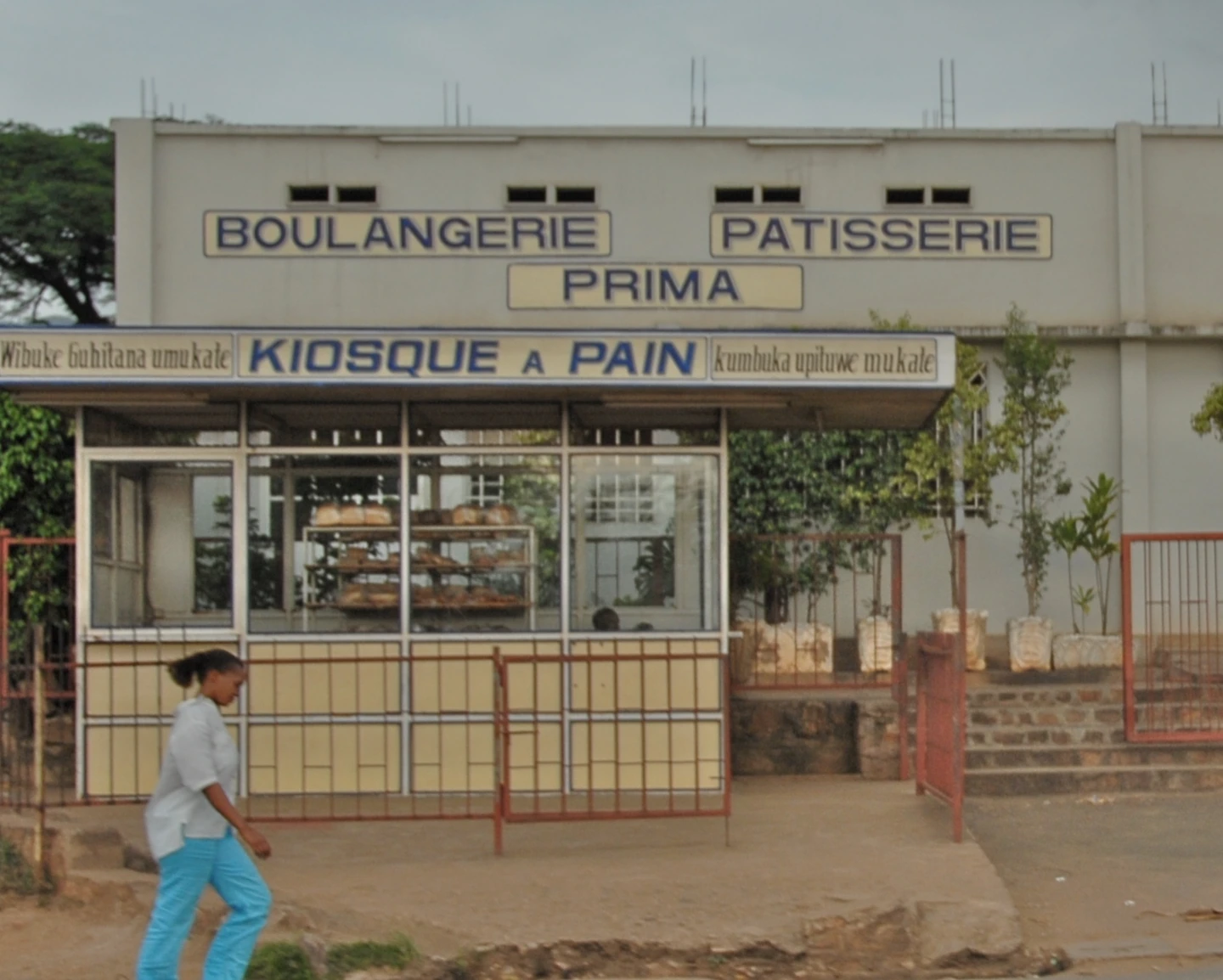
Shopfront writing in Bujumbura, Burundi, photographed on 25 March 2007. The file is explicitly classified under Kirundi language and signs in Burundi on Commons; not independently transcribed.
Saved in Babelbook · resized display copy. Select the image to open it independently of its source.
Dave Proffer · Source ↗CC BY 2.0 ↗View the local visual field note
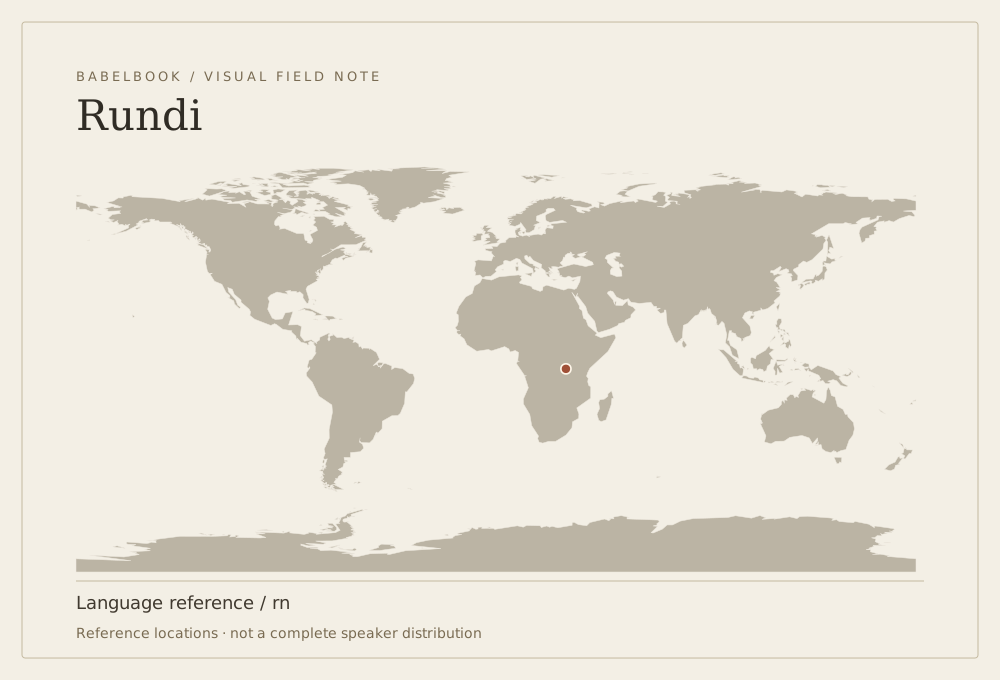
Representative reference points from Glottolog. Historical entries show reference locations, not current speakers. 1 point.
Reference & context ↗Babelbook · original editorial illustration · CC BY 4.0 · Glottolog locations; public-domain Natural Earth land
Source excerpts, selected, shortened and where noted editorially corrected from Kirundi by Wikipedia contributors. Retrieved 2026-10-05. CC BY-SA 4.0. These excerpts are not an independently verified scholarly history; missing accounts are identified above.