Romanian
Romanian (obsolete spelling: Roumanian; endonym: limba română [ˈlimba roˈmɨnə] , or românește [romɨˈneʃte], lit. 'in Romanian') is the official and main language of Romania and Moldova. Romanian is part of the Eastern Romance sub-branch of Romance languages, a linguistic group that evolved from several dialects of Vulgar Latin which separated from the Western Romance languages in the course of the period from the 5th to the 8th centuries. To distinguish it within the Eastern Romance languages, in comparative linguistics it is called Daco-Romanian as opposed to its closest relatives, Aromanian, Megleno-Romanian, and Istro-Romanian. It is also spoken as a minority language by stable communities in the countries surrounding Romania (Bulgaria, Hungary, Serbia and Ukraine), and by the large Romanian diaspora. In total, it is spoken by 22 million people as a first language. Romanian was also known as Moldovan in Moldova, although the Constitutional Court of Moldova ruled in 2013 that "the official language of Moldova is Romanian". On 16 March 2023, the Moldovan Parliament approved a law on referring to the national language as Romanian in all legislative texts and the constitution. On 22 March, the president of Moldova, Maia Sandu, promulgated the law.
Translate in Romanian ↗Romanian is spoken mostly in Central, South-Eastern, and Eastern Europe, although speakers of the language can be found all over the world, mostly due to emigration of Romanian nationals and the return of immigrants to Romania back to their original countries. Romanian speakers account for 0.5% of the world's population, and 4% of the Romance-speaking population of the world. Romanian is the single official and national language in Romania and Moldova, although it shares the official status at regional level with other languages in the Moldovan autonomies of Gagauzia and Transnistria. Romanian is also an official language of the Autonomous Province of Vojvodina in Serbia along with five other languages. Romanian minorities are encountered in Serbia (Timok Valley), Ukraine (Chernivtsi and Odesa oblasts), and Hungary (Gyula). Large immigrant communities are found in Italy, Spain, France, and Portugal. In 1995, the largest Romanian-speaking community in the Middle East was found in Israel, where Romanian was spoken by 5% of the population. Romanian is also spoken as a second language by people from Arabic-speaking countries who have studied in Romania. It is estimated that almost half a million Middle Eastern Arabs studied in Romania during the 1980s. Small Romanian-speaking communities are to be found in Kazakhstan and Russia.
Europe
Present-day use
The modern age of Romanian starts in 1780 with the printing in Vienna of a very important grammar book titled Elementa linguae daco-romanae sive valachicae. The author of the book, Samuil Micu-Klein, and the revisor, Gheorghe Șincai, both members of the Transylvanian School, chose to use Latin as the language of the text and presented the phonological and grammatical features of Romanian in comparison to its ancestor. The Modern age of Romanian language can be further divided into three phases: pre-modern or modernizing between 1780 and 1830, modern phase between 1831 and 1880, and contemporary from 1880 onwards. Beginning with the printing in 1780 of Elementa linguae daco-romanae sive valachicae, the pre-modern phase was characterized by the publishing of school textbooks, appearance of first normative works in Romanian, numerous translations, and the beginning of a conscious stage of re-latinization of the language. Notable contributions, besides that of the Transylvanian School, are the activities of Gheorghe Lazăr, founder of the first Romanian school, and Ion Heliade Rădulescu. The end of this period is marked by the first printing of magazines and newspapers in Romanian, in particular Curierul Românesc and Albina Românească. Starting from 1831 and lasting until 1880 the modern phase is characterized by the development of literary styles: scientific, administrative, and belletristic. It quickly reached a high point with the printing of Dacia Literară, a journal founded by Mihail Kogălniceanu and representing a literary society, which together with other publications like Propășirea and Gazeta de Transilvania spread the ideas of Romantic nationalism and later contributed to the formation of other societies that took part in the Revolutions of 1848.
Origins
The captured article does not contain a separate origins section. See the historical account and linked source.
Development
The first Romanian grammar was published in Vienna in 1780. Following the annexation of Bessarabia by Russia in 1812, Moldavian was established as an official language in the governmental institutions of Bessarabia, used along with Russian. The publishing works established by Archbishop Gavril Bănulescu-Bodoni were able to produce books and liturgical works in Moldavian between 1815 and 1820. Bessarabia during the 1812–1918 era witnessed the gradual development of bilingualism. Russian continued to develop as the official language of privilege, whereas Romanian remained the principal vernacular. The period from 1905 to 1917 was one of increasing linguistic conflict spurred by an increase in Romanian nationalism. In 1905 and 1906, the Bessarabian zemstva asked for the re-introduction of Romanian in schools as a "compulsory language", and the "liberty to teach in the mother language (Romanian language)". At the same time, Romanian-language newspapers and journals began to appear, such as Basarabia (1906), Viața Basarabiei (1907), Moldovanul (1907), Luminătorul (1908), Cuvînt moldovenesc (1913), Glasul Basarabiei (1913). From 1913, the synod permitted that "the churches in Bessarabia use the Romanian language". Romanian finally became the official language with the Constitution of 1923.
Writing
The first written record about a Romance language spoken in the Middle Ages in the Balkans is from 587. A Vlach muleteer accompanying the Byzantine army noticed that the load was falling from one of the animals and shouted to a companion Torna, torna, fratre! (meaning "Return, return, brother!"). Theophanes Confessor recorded it as part of a 6th-century military expedition by Comentiolus and Priscus against the Avars and Slovenes. The oldest surviving written text in Romanian is a letter from late June 1521, in which Neacșu of Câmpulung wrote to the mayor of Brașov about an imminent attack of the Turks. It was written using the Cyrillic alphabet, like most early Romanian writings. The earliest surviving writing in Latin script was a late 16th-century Transylvanian text which was written with the Hungarian alphabet conventions. In the 18th century, Transylvanian scholars noted the Latin origin of Romanian and adapted the Latin alphabet to the Romanian language, using some orthographic rules from Italian, recognized as Romanian's closest relative. The Cyrillic alphabet remained in (gradually decreasing) use until 1860, when Romanian writing was first officially regulated. In the Soviet Republic of Moldova, the Russian-derived Moldovan Cyrillic alphabet was used until 1989, when the Romanian Latin alphabet was introduced; in the breakaway territory of Transnistria the Cyrillic alphabet remains in use.
Beyond the typeface.
Signs, manuscripts, published pages and contextual photographs, with their place, period, source and reuse terms. Captions identify historical spellings, regional examples, community references and character imagery.
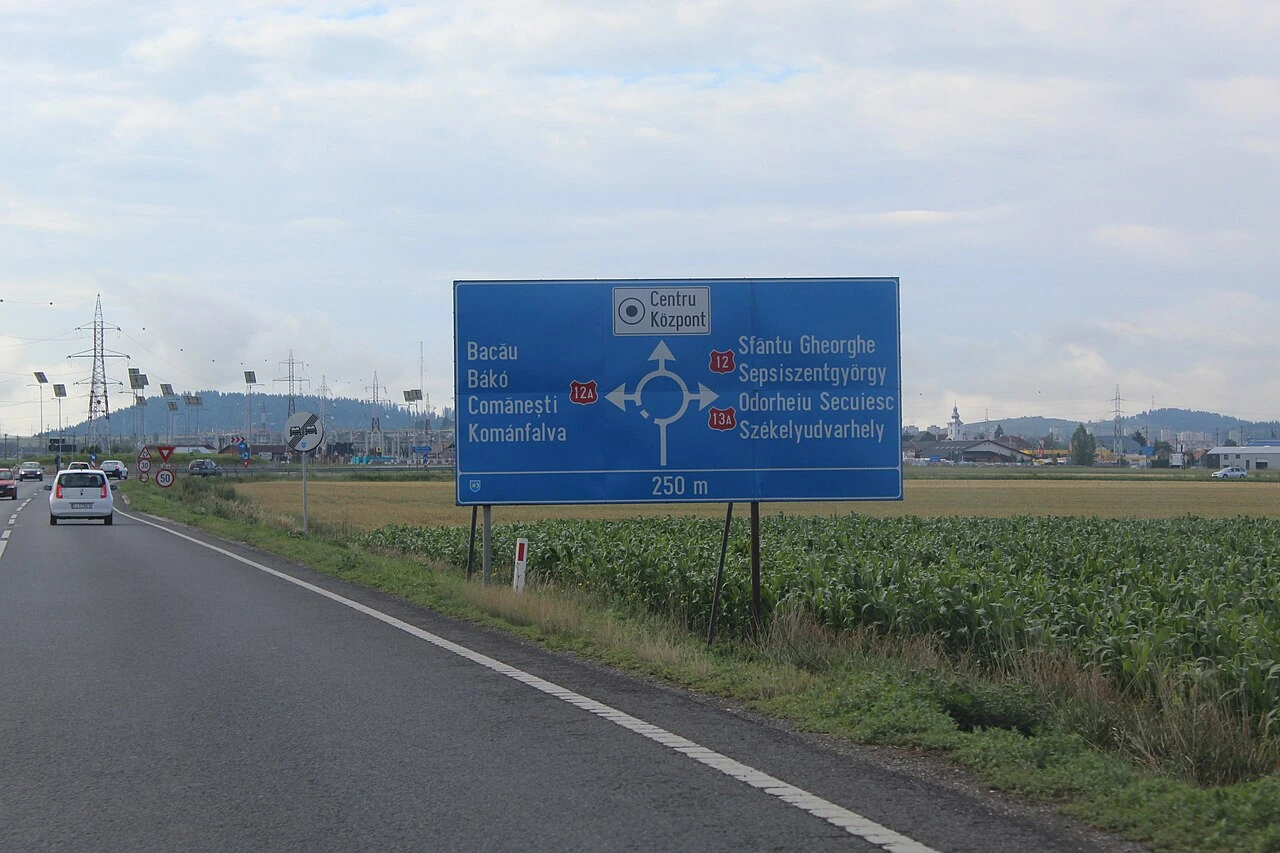
Romanian and Hungarian road sign north of Miercurea Ciuc, Romania. Language identification follows the source description; not independently transcribed.
Saved in Babelbook · resized display copy. Select the image to open it independently of its source.
TrainSimFan · Source ↗CC BY-SA 4.0 ↗View the local visual field note
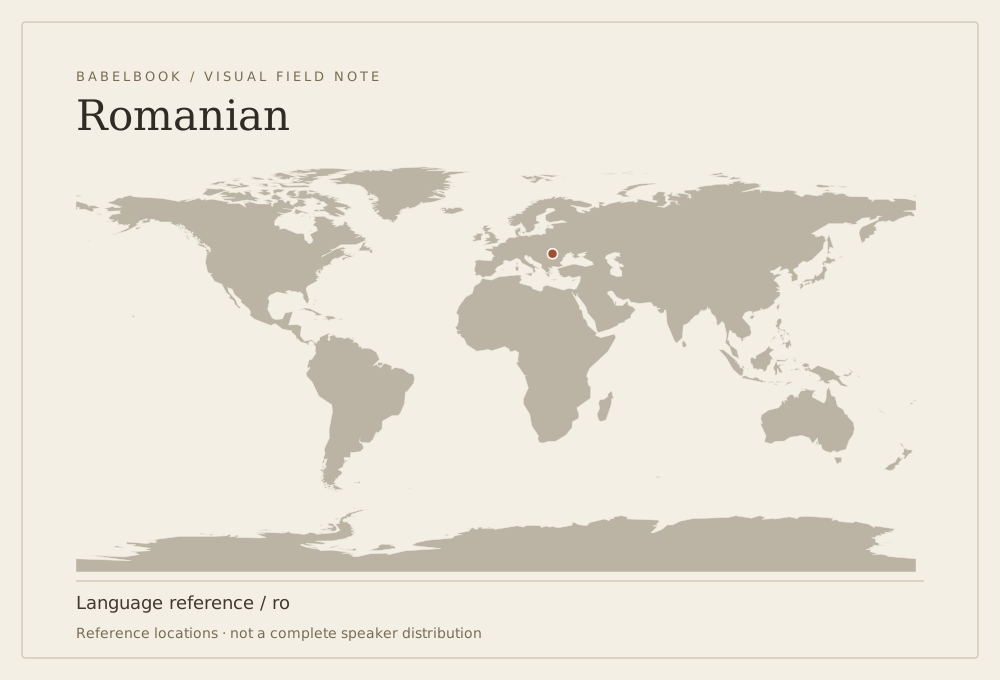
Representative reference points from Glottolog. Historical entries show reference locations, not current speakers. 1 point.
Reference & context ↗Babelbook · original editorial illustration · CC BY 4.0 · Glottolog locations; public-domain Natural Earth land
Source excerpts, selected, shortened and where noted editorially corrected from Romanian language by Wikipedia contributors. Retrieved 2026-10-05. CC BY-SA 4.0. These excerpts are not an independently verified scholarly history; missing accounts are identified above.
Read further in the source
Modern history of Romanian in Bessarabia
The first Romanian grammar was published in Vienna in 1780. Following the annexation of Bessarabia by Russia in 1812, Moldavian was established as an official language in the governmental institutions of Bessarabia, used along with Russian. The publishing works established by Archbishop Gavril Bănulescu-Bodoni were able to produce books and liturgical works in Moldavian between 1815 and 1820. Bessarabia during the 1812–1918 era witnessed the gradual development of bilingualism. Russian continued to develop as the official language of privilege, whereas Romanian remained the principal vernacular. The period from 1905 to 1917 was one of increasing linguistic conflict spurred by an increase in Romanian nationalism. In 1905 and 1906, the Bessarabian zemstva asked for the re-introduction of Romanian in schools as a "compulsory language", and the "liberty to teach in the mother language (Romanian language)". At the same time, Romanian-language newspapers and journals began to appear, such as Basarabia (1906), Viața Basarabiei (1907), Moldovanul (1907), Luminătorul (1908), Cuvînt moldovenesc (1913), Glasul Basarabiei (1913). From 1913, the synod permitted that "the churches in Bessarabia use the Romanian language". Romanian finally became the official language with the Constitution of 1923.
Geographic distribution
Romanian is spoken mostly in Central, South-Eastern, and Eastern Europe, although speakers of the language can be found all over the world, mostly due to emigration of Romanian nationals and the return of immigrants to Romania back to their original countries. Romanian speakers account for 0.5% of the world's population, and 4% of the Romance-speaking population of the world. Romanian is the single official and national language in Romania and Moldova, although it shares the official status at regional level with other languages in the Moldovan autonomies of Gagauzia and Transnistria. Romanian is also an official language of the Autonomous Province of Vojvodina in Serbia along with five other languages. Romanian minorities are encountered in Serbia (Timok Valley), Ukraine (Chernivtsi and Odesa oblasts), and Hungary (Gyula). Large immigrant communities are found in Italy, Spain, France, and Portugal. In 1995, the largest Romanian-speaking community in the Middle East was found in Israel, where Romanian was spoken by 5% of the population. Romanian is also spoken as a second language by people from Arabic-speaking countries who have studied in Romania. It is estimated that almost half a million Middle Eastern Arabs studied in Romania during the 1980s. Small Romanian-speaking communities are to be found in Kazakhstan and Russia. Romanian is also spoken within communities of Romanian and Moldovan immigrants in the United States, Canada and Australia, although they do not make up a large homogeneous community statewide.
Regional language status in Ukraine
In parts of Ukraine where Romanians constitute a significant share of the local population (districts in Chernivtsi, Odesa and Zakarpattia oblasts) Romanian is taught in schools as a primary language and there are Romanian-language newspapers, TV, and radio broadcasting. The University of Chernivtsi in western Ukraine trains teachers for Romanian schools in the fields of Romanian philology, mathematics and physics. In Hertsa Raion of Ukraine as well as in other villages of Chernivtsi Oblast and Zakarpattia Oblast, Romanian has been declared a "regional language" alongside Ukrainian as per the 2012 legislation on languages in Ukraine.
Dialects
Romanian is also called Daco-Romanian in comparative linguistics to distinguish from the other dialects of Common Romanian: Aromanian, Megleno-Romanian, and Istro-Romanian. The origin of the term "Daco-Romanian" can be traced back to the first printed book of Romanian grammar in 1780, by Samuil Micu and Gheorghe Șincai. There, the Romanian dialect spoken north of the Danube is called lingua Daco-Romana to emphasize its origin and its area of use, which includes the former Roman province of Dacia, although it is spoken also south of the Danube, in Dobruja, the Timok Valley and northern Bulgaria. This article deals with the Romanian (i.e. Daco-Romanian) language, and thus only its dialectal variations are discussed here. The differences between the regional varieties are small, limited to regular phonetic changes, few grammar aspects, and lexical particularities. There is a single written and spoken standard (literary) Romanian language used by all speakers, regardless of region. Like most natural languages, Romanian dialects are part of a dialect continuum. The dialects of Romanian are also referred to as 'sub-dialects' and are distinguished primarily by phonetic differences. Romanians themselves speak of the differences as 'accents' or 'speeches' (in Romanian: accent or grai). Depending on the criteria used for classifying these dialects, fewer or more are found, ranging from 2 to 20, although the most widespread approaches give a number of five dialects. These are grouped into two main types, southern and northern, further divided as follows:
The southern type has only one member: the Wallachian dialect, spoken in the southern part of Romania, in the historical regions of Muntenia, Oltenia and the southern part of Northern Dobruja, but also extending in the southern parts of Transylvania. The northern type consists of several dialects: the Moldavian dialect, spoken in the historical region of Moldavia, now split among Romania, the Republic of Moldova, and Ukraine (Bukovina, Bessarabia and to the east of Transnistria), as well as northern part of Northern Dobruja; the Banat dialect, spoken in the historical region of Banat, including parts of Serbia; a group of finely divided and transition-like Transylvanian varieties, among which two are most often distinguished, those of Crișana and Maramureș. Over the last century, however, regional accents have been weakened due to mass communication and greater mobility. Some argots and speech forms have also arisen from the Romanian language. Examples are the Gumuțeasca, spoken in Mărgău, and the Totoiana, an inverted "version" of Romanian spoken in Totoi.
Writing system
The first written record about a Romance language spoken in the Middle Ages in the Balkans is from 587. A Vlach muleteer accompanying the Byzantine army noticed that the load was falling from one of the animals and shouted to a companion Torna, torna, fratre! (meaning "Return, return, brother!"). Theophanes Confessor recorded it as part of a 6th-century military expedition by Comentiolus and Priscus against the Avars and Slovenes. The oldest surviving written text in Romanian is a letter from late June 1521, in which Neacșu of Câmpulung wrote to the mayor of Brașov about an imminent attack of the Turks. It was written using the Cyrillic alphabet, like most early Romanian writings. The earliest surviving writing in Latin script was a late 16th-century Transylvanian text which was written with the Hungarian alphabet conventions. In the 18th century, Transylvanian scholars noted the Latin origin of Romanian and adapted the Latin alphabet to the Romanian language, using some orthographic rules from Italian, recognized as Romanian's closest relative. The Cyrillic alphabet remained in (gradually decreasing) use until 1860, when Romanian writing was first officially regulated. In the Soviet Republic of Moldova, the Russian-derived Moldovan Cyrillic alphabet was used until 1989, when the Romanian Latin alphabet was introduced; in the breakaway territory of Transnistria the Cyrillic alphabet remains in use.