Russian
Russian is an East Slavic language belonging to the Balto-Slavic branch of the Indo-European language family. It is one of the four extant East Slavic languages, and is the native language of the Russian people. Russian was the de facto (and de jure in its final years) official language of the former Soviet Union. It has remained an official language of Russia, Belarus, Kazakhstan, and Kyrgyzstan, has constitutional status as the language of inter-ethnic communication in Tajikistan, and is still used as a lingua franca in Ukraine, Moldova, the Caucasus, Central Asia, and to a lesser extent in the Baltic states and Israel. Russian has over 210 million total speakers worldwide. It is the most spoken native language in Europe, the most spoken Slavic language, and the most geographically widespread language of Eurasia. It is the world's seventh-most spoken language by number of native speakers, and the world's eleventh-most spoken language by total number of speakers. Russian is one of two official languages aboard the International Space Station, one of the six official languages of the United Nations, as well as the seventh most widely used language on the Internet. Russian is written using the Russian alphabet of the Cyrillic script; it distinguishes between consonant phonemes with palatal secondary articulation and those without, the so-called "soft" and "hard" sounds.
Translate in Russian ↗In 2010, there were 259.8 million speakers of Russian in the world: in Russia – 137.5 million, in the CIS and Baltic countries – 93.7 million, in Eastern Europe – 12.9 million, Western Europe – 7.3 million, Asia – 2.7 million, in the Middle East and North Africa – 1.3 million, Sub-Saharan Africa – 0.1 million, Latin America – 0.2 million, U.S., Canada, Australia, and New Zealand – 4.1 million speakers. Therefore, the Russian language is the seventh-largest in the world by the number of speakers, after English, Mandarin, Hindi-Urdu, Spanish, French, Arabic, and Portuguese. Russian is one of the six official languages of the United Nations. Education in Russian is still a popular choice for both Russian as a second language (RSL) and native speakers in Russia, and in many former Soviet republics. Russian is still seen as an important language for children to learn in most of the former Soviet republics.
Europe
Present-day use
The captured source does not contain a separate current-use account.
Origins
The captured article does not contain a separate origins section. See the historical account and linked source.
Development
No single periodization is universally accepted. The history of the Russian language is sometimes divided into Old Russian from the 11th to 17th centuries, followed by Modern Russian. It is also sometimes divided into the following periods: Old Russian (with the earliest forms sometimes referred to as Old East Slavic; until the 13th–14th centuries); Middle Russian (14th–15th centuries until the 16th–17th centuries); Modern Russian (17th–18th centuries to the present). The emergence of writing (and thus Old Russian literature) is dated to around the year 1000, after Old Church Slavonic was introduced as the liturgical language in the late 10th century. At this point, the two languages were mutually intelligible, but there were clear East Slavic and South Slavic forms. The modern view is that Church Slavonic and Old Russian were perceived as different registers of the same language. The vernacular was considered the "low variety", while Church Slavonic was considered the "high variety". As a result, the two were in a diglossic relationship, and in the following centuries, Church Slavonic became increasingly Russianized. Literacy among the Russians initially developed through religious and hagiographical writings. The Ostromir Gospels (1056–1057) are the earliest dated manuscript to contain Russian elements and mark the beginning of Russianized Church Slavonic, which would gradually spread to liturgical, ecclesiastical and chancery texts. The language found in the birch bark manuscripts of the 11th–15th centuries represents the closest approximation to the vernacular Old Russian language, and shows more evidence of a native Russian idiom. During the rise of Moscow as the political center of Russia in the 14th–16th centuries, the language of the region is sometimes called Great Russian to distinguish it from the territories where the future Belarusian and Ukrainian languages developed.
Writing
According to the Institute of Russian Language of the Russian Academy of Science, an optional acute accent (знак ударения) may, and sometimes should, be used to mark stress. For example, it is used to distinguish between otherwise identical words, especially when context does not make it obvious: замо́к (zamók – "lock") – за́мок (zámok – "castle"), сто́ящий (stóyashchy – "worthwhile") – стоя́щий (stoyáshchy – "standing"), чудно́ (chudnó – "this is odd") – чу́дно (chúdno – "this is marvellous"), молоде́ц (molodéts – "well done!") – мо́лодец (mólodets – "fine young man"), узна́ю (uznáyu – "I shall learn it") – узнаю́ (uznayú – "I recognize it"), отреза́ть (otrezát – "to be cutting") – отре́зать (otrézat – "to have cut"); to indicate the proper pronunciation of uncommon words, especially personal and family names, like афе́ра (aféra, "scandal, affair"), гу́ру (gúru, "guru"), Гарси́я (García), Оле́ша (Olésha), Фе́рми (Fermi), and to show which is the stressed word in a sentence, for example Ты́ съел печенье? (Tý syel pechenye? – "Was it you who ate the cookie?") – Ты съе́л печенье? (Ty syél pechenye? – "Did you eat the cookie?) – Ты съел пече́нье? (Ty syel pechénye? "Was it the cookie you ate?"). Stress marks are mandatory in lexical dictionaries and books for children or Russian learners.
Beyond the typeface.
Signs, manuscripts, published pages and contextual photographs, with their place, period, source and reuse terms. Captions identify historical spellings, regional examples, community references and character imagery.

Russian and English no-smoking notice at Domodedovo Airport’s Aeroexpress station, Moscow, 2019. Russian text includes “Курить запрещено”. Displayed at reduced size; no additional crop.
Saved in Babelbook · resized display copy. Select the image to open it independently of its source.
RG72 · Source ↗CC BY-SA 4.0 ↗View the local visual field note
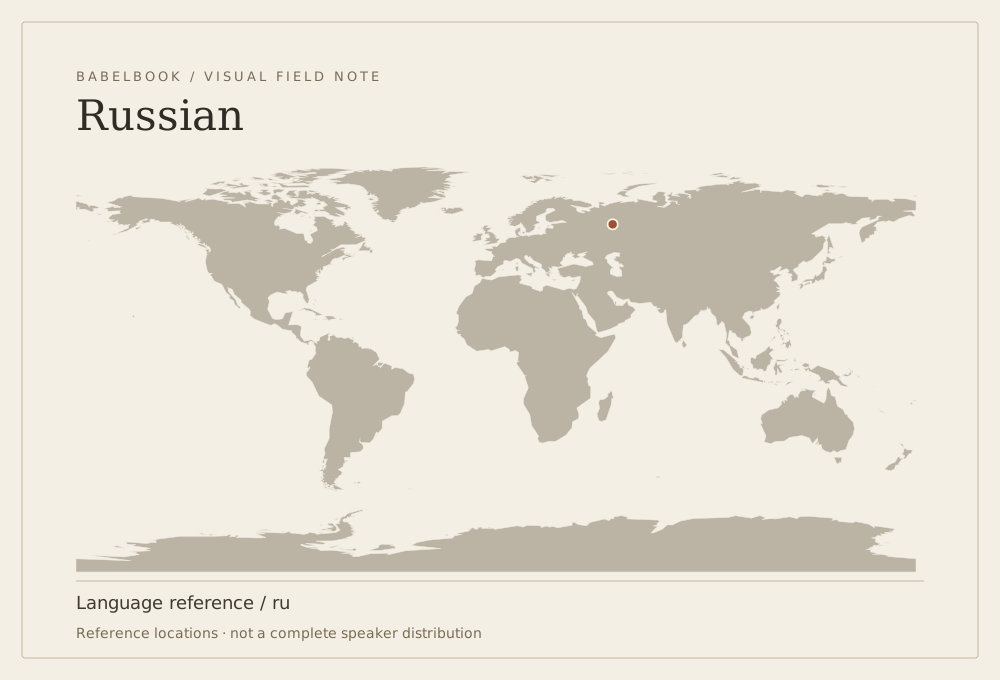
Representative reference points from Glottolog. Historical entries show reference locations, not current speakers. 1 point.
Reference & context ↗Babelbook · original editorial illustration · CC BY 4.0 · Glottolog locations; public-domain Natural Earth land
Source excerpts, selected, shortened and where noted editorially corrected from Russian language by Wikipedia contributors. Retrieved 2026-10-05. CC BY-SA 4.0. These excerpts are not an independently verified scholarly history; missing accounts are identified above.
Read further in the source
Standard Russian
Feudal divisions and conflicts created obstacles between the Russian principalities before and especially during Mongol rule. This strengthened dialectal differences, and for a while, prevented the emergence of a standardized national language. The formation of the unified and centralized Russian state in the 15th and 16th centuries, and the gradual re-emergence of a common political, economic, and cultural space created the need for a common standard language. The initial impulse for standardization came from the government bureaucracy for the lack of a reliable tool of communication in administrative, legal, and judicial affairs became an obvious practical problem. The earliest attempts at standardizing Russian were made based on the so-called Moscow official or chancery language, during the 15th to 17th centuries. However, the use of Church Slavonic by the church meant that Russian had a secondary status. By the 17th century, the idea of expanding the use of Russian had emerged when it became clear that Church Slavonic was ill-suited for use in administrative and business matters. Since then, the trend of language policy in Russia has been standardization in both the restricted sense of reducing dialectical barriers between ethnic Russians, and the broader sense of expanding the use of Russian alongside or in favour of other languages. The current standard form of Russian is generally regarded as the modern Russian literary language (современный русский литературный язык, sovremennyy russkiy literaturnyy yazyk), or Contemporary Standard Russian. It arose at the beginning of the 18th century with the modernization reforms of the Russian state under the rule of Peter the Great and developed from the Moscow dialect substratum under some influence of the Russian chancery language. The Moscow dialect had a northern dialectal base, but after Moscow became the center of a unified state, the attraction of southern dialectal speakers led to the emergence of a transitional dialect group. Peter regarded the standardization of Russian as essential to the development of a modern system of government, education and science, and consequently, to Russia's economic development. By the early 18th century, Russian had replaced Church Slavonic in secular matters. The spread of the Russian literary language was further advanced by a new generation of intellectuals, including Mikhail Lomonosov, who authored the first scientific grammar of Russian and developed a theoretical system of stylistic registers. In addition, he introduced several new literary genres derived from Western European literary traditions. The re-emergence and standardization of Russian for official, administrative, and commercial use laid the foundations for modern Russian. Prior to the Bolshevik Revolution, the spoken form of the Russian language was that of the nobility and the urban bourgeoisie. Russian peasants, the great majority of the population, continued to speak in their own dialects. However, the peasants' speech was never systematically studied, as it was generally regarded by philologists as simply a source of folklore and an object of curiosity. This was acknowledged by the noted Russian dialectologist Nikolai Karinsky, who toward the end of his life wrote: "Scholars of Russian dialects mostly studied phonetics and morphology. Some scholars and collectors compiled local dictionaries. We have almost no studies of lexical material or the syntax of Russian dialects." After 1917, Marxist linguists had no interest in the multiplicity of peasant dialects and regarded their language as a relic of the rapidly disappearing past that was not worthy of scholarly attention. Nakhimovsky quotes the Soviet academicians A. M. Ivanov and L. P. Yakubinsky, writing in 1930:
The language of peasants has a motley diversity inherited from feudalism. On its way to becoming proletariat peasantry brings to the factory and the industrial plant their local peasant dialects with their phonetics, grammar, and vocabulary, and the very process of recruiting workers from peasants and the mobility of the worker population generate another process: the liquidation of peasant inheritance by way of leveling the particulars of local dialects. On the ruins of peasant multilingual, in the context of developing heavy industry, a qualitatively new entity can be said to emerge—the general language of the working class... capitalism has the tendency of creating the general urban language of a given society.
Geographic distribution
In 2010, there were 259.8 million speakers of Russian in the world: in Russia – 137.5 million, in the CIS and Baltic countries – 93.7 million, in Eastern Europe – 12.9 million, Western Europe – 7.3 million, Asia – 2.7 million, in the Middle East and North Africa – 1.3 million, Sub-Saharan Africa – 0.1 million, Latin America – 0.2 million, U.S., Canada, Australia, and New Zealand – 4.1 million speakers. Therefore, the Russian language is the seventh-largest in the world by the number of speakers, after English, Mandarin, Hindi-Urdu, Spanish, French, Arabic, and Portuguese. Russian is one of the six official languages of the United Nations. Education in Russian is still a popular choice for both Russian as a second language (RSL) and native speakers in Russia, and in many former Soviet republics. Russian is still seen as an important language for children to learn in most of the former Soviet republics.
Dialects
Despite leveling after 1900, especially in matters of vocabulary and phonetics, a number of dialects still exist in Russia. Some linguists divide the dialects of Russian into two primary regional groupings, "Northern" and "Southern", with Moscow lying on the zone of transition between the two. Others divide the language into three groupings, Northern, Central (or Middle), and Southern, with Moscow lying in the Central region. The Northern Russian dialects and those spoken along the Volga River typically pronounce unstressed /o/ clearly, a phenomenon called okanye (оканье). Besides the absence of vowel reduction, some dialects have high or diphthongal /e⁓i̯ɛ/ in place of *ě and /o⁓u̯ɔ/ in stressed closed syllables (as in Ukrainian) instead of Standard Russian /e/ and /o/, respectively. Another Northern dialectal morphological feature is a post-posed definite article -to, -ta, -te similar to that existing in Bulgarian and Macedonian. In the Southern Russian dialects, instances of unstressed /e/ and /a/ following palatalized consonants and preceding a stressed syllable are not reduced to [ɪ] (as occurs in the Moscow dialect), being instead pronounced [a] in such positions (e.g. несли is pronounced [nʲaˈslʲi], not [nʲɪsˈlʲi]) – this is called yakanye (яканье). Consonants include a fricative /ɣ/, a semivowel /w⁓u̯/ and /x⁓xv⁓xw/, whereas the Standard and Northern dialects have the consonants /ɡ/, /v/, and final /l/ and /f/, respectively. The morphology features a palatalized final /tʲ/ in 3rd person forms of verbs (this is unpalatalized in the Standard and Northern dialects).
Orthography
According to the Institute of Russian Language of the Russian Academy of Science, an optional acute accent (знак ударения) may, and sometimes should, be used to mark stress. For example, it is used to distinguish between otherwise identical words, especially when context does not make it obvious: замо́к (zamók – "lock") – за́мок (zámok – "castle"), сто́ящий (stóyashchy – "worthwhile") – стоя́щий (stoyáshchy – "standing"), чудно́ (chudnó – "this is odd") – чу́дно (chúdno – "this is marvellous"), молоде́ц (molodéts – "well done!") – мо́лодец (mólodets – "fine young man"), узна́ю (uznáyu – "I shall learn it") – узнаю́ (uznayú – "I recognize it"), отреза́ть (otrezát – "to be cutting") – отре́зать (otrézat – "to have cut"); to indicate the proper pronunciation of uncommon words, especially personal and family names, like афе́ра (aféra, "scandal, affair"), гу́ру (gúru, "guru"), Гарси́я (García), Оле́ша (Olésha), Фе́рми (Fermi), and to show which is the stressed word in a sentence, for example Ты́ съел печенье? (Tý syel pechenye? – "Was it you who ate the cookie?") – Ты съе́л печенье? (Ty syél pechenye? – "Did you eat the cookie?) – Ты съел пече́нье? (Ty syel pechénye? "Was it the cookie you ate?"). Stress marks are mandatory in lexical dictionaries and books for children or Russian learners.
History and literary language
No single periodization is universally accepted. The history of the Russian language is sometimes divided into Old Russian from the 11th to 17th centuries, followed by Modern Russian. It is also sometimes divided into the following periods:
Old Russian (with the earliest forms sometimes referred to as Old East Slavic; until the 13th–14th centuries); Middle Russian (14th–15th centuries until the 16th–17th centuries); Modern Russian (17th–18th centuries to the present).
The emergence of writing (and thus Old Russian literature) is dated to around the year 1000, after Old Church Slavonic was introduced as the liturgical language in the late 10th century. At this point, the two languages were mutually intelligible, but there were clear East Slavic and South Slavic forms. The modern view is that Church Slavonic and Old Russian were perceived as different registers of the same language. The vernacular was considered the "low variety", while Church Slavonic was considered the "high variety". As a result, the two were in a diglossic relationship, and in the following centuries, Church Slavonic became increasingly Russianized. Literacy among the Russians initially developed through religious and hagiographical writings. The Ostromir Gospels (1056–1057) are the earliest dated manuscript to contain Russian elements and mark the beginning of Russianized Church Slavonic, which would gradually spread to liturgical, ecclesiastical and chancery texts. The language found in the birch bark manuscripts of the 11th–15th centuries represents the closest approximation to the vernacular Old Russian language, and shows more evidence of a native Russian idiom. During the rise of Moscow as the political center of Russia in the 14th–16th centuries, the language of the region is sometimes called Great Russian to distinguish it from the territories where the future Belarusian and Ukrainian languages developed. The influx of speakers from the southern dialect areas gave rise to a hybrid dialect, known as the Moscow dialect, and this became the basis of the standard language. During this period, local Russian vernaculars gained increased functionality, especially the Moscow dialect. The Moscow dialect and the chancery language—together sometimes referred to as a koiné—were responsible for the development and spread of implicit norms of usage that later became the norms of Modern Russian. The main phonological development during this period was akanye. However, in the 15th century, a more rigid standard of Church Slavonic replaced the strongly vernacularized language of the 13th and 14th centuries as a result of South Slavic influence. In the following centuries, this development transformed the diglossic situation into one of bilingualism. It was not until the 18th century that Church Slavonic lost its function as the high literary style. The political reforms of Peter the Great were accompanied by a reform of the alphabet, and achieved their goal of secularization and modernization, but caused a need for a written language that more closely resembled the spoken vernacular. The polymath Mikhail Lomonosov, in his Russian Grammar (1755), defined three styles: the "high style" (i.e. Church Slavonic, which would be used for high poetic genres, in addition to religious texts), the "middle style" (for lyric poetry, literary prose, scientific works), and a "low style" (i.e. a pure vernacular, which would be used for personal correspondence and low comedy). The modern standard language is closest to the middle style. Blocks of specialized vocabulary were adopted from the languages of Western Europe. By 1800, a significant portion of the gentry spoke French daily, and German sometimes. Many Russian novels of the 19th century, e.g. Leo Tolstoy's War and Peace, contain entire paragraphs and even pages in French with no translation given, with an assumption that educated readers would not need one. The modern literary language was established by the time of Alexander Pushkin in the first third of the 19th century. Pushkin revolutionized Russian literature by rejecting archaic grammar and vocabulary (the "high style") in favor of grammar and vocabulary found in the spoken language of the time. Even modern readers of younger age may only experience slight difficulties understanding some words in Pushkin's texts, since relatively few words used by Pushkin have become archaic or changed meaning. In fact, many expressions used by Russian writers of the early 19th century, in particular Pushkin, Mikhail Lermontov, Nikolai Gogol, Aleksander Griboyedov, became proverbs or sayings which can be frequently found even in modern Russian colloquial speech.
During the Soviet period, the policy toward the languages of the various other ethnic groups fluctuated in practice. Though each of the constituent republics had its own official language, the unifying role and superior status was reserved for Russian, although it was declared the official language only in 1990. Following the dissolution of the Soviet Union in 1991, several of the newly independent states have encouraged their native languages, which has partly reversed the privileged status of Russian, though its role as the language of post-Soviet national discourse throughout the region has continued.
According to figures published in 2006 in the journal "Demoskop Weekly" by A. L. Arefyev, research deputy director of the Research Center for Sociological Research of the Ministry of Education and Science, the Russian language is gradually losing its position in the world in general, and in Russia in particular. In 2012, Arefyev published a new study "Russian language at the turn of the 20th–21st centuries", in which he confirmed his conclusion about the trend of weakening of the Russian language after the Soviet Union's collapse in various regions of the world. In the countries of the former Soviet Union the Russian language was being replaced or used in conjunction with local languages. Currently, the number of speakers of Russian in the world depends on the number of Russians in the world and total population in Russia.