Kinyarwanda
Kinyarwanda, officially known as Ikinyarwanda, is a Bantu language and the national language of Rwanda. It is a dialect of the Rwanda-Rundi language that is also spoken in Uganda, where the dialect is known as Ikinyakore, Rufumbira, or Urufumbira. Kinyarwanda is universal among the native population of Rwanda and is mutually intelligible with Kirundi, the national language of neighbouring Burundi. In 2010, the Rwanda Academy of Language and Culture (RALC) was established to help promote and sustain Kinyarwanda. The organization attempted an orthographic reform in 2014, but it was met with pushback due to their perceived top-down and political nature, among other reasons.
Translate in Kinyarwanda ↗Kinyarwanda is spoken in Rwanda, the Democratic Republic of the Congo and Uganda.
Sub-Saharan Africa
Present-day use
The captured source does not contain a separate current-use account.
Origins
The captured article does not contain a separate origins section. See the historical account and linked source.
Development
The captured article does not contain a distinct historical account. No chronology has been invented.
Writing
Except in a few morphological contexts, the sequences 'ki' and 'ke' may be pronounced interchangeably as [ki] and [ke] or [ci] and [ce] according to speaker's preference. The letters ⟨a, e, i⟩ at the end of a word followed by a word starting with a vowel often follows a pattern of omission in common speech (sandhi), though the orthography remains the same. Consider the following excerpt of the Rwandan anthem: Reka tukurate tukuvuge ibigwi wowe utubumbiye hamwe twese Abanyarwanda uko watubyaye berwa, sugira, singizwa iteka. would be pronounced as Reka tukurate tukuvug' ibigwi wow' utubumiye hamwe twes' abanyarwand' uko watubyaye berwa, sugira singizw' iteka. There are some discrepancies in pronunciation from orthographic Cw and Cy. The glides /w j/ strengthen to stops in consonant clusters. For example, rw (as in Rwanda) is normally pronounced [ɾɡw]. The differences are the following: These are all sequences; [bɡ], for example, is not labial-velar [ɡ͡b]. Even when Rwanda is pronounced [ɾwaːnda] rather than [ɾɡwaːnda], the onset is a sequence, not a labialized [ɾʷ].
Beyond the typeface.
Signs, manuscripts, published pages and contextual photographs, with their place, period, source and reuse terms. Captions identify historical spellings, regional examples, community references and character imagery.
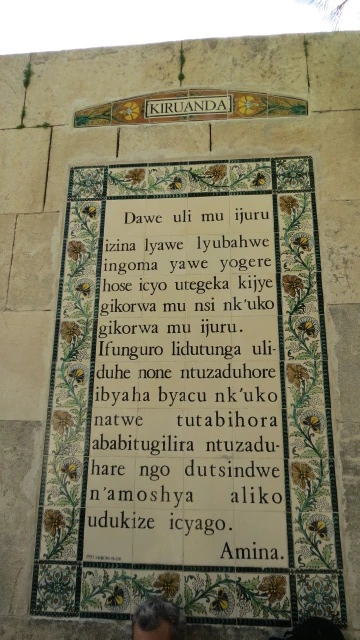
Kinyarwanda prayer tablet at the Pater Noster church in Jerusalem, photographed on 3 February 2015. Language identification follows the explicit Commons classification; not independently transcribed.
Saved in Babelbook · resized display copy. Select the image to open it independently of its source.
Hoshvilim · Source ↗CC BY-SA 4.0 ↗View the local visual field note
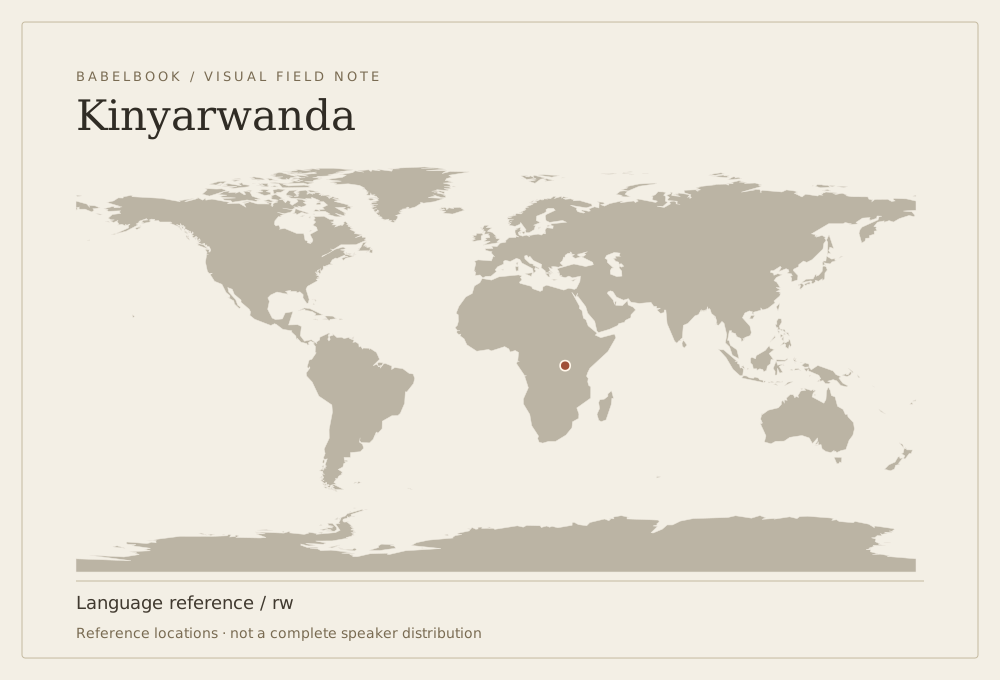
Representative reference points from Glottolog. Historical entries show reference locations, not current speakers. 1 point.
Reference & context ↗Babelbook · original editorial illustration · CC BY 4.0 · Glottolog locations; public-domain Natural Earth land
Source excerpts, selected, shortened and where noted editorially corrected from Kinyarwanda by Wikipedia contributors. Retrieved 2026-10-05. CC BY-SA 4.0. These excerpts are not an independently verified scholarly history; missing accounts are identified above.
Read further in the source
Geographic distribution
Kinyarwanda is spoken in Rwanda, the Democratic Republic of the Congo and Uganda.
Orthography
Except in a few morphological contexts, the sequences 'ki' and 'ke' may be pronounced interchangeably as [ki] and [ke] or [ci] and [ce] according to speaker's preference. The letters ⟨a, e, i⟩ at the end of a word followed by a word starting with a vowel often follows a pattern of omission in common speech (sandhi), though the orthography remains the same. Consider the following excerpt of the Rwandan anthem: Reka tukurate tukuvuge ibigwi wowe utubumbiye hamwe twese Abanyarwanda uko watubyaye berwa, sugira, singizwa iteka. would be pronounced as Reka tukurate tukuvug' ibigwi wow' utubumiye hamwe twes' abanyarwand' uko watubyaye berwa, sugira singizw' iteka. There are some discrepancies in pronunciation from orthographic Cw and Cy. The glides /w j/ strengthen to stops in consonant clusters. For example, rw (as in Rwanda) is normally pronounced [ɾɡw]. The differences are the following:
These are all sequences; [bɡ], for example, is not labial-velar [ɡ͡b]. Even when Rwanda is pronounced [ɾwaːnda] rather than [ɾɡwaːnda], the onset is a sequence, not a labialized [ɾʷ].