Sanskrit
Sanskrit (; stem form संस्कृत; nominal singular संस्कृतम्, saṃskṛtam,) is a classical language belonging to the Indo-Aryan branch of the Indo-European languages. It arose in South Asia after its predecessor languages had diffused there from the northwest in the late Bronze Age. Sanskrit is the sacred language of Hinduism, the language of classical Hindu philosophy, and of historical texts of Buddhism and Jainism. It was a link language in ancient and medieval South Asia, and upon transmission of Hindu and Buddhist culture to Southeast Asia, East Asia and Central Asia in the early medieval era, it became a language of religion and high culture, and of the political elites in some of these regions. As a result, Sanskrit had a lasting effect on the languages of South Asia, Southeast Asia and East Asia, especially in their formal and learned vocabularies. Sanskrit generally connotes several Old Indo-Aryan language varieties. The most archaic of these is the Vedic Sanskrit found in the Rigveda, a collection of 1,028 hymns composed between 1500 and 1200 BCE by Indo-Aryan tribes migrating east from the mountains of what is today northern Afghanistan across northern Pakistan and into northwestern India. Vedic Sanskrit interacted with the preexisting ancient languages of the subcontinent, absorbing names of newly encountered plants and animals; in addition, the ancient Dravidian languages influenced Sanskrit's phonology and syntax.
Translate in Sanskrit ↗The Sanskrit language's historic presence is attested across a wide geography beyond South Asia. Inscriptions and literary evidence suggests that Sanskrit language was already being adopted in Southeast Asia and Central Asia in the 1st millennium CE, through monks, religious pilgrims and merchants. South Asia has been the geographic range of the largest collection of the ancient and pre-18th-century Sanskrit manuscripts and inscriptions. Beyond ancient India, significant collections of Sanskrit manuscripts and inscriptions have been found in China (particularly the Tibetan monasteries), Myanmar, Indonesia, Cambodia, Laos, Vietnam, Thailand, and Malaysia. Sanskrit inscriptions, manuscripts or its remnants, including some of the oldest known Sanskrit written texts, have been discovered in dry high deserts and mountainous terrains such as in Nepal, Tibet, Afghanistan, Mongolia, Uzbekistan, Turkmenistan, Tajikistan, and Kazakhstan. Some Sanskrit texts and inscriptions have also been discovered in Korea and Japan. In India, Sanskrit is among the 22 official languages of India in the Eighth Schedule to the Constitution. In 2010, Uttarakhand became the first state in India to make Sanskrit its second official language. In 2019, Himachal Pradesh made Sanskrit its second official language, becoming the second state in India to do so. Sanskrit has been taught in schools from time immemorial in India. In modern times, the first Sanskrit University was Sampurnanand Sanskrit University, established in 1791 in the Indian city of Varanasi. Sanskrit is taught in 5,000 traditional schools (Pathashalas), and 14,000 schools in India. Sanskrit is one of the 22 scheduled languages of India. Despite it being a studied school subject in contemporary India, Sanskrit has not been spoken as a native language in centuries. In India, Sanskrit is offered as a language in central and several state education board schools and is also taught in traditional gurukulas across the country.
South Asia
Present-day use
The relationship of Sanskrit to the Prakrit languages, particularly the modern form of Indian languages, is complex and spans about 3,500 years, states Colin Masica—a linguist specialising in South Asian languages. A part of the difficulty is the lack of sufficient textual, archaeological and epigraphical evidence for the ancient Prakrit languages with rare exceptions such as Pali, leading to a tendency toward anachronistic errors. Sanskrit and Prakrit languages may be divided into Old Indo-Aryan (1500 BCE – 600 BCE), Middle Indo-Aryan (600 BCE – 1000 CE) and New Indo-Aryan (1000 CE – present), each can further be subdivided into early, middle or second, and late evolutionary substages. Vedic Sanskrit belongs to the early Old Indo-Aryan stage, while Classical Sanskrit to the later Old Indo-Aryan stage. The evidence for Prakrits such as Pali (Theravada Buddhism) and Ardhamagadhi (Jainism), along with Magadhi, Maharashtri, Sinhala, Sauraseni and Niya (Gandhari), emerge in the Middle Indo-Aryan stage in two versions—archaic and more formalised—that may be placed in early and middle substages of the 600 BCE – 1000 CE period. Two literary Indo-Aryan languages can be traced to the late Middle Indo-Aryan stage and these are Apabhramsa and Elu (a literary form of Sinhalese). Numerous North, Central, Eastern and Western Indian languages, such as Hindi, Gujarati, Sindhi, Punjabi, Kashmiri, Nepali, Braj, Awadhi, Bengali, Assamese, Oriya, Marathi, and others belong to the New Indo-Aryan stage. There is an extensive overlap in the vocabulary, phonetics and other aspects of these New Indo-Aryan languages with Sanskrit, but it is neither universal nor identical across the languages. They likely emerged from a synthesis of the ancient Sanskrit language traditions and an admixture of various regional dialects. Each language has some unique and regionally creative aspects, with unclear origins.
Origins
In Sanskrit, the verbal adjective sáṃskṛta- is a compound word consisting of sáṃ ('together, good, well, perfected') and kṛta- ('made, formed, work'). It connotes a work that has been "well prepared, pure and perfect, polished, sacred". According to Biderman, the perfection contextually being referred to in the etymological origins of the word is its tonal—rather than semantic—qualities. Sound and oral transmission were highly valued qualities in ancient India, and its sages refined the alphabet, the structure of words, and its exacting grammar into a "collection of sounds, a kind of sublime musical mold" as an integral language they called Saṃskṛta. From the late Vedic period onwards, state Annette Wilke and Oliver Moebus, resonating sound and its musical foundations attracted an "exceptionally large amount of linguistic, philosophical and religious literature" in India. Sound was visualised as "pervading all creation", another representation of the world itself. The search for perfection in thought and the goal of liberation were among the dimensions of sacred sound, and the common thread that wove all ideas and inspirations together became the quest for what the ancient Indians believed to be a perfect language, the "phonocentric episteme" of Sanskrit. Sanskrit belongs to the Indo-European family of languages. It is one of the three earliest ancient documented languages that arose from a common root language now referred to as Proto-Indo-European. Other Indo-European languages distantly related to Sanskrit include archaic and Classical Latin (c. 600 BCE–100 CE, Italic languages), Gothic (archaic Germanic language, c. 350 CE), Old Norse (c. 200 CE and after), Old Avestan (c. late 2nd millennium BCE) and Younger Avestan (c. 900 BCE).
Development
Sanskrit belongs to the Indo-European family of languages. It is one of the three earliest ancient documented languages that arose from a common root language now referred to as Proto-Indo-European. Other Indo-European languages distantly related to Sanskrit include archaic and Classical Latin (c. 600 BCE–100 CE, Italic languages), Gothic (archaic Germanic language, c. 350 CE), Old Norse (c. 200 CE and after), Old Avestan (c. late 2nd millennium BCE) and Younger Avestan (c. 900 BCE). The closest ancient relatives of Vedic Sanskrit in the Indo-European languages are the Nuristani languages found in the remote Hindu Kush region of northeastern Afghanistan and northwestern Himalayas, as well as the extinct Avestan and Old Persian – both Iranian languages. Sanskrit belongs to the satem group of the Indo-European languages. Colonial era scholars familiar with Latin and Greek were struck by the resemblance of the Sanskrit language, both in its vocabulary and grammar, to the classical languages of Europe. In The Oxford Introduction to Proto-Indo-European and the Proto-Indo-European World, Mallory and Adams illustrate the resemblance with the following examples of cognate forms (with the addition of Old English for further comparison): The correspondences suggest some common root, and historical links between some of the distant major ancient languages of the world. The Indo-Aryan migrations theory explains the common features shared by Sanskrit and other Indo-European languages by proposing that the original speakers of what became Sanskrit arrived in South Asia from a region of common origin, somewhere north-west of the Indus region, during the early 2nd millennium BCE.
Writing
The early history of writing Sanskrit and other languages in ancient India is a problematic topic despite a century of scholarship, states Richard Salomon – an epigraphist and Indologist specialising in Sanskrit and Pali literature. The earliest possible script from South Asia is from the Indus Valley civilisation (3rd/2nd millennium BCE), but this script – if it is a script – remains undeciphered. If any scripts existed in the Vedic period, they have not survived. Scholars generally accept that Sanskrit was spoken in an oral society, and that an oral tradition preserved the extensive Vedic and Classical Sanskrit literature. Other scholars such as Jack Goody argue that the Vedic Sanskrit texts are not the product of an oral society, basing this view by comparing inconsistencies in the transmitted versions of literature from various oral societies such as the Greek (Greco-Sanskrit), Serbian, and other cultures. This minority of scholars argue that the Vedic literature is too consistent and vast to have been composed and transmitted orally across generations, without having been written down. Lipi is the term in Sanskrit which means "writing, letters, alphabet". It contextually refers to scripts, the art or any manner of writing or drawing. The term, in the sense of a writing system, appears in some of the earliest Buddhist, Hindu, and Jaina texts. Pāṇini's Astadhyayi, composed sometime around the 5th or 4th century BCE, for example, mentions lipi in the context of a writing script and education system in his times, but he does not name the script. Several early Buddhist and Jaina texts, such as the Lalitavistara Sūtra and Pannavana Sutta include lists of numerous writing scripts in ancient India. The Buddhist texts list the sixty four lipi that the Buddha knew as a child, with the Brahmi script topping the list. "The historical value of this list is however limited by several factors", states Salomon. The list may be a later interpolation.
Beyond the typeface.
Signs, manuscripts, published pages and contextual photographs, with their place, period, source and reuse terms. Captions identify historical spellings, regional examples, community references and character imagery.
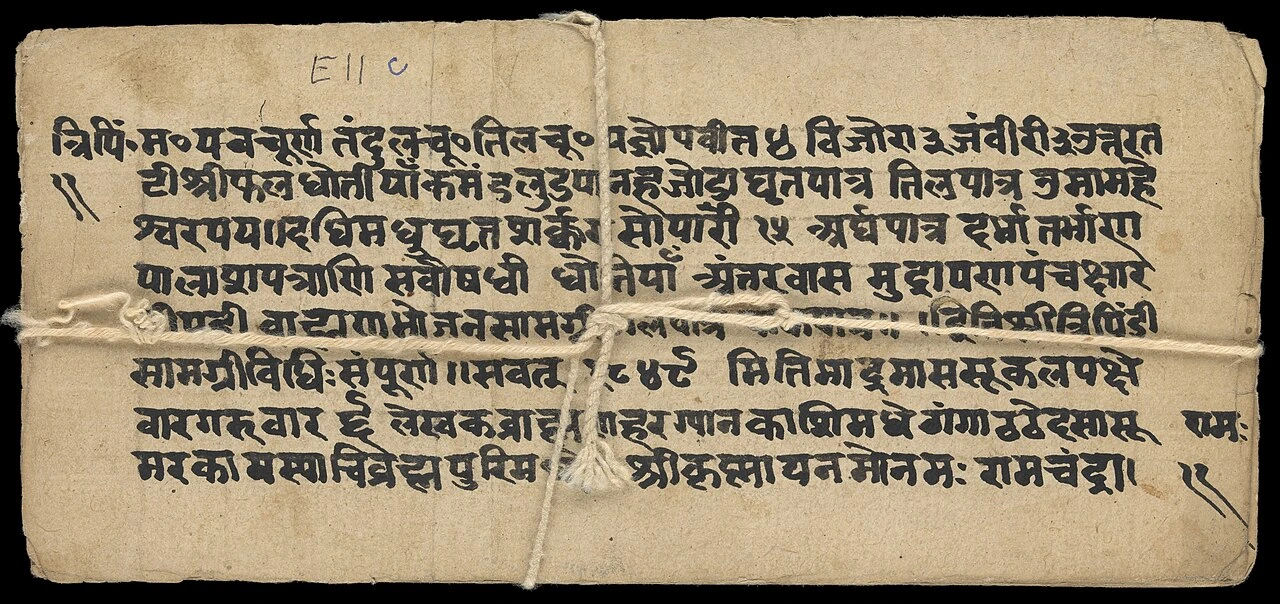
Digitized manuscript identified as Sanskrit in the Wellcome Asian Collection. A manuscript date is not established here. Displayed at reduced size; no additional crop.
Saved in Babelbook · resized display copy. Select the image to open it independently of its source.
Wellcome Library, London · Source ↗CC BY 4.0 ↗View the local visual field note
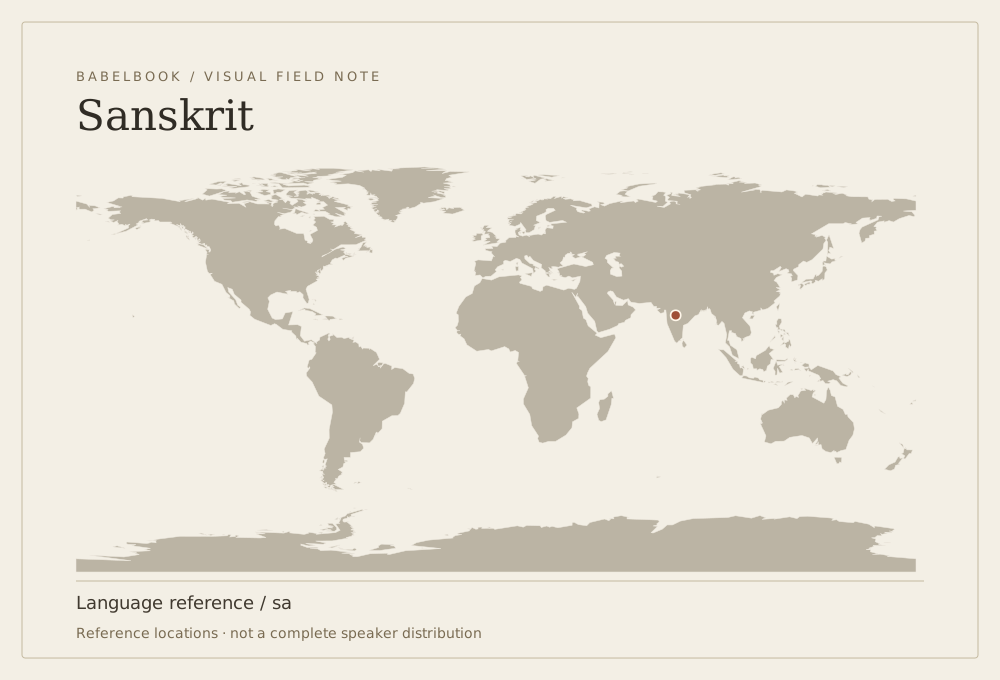
Representative reference points from Glottolog. Historical entries show reference locations, not current speakers. 1 point.
Reference & context ↗Babelbook · original editorial illustration · CC BY 4.0 · Glottolog locations; public-domain Natural Earth land
Source excerpts, selected, shortened and where noted editorially corrected from Sanskrit by Wikipedia contributors. Retrieved 2026-10-05. CC BY-SA 4.0. These excerpts are not an independently verified scholarly history; missing accounts are identified above.
Read further in the source
Origin and development
Sanskrit belongs to the Indo-European family of languages. It is one of the three earliest ancient documented languages that arose from a common root language now referred to as Proto-Indo-European. Other Indo-European languages distantly related to Sanskrit include archaic and Classical Latin (c. 600 BCE–100 CE, Italic languages), Gothic (archaic Germanic language, c. 350 CE), Old Norse (c. 200 CE and after), Old Avestan (c. late 2nd millennium BCE) and Younger Avestan (c. 900 BCE). The closest ancient relatives of Vedic Sanskrit in the Indo-European languages are the Nuristani languages found in the remote Hindu Kush region of northeastern Afghanistan and northwestern Himalayas, as well as the extinct Avestan and Old Persian – both Iranian languages. Sanskrit belongs to the satem group of the Indo-European languages. Colonial era scholars familiar with Latin and Greek were struck by the resemblance of the Sanskrit language, both in its vocabulary and grammar, to the classical languages of Europe. In The Oxford Introduction to Proto-Indo-European and the Proto-Indo-European World, Mallory and Adams illustrate the resemblance with the following examples of cognate forms (with the addition of Old English for further comparison):
The correspondences suggest some common root, and historical links between some of the distant major ancient languages of the world. The Indo-Aryan migrations theory explains the common features shared by Sanskrit and other Indo-European languages by proposing that the original speakers of what became Sanskrit arrived in South Asia from a region of common origin, somewhere north-west of the Indus region, during the early 2nd millennium BCE. Evidence for such a theory includes the close relationship between the Indo-Iranian tongues and the Baltic and Slavic languages, vocabulary exchange with the non-Indo-European Uralic languages, and the nature of the attested Indo-European words for flora and fauna. The pre-history of Indo-Aryan languages which preceded Vedic Sanskrit is unclear and various hypotheses place it over a fairly wide limit. According to Thomas Burrow, based on the relationship between various Indo-European languages, the origin of all these languages may possibly be in what is now Central or Eastern Europe, while the Indo-Iranian group possibly arose in Central Russia. The Iranian and Indo-Aryan branches separated quite early. It is the Indo-Aryan branch that moved into eastern Iran and then south into South Asia in the first half of the 2nd millennium BCE. Once in ancient India, the Indo-Aryan language underwent rapid linguistic change and morphed into the Vedic Sanskrit language.
Geographic distribution
The Sanskrit language's historic presence is attested across a wide geography beyond South Asia. Inscriptions and literary evidence suggests that Sanskrit language was already being adopted in Southeast Asia and Central Asia in the 1st millennium CE, through monks, religious pilgrims and merchants. South Asia has been the geographic range of the largest collection of the ancient and pre-18th-century Sanskrit manuscripts and inscriptions. Beyond ancient India, significant collections of Sanskrit manuscripts and inscriptions have been found in China (particularly the Tibetan monasteries), Myanmar, Indonesia, Cambodia, Laos, Vietnam, Thailand, and Malaysia. Sanskrit inscriptions, manuscripts or its remnants, including some of the oldest known Sanskrit written texts, have been discovered in dry high deserts and mountainous terrains such as in Nepal, Tibet, Afghanistan, Mongolia, Uzbekistan, Turkmenistan, Tajikistan, and Kazakhstan. Some Sanskrit texts and inscriptions have also been discovered in Korea and Japan.
Official status
In India, Sanskrit is among the 22 official languages of India in the Eighth Schedule to the Constitution. In 2010, Uttarakhand became the first state in India to make Sanskrit its second official language. In 2019, Himachal Pradesh made Sanskrit its second official language, becoming the second state in India to do so.
Writing system
The early history of writing Sanskrit and other languages in ancient India is a problematic topic despite a century of scholarship, states Richard Salomon – an epigraphist and Indologist specialising in Sanskrit and Pali literature. The earliest possible script from South Asia is from the Indus Valley civilisation (3rd/2nd millennium BCE), but this script – if it is a script – remains undeciphered. If any scripts existed in the Vedic period, they have not survived. Scholars generally accept that Sanskrit was spoken in an oral society, and that an oral tradition preserved the extensive Vedic and Classical Sanskrit literature. Other scholars such as Jack Goody argue that the Vedic Sanskrit texts are not the product of an oral society, basing this view by comparing inconsistencies in the transmitted versions of literature from various oral societies such as the Greek (Greco-Sanskrit), Serbian, and other cultures. This minority of scholars argue that the Vedic literature is too consistent and vast to have been composed and transmitted orally across generations, without having been written down. Lipi is the term in Sanskrit which means "writing, letters, alphabet". It contextually refers to scripts, the art or any manner of writing or drawing. The term, in the sense of a writing system, appears in some of the earliest Buddhist, Hindu, and Jaina texts. Pāṇini's Astadhyayi, composed sometime around the 5th or 4th century BCE, for example, mentions lipi in the context of a writing script and education system in his times, but he does not name the script. Several early Buddhist and Jaina texts, such as the Lalitavistara Sūtra and Pannavana Sutta include lists of numerous writing scripts in ancient India. The Buddhist texts list the sixty four lipi that the Buddha knew as a child, with the Brahmi script topping the list. "The historical value of this list is however limited by several factors", states Salomon. The list may be a later interpolation. The Jain canonical texts such as the Pannavana Sutta – probably older than the Buddhist texts – list eighteen writing systems, with the Brahmi topping the list and Kharotthi (Kharoshthi) listed as fourth. The Jaina text elsewhere states that the "Brahmi is written in 18 different forms", but the details are lacking. However, the reliability of these lists has been questioned and the empirical evidence of writing systems in the form of Sanskrit or Prakrit inscriptions dated prior to the 3rd century BCE has not been found. If the ancient surfaces for writing Sanskrit were palm leaves, tree bark and cloth – the same as those in later times – these have not survived. According to Salomon, many find it difficult to explain the "evidently high level of political organization and cultural complexity" of ancient India without a writing system for Sanskrit and other languages. The oldest datable writing systems for Sanskrit are the Brāhmī script, the related Kharoṣṭhī script and the Brahmi derivatives. The Kharosthi was used in the northwestern part of South Asia and it became extinct, while the Brahmi was used all over the subcontinent along with regional scripts such as Old Tamil. Of these, the earliest records in the Sanskrit language are in Brahmi, a script that later evolved into numerous related Indic scripts for Sanskrit, along with Southeast Asian scripts (Burmese, Thai, Lao, Khmer, others) and many extinct Central Asian scripts such as those discovered along with the Kharosthi in the Tarim Basin of western China and in Uzbekistan. The most extensive inscriptions that have survived into the modern era are the rock edicts and pillar inscriptions of the 3rd century BCE Mauryan emperor Ashoka, but these are not in Sanskrit.
Other writing systems
Other scripts such as Gujarati, Bangla-Assamese, Odia and major south Indian scripts, states Salomon, "have been and often still are used in their proper territories for writing Sanskrit". These and many Indian scripts look different to the untrained eye, but the differences between Indic scripts is "mostly superficial and they share the same phonetic repertoire and systemic features", states Salomon. They all have essentially the same set of eleven to fourteen vowels and thirty-three consonants as established by the Sanskrit language and attestable in the Brahmi script. Further, a closer examination reveals that they all have the similar basic graphic principles, the same varnamala (literally, "garland of letters") alphabetic ordering following the same logical phonetic order, easing the work of historic skilled scribes writing or reproducing Sanskrit works across South Asia.
In the south, where Dravidian languages predominate, scripts used for Sanskrit include the Kannada, Telugu, Malayalam and Grantha alphabets.
Schools and contemporary status
Sanskrit has been taught in schools from time immemorial in India. In modern times, the first Sanskrit University was Sampurnanand Sanskrit University, established in 1791 in the Indian city of Varanasi. Sanskrit is taught in 5,000 traditional schools (Pathashalas), and 14,000 schools in India. Sanskrit is one of the 22 scheduled languages of India. Despite it being a studied school subject in contemporary India, Sanskrit has not been spoken as a native language in centuries. In India, Sanskrit is offered as a language in central and several state education board schools and is also taught in traditional gurukulas across the country. A number of colleges and universities in India have dedicated departments for Sanskrit studies. In March 2020, the Indian Parliament passed the Central Sanskrit Universities Act, 2020 which upgraded three universities, National Sanskrit University, Central Sanskrit University and Shri Lal Bahadur Shastri National Sanskrit University, from the deemed to be university status to a central university status. Dmitri Mendeleev used the Sanskrit numbers of one, two and three (eka-, dvi- or dwi-, and tri- respectively) to give provisional names to his predicted elements, like eka-boron being Gallium or eka-Francium being Ununennium. In the province of Bali in Indonesia, a number of educational and scholarly institutions have also been conducting Sanskrit lessons for Hindu locals.