Sardinian
Sardinian or Sard is a Romance language spoken by the Sardinians on the Italian Mediterranean island of Sardinia. The distinctive character of the Sardinian language among the Romance languages has long been known among linguists. Many Romance linguists consider it, together with Italian, as the language that is the closest to Latin among all of Latin's descendants. However, it has also incorporated elements of Pre-Latin (mostly Paleo-Sardinian and, to a much lesser degree, Punic) substratum, as well as a Byzantine Greek, Catalan, Spanish, French, and Italian superstratum. These elements originate in the political history of Sardinia, whose indigenous society experienced competition and, at times, conflict with a series of colonizing newcomers. Following the end of the Roman Empire in Western Europe, Sardinia passed through periods of successive control by the Vandals, Byzantines, local Judicates, the Kingdom of Aragon, the Savoyard state, and finally Italy. These regimes varied in their usage of Sardinian as against other languages. For example, under the Judicates, Sardinian was used in administrative documents. Under Aragonese control, Catalan and Castilian became the island's prestige languages, and would remain so well into the 18th century. More recently, Italy's linguistic policies have encouraged diglossia, reducing the predominance of both Sardinian and Catalan.
Translate in Sardinian ↗Sardinian or Sard is a Romance language spoken by the Sardinians on the Italian Mediterranean island of Sardinia. The distinctive character of the Sardinian language among the Romance languages has long been known among linguists. Many Romance linguists consider it, together with Italian, as the language that is the closest to Latin among all of Latin's descendants. However, it has also incorporated elements of Pre-Latin (mostly Paleo-Sardinian and, to a much lesser degree, Punic) substratum, as well as a Byzantine Greek, Catalan, Spanish, French, and Italian superstratum. These elements originate in the political history of Sardinia, whose indigenous society experienced competition and, at times, conflict with a series of colonizing newcomers. Following the end of the Roman Empire in Western Europe, Sardinia passed through periods of successive control by the Vandals, Byzantines, local Judicates, the Kingdom of Aragon, the Savoyard state, and finally Italy. These regimes varied in their usage of Sardinian as against other languages. For example, under the Judicates, Sardinian was used in administrative documents. Under Aragonese control, Catalan and Castilian became the island's prestige languages, and would remain so well into the 18th century. More recently, Italy's linguistic policies have encouraged diglossia, reducing the predominance of both Sardinian and Catalan.
Europe
Present-day use
Prenuragic and Nuragic era The origins of ancient Sardinian, also known as Paleo-Sardinian, are currently unknown. Research has attempted to discover obscure, indigenous, pre-Romance roots. The root s(a)rd, indicating many place names as well as the island's people, is reportedly either associated with or originating from the Sherden, one of the Sea Peoples. Other sources trace instead the root s(a)rd from Σαρδώ, a legendary woman from the Anatolian Kingdom of Lydia, or from the Libyan mythological figure of the Sardus Pater Babai ("Sardinian Father" or "Father of the Sardinians"). In 1984, Massimo Pittau claimed to have found the etymology of many Latin words in the Etruscan language, after comparing it with the Nuragic language(s). Etruscan elements, formerly thought to have originated in Latin, would indicate a connection between the ancient Sardinian culture and the Etruscans. According to Pittau, the Etruscan and Nuragic language(s) are descended from Lydian (and therefore Indo-European) as a consequence of contact with Etruscans and other Tyrrhenians from Sardis as described by Herodotus. Although Pittau suggests that the Tirrenii landed in Sardinia and the Etruscans landed in modern Tuscany, his views are not shared by most Etruscologists. According to Bertoldi and Terracini, Paleo-Sardinian has similarities with the Iberic languages and Siculian; for example, the suffix -ara in proparoxytones indicated the plural. Terracini proposed the same for suffixes in -/àna/, -/ànna/, -/énna/, -/ònna/ + /r/ + a paragogic vowel (such as the toponym Bunnànnaru). Rohlfs, Butler and Craddock add the suffix -/ini/ (such as the toponym Barùmini) as a unique element of Paleo-Sardinian. Suffixes in /a, e, o, u/ + -rr- found a correspondence in north Africa (Terracini), in Iberia (Blasco Ferrer) and in southern Italy and Gascony (Rohlfs), with a closer relationship to Basque (Wagner and Hubschmid).
Origins
Prenuragic and Nuragic era The origins of ancient Sardinian, also known as Paleo-Sardinian, are currently unknown. Research has attempted to discover obscure, indigenous, pre-Romance roots. The root s(a)rd, indicating many place names as well as the island's people, is reportedly either associated with or originating from the Sherden, one of the Sea Peoples. Other sources trace instead the root s(a)rd from Σαρδώ, a legendary woman from the Anatolian Kingdom of Lydia, or from the Libyan mythological figure of the Sardus Pater Babai ("Sardinian Father" or "Father of the Sardinians"). In 1984, Massimo Pittau claimed to have found the etymology of many Latin words in the Etruscan language, after comparing it with the Nuragic language(s). Etruscan elements, formerly thought to have originated in Latin, would indicate a connection between the ancient Sardinian culture and the Etruscans. According to Pittau, the Etruscan and Nuragic language(s) are descended from Lydian (and therefore Indo-European) as a consequence of contact with Etruscans and other Tyrrhenians from Sardis as described by Herodotus. Although Pittau suggests that the Tirrenii landed in Sardinia and the Etruscans landed in modern Tuscany, his views are not shared by most Etruscologists. According to Bertoldi and Terracini, Paleo-Sardinian has similarities with the Iberic languages and Siculian; for example, the suffix -ara in proparoxytones indicated the plural. Terracini proposed the same for suffixes in -/àna/, -/ànna/, -/énna/, -/ònna/ + /r/ + a paragogic vowel (such as the toponym Bunnànnaru). Rohlfs, Butler and Craddock add the suffix -/ini/ (such as the toponym Barùmini) as a unique element of Paleo-Sardinian. Suffixes in /a, e, o, u/ + -rr- found a correspondence in north Africa (Terracini), in Iberia (Blasco Ferrer) and in southern Italy and Gascony (Rohlfs), with a closer relationship to Basque (Wagner and Hubschmid).
Development
Sardinia's relative isolation from mainland Europe encouraged the development of a Romance language that preserves traces of its indigenous, pre-Roman language(s). The language is posited to have substratal influences from Paleo-Sardinian, which some scholars have linked to Basque and Etruscan; comparisons have also been drawn with the Berber languages from North Africa to shed more light on the language(s) spoken in Sardinia prior to its Romanization. Subsequent adstratal influences include Catalan, Spanish, and Italian. The situation of the Sardinian language with regard to the politically dominant ones did not change until fascism and, most evidently, the 1950s.
Writing
Latin or customary script (catalog classification; see the source for context).
Beyond the typeface.
Signs, manuscripts, published pages and contextual photographs, with their place, period, source and reuse terms. Captions identify historical spellings, regional examples, community references and character imagery.
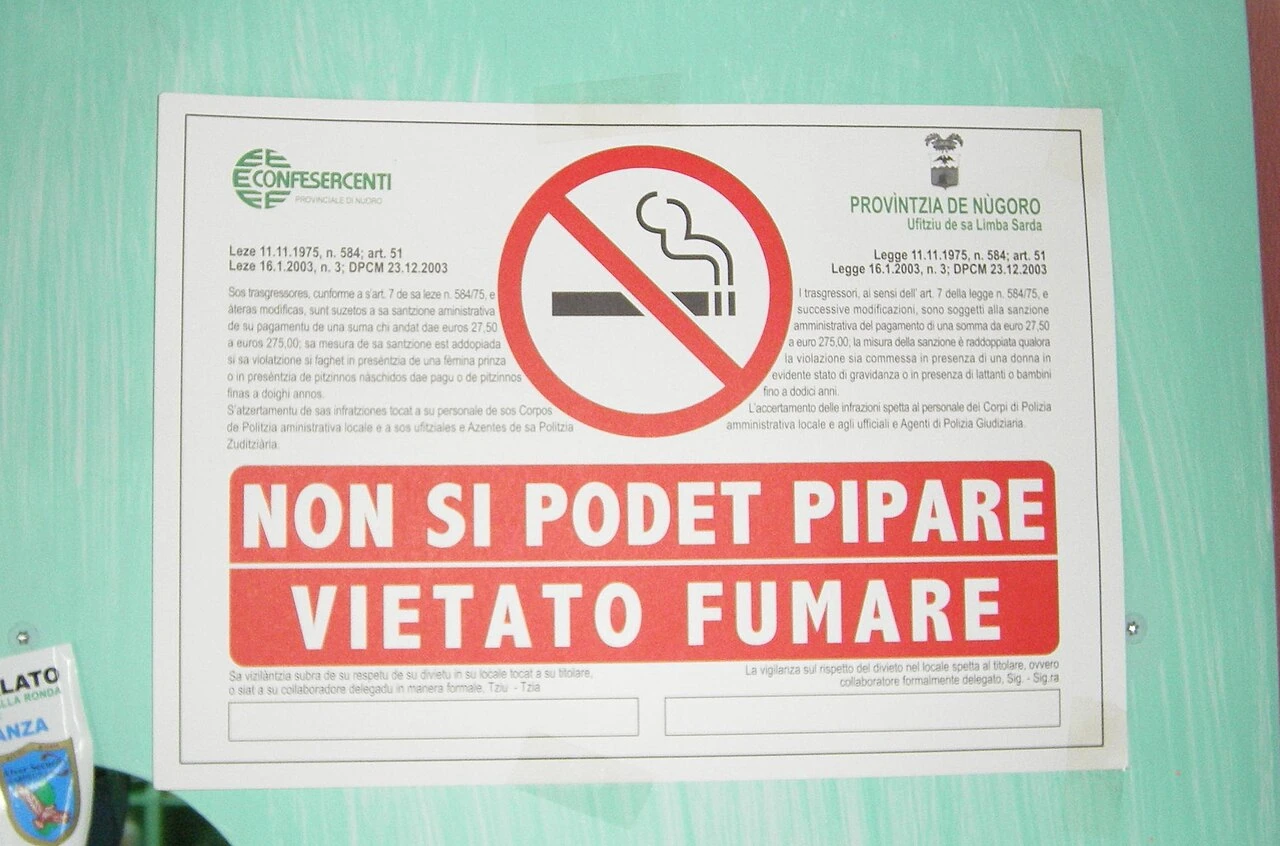
A bilingual Sardinian and Italian no-smoking sign photographed in 2006. Commons provides the Sardinian transcription as well as explicit language identification.
Saved in Babelbook · resized display copy. Select the image to open it independently of its source.
Gaúcho · Source ↗CC BY-SA 3.0 ↗View the local visual field note
Representative reference points from Glottolog. Historical entries show reference locations, not current speakers. 4 points.
Reference & context ↗Babelbook · original editorial illustration · CC BY 4.0 · Glottolog locations; public-domain Natural Earth land
Source excerpts, selected, shortened and where noted editorially corrected from Sardinian language by Wikipedia contributors. Retrieved 2026-10-05. CC BY-SA 4.0. These excerpts are not an independently verified scholarly history; missing accounts are identified above.
Read further in the source
History
Sardinia's relative isolation from mainland Europe encouraged the development of a Romance language that preserves traces of its indigenous, pre-Roman language(s). The language is posited to have substratal influences from Paleo-Sardinian, which some scholars have linked to Basque and Etruscan; comparisons have also been drawn with the Berber languages from North Africa to shed more light on the language(s) spoken in Sardinia prior to its Romanization. Subsequent adstratal influences include Catalan, Spanish, and Italian. The situation of the Sardinian language with regard to the politically dominant ones did not change until fascism and, most evidently, the 1950s.
Origins of modern Sardinian
Prenuragic and Nuragic era
The origins of ancient Sardinian, also known as Paleo-Sardinian, are currently unknown. Research has attempted to discover obscure, indigenous, pre-Romance roots. The root s(a)rd, indicating many place names as well as the island's people, is reportedly either associated with or originating from the Sherden, one of the Sea Peoples. Other sources trace instead the root s(a)rd from Σαρδώ, a legendary woman from the Anatolian Kingdom of Lydia, or from the Libyan mythological figure of the Sardus Pater Babai ("Sardinian Father" or "Father of the Sardinians"). In 1984, Massimo Pittau claimed to have found the etymology of many Latin words in the Etruscan language, after comparing it with the Nuragic language(s). Etruscan elements, formerly thought to have originated in Latin, would indicate a connection between the ancient Sardinian culture and the Etruscans. According to Pittau, the Etruscan and Nuragic language(s) are descended from Lydian (and therefore Indo-European) as a consequence of contact with Etruscans and other Tyrrhenians from Sardis as described by Herodotus. Although Pittau suggests that the Tirrenii landed in Sardinia and the Etruscans landed in modern Tuscany, his views are not shared by most Etruscologists. According to Bertoldi and Terracini, Paleo-Sardinian has similarities with the Iberic languages and Siculian; for example, the suffix -ara in proparoxytones indicated the plural. Terracini proposed the same for suffixes in -/àna/, -/ànna/, -/énna/, -/ònna/ + /r/ + a paragogic vowel (such as the toponym Bunnànnaru). Rohlfs, Butler and Craddock add the suffix -/ini/ (such as the toponym Barùmini) as a unique element of Paleo-Sardinian. Suffixes in /a, e, o, u/ + -rr- found a correspondence in north Africa (Terracini), in Iberia (Blasco Ferrer) and in southern Italy and Gascony (Rohlfs), with a closer relationship to Basque (Wagner and Hubschmid). However, these early links to a Basque precursor have been questioned by some Basque linguists. According to Terracini, suffixes in -/ài/, -/éi/, -/òi/, and -/ùi/ are common to Paleo-Sardinian and northern African languages. Pittau emphasized that this concerns terms originally ending in an accented vowel, with an attached paragogic vowel; the suffix resisted Latinization in some place names, which show a Latin body and a Nuragic suffix. According to Bertoldi, some toponyms ending in -/ài/ and -/asài/ indicated an Anatolian influence. The suffix -/aiko/, widely used in Iberia and possibly of Celtic origin, and the ethnic suffix in -/itanos/ and -/etanos/ (for example, the Sardinian Sulcitanos) have also been noted as Paleo-Sardinian elements (Terracini, Ribezzo, Wagner, Hubschmid and Faust). Some linguists, like Max Leopold Wagner (1931), Blasco Ferrer (2009, 2010) and Arregi (2017) have attempted to revive a theoretical connection with Basque by linking words such as Sardinian idile 'marshland' and Basque itil 'puddle'; Sardinian ospile 'fresh grazing for cattle' and Basque hozpil 'cool, fresh'; Sardinian arrotzeri 'vagabond' and Basque arrotz 'stranger'; Sardinian golostiu and Basque gorosti 'holly'; Gallurese (Corso-Sardinian) zerru 'pig' (with z for [dz]) and Basque zerri (with z for [s]). Genetic data have found the Basques to be close to the Sardinians.
Since the Neolithic period, some degree of variance across the island's regions is also attested. The Arzachena culture, for instance, suggests a link between the northernmost Sardinian region (Gallura) and southern Corsica that finds further confirmation in the Natural History by Pliny the Elder. There are also some stylistic differences across Northern and Southern Nuragic Sardinia, which may indicate the existence of two other tribal groups (Balares and Ilienses) mentioned by the same Roman author. According to the archeologist Giovanni Ugas, these tribes may have in fact played a role in shaping the current regional linguistic differences of the island.
Classical period
Around the 10th and 9th century BC, Phoenician merchants were known to have made their presence in Sardinia, which acted as a geographical mediator in between the Iberian and the Italian peninsula. In the eighth and seventh centuries, the Phoenicians began to develop permanent settlements, politically arranged as city-states in similar fashion to the Lebanese coastal areas. It did not take long before they started gravitating around the Carthaginian sphere of influence, whose level of prosperity spurred Carthage to send a series of expeditionary forces to the island; although they were initially repelled by the natives, the North African city vigorously pursued a policy of active imperialism and, by the sixth century, managed to establish its political hegemony and military control over South-Western Sardinia. Punic began to be spoken in the area, and many words entered ancient Sardinian as well. Words like giara 'plateau' (cf. Hebrew yaʿar 'forest, scrub'), g(r)uspinu 'nasturtium' (from Punic cusmin), curma 'fringed rue' (cf. Arabic ḥarmal 'Syrian rue'), mítza 'spring' (cf. Hebrew mitsa, metza 'source, fountainhead'), síntziri 'marsh horsetail' (from Punic zunzur 'common knotgrass'), tzeúrra 'sprout' (from *zerula, diminutive of Punic zeraʿ 'seed'), tzichirìa 'dill' (from Punic sikkíria; cf. Hebrew šēkār 'ale') and tzípiri 'rosemary' (from Punic zibbir) are commonly used, especially in the modern Sardinian varieties of the Campidanese plain, while proceeding northwards the influence is more limited to place names, such as the town of Magomadas, Macumadas in Nuoro or Magumadas in Gesico and Nureci, all of which deriving from the Punic maqom hadash 'new city'. The Roman domination began in 238 BC, but was often contested by the local Sardinian tribes, who had by then acquired a high level of political organization, and would manage to only partly supplant the pre-Latin Sardinian languages, including Punic. Although the colonists and negotiatores (businessmen) of strictly Italic descent would later play a relevant role in introducing and spreading Latin to Sardinia, Romanisation proved slow to take hold among the Sardinian natives, whose proximity to the Carthaginian cultural influence was noted by Roman authors. Punic continued to be spoken well into the 3rd–4th century AD, as attested by votive inscriptions, and it is thought that the natives from the most interior areas, led by the tribal chief Hospito, joined their brethren in making the switch to Latin around the 7th century AD, through their conversion to Christianity. Cicero, who loathed the Sardinians on the ground of numerous factors, such as their outlandish language, their kinship with Carthage and their refusal to engage with Rome, would call the Sardinian rebels latrones mastrucati ('thieves with rough wool cloaks') or Afri ('Africans') to emphasize Roman superiority over a population mocked as the refuse of Carthage. A number of obscure Nuragic roots remained unchanged, and in many cases Latin accepted the local roots (like nur, presumably cognate of Norax, which makes its appearance in nuraghe, Nurra, Nurri and many other toponyms). Barbagia, the mountainous central region of the island, derives its name from the Latin Barbaria (a term meaning 'Land of the Barbarians', similar in origin to the now antiquated word Barbary), because its people refused cultural and linguistic assimilation for a long time: 50% of toponyms of central Sardinia, particularly in the territory of Olzai, are actually not related to any known language. According to Terracini, amongst the regions in Europe that went on to draw their language from Latin, Sardinia has overall preserved the highest proportion of pre-Latin toponyms. Besides the place names, on the island there are still a few names of plants, animals and geological formations directly traceable to the ancient Nuragic era. By the end of the Roman domination, Latin had gradually become however the speech of most of the island's inhabitants. As a result of this protracted and prolonged process of Romanisation, the modern Sardinian language is today classified as Romance or neo-Latin, with some phonetic features resembling Old Latin. Some linguists assert that modern Sardinian, being part of the Island Romance group, was the first language to split off from Latin, all others evolving from Latin as Continental Romance. In fact, contact with Rome might have ceased from as early as the first century BC. In terms of vocabulary, Sardinian retains an array of peculiar Latin-based forms that are either unfamiliar to, or have altogether disappeared in, the rest of the Romance-speaking world. The number of Latin inscriptions on the island is relatively small and fragmented. Some engraved poems in ancient Greek and Latin (the two most prestigious languages in the Roman Empire) are seen in the so-called "Viper's Cave" (Gruta 'e sa Pibera in Sardinian, Grotta della Vipera in Italian, Cripta Serpentum in Latin), a burial monument built in Caralis (Cagliari) by Lucius Cassius Philippus (a Roman who had been exiled to Sardinia) in remembrance of his dead spouse Atilia Pomptilla; we also have some religious works by Eusebius and Saint Lucifer, both from Caralis and in the writing style of whom may be noted the lexicon and perifrastic forms typical of Sardinian (e.g. narrare in place of dicere; compare with Sardinian nàrrere or nàrri(ri) 'to say'). After a period of 80 years under the Vandals, Sardinia would again be part of the Byzantine Empire under the Exarchate of Africa for almost another five centuries. Luigi Pinelli believes that the Vandal presence had "estranged Sardinia from Europe, linking its own destiny to Africa's territorial expanse" in a bond that was to strengthen further "under Byzantine rule, not only because the Roman Empire included the island in the African Exarchate, but also because it developed from there, albeit indirectly, its ethnic community, causing it to acquire many of the African characteristics" that would allow ethnologists and historians to elaborate the theory of the Paleo-Sardinians' supposed African origin, now disproved. Casula is convinced that the Vandal domination caused a "clear breaking with the Roman-Latin writing tradition or, at the very least, an appreciable bottleneck" so that the subsequent Byzantine government was able to establish "its own operational institutions" in a "territory disputed between the Greek- and the Latin-speaking world". Despite a period of almost five centuries, the Greek language only lent Sardinian a few ritual and formal expressions using Greek structure and, sometimes, the Greek alphabet. Evidence for this is found in the condaghes, the first written documents in Sardinian. From the long Byzantine era there are only a few entries but they already provide a glimpse of the sociolinguistical situation on the island in which, in addition to the community's everyday Neo-Latin language, Greek was also spoken by the ruling classes. Some toponyms, such as Jerzu (thought to derive from the Greek khérsos, 'untilled'), together with the personal names Mikhaleis, Konstantine and Basilis, demonstrate Greek influence.
Standardization
Until 2001, there was not a unifying orthographic standard available for all the dialects of Sardinian, neither in the literary nor in the oral domain (one designed for the latter does not exist to this day). After the Middle Ages, where a certain orthographic uniformity can be observed, the only steps to provide the language with a single standard, called "illustrious Sardinian", were undertaken by such writers as Hieronimu Araolla, Ioan Mattheu Garipa and Matteo Madau, who had based their works on the model of medieval Sardinian. However, attempts to formalise and spread this orthography would be hindered by the Iberian and later Savoyard authorities. The dialectally fragmented nature of the language is such that it is popularly contended that Sardinian is divided into two or more groups, which have provided themselves with a series of traditional orthographies already, albeit with many changes over the time. While this belief is not grounded on linguistic considerations, it is however motivated by political and social reasons. In addition to the orthographies commonly referred to as "Logudorese" and "Campidanese", the Nuorese orthography, the Arborense one and even those restricted to individual towns were also developed, sometimes finding common ground with some general rules, such as those required by the Ozieri Award. It is often the case, however, that speakers who are not commonly taught the Sardinian language and are thus literate only in Italian, for lack of a bilingual education, transcribe their local spelling following rules pertaining to the latter rather than the former. However, some attempts have been made to introduce a single orthographic form for administrative purposes over the recent decades; said form does not aim to refer to morphology and syntax, which is already fairly homogeneous, but concerns itself primarily with spelling. To allow for an effective implementation of the provisions on the language, as per the regional law no. 26/1997 and the national law no. 482/1999, the Sardinian Autonomous Region arranged for a commission of experts to elaborate a standard capable of overcoming the hurdle posed by the dialectal differences and thereby providing a unified writing system. A first proposal (the LSU: Limba Sarda Unificada, published on 28 February 2001) was tabled, which identified a model language of reference (based on the analysis of local varieties of Sardinian and on the selection of the most representative and compatible models) so as to guarantee the necessary characteristics of certainty, coherence, univocity, and supra-local diffusion. The people appointed for the task were Eduardo Blasco Ferrer, Roberto Bolognesi, Diego Salvatore Corraine, Ignazio Delogu, Antonietta Dettori, Giulio Paulis, Massimo Pittau, Tonino Rubattu, Leonardo Sole, Heinz Jürgen Wolf, and Matteo Porru acting as the Committee's secretary. This study, although scientifically valid, has never been adopted at an institutional level: critics argued that it was an "artificial" system "imposed" on Sardinian speakers. Nevertheless, the LSU would act as a springboard for a subsequent drafting proposal, this time drawn by a new Committee composed of Giulio Angioni, Roberto Bolognesi, Manlio Brigaglia, Michel Contini, Diego Corraine, Giovanni Lupinu, Anna Oppo, Giulio Paulis, Maria Teresa Pinna Catte and Mario Puddu. The new project continued to be worked on, going by the name of LSC (Limba Sarda Comuna). The new experimental standard proposal, published in 2006, was characterised by taking the mesania (transitional) varieties as reference, and welcoming elements of the spoken language so as to be perceived as a more "natural" mediation; it also ensured that the common orthography would be provided with the characteristics of over-dialectality and supra-municipality, while being open to integrating the phonetic peculiarities of the local variants. Despite this, there was some criticism for this norm as well, both by those who proposed amendments to improve it, and by those who preferred to insist with the idea of dividing Sardinian into two macro-variants with their own separate orthographies. The Sardinian Regional Government, with the resolution of the Regional Council n. 16/14 of 18 April 2006 "Limba Sarda Comuna. Adoption of the reference standards of an experimental nature for the written language output of the Regional Administration", has experimentally adopted the LSC as the official orthography for the acts and documents issued by the Region of Sardinia (even if, as per Article 8 of the national Law no. 482/99, only the text written in Italian has legal value), giving citizens the right to write to the Public Administration in their own variety and establishing the regional language desk Ufitziu de sa Limba Sarda. The resolution does not aim to impose the guide and further notes that it is "open to integrations" and that "all solutions are of equal linguistic value". In the following years, the Region has abided by the LSC standard in the translation of many documents and resolutions and in many other areas. In addition, the LSC standard has been adopted on a voluntary basis by many other institutions, schools and media, often in a complementary manner with orthographic norms closer to the local spelling. Regarding these uses, a percentage estimate was made, considering only the projects financed or co-financed by the Region for the diffusion of the Sardinian language in the municipal and supra-municipal language offices, for the teaching in schools and the media from 2007 to 2013. The monitoring, by the Sardinian Language and Culture Service of the Department of Public Education, was published on the website of the Sardinian Autonomous Region in April 2014. Regarding the school projects financed in 2013, for example, it appears that there was a clear preference, in schools, for the use of the LSC orthographic standard together with a local spelling (51%), compared to the exclusive use of the LSC (11%) or the exclusive use of a local spelling (33%). On the other hand, regarding the editorial projects in Sardinian language in the regional media, financed by the Region in 2012, we find a greater presence of the LSC (which could derive from a reward of 2 points in the formation of the rankings to take funding, a reward that was not present in the notice for schools). According to those data, it appears that 35% of textual production in media projects was in LSC, 35% in LSC and in local spellings and 25% in local spellings only. The local language offices, co-financed by the Regional Government, in 2012 used LSC in 50% of their writing, LSC together with local spelling for 9% and local spellings for 41%. A recent research on the use of the LSC orthography in schools, carried out in the municipality of Orosei, showed that the students of the local middle school had no problem using that standard despite the fact that the Sardinian they spoke was partly different. No pupil rejected it or considered it "artificial", a thing that proved its validity as a didactic tool. The results were first presented in 2016 and published in an article in 2021.