Sindhi
Sindhi ( SIN-dee; Sindhi: سِنڌِي (Perso-Arabic) or सिन्धी (Devanagari), pronounced [sɪndʱiː]) is an Indo-Aryan language. It is the official language of the Pakistani province of Sindh. It is also an official scheduled language in India. Sindhi is written in the Perso-Arabic script in Pakistan and both the Perso-Arabic and Devanagari scripts in India. Sindhi is an inflected language, with five cases for noun, three for personal pronoun, four for third-person pronoun; eleven case markers; two genders (masculine, feminine); and two numbers (singular, plural). Sindh was one of the first regions in the Indian subcontinent to encounter influence from Persian and Arabic following the Umayyad conquest in 712 AD. A substantial body of Sindhi literature subsequently developed, the most famous of which is the religious and mystic poetry of Shah Abdul Latif Bhittai from the 18th century. Modern Sindhi was promoted under British rule beginning in 1843. The current regulatory agency for the development and promotion of the language in Sindh is the Sindhi Language Authority. It is spoken by more than 34 million people in Pakistan and by 2.7 million people in India.
Translate in Sindhi ↗Sindhi is the official language of the Pakistani province of Sindh and one of the scheduled languages in the constitution of India. Sindhi is additionally spoken by many members of the Sindhi diaspora, particularly in Malaysia, Oman, Singapore, UAE, USA and UK.
South Asia
Present-day use
The captured source does not contain a separate current-use account.
Origins
The captured article does not contain a separate origins section. See the historical account and linked source.
Development
The name "Sindhi" is derived from the Sanskrit síndhu, the original name of the Indus River, along whose delta Sindhi is spoken. In the Bronze Age (c. 3300 – c. 1200 BCE), the primary language of this region was likely the Harappan language, but no records exist indicating when or how that language was replaced by the Indo-Aryan languages. Like other languages of the Indo-Aryan family, Sindhi is descended from Old Indo-Aryan (Sanskrit) via Middle Indo-Aryan (Pali, secondary Prakrits, and Apabhramsha). 20th century Western scholars such as George Abraham Grierson believed that Sindhi descended specifically from the Vrācaḍa dialect of Apabhramsha (described by Markandeya as being spoken in Sindhu-deśa, corresponding to modern Sindh) but later work has shown this to be unclear. The sound changes that characterise the development of Sindhi from Middle Indo-Aryan are: Development of implosives from geminate and initial stops (e.g. g-, -gg > ɠ); this is a highly distinctive sound change in NIA Shortening of geminates (e.g. MIA akkhi > Sindhi akhi "eye") Voicing of post-nasal consonants (e.g. MIA danta > Sindhi ɗ̣andu "tooth") Debuccalization of intervocalic -s- > -h- Intervocalic -l- > -r- (likely via intermediate retroflex -ḷ-), -ll- > -l-, -ḍ- > -ṛ- Fronting of r from medial clusters to initial (e.g. OIA dīrgha > Sindhi ḍrigho "long") Additionally, the following retentions distinguish Sindhi from other New Indo-Aryan languages: Retention of MIA -ṇ- Retention of final short vowels -a, -i, -u, but also insertion of these into loanwords Retention of long vowels before geminates (more archaic than e.g. Prakrit) Retention of stop + r clusters but with retroflexion, e.g. tr- > ṭr- Retention of v- Literary attestation of early Sindhi is sparse.
Writing
Sindhis in Pakistan use a version of the Perso-Arabic script with new letters adapted to Sindhi phonology, while in India a greater variety of scripts is in use, including Devanagari and historicallyKhudabadi, Khojki, and Gurmukhi. Perso-Arabic for Sindhi was also made digitally accessible relatively earlier. The earliest attested records in Sindhi are from the 15th century. Before the standardisation of Sindhi orthography, numerous forms of Devanagari and Laṇḍā scripts were used for trading. For literary and religious purposes, a Perso-Arabic script developed by Abul-Hasan as-Sindi and Gurmukhi (a subset of Laṇḍā) were used. Another two scripts, Khudabadi and Shikarpuri, were reforms of the Landa script. During British rule in the late 19th century, the Perso-Arabic script was decreed standard over Devanagari. During the British Raj, a variant of the Persian alphabet was adopted for Sindhi in the 19th century. The script is used in Pakistan and India today. It has a total of 52 letters, augmenting the Persian with digraphs and eighteen new letters (ڄ ٺ ٽ ٿ ڀ ٻ ڙ ڍ ڊ ڏ ڌ ڇ ڃ ڦ ڻ ڱ ڳ ڪ) for sounds particular to Sindhi and other Indo-Aryan languages. Some letters that are distinguished in Arabic or Persian are homophones in Sindhi. The table presents the Sindhi Perso-Arabic alphabet. Letters shaded in yellow are solely used in writing of loanwords, and the phonemes they represent are also represented by other letters in the alphabet. Letters and digraphs shaded in green aren't usually considered part of the base alphabet. They are either commonly used digraphs representing aspirated consonants, or are ligatures serving a grammatical function. These ligatures include the ۽, which is pronounced as [ãĩ̯] and represents and, and the ۾, which is pronounced as [mẽ] and creates a locative relationship between words. The orthography of the letter hāʾ in Sindhi, especially as it comes to typing as opposed to handwriting, has been a source of confusion for many.
Beyond the typeface.
Signs, manuscripts, published pages and contextual photographs, with their place, period, source and reuse terms. Captions identify historical spellings, regional examples, community references and character imagery.
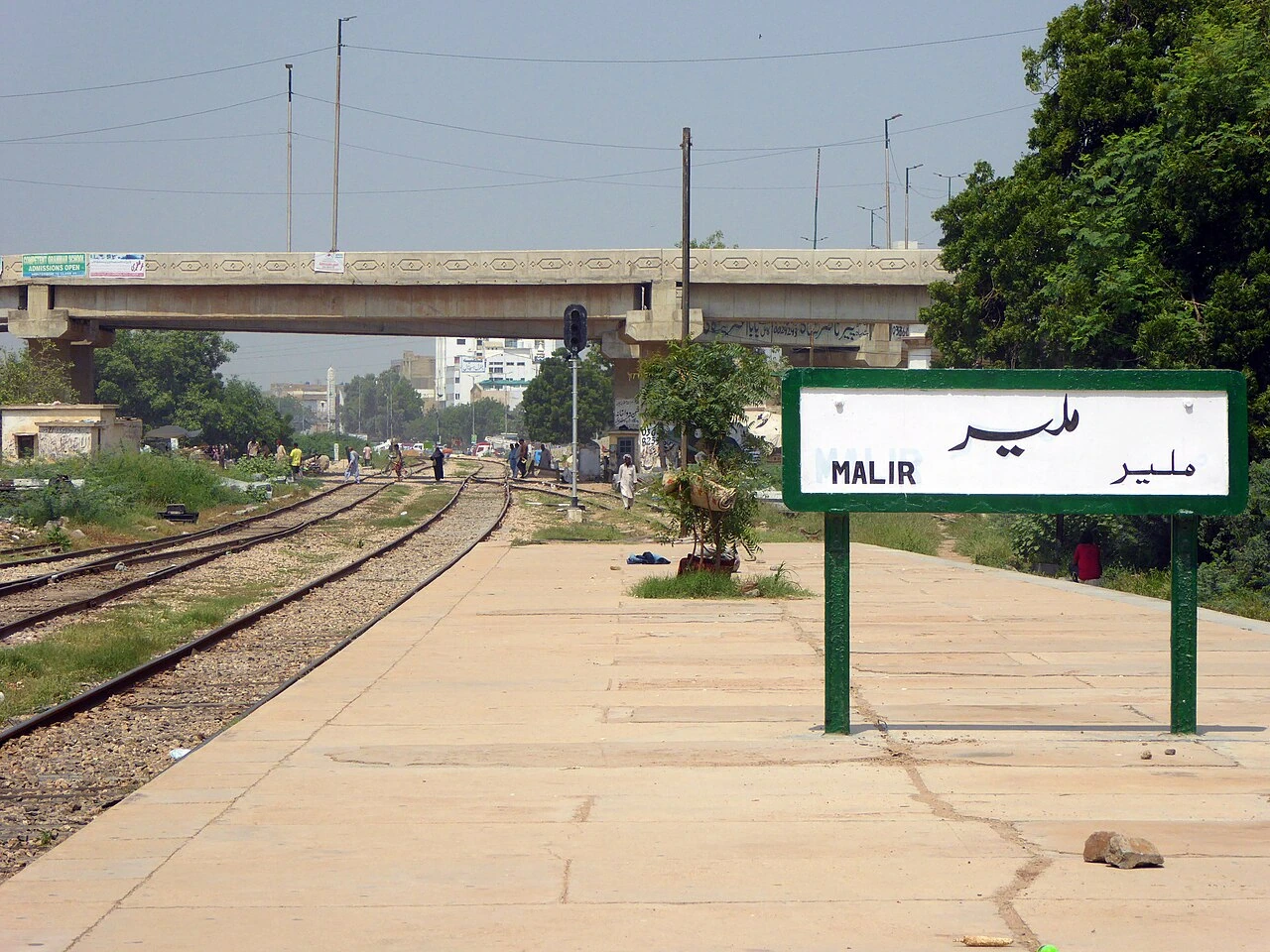
A station name board on the Karachi–Peshawar railway, catalogued as Sindhi–Urdu–English signage.
Saved in Babelbook · resized display copy. Select the image to open it independently of its source.
Asad Razzaki · Source ↗CC BY-SA 4.0 ↗View the local visual field note
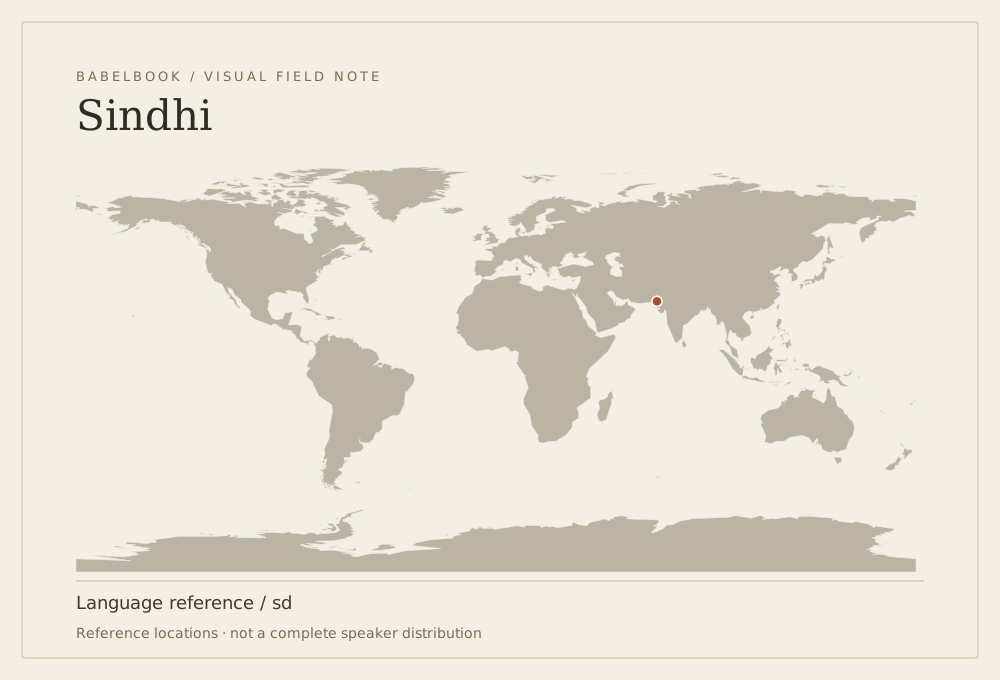
Representative reference points from Glottolog. Historical entries show reference locations, not current speakers. 1 point.
Reference & context ↗Babelbook · original editorial illustration · CC BY 4.0 · Glottolog locations; public-domain Natural Earth land
Source excerpts, selected, shortened and where noted editorially corrected from Sindhi language by Wikipedia contributors. Retrieved 2026-10-05. CC BY-SA 4.0. These excerpts are not an independently verified scholarly history; missing accounts are identified above.
Read further in the source
History
The name "Sindhi" is derived from the Sanskrit síndhu, the original name of the Indus River, along whose delta Sindhi is spoken. In the Bronze Age (c. 3300 – c. 1200 BCE), the primary language of this region was likely the Harappan language, but no records exist indicating when or how that language was replaced by the Indo-Aryan languages. Like other languages of the Indo-Aryan family, Sindhi is descended from Old Indo-Aryan (Sanskrit) via Middle Indo-Aryan (Pali, secondary Prakrits, and Apabhramsha). 20th century Western scholars such as George Abraham Grierson believed that Sindhi descended specifically from the Vrācaḍa dialect of Apabhramsha (described by Markandeya as being spoken in Sindhu-deśa, corresponding to modern Sindh) but later work has shown this to be unclear. The sound changes that characterise the development of Sindhi from Middle Indo-Aryan are:
Development of implosives from geminate and initial stops (e.g. g-, -gg > ɠ); this is a highly distinctive sound change in NIA Shortening of geminates (e.g. MIA akkhi > Sindhi akhi "eye") Voicing of post-nasal consonants (e.g. MIA danta > Sindhi ɗ̣andu "tooth") Debuccalization of intervocalic -s- > -h- Intervocalic -l- > -r- (likely via intermediate retroflex -ḷ-), -ll- > -l-, -ḍ- > -ṛ- Fronting of r from medial clusters to initial (e.g. OIA dīrgha > Sindhi ḍrigho "long") Additionally, the following retentions distinguish Sindhi from other New Indo-Aryan languages:
Retention of MIA -ṇ- Retention of final short vowels -a, -i, -u, but also insertion of these into loanwords Retention of long vowels before geminates (more archaic than e.g. Prakrit) Retention of stop + r clusters but with retroflexion, e.g. tr- > ṭr- Retention of v- Literary attestation of early Sindhi is sparse. Historically, Isma'ili religious literature and poetry in India, as old as the 11th century CE, used a language that was closely related to Sindhi and Gujarati; at this point, Sindhi was not clearly established as an independent literary language. Much of this work is in the form of ginans (a kind of devotional hymn). Sindhi was the first Indo-Aryan language to be in close contact with Arabic and Persian following the Umayyad conquest of Sindh in 712 CE. Arabic sources thus do mention the language of Sindh in various instances. The following excerpts are translated from The History of India, as Told by Its Own Historians by Henry Miers Elliot.
The language of Sind is different from that of India. Sind is the country which is nearer to the domains of the Muslims; India is farther from them. The language of Mansúra, Multán, and those parts is Arabic and Sindian. In Makrán, they use Persian and Makranic. Additionally, the Korean Buddhist monk Hyech'o mentions the unique language of Sindh in his travelogue:
From Takka, I walked towards the West for another month and arrived at the country of Sindhukula. The dress, customs, climate, and temperature are similar to north India, although the language is slightly different.Medieval Sindhi literature is of a primarily religious genre, comprising a syncretic Sufi and Advaita Vedanta poetry, the latter in the devotional bhakti tradition. The format of this poetry is the bayt, indicating significant influence from Arabic and Persian. The earliest known Sindhi poet of the Sufi tradition is Qazi Qadan (1493–1551). Other early poets were Shah Inat Rizvi (c. 1613–1701) and Shah Abdul Karim Bulri (1538–1623). These poets had a mystical bent that profoundly influenced Sindhi poetry for much of this period. Another famous part of Medieval Sindhi literature is a wealth of Sindhi folktales, adapted and readapted into verse by many bards at various times and possibly much older than their earliest literary attestations. These include romantic epics such as Sassui Punnhun, Sohni Mahiwal, Momal Rano, Noori Jam Tamachi, Lilan Chanesar, and others. The greatest poet of Sindhi was Shah Abdul Latif Bhittai (1689/1690–1752), whose verses were compiled into the Shah Jo Risalo by his followers. While primarily Sufi, his verses also recount traditional Sindhi folktales and aspects of the cultural history of Sindh. The first attested Sindhi translation of the Quran was done by Akhund Azizullah Muttalawi (1747–1824) and published in Gujarat in 1870. The first to appear in print was by Muhammad Siddiq in 1867.
Geographical distribution
Sindhi is the official language of the Pakistani province of Sindh and one of the scheduled languages in the constitution of India. Sindhi is additionally spoken by many members of the Sindhi diaspora, particularly in Malaysia, Oman, Singapore, UAE, USA and UK.
Dialects
Sindhi has many dialects, and forms a dialect continuum at some places with neighboring languages such as Saraiki to the north and Gujarati to the south, but not with Marwari to the east. Some of the documented dialects of Sindhi are:
Vicholi: The prestige dialect spoken around Hyderabad and central Sindh (the Vicholo region), on which the literary standard is based. Uttaradi: The dialect of northern Sindh (Uttaru, meaning "north"), with minor differences in Larkana, Shikarpur and in parts of Sukkur and Kandiaro. Lari: The dialect of southern Sindh (Lāṛu) spoken around areas like Karachi, Thatta, Sujawal, Tando Muhammad Khan and Badin districts. Siroli (also Siraiki, Ubheji): The dialect of northernmost Sindh (Siro, meaning "head"). Spoken in smaller number all over Sindh but mainly in Jacobabad and Kashmore districts, it may be transitional with the Saraiki language of southern Punjab and has variously been treated either as a dialect of Saraiki or as a dialect of Sindhi. Lasi: The dialect of Lasbela, Hub and Gwadar districts in Balochistan, closely related to Lari and Vicholi, and in contact with Balochi. Firaqi: The dialect of the Kachhi plains the north eastern districts of Balochistan, where it is referred to as Firaqi Sindhi or commonly just Sindhi. Thareli (also Tharechi): Spoken in the northeastern Thar desert of Sindh, but mainly spoken in the western part of Jaisalmer district of Rajasthan, India by many Sindhi Muslims. Sindhi Bhili: Spoken in Sindh by the Sindhi Meghwars and Bhils. Furthermore, Kutchi and Jadgali are sometimes classified as dialects of Sindhi rather than independent languages.
Writing systems
Sindhis in Pakistan use a version of the Perso-Arabic script with new letters adapted to Sindhi phonology, while in India a greater variety of scripts is in use, including Devanagari and historicallyKhudabadi, Khojki, and Gurmukhi. Perso-Arabic for Sindhi was also made digitally accessible relatively earlier. The earliest attested records in Sindhi are from the 15th century. Before the standardisation of Sindhi orthography, numerous forms of Devanagari and Laṇḍā scripts were used for trading. For literary and religious purposes, a Perso-Arabic script developed by Abul-Hasan as-Sindi and Gurmukhi (a subset of Laṇḍā) were used. Another two scripts, Khudabadi and Shikarpuri, were reforms of the Landa script. During British rule in the late 19th century, the Perso-Arabic script was decreed standard over Devanagari.