Northern Sámi
Northern Sámi (or North Sámi; US: SAH-mee, UK: also SAM-ee; Northern Sami: davvisámegiella [ˈtavːiːˌsaːmeˌkie̯lːa]; Finnish: pohjoissaame [ˈpohjoi̯sˌsɑːme]; Norwegian: nordsamisk; Swedish: nordsamiska; disapproved exonym Lappish or Lapp) is the most widely spoken of all Sámi languages. The area where Northern Sámi is spoken covers the northern parts of Norway, Sweden and Finland.
Translate in Northern Sámi ↗The number of Northern Sámi speakers is estimated to be somewhere between 15,000 and 25,000. About 2,000 of these live in Finland and between 5,000 and 6,000 in Sweden, with the remaining portions being in Norway. Based on the highest estimates above of 18,000 speakers in Norway, and Statistics Norway estimating the total population of Norway to be 5,594,340 at the start of 2025, this gives the percentage of Northern Sámi speakers in Norway as approximately 0.32%. Similar calculations for Sweden and Finland give them as 0.05% and 0.03% respectively in those countries.
Europe
Present-day use
The captured source does not contain a separate current-use account.
Origins
The captured article does not contain a separate origins section. See the historical account and linked source.
Development
Among the first printed Sámi texts is Swenske och Lappeske ABC Book ("Swedish and Lappish ABC book"), written in Swedish and what is likely a form of Northern Sámi. It was published in two editions in 1638 and 1640 and includes 30 pages of prayers and confessions of Protestant faith. It has been described as the first book "with a regular Sámi language form". Northern Sámi was first described by Knud Leem (En lappisk Grammatica efter den Dialect, som bruges af Field-Lapperne udi Porsanger-Fiorden) in 1748 and in dictionaries in 1752 and 1768. One of Leem's fellow grammaticians, who had also assisted him, was Anders Porsanger, himself Sámi and in fact the first Sámi to receive higher education, who studied at the Trondheim Cathedral School and other schools, but who was unable to publish his work on Sámi due to racist attitudes at the time. The majority of his work has disappeared. In 1832, Rasmus Rask published the highly influential Ræsonneret lappisk Sproglære ('Reasoned Sámi Grammar'), Northern Sámi orthography being based on his notation (according to E. N. Setälä). No major official nationwide surveys on the distribution of speakers by municipality or county in Norway have been done. A 2000 survey by the Sami Language Council showed Kautokeino Municipality and Karasjok Municipality as 96% and 94% Sami-speaking respectively; should those percentages still be true as of the 2022 national population survey, this would result in 2,761 and 2,428 speakers respectively, virtually all of which being speakers of Northern Sámi. Tromsø Municipality has no speaker statistics despite having (as of June 2019) the largest voter roll in the 2021 Norwegian Sámi parliamentary election.
Writing
Northern Sámi has a long orthographic history, which includes no fewer than 9 Latin alphabets.
Beyond the typeface.
Signs, manuscripts, published pages and contextual photographs, with their place, period, source and reuse terms. Captions identify historical spellings, regional examples, community references and character imagery.
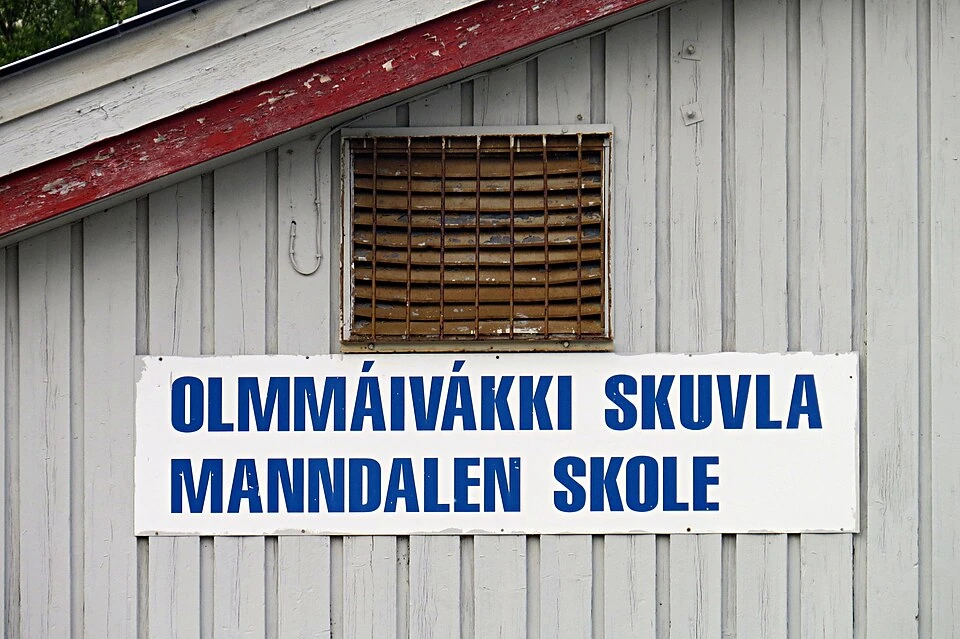
Northern Sámi and Norwegian sign at Olmmáivággi/Manndalen School. Language identification follows Commons metadata; not independently transcribed.
Saved in Babelbook · resized display copy. Select the image to open it independently of its source.
Kimberli Mäkäräinen · Source ↗CC BY-SA 4.0 ↗View the local visual field note
Representative reference points from Glottolog. Historical entries show reference locations, not current speakers. 1 point.
Reference & context ↗Babelbook · original editorial illustration · CC BY 4.0 · Glottolog locations; public-domain Natural Earth land
Source excerpts, selected, shortened and where noted editorially corrected from Northern Sámi by Wikipedia contributors. Retrieved 2026-10-05. CC BY-SA 4.0. These excerpts are not an independently verified scholarly history; missing accounts are identified above.
Read further in the source
Geographic distribution
The number of Northern Sámi speakers is estimated to be somewhere between 15,000 and 25,000. About 2,000 of these live in Finland and between 5,000 and 6,000 in Sweden, with the remaining portions being in Norway. Based on the highest estimates above of 18,000 speakers in Norway, and Statistics Norway estimating the total population of Norway to be 5,594,340 at the start of 2025, this gives the percentage of Northern Sámi speakers in Norway as approximately 0.32%. Similar calculations for Sweden and Finland give them as 0.05% and 0.03% respectively in those countries.
History
Among the first printed Sámi texts is Swenske och Lappeske ABC Book ("Swedish and Lappish ABC book"), written in Swedish and what is likely a form of Northern Sámi. It was published in two editions in 1638 and 1640 and includes 30 pages of prayers and confessions of Protestant faith. It has been described as the first book "with a regular Sámi language form". Northern Sámi was first described by Knud Leem (En lappisk Grammatica efter den Dialect, som bruges af Field-Lapperne udi Porsanger-Fiorden) in 1748 and in dictionaries in 1752 and 1768. One of Leem's fellow grammaticians, who had also assisted him, was Anders Porsanger, himself Sámi and in fact the first Sámi to receive higher education, who studied at the Trondheim Cathedral School and other schools, but who was unable to publish his work on Sámi due to racist attitudes at the time. The majority of his work has disappeared. In 1832, Rasmus Rask published the highly influential Ræsonneret lappisk Sproglære ('Reasoned Sámi Grammar'), Northern Sámi orthography being based on his notation (according to E. N. Setälä). No major official nationwide surveys on the distribution of speakers by municipality or county in Norway have been done. A 2000 survey by the Sami Language Council showed Kautokeino Municipality and Karasjok Municipality as 96% and 94% Sami-speaking respectively; should those percentages still be true as of the 2022 national population survey, this would result in 2,761 and 2,428 speakers respectively, virtually all of which being speakers of Northern Sámi. Tromsø Municipality has no speaker statistics despite having (as of June 2019) the largest voter roll in the 2021 Norwegian Sámi parliamentary election. A common urban myth is that Oslo has the largest Sámi population despite being nowhere near the core Sápmi area, but it had only the 5th largest voter roll in 2019.
Dialectal variation
Not all Northern Sámi dialects have identical consonant inventories. Some consonants are absent from some dialects, while others are distributed differently.
Western Finnmark lacks /ŋ/, using /ɲ/ in its place. This also applies to sequences of pre-stopped /ɡːŋ/ and /kŋ/, which become /dːɲ/ and /tɲ/ respectively. [ŋ] is retained before a velar consonant, but as an allophone of /n/. Eastern Finnmark does not have voiced pre-stopped nasals, replacing them with voiceless equivalents. Sea Sámi does not have pre-stopped nasals at all, having geminate nasals in their place. The postaspirated stops do not occur in Western Finnmark dialects, plain stops are used instead. They occur only in recent loanwords from the Scandinavian languages, and only before a stressed syllable when not next to another consonant.
Dialectal variation
The Eastern Finnmark dialects possess additional contrasts that other dialects of Northern Sámi do not:
There is a maximally three-way contrast among open vowels between /æ/, /a/ and /ɑ/, both short and long. The vowel spelled ⟨a⟩ is /ɑ/ in stressed syllables, /a/ in unstressed syllables. The vowel spelled ⟨á⟩ is /a/ in stressed syllables if the next syllable has a back vowel (including ⟨a⟩ but not ⟨á⟩), and /æ/ everywhere else (including all unstressed syllables). In other eastern varieties, only a two-way contrast between /æ/ and /ɑ/ is found. Jarvansalo (2006) reports the Kárášjohka dialect following this contrast, but having /ɑ/ for ⟨á⟩, /ɒ/ for stressed ⟨a⟩. There is a length contrast between short and long diphthongs. In other dialects, this distinction exists as well, but is allophonic. Some Torne dialects have /ie̯/ and /uo̯/ instead of stressed /eː/ and /oː/ (from diphthong simplification) as well as unstressed /iː/ and /uː/.
Dialects
Sammallahti divides Northern Sámi dialects into certain regions as follows:
Finnmark dialects Western Finnmark: eastern Enontekiö, northern Sodankylä, and part of Inari in Finland plus Kautokeino and Alta in Norway Eastern Finnmark: Utsjoki and part of Inari in Finland plus Karasjok, Porsanger, and Tana in Norway Torne dialects Finnish Wedge: western Enontekiö in Finland plus Skibotnelva, Gálggojávri, and Nordreisa in Norway Karesuando: Könkämävuoma and Lainiovuoma in Sweden plus Lyngen and Balsfjord in Norway Jukkasjärvi: Saarivuoma, Talma, Rautasvuoma and Kaalasvuoma in Sweden plus Vågsfjord and Ofotfjord in Norway Kaitum: Norrkaitum and Mellanbyn in Sweden Sea Sámi The written language is primarily based on the western Finnmark dialects, with some elements from the eastern Finnmark dialects.
Western Finnmark dialects
Features of the western Finnmark dialects are:
Merging of the velar nasals into the palatal nasals, except before a (plain or preaspirated) homorganic stop. Lengthening of short /a/ when the preceding syllable contains a short vowel and a quantity 1 or 2 consonant. This new long /aː/ does not trigger consonant lengthening. Kautokeino: Merging of /ɟ/ into /tʃ/. Kautokeino: Assibilation of /θ/ into /s/.
Eastern Finnmark dialects
The eastern Finnmark dialects have the following characteristics:
Lengthening of stressed vowels before quantity 1 and 2 consonants. Shortening of the first element of quantity 3 consonants, merging them with quantity 2 consonants (unless the second element of the corresponding Q2 consonant is doubled, which keeps them distinct). Combined with the previous change, this causes Q3-Q2 gradation in Eastern Finnmark to become primarily about vowel length rather than consonant length. A distinction between /a/ and /ɑ/, the former spelled ⟨á⟩ and reflecting Proto-Samic *ā, the latter spelled ⟨a⟩ and reflecting Proto-Samic *ë. Fronting of /a/ to /æ/ in unstressed syllables. Umlaut: fronting of vowels before a following front vowel in the second syllable (including /æ/ produced by the previous change). /a/ is fronted to /æ/. /ea̯/ is fronted to /eæ̯/. /oɑ̯/ is fronted to /oæ̯/. /uo̯/ is fronted to /ue̯/. Between vowels, lenition of /b/ to /v/, and of /ɡ/ to /ɣ/, which in modern speech becomes /j/ between a stressed vowel and a front vowel, and zero otherwise. Raising of the non-close diphthongs /ea̯/ and /oɑ̯/. Along the lower Tana river, these merge entirely with standard /ie̯/ and /uo̯/, resulting in /iɑ̯/ and /uɑ̯/ (when not fronted) or /iæ̯/ and /uæ̯/ (when fronted). Along the upper Tana, the non-close diphthongs are only raised before single and (original) geminate consonants, and they may or may not merge with original /ie̯/ and /uo̯/. In dialects south of Tana bru, only fronted /eæ̯/ and /oæ̯/ are raised to /iæ̯/ and /uæ̯/.
Torne dialects
Jukkasjärvi, Karesuando, Finnish Wedge: Loss of distinction between postalveolar and plain alveolar consonants, with the result being alveolar in Karesuando and postalveolar in the Finnish Wedge. Use of -n instead of -s in the locative singular. This originates from the old inessive case, whereas the standard ending is from the old elative case. Use of -o instead of -u in the third-person singular present tense. Jukkasjärvi and Kaitum: Use of -is instead of -in in the locative plural. Again, these originate from two different older cases. Karesuando: Long /eː/ and /oː/ from diphthong simplification are re-diphthongised to /ie̯/ and /uo̯/. Jukkasjärvi and Karesuando: Raising of short /a/ to /e/ before /j/ and /v/. Jukkasjärvi and Karesuando: /ie̯/ and /uo̯/ instead of standard long /iː/ and /uː/ in post-stressed syllables. All except Finnish Wedge: /ɡd/ and /ɡdʒ/ instead of standard /vd/ and /vdʒ/ from the Proto-Samic clusters *mt and *mč.
Sea Sámi dialects
Lack of fortition in strong-grade nasals and glides, thus /mː/, /nː/, /ɲː/, /ŋː/ rather than /pm/, /tn/, /tɲ/ and /kŋ/. Use of -st instead of -s in the locative singular. Eastern Sea Sámi: Loss of distinction between postalveolar and plain alveolar consonants.
Orthography
Northern Sámi has a long orthographic history, which includes no fewer than 9 Latin alphabets.
History
The roots of the current orthography for Northern Sámi were laid by Rasmus Rask who, after discussions with Nils Vibe Stockfleth, published Ræsonneret lappisk sproglære efter den sprogart, som bruges af fjældlapperne i Porsangerfjorden i Finmarken. En omarbejdelse af Prof. Knud Leems Lappiske grammatica in 1832. Rask opted for a phonemic orthographic system. All of the orthographies that have been used for Northern Sámi trace their roots back to Rask's system, unlike the orthographies used for Lule and Southern Sámi, which are mainly based on the orthographical conventions of Swedish and Norwegian. Following in the tradition of Rask meant that diacritics were used with some consonants (⟨č⟩, ⟨đ⟩, ⟨ŋ⟩, ⟨š⟩, ⟨ŧ⟩ and ⟨ž⟩), which caused data-processing problems before Unicode was introduced. Both Stockfleth and J. A. Friis went on to publish grammar books and dictionaries for Sámi. It can be said that Northern Sámi was better described than Norwegian was before Ivar Aasen published his Grammar of the Norwegian Dialects. Northern Sámi was and is used in three countries, each of which used its own orthography for years. Friis' orthography was used when work on translating the Bible into Northern Sámi commenced, in the first Sámi newspaper called Saǥai Muittalægje, and in the Finnemisjonen's own newspaper Nuorttanaste. The groundwork for Northern Sámi lexicography was laid by Konrad Nielsen who used an orthography of his own creation in his dictionary Lappisk ordbok. Starting in 1948, the orthographies used in Norway and Sweden were combined into a single Bergsland-Ruong orthography. It was not greatly used in Norway. In 1979, an official orthography for Northern Sámi was adopted for use in Norway, Sweden and Finland. Thus, until the official orthography currently in use was adopted in 1979, each country had its own, slightly different standard, so it is quite possible to come across older books that are difficult to understand for people unacquainted with the orthography:
Maanat leät poahtan skuvllai. Mánát leat boahtán skuvlii. (The children have come to school.) The first sentence is from Antti Outakoski's Samekiela kiellaoahpa from 1950; the second one is how it would be written according to the current orthography.