Sango
Sango (also spelled Sangho) is a major language spoken in Central Africa, especially the Central African Republic, southern Chad and Democratic Republic of the Congo. The primary language of the Sango people (or Basango, Bosango, Sangho, Sangos), it is an official language in the Central African Republic, where it is used as a lingua franca across the country. Although there are no statistics to quantify people who speak it as a first versus second language, almost all 5,500,000 people in the Central African Republic speak it as of 2025. Sango is a language with contested classification, with some linguists considering it a Ngbandi-based creole, while others argue that the changes in Sango structures can be explained without a creolization process. It has many French loanwords, but its structure remains wholly Ngbandi. Sango was used as a trade language along the Ubangi River before French colonisation in the late 1800s and has since expanded as an interethnic communication language. In colloquial speech, almost all of the language's vocabulary is Ngbandi-based, whereas in more technical speech French loanwords constitute the majority. Sango has three distinct sociolinguistic norms: an urban "radio" variety, a "pastor" variety, and a "functionary" variety spoken by learned people who make the highest use of French loanwords. Sango is a tonal language with subject–verb–object word order, and its orthography was officially established in 1984. It has limited written material, mainly focused on religious literature.
Translate in Sango ↗Sango is widespread in the Central African Republic, with a population in CAR of approximately 5,500,000 in 2025. It is also spoken as a lingua franca in southern Chad, where it is probably not spoken natively and its use is decreasing, and in the Democratic Republic of the Congo, where its use is increasing. Today, Sango is both a national and official language of the Central African Republic, which makes the Central African Republic one of the few African countries to have an indigenous language as an official language.
Sub-Saharan Africa
Present-day use
The captured source does not contain a separate current-use account.
Origins
The captured article does not contain a separate origins section. See the historical account and linked source.
Development
A variety of Sango was used as a lingua franca along the Ubangi River before French colonization, in the late 1800s. The French army recruited Central Africans, causing them to increasingly use Sango as a means of interethnic communication. Throughout the 20th century, missionaries promoted Sango because of its wide usage. Originally used by river traders, Sango arose as a lingua franca based on the Northern Ngbandi dialect of the Sango tribe, part of the Ngbandi language cluster, with some French influence. The rapid growth of the city of Bangui since the 1960s has had significant implications for the development of Sango, with the creation, for the first time, of a population of first-language speakers. Whereas rural immigrants to the city spoke many different languages and used Sango only as a lingua franca, their children use Sango as their main (and sometimes only) language. That has led to a rapid expansion of the lexicon, including both formal and slang terms. Also, its new position as the everyday language of the capital city has led to Sango gaining greater status and being used increasingly in fields for which it was previously the norm to use French.
Writing
Sango began being written by French missionaries, with Catholic and Protestant conventions differing slightly. The 1966 Bible and 1968 hymnal were highly influential and still used today. In 1984, President André Kolingba signed "Décret No 84.025", establishing an official orthography for Sango. The official Sango alphabet consists of 22 letters: Letters are pronounced as their IPA equivalent except for ⟨y⟩, pronounced as [j]. Also, the digraphs ⟨kp, gb, mb, mv, nd, ng, ngb, nz⟩ are pronounced [k͡p], [ɡ͡b], [ᵐb], [(ᶬv)], [ⁿd], [ᵑɡ], [ᵑ͡ᵐɡ͡b] and [ⁿz], respectively. ⟨’b⟩, ⟨ty⟩, and ⟨dy⟩ may be used in loan words not fully integrated into Sango's phonological system. The official orthography contains the following consonants: ⟨p, b, t, d, k, g, kp, gb, mb, mv, nd, ng, ngb, nz, f, v, s, z, h, l, r, y, w⟩: some add ⟨’b⟩ for the implosive /ɓ/. Sango has seven oral vowels, /a e ɛ i o ɔ u/, of which five, /ĩ ã ɛ̃ ɔ̃ ũ/, occur nasalized. In the official orthography, ⟨e⟩ stands for both /e/ and /ɛ/, and ⟨o⟩ stands for both /o/ and /ɔ/; nasal vowels are written ⟨in, en, an, on, un⟩. Sango has three tones: low, mid, and high. In standard orthography, low tone is unmarked, ⟨e⟩, mid tone is marked with diaeresis, ⟨ë⟩, and high tone with circumflex, ⟨ê⟩: do-re-mi would be written ⟨do-rë-mî⟩. Sango has little written material apart from religious literature, but some basic literacy material has been developed.
Beyond the typeface.
Signs, manuscripts, published pages and contextual photographs, with their place, period, source and reuse terms. Captions identify historical spellings, regional examples, community references and character imagery.
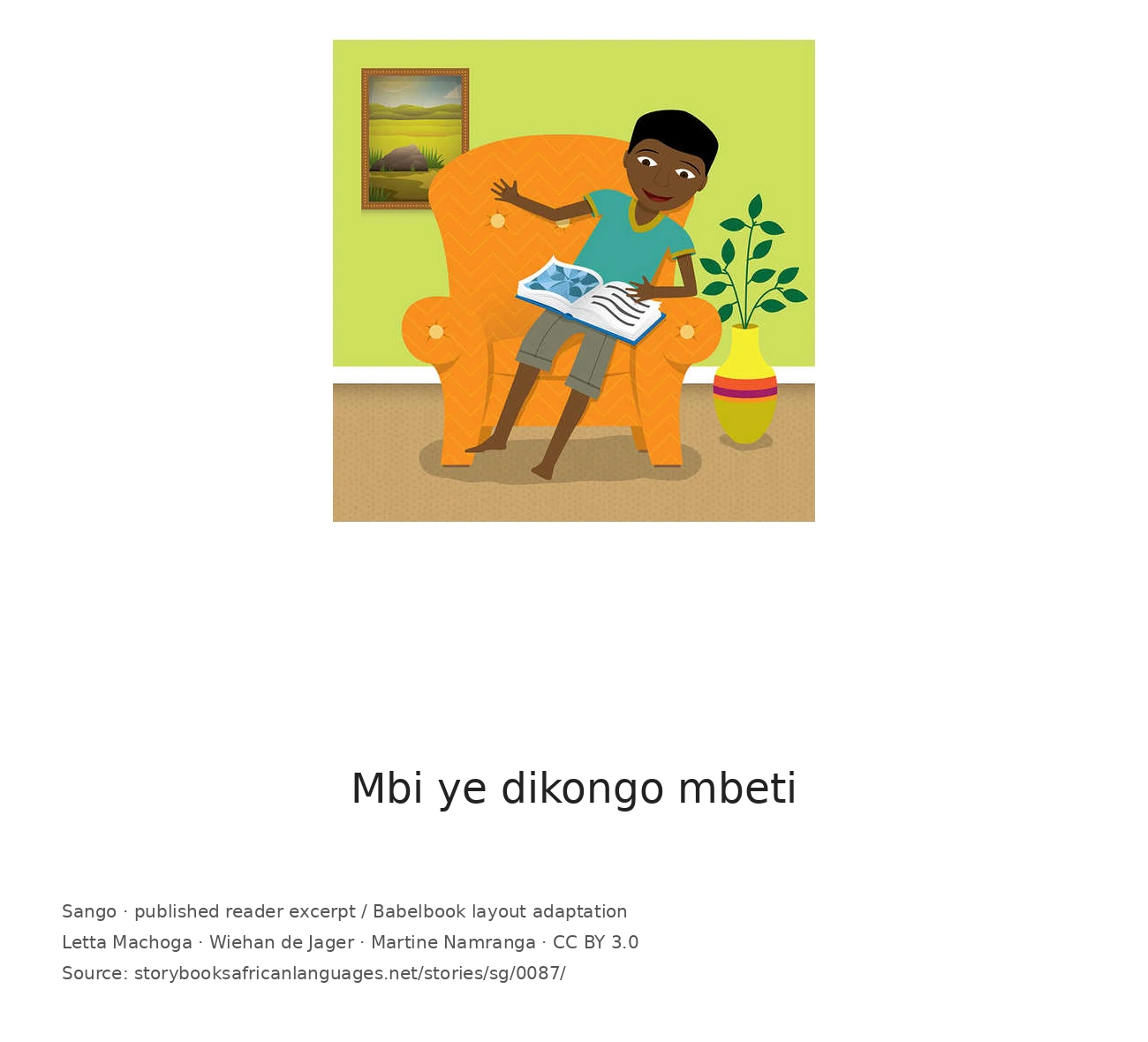
Published Sango words and the accompanying illustration from Mbi ye dikongo mbeti, faithfully reused with a new Babelbook display layout. This is an attributed adaptation of a licensed digital reader, not a photographed page, historical manuscript, or invented translation.
Saved in Babelbook · resized display copy. Select the image to open it independently of its source.
Letta Machoga (author); Wiehan de Jager (illustrator); Martine Namranga (Sango translator); Babelbook (layout adaptation) · Source ↗CC BY 3.0 ↗View the local visual field note
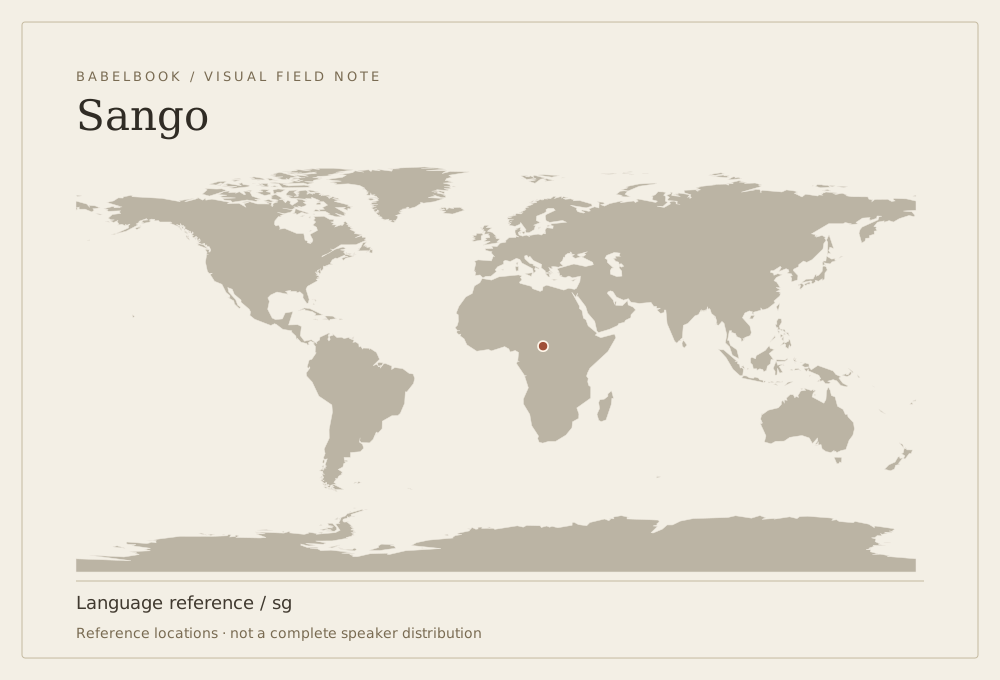
Representative reference points from Glottolog. Historical entries show reference locations, not current speakers. 1 point.
Reference & context ↗Babelbook · original editorial illustration · CC BY 4.0 · Glottolog locations; public-domain Natural Earth land
Source excerpts, selected, shortened and where noted editorially corrected from Sango language by Wikipedia contributors. Retrieved 2026-10-05. CC BY-SA 4.0. These excerpts are not an independently verified scholarly history; missing accounts are identified above.
Read further in the source
History
A variety of Sango was used as a lingua franca along the Ubangi River before French colonization, in the late 1800s. The French army recruited Central Africans, causing them to increasingly use Sango as a means of interethnic communication. Throughout the 20th century, missionaries promoted Sango because of its wide usage. Originally used by river traders, Sango arose as a lingua franca based on the Northern Ngbandi dialect of the Sango tribe, part of the Ngbandi language cluster, with some French influence. The rapid growth of the city of Bangui since the 1960s has had significant implications for the development of Sango, with the creation, for the first time, of a population of first-language speakers. Whereas rural immigrants to the city spoke many different languages and used Sango only as a lingua franca, their children use Sango as their main (and sometimes only) language. That has led to a rapid expansion of the lexicon, including both formal and slang terms. Also, its new position as the everyday language of the capital city has led to Sango gaining greater status and being used increasingly in fields for which it was previously the norm to use French.
Geographic distribution
Sango is widespread in the Central African Republic, with a population in CAR of approximately 5,500,000 in 2025. It is also spoken as a lingua franca in southern Chad, where it is probably not spoken natively and its use is decreasing, and in the Democratic Republic of the Congo, where its use is increasing. Today, Sango is both a national and official language of the Central African Republic, which makes the Central African Republic one of the few African countries to have an indigenous language as an official language.
Orthography
Sango began being written by French missionaries, with Catholic and Protestant conventions differing slightly. The 1966 Bible and 1968 hymnal were highly influential and still used today. In 1984, President André Kolingba signed "Décret No 84.025", establishing an official orthography for Sango. The official Sango alphabet consists of 22 letters:
Letters are pronounced as their IPA equivalent except for ⟨y⟩, pronounced as [j]. Also, the digraphs ⟨kp, gb, mb, mv, nd, ng, ngb, nz⟩ are pronounced [k͡p], [ɡ͡b], [ᵐb], [(ᶬv)], [ⁿd], [ᵑɡ], [ᵑ͡ᵐɡ͡b] and [ⁿz], respectively. ⟨’b⟩, ⟨ty⟩, and ⟨dy⟩ may be used in loan words not fully integrated into Sango's phonological system. The official orthography contains the following consonants: ⟨p, b, t, d, k, g, kp, gb, mb, mv, nd, ng, ngb, nz, f, v, s, z, h, l, r, y, w⟩: some add ⟨’b⟩ for the implosive /ɓ/. Sango has seven oral vowels, /a e ɛ i o ɔ u/, of which five, /ĩ ã ɛ̃ ɔ̃ ũ/, occur nasalized. In the official orthography, ⟨e⟩ stands for both /e/ and /ɛ/, and ⟨o⟩ stands for both /o/ and /ɔ/; nasal vowels are written ⟨in, en, an, on, un⟩. Sango has three tones: low, mid, and high. In standard orthography, low tone is unmarked, ⟨e⟩, mid tone is marked with diaeresis, ⟨ë⟩, and high tone with circumflex, ⟨ê⟩: do-re-mi would be written ⟨do-rë-mî⟩. Sango has little written material apart from religious literature, but some basic literacy material has been developed.