Old Irish
Old Irish, also called Old Gaelic (endonym: Goídelc; Irish: Sean-Ghaeilge; Scottish Gaelic: Seann-Ghàidhlig; Manx: Shenn Yernish or Shenn Ghaelg), is the oldest form of the Goidelic/Gaelic language for which there are extensive written texts. It was used from c. 600 to c. 900. The main contemporary texts are dated c. 700–850; by 900 the language had already transitioned into Early Middle Irish. Some Old Irish texts date from the 10th century, although these are presumably copies of texts written at an earlier time. Old Irish is the direct ancestor to Early Modern Irish, Manx Gaelic and Scots Gaelic. Old Irish is known for having a particularly complex system of morphology and especially of allomorphy (more or less unpredictable variations in stems and suffixes in differing circumstances), as well as a complex sound system involving grammatically significant consonant mutations to the initial consonant of a word. Apparently, neither characteristic was present in the preceding Primitive Irish period, though initial mutations likely existed in a non-grammaticalised form in the prehistoric era. Contemporary Old Irish scholarship is still greatly influenced by the works of a small number of scholars active in the late 19th and early 20th centuries, such as Rudolf Thurneysen (1857–1940) and Osborn Bergin (1873–1950).
Translate in Old Irish ↗Old Irish, also called Old Gaelic (endonym: Goídelc; Irish: Sean-Ghaeilge; Scottish Gaelic: Seann-Ghàidhlig; Manx: Shenn Yernish or Shenn Ghaelg), is the oldest form of the Goidelic/Gaelic language for which there are extensive written texts. It was used from c. 600 to c. 900. The main contemporary texts are dated c. 700–850; by 900 the language had already transitioned into Early Middle Irish. Some Old Irish texts date from the 10th century, although these are presumably copies of texts written at an earlier time. Old Irish is the direct ancestor to Early Modern Irish, Manx Gaelic and Scots Gaelic. Old Irish is known for having a particularly complex system of morphology and especially of allomorphy (more or less unpredictable variations in stems and suffixes in differing circumstances), as well as a complex sound system involving grammatically significant consonant mutations to the initial consonant of a word. Apparently, neither characteristic was present in the preceding Primitive Irish period, though initial mutations likely existed in a non-grammaticalised form in the prehistoric era. Contemporary Old Irish scholarship is still greatly influenced by the works of a small number of scholars active in the late 19th and early 20th centuries, such as Rudolf Thurneysen (1857–1940) and Osborn Bergin (1873–1950).
Europe
Present-day use
The captured source does not contain a separate current-use account.
Origins
The captured article does not contain a separate origins section. See the historical account and linked source.
Development
Old Irish underwent extensive phonological changes from Proto-Celtic in both consonants and vowels. Final syllables were lost or transphonologized as grammatical mutations on the following word. In addition, unstressed syllables faced various reductions and deletions of their vowels.
Writing
As with most medieval languages, the orthography of Old Irish is not fixed, so the following statements are to be taken as generalisations only. Individual manuscripts may vary greatly from these guidelines. The Old Irish alphabet consists of the following eighteen letters of the Latin alphabet: a, b, c, d, e, f, g, h, i, l, m, n, o, p, r, s, t, u, in addition to the five long vowels, shown by an acute accent (´): á, é, í, ó, ú, the lenited consonants denoted with a superdot (◌̇): ḟ, ṡ, and the eclipsis consonants also denoted with a superdot: ṁ, ṅ. Old Irish digraphs include the lenition consonants: ch, fh, th, ph, sh, the eclipsis consonants: mb, nd, ng; ṁb, ṅd, ṅg, the geminatives: bb, cc, ll, mm, nn, pp, rr, tt, and the diphthongs: aé/áe/aí/ái, oé/óe/oí/ói, uí, ía, áu, úa, éu, óu, iu, au, eu, ai, ei, oi, ui; ái, éi, ói, úi. The following table indicates the broad pronunciation of various consonant letters in various environments: When the consonants b, d, g are eclipsed by the preceding word (always from a word-initial position), their spelling and pronunciation change to: ⟨mb⟩ /m/, ⟨nd⟩ /N/, ⟨ng⟩ /ŋ/ Generally, geminating a consonant ensures its unmutated sound.
Beyond the typeface.
Signs, manuscripts, published pages and contextual photographs, with their place, period, source and reuse terms. Captions identify historical spellings, regional examples, community references and character imagery.
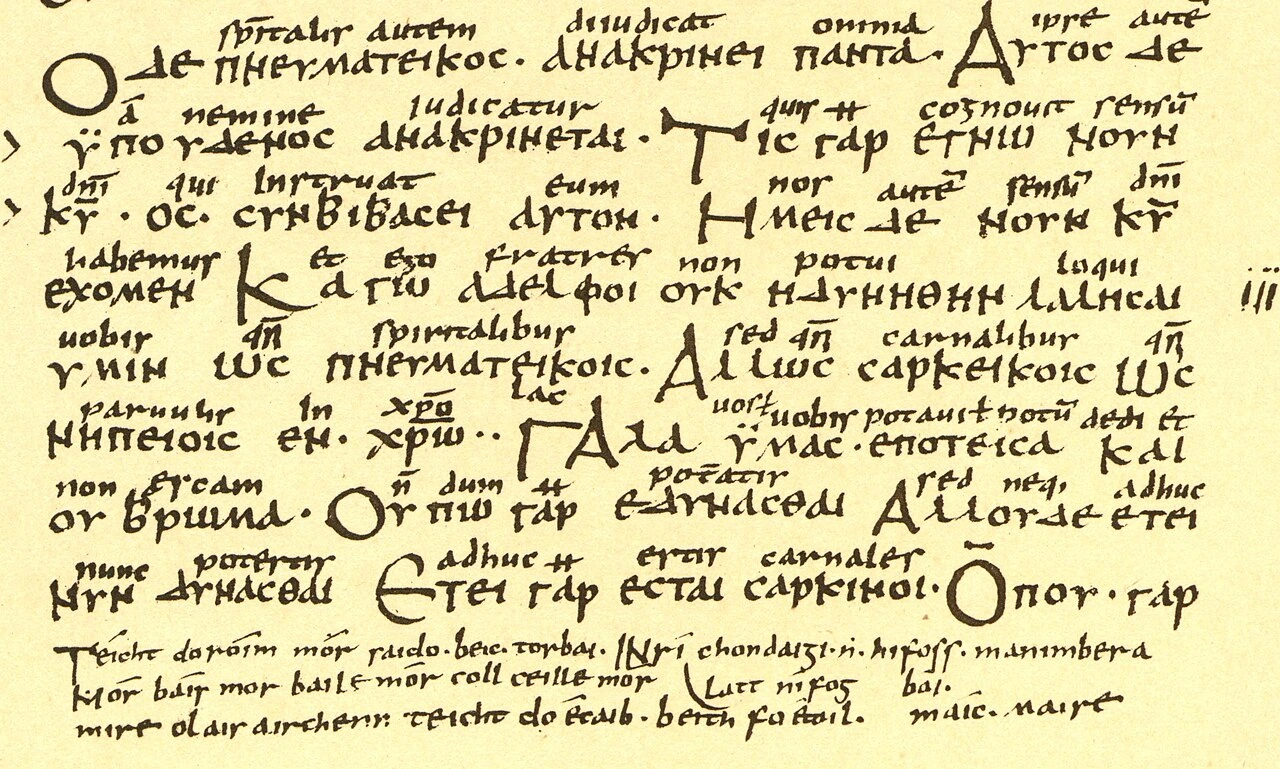
Irish verse beneath the biblical text in Codex Boernerianus, circa 850. Commons identifies the Irish verse; Thesaurus Palaeohibernicus II, page 296 explicitly identifies these quatrains as Old Irish. The source pages disagree on recto/verso, so no side designation is asserted.
Saved in Babelbook · resized display copy. Select the image to open it independently of its source.
Irish monk from Sankt Gallen; manuscript scribe unnamed · Source ↗Public domain ↗View the local visual field note
Representative reference points from Glottolog. Historical entries show reference locations, not current speakers. 1 point.
Reference & context ↗Babelbook · original editorial illustration · CC BY 4.0 · Glottolog locations; public-domain Natural Earth land
Source excerpts, selected, shortened and where noted editorially corrected from Old Irish by Wikipedia contributors. Retrieved 2026-10-05. CC BY-SA 4.0. These excerpts are not an independently verified scholarly history; missing accounts are identified above.
Read further in the source
Orthography
As with most medieval languages, the orthography of Old Irish is not fixed, so the following statements are to be taken as generalisations only. Individual manuscripts may vary greatly from these guidelines. The Old Irish alphabet consists of the following eighteen letters of the Latin alphabet:
a, b, c, d, e, f, g, h, i, l, m, n, o, p, r, s, t, u, in addition to the five long vowels, shown by an acute accent (´):
á, é, í, ó, ú, the lenited consonants denoted with a superdot (◌̇):
ḟ, ṡ, and the eclipsis consonants also denoted with a superdot:
ṁ, ṅ. Old Irish digraphs include the lenition consonants:
ch, fh, th, ph, sh, the eclipsis consonants:
mb, nd, ng; ṁb, ṅd, ṅg, the geminatives:
bb, cc, ll, mm, nn, pp, rr, tt, and the diphthongs:
aé/áe/aí/ái, oé/óe/oí/ói, uí, ía, áu, úa, éu, óu, iu, au, eu, ai, ei, oi, ui; ái, éi, ói, úi. The following table indicates the broad pronunciation of various consonant letters in various environments:
When the consonants b, d, g are eclipsed by the preceding word (always from a word-initial position), their spelling and pronunciation change to: ⟨mb⟩ /m/, ⟨nd⟩ /N/, ⟨ng⟩ /ŋ/ Generally, geminating a consonant ensures its unmutated sound. While the letter ⟨c⟩ may be voiced /ɡ/ at the end of some words, but when it is written double ⟨cc⟩ it is always voiceless /k/ in regularised texts; however, even final /ɡ/ was often written "cc", as in bec / becc "small, little" (Modern Irish and Scottish beag, Manx beg). In later Irish manuscripts, lenited f and s are denoted with the letter h ⟨fh⟩, ⟨sh⟩, instead of using a superdot ⟨ḟ⟩, ⟨ṡ⟩. When initial s stemmed from Primitive Irish *sw-, its lenited version is ⟨f⟩ [ɸ]. The slender (palatalised) variants of the 13 consonants, transcribed in IPA with a following /ʲ/, occur in the following environments:
Before a written e, é, i, í After a written i, when not followed by a vowel letter (but not after the diphthongs aí, oí, uí) Although Old Irish has both a sound /h/ and a letter h, there is no consistent relationship between the two. Vowel-initial words are sometimes written with an unpronounced h, especially if they are very short (the Old Irish preposition i "in" was sometimes written hi) or if they need to be emphasised (the name of Ireland, Ériu, was sometimes written Hériu). On the other hand, words that begin with the sound /h/ are usually written without it: a ór /a hoːr/ "her gold". If the sound and the spelling co-occur, it is by coincidence, as ní hed /Nʲiː heð/ "it is not".
History
Old Irish underwent extensive phonological changes from Proto-Celtic in both consonants and vowels. Final syllables were lost or transphonologized as grammatical mutations on the following word. In addition, unstressed syllables faced various reductions and deletions of their vowels.