Sinhala
Sinhala ( SIN-hə-lə, SING-ə-lə; Sinhala: සිංහල, siṁhala, [ˈsiŋɦələ]), sometimes called Sinhalese ( SIN-(h)ə-LEEZ, SING-(g)ə-LEEZ), is an Indo-Aryan language primarily spoken by the Sinhalese people of Sri Lanka, who make up the largest ethnic group on the island, numbering about 16 million. It is also the first language of about 2 million other Sri Lankans, as of 2001. It is written in the Sinhalese script. The language has two main varieties, written and spoken, and is a notable example of the linguistic phenomenon known as diglossia. Sinhala is one of the two national languages of Sri Lanka, along with Tamil. Along with Pali, it played a major role in the development of Theravada Buddhist literature. Early forms of the Sinhalese language are attested to as early as the 3rd century BCE. The language of these inscriptions, still retaining long vowels and aspirated consonants, is a Prakrit similar to Magadhi, a regional associate of the Middle-Indian Prakrits that had been spoken during the lifetime of the Buddha. The most closely related languages to Sinhalese are the Vedda language and the Maldivian languages; the former is an endangered indigenous creole still spoken by a minority of Sri Lankans, which mixes Sinhalese with an isolate of unknown origin. Old Sinhalese borrowed various aspects of Vedda into its main Indo-Aryan substrate.
Translate in Sinhala ↗Sinhala ( SIN-hə-lə, SING-ə-lə; Sinhala: සිංහල, siṁhala, [ˈsiŋɦələ]), sometimes called Sinhalese ( SIN-(h)ə-LEEZ, SING-(g)ə-LEEZ), is an Indo-Aryan language primarily spoken by the Sinhalese people of Sri Lanka, who make up the largest ethnic group on the island, numbering about 16 million. It is also the first language of about 2 million other Sri Lankans, as of 2001. It is written in the Sinhalese script. The language has two main varieties, written and spoken, and is a notable example of the linguistic phenomenon known as diglossia. Sinhala is one of the two national languages of Sri Lanka, along with Tamil. Along with Pali, it played a major role in the development of Theravada Buddhist literature. Early forms of the Sinhalese language are attested to as early as the 3rd century BCE. The language of these inscriptions, still retaining long vowels and aspirated consonants, is a Prakrit similar to Magadhi, a regional associate of the Middle-Indian Prakrits that had been spoken during the lifetime of the Buddha. The most closely related languages to Sinhalese are the Vedda language and the Maldivian languages; the former is an endangered indigenous creole still spoken by a minority of Sri Lankans, which mixes Sinhalese with an isolate of unknown origin. Old Sinhalese borrowed various aspects of Vedda into its main Indo-Aryan substrate.
South Asia
Present-day use
The captured source does not contain a separate current-use account.
Origins
Sinhala (Siṅhala) is a Sanskrit term; the corresponding Middle Indo-Aryan (Eḷu) word is Sīhala. The name is a derivative of the Sanskrit word for 'lion' siṁha. The name is sometimes glossed as 'abode of lions', and attributed to a supposed former abundance of lions on the island.
Development
According to the chronicle Mahāvaṃsa, written in Pali, Prince Vijaya of the Vanga Kingdom and his entourage merged in Sri Lanka with later settlers from the Pandya kingdom. In the following centuries, there was substantial immigration from Eastern India, including additional migration from the Vanga Kingdom (Bengal), as well as Kalinga and Magadha. This influx led to an admixture of features of Eastern Prakrits. The development of Sinhala is divided into four epochs: Elu Prakrit (3rd c. BCE to 4th c. CE) Proto-Sinhala (4th c. CE to 8th c. CE) Medieval Sinhala (8th c. CE to 13th c. CE) Modern Sinhala (13th c. CE to the present) The most important phonetic developments of Sinhala include: the loss of aspiration as a distinction for plosive consonants (e.g. kanavā "eating" corresponds to Sanskrit khādati, Hindustani khānā) the loss of original vowel length distinction; long vowels in the modern language are found in loanwords (e.g. vibāgaya "exam" < Sanskrit vibhāga) or as a result of sandhi, either after elision of intervocalic consonants (e.g. dānavā "to put" < damanavā) or in originally compound words. the simplification of consonant clusters and geminate consonants into geminates and single consonants respectively (e.g. Sanskrit viṣṭā "time" > Helu viṭṭa > Modern Sinhala viṭa) development of /tʃ/ to /s/ and/or /ɦ/ (e.g. san̆da/han̆da "moon" corresponds to Sanskrit candra) and development of /dʒ/ to /d/ (e.g. dæla "web" corresponds to Sanskrit jāla) development of prenasalized consonants from Sanskrit nasal + voiced stops (as in han̆da) retention of initial /w/ and /j/, the latter only shared with Kashmiri (as in viṭa and yutu "fit, proper" < Sanskrit yukta)
Writing
The Sinhala script, (Sinhala hodiya), is based on the ancient Brahmi script, and is thus a Brahmic script along with most Indian scripts and many Southeast Asian scripts. The Sinhala script is closely related to Grantha script and Khmer script, but it has also taken some elements from the related Kadamba script. The writing system for Sinhala is an abugida, where the consonants are written with letters while the vowels are indicated with diacritics (pilla) on those consonants, unlike alphabets like English where both consonants and vowels are full letters, or abjads like Urdu where vowels need not be written at all. Also, when a diacritic is not used, an "inherent vowel", either /a/ or /ə/, is understood, depending on the position of the consonant within the word. For example, the letter ක k on its own indicates ka, realized as /ka/ in stressed syllables and /kə/ in unstressed syllables. The other monophthong vowels are written: කා /kaː/, කැ /kæ/, and කෑ /kæː/ (after the consonant); කි /ki/ and කී /kiː/ (above the consonant); කු /ku/ and කූ /kuː/ (below the consonant); කෙ /ke/ and කේ /keː/ (before the consonant); and lastly, කො /ko/ and කෝ /koː/ (surrounding the consonant). For simple /k/ without a following vowel, a vowel-cancelling diacritic called හල් කිරීම (/hal kiriːmə/, hal kirima) is used, creating ක් /k/. There are also a few diacritics for consonants, such as /r/ in special circumstances, although the tendency now is to spell words with the full letter ර /r/, with a hal kirima on whichever consonant has no vowel following it. One word that is still spelt with an "r" diacritic is ශ්රී, as in ශ්රී ලංකාව (Śri Lankāwa). The "r" diacritic is the curved line under the first letter ("ශ" → "ශ්ර"). A second diacritic representing the vowel sound /iː/ completes the word ("ශ්ර" → "ශ්රී"). Several of these diacritics occur in two or more forms, and the form used depends on the shape of the consonant letter.
Beyond the typeface.
Signs, manuscripts, published pages and contextual photographs, with their place, period, source and reuse terms. Captions identify historical spellings, regional examples, community references and character imagery.
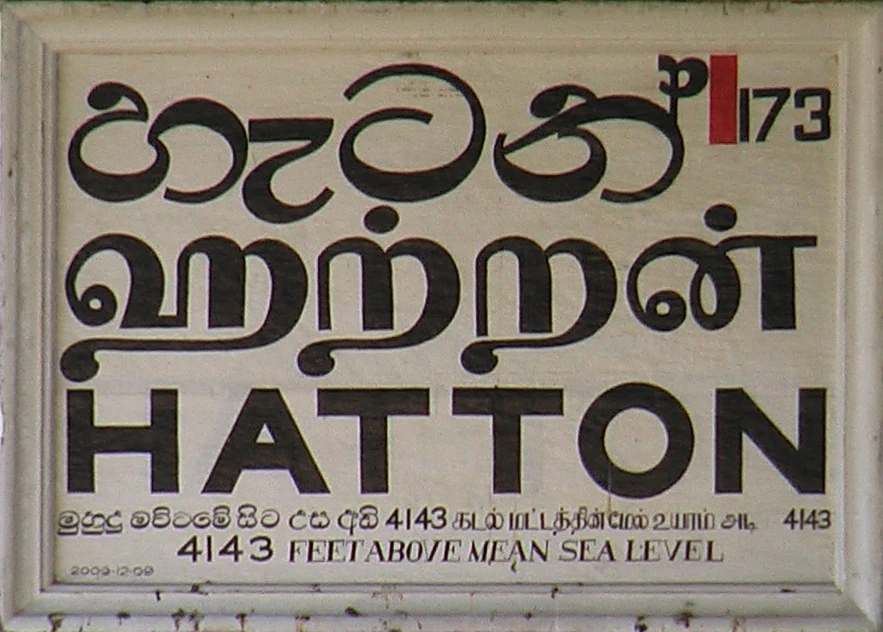
Hatton railway station sign in Sinhala, Tamil and English, Sri Lanka. Language identification follows Commons metadata; not independently transcribed.
Saved in Babelbook · resized display copy. Select the image to open it independently of its source.
Krankman · Source ↗CC BY-SA 3.0 ↗View the local visual field note
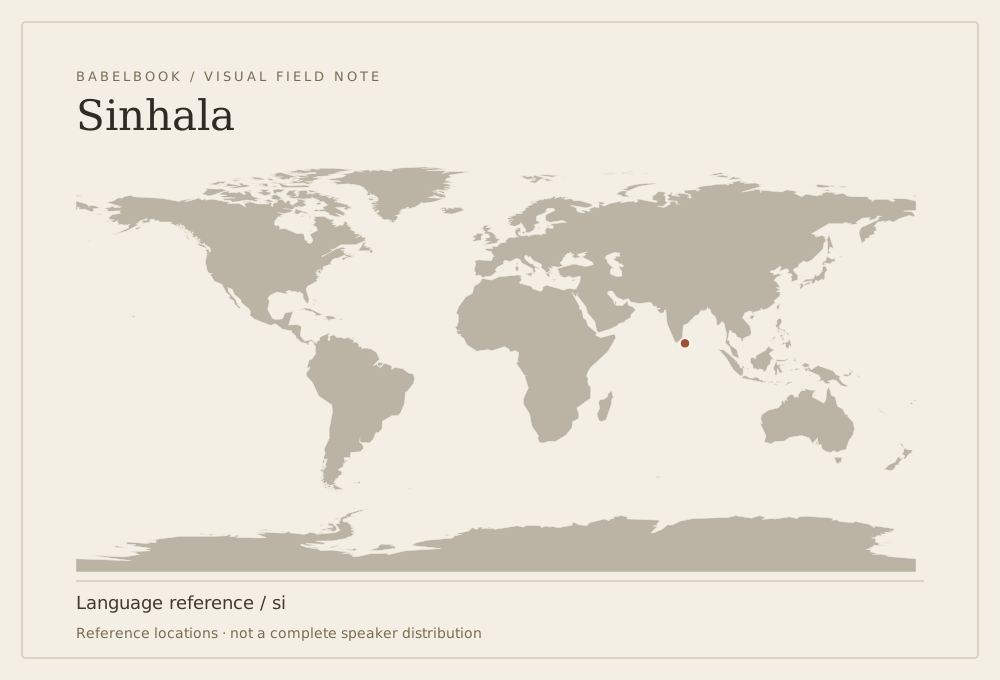
Representative reference points from Glottolog. Historical entries show reference locations, not current speakers. 1 point.
Reference & context ↗Babelbook · original editorial illustration · CC BY 4.0 · Glottolog locations; public-domain Natural Earth land
Source excerpts, selected, shortened and where noted editorially corrected from Sinhala language by Wikipedia contributors. Retrieved 2026-10-05. CC BY-SA 4.0. These excerpts are not an independently verified scholarly history; missing accounts are identified above.
Read further in the source
History
According to the chronicle Mahāvaṃsa, written in Pali, Prince Vijaya of the Vanga Kingdom and his entourage merged in Sri Lanka with later settlers from the Pandya kingdom. In the following centuries, there was substantial immigration from Eastern India, including additional migration from the Vanga Kingdom (Bengal), as well as Kalinga and Magadha. This influx led to an admixture of features of Eastern Prakrits.
Accents and dialects
The Sinhala language has different types of variations which are commonly identified as dialects and accents. Among those variations, regional variations are prominent. Some of the well-known regional variations of Sinhala language are:
The Uva Province variation (Monaragala, Badulla). The southern variation (Matara, Galle). The up-country variation (Kandy, Matale). The Sabaragamu variation (Kegalle, Balangoda).
Writing system
The Sinhala script, (Sinhala hodiya), is based on the ancient Brahmi script, and is thus a Brahmic script along with most Indian scripts and many Southeast Asian scripts. The Sinhala script is closely related to Grantha script and Khmer script, but it has also taken some elements from the related Kadamba script. The writing system for Sinhala is an abugida, where the consonants are written with letters while the vowels are indicated with diacritics (pilla) on those consonants, unlike alphabets like English where both consonants and vowels are full letters, or abjads like Urdu where vowels need not be written at all. Also, when a diacritic is not used, an "inherent vowel", either /a/ or /ə/, is understood, depending on the position of the consonant within the word. For example, the letter ක k on its own indicates ka, realized as /ka/ in stressed syllables and /kə/ in unstressed syllables. The other monophthong vowels are written: කා /kaː/, කැ /kæ/, and කෑ /kæː/ (after the consonant); කි /ki/ and කී /kiː/ (above the consonant); කු /ku/ and කූ /kuː/ (below the consonant); කෙ /ke/ and කේ /keː/ (before the consonant); and lastly, කො /ko/ and කෝ /koː/ (surrounding the consonant). For simple /k/ without a following vowel, a vowel-cancelling diacritic called හල් කිරීම (/hal kiriːmə/, hal kirima) is used, creating ක් /k/. There are also a few diacritics for consonants, such as /r/ in special circumstances, although the tendency now is to spell words with the full letter ර /r/, with a hal kirima on whichever consonant has no vowel following it. One word that is still spelt with an "r" diacritic is ශ්රී, as in ශ්රී ලංකාව (Śri Lankāwa). The "r" diacritic is the curved line under the first letter ("ශ" → "ශ්ර"). A second diacritic representing the vowel sound /iː/ completes the word ("ශ්ර" → "ශ්රී"). Several of these diacritics occur in two or more forms, and the form used depends on the shape of the consonant letter. Vowels also have independent letters, but these are only used at the beginning of words where there is no preceding consonant to add a diacritic to. The complete script consists of about 60 letters, 18 for vowels and 42 for consonants. However, only 57 (16 vowels and 41 consonants) are required for writing colloquial spoken Sinhala (śuddha Sinhala). The rest indicate sounds that have been merged in the course of linguistic change, such as the aspirates, and are restricted to Sanskrit and Pali loan words. One letter (ඦ), representing the sound /ⁿd͡ʒa/, is attested in the script, although only a few words using this letter are known (වෑංඦන, ඉඦූ). The Sinhala script is written from left to right, and is mainly used for Sinhala. It is also used for the liturgical languages Pali and Sanskrit, which are important in Buddhism and academic works. The alphabetic sequence is similar to those of other Brahmic scripts: